
A truck dispatcher, also called a trucking dispatcher or freight dispatcher, finds freight for a motor carrier and keeps its trucks moving: booking loads, assigning drivers, tracking deliveries and handling whatever goes wrong on the road. No federal license is required for the job itself. In US trucking companies the median dispatcher earned $57,010 in May 2025, according to the Bureau of Labor Statistics. Independent dispatchers for trucking companies usually charge carriers a percentage of each load instead. The legal line is simple to state and easy to cross: if you choose which of several carriers gets a load, or take your pay from the broker or factoring company, FMCSA’s guidance says you should have broker authority, and that means a $75,000 bond. This guide is part of our careers and training hub.
This is general information, not legal, tax or financial advice. Have a transportation attorney read any dispatch agreement before you rely on it.
The short version
- What the job is: planning and running freight for a carrier. A company dispatcher is on the payroll. An independent dispatcher sells the same work to small carriers under contract.
- Who regulates it: no federal agency, as such. FMCSA says it has no authority over a dispatch service unless the service also meets the test for a broker, freight forwarder or motor carrier.
- Employee pay: a $50,340 median across all industries and $57,010 in truck transportation (BLS, May 2025).
- Independent pay: the published fees we read run from 4% to 8% of the load, or a flat $250 to $350 a week.
- The risk: unlicensed brokering can bring federal civil penalties set at $13,676 per violation, liability for valid claims, and personal exposure for a company’s officers and principals.
- The second line: a dispatcher must not push a driver past the hours-of-service limits. Federal rules name carriers’ agents directly.
What a truck dispatcher does
The federal job description, on O*NET, covers scheduling and sending out vehicles, preparing run schedules, relaying messages, monitoring equipment locations, arranging repairs, advising drivers about traffic and weather, and keeping records. In trucking, that breaks down into six kinds of work.
| Task | What it looks like |
|---|---|
| Finding freight | Calling brokers, searching load boards and, inside a carrier, working with its regular customers |
| Negotiating | Getting a rate that covers fuel, miles and the empty run to pickup, then checking the rate confirmation matches the deal |
| Assigning | Matching each load to a truck, trailer type, driver and the hours that driver has left |
| Tracking | Following the truck, updating the customer, chasing late pickups and detention time |
| Fixing problems | Breakdowns, weather, a refused delivery, a shipper who changes the appointment |
| Paperwork | Rate confirmations, the signed bill of lading and proof of delivery, so the carrier can invoice |
The work changes with the freight. A long-haul truckload dispatcher plans days ahead and worries about where the truck ends up. A local or drayage dispatcher may re-sequence stops all day. On LTL or partial shipments you may need to quote by NMFC class, which a pallet density calculator can estimate from a pallet’s size and weight. Loads move around the clock, so expect early starts, weekend shifts or phone calls after hours. Many carriers run that work through dispatch software for trucking companies, which ties loads, drivers and invoices together.

Company or independent dispatcher
The title covers two different jobs, with different pay and different legal risk.
| Company dispatcher | Independent dispatcher | |
|---|---|---|
| Who you work for | One carrier, as an employee | One or more carriers, as a contractor |
| How you are paid | Wage or salary, on a W-2 | A percentage or flat fee from the carrier, usually on a 1099 |
| Who finds the freight | Often sales staff and dedicated accounts, plus you | You, mostly through brokers and load boards |
| Broker authority risk | Low, as you work for one carrier | Real, and it grows with each carrier you add |
| Your taxes and benefits | Employer withholds and pays its share | You pay your own |
An independent dispatcher mainly serves owner-operators and small fleets who cannot justify a full-time hire. FMCSA acknowledged this in its guidance, saying small carriers that cannot afford a full-time employee may rely on dispatch services to keep freight coming in while they focus on hauling it.
Freight broker vs dispatcher, and the freight agent
The short answer: a dispatcher works for the carrier and is paid by it, while a freight broker sits between shipper and carrier, needs FMCSA broker authority backed by a $75,000 surety bond or trust fund (49 CFR 387.307, read 14 November 2026), and earns the margin between what the shipper pays and what the carrier gets. A freight agent sells for a brokerage under that brokerage’s authority. These three get mixed up constantly, and the difference is who you represent.
| Independent dispatcher | Freight broker | Freight agent | |
|---|---|---|---|
| Represents | The carrier | Neither side: it arranges the move between them | A brokerage |
| Deals with shippers | No | Yes | Yes, for the brokerage |
| FMCSA authority | None, if it stays a true agent of the carrier | Required, with a $75,000 bond or trust | Usually none of its own: uses the brokerage’s |
| Who pays them | The carrier | The shipper. The broker keeps the margin after paying the carrier | The brokerage, from the margin |
Our guide to what a freight broker does covers that side in detail.
Truck dispatcher salary and pay
Employees: what BLS reports
BLS groups truck dispatchers with every other non-emergency dispatcher, including those sending out passenger vehicles and repair crews, so the all-industry number is not really a trucking number. Only about one in six of these jobs is in truck transportation, and they pay better than the group as a whole. These are the May 2025 estimates for occupation 43-5032, annual pay, from the BLS national and industry wage tables.
| Where they work | Jobs | Bottom 10% earn under | Median | Top 10% earn over |
|---|---|---|---|---|
| All industries | 202,810 | $36,030 | $50,340 | $78,140 |
| Truck transportation | 34,890 | $38,650 | $57,010 | $80,440 |
| Freight transportation arrangement | 8,350 | $33,380 | $50,120 | $77,990 |
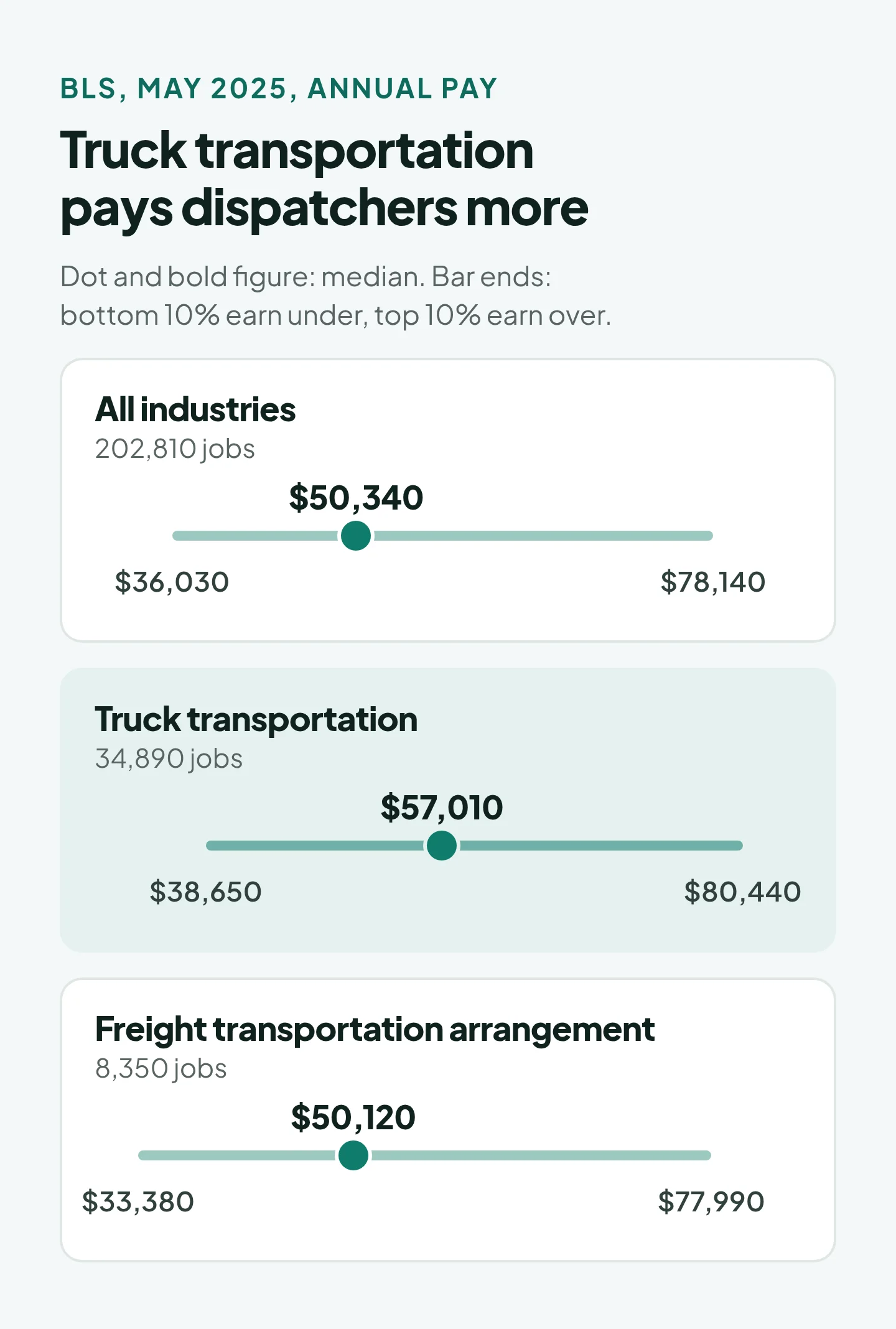
By the hour, the median dispatcher earned $27.41 in truck transportation and $24.10 in freight transportation arrangement, the industry that includes brokerages and forwarders (BLS, May 2025, read 14 November 2026). The median across all industries works out at $24.20 an hour. These estimates cover employees only, so they say nothing about self-employed independent dispatchers. BLS does not publish a separate occupation for truck dispatchers, which means job-site “truck dispatcher salary” figures are a different kind of number: estimates built from postings and user reports. Treat them as a local market check, not as data.
The outlook is flat. BLS projects the occupation at 202,100 jobs in 2035, down 1% from 203,500 in 2025, with about 16,000 openings a year, mostly from people leaving existing jobs.
Overtime is worth checking. The federal Motor Carrier Act overtime exemption that covers drivers does not cover dispatchers: 29 CFR 782.6(b) names jobs “confined to such work as that of dispatchers” among those that do not directly affect vehicle safety. So someone whose job is confined to dispatching is owed overtime after 40 hours unless another exemption applies. The likeliest are the executive and administrative exemptions, which have duties tests and a salary floor of $684 a week, or $35,568 a year. A salary alone does not make you exempt. State law can go further.
Independents: what the fees add up to
There is no official data on dispatch fees, so we read three published price lists on 1 November 2026. Truck Dispatch Experts (page updated 1 March 2026) lists 6% or $250 a week for semi trucks, and 8% or $350 for box trucks and hotshots. TruckLeap (undated, copyright 2026) and BuddyLoads (updated October 2026) both list 7% for carriers with new authority, 5% for one established truck, and 4% for fleets as a limited-time rate. Those are the prices each company charges itself. The same pages say others charge more: Truck Dispatch Experts lists market ranges up to 10% for box trucks and hotshots, and TruckLeap gives 8% to 12% for the “industry.” This is a small sample of companies’ own marketing, not a survey or a recommendation.
Here is what that means in income. The inputs are our assumptions, chosen to make the arithmetic clear, not industry averages.
| Line | Amount |
|---|---|
| Each truck grosses, per week | $6,000 |
| Your 5% fee per truck | $300 |
| Three trucks, 50 weeks | $45,000 |
| Less your software, phone, insurance and other costs (assumed) | $5,000 |
| Net before tax | $40,000 |
| Self-employment tax | About $5,650 |
The tax line uses the 15.3% IRS rate, applied to 92.35% of net earnings. It covers the employer share of Social Security and Medicare too, which a company would otherwise pay for you, and you still buy your own health insurance. A carrier paying you $2,000 or more in 2026 generally reports it on Form 1099-NEC, under the threshold raised for payments after 2025.
On those assumptions, matching the $57,010 trucking median takes more than four trucks, even before tax. That is where the business model and the law collide, because every carrier you add makes it harder to avoid choosing between them. FMCSA says an agent working for a single carrier makes no allocation choice, so one small fleet is a safer client than five unrelated owner-operators hauling the same freight.
If you are the carrier, the choice between percentage and flat fee is simple division. At 6% or $250 a week on one truck, the flat fee is cheaper once that truck grosses more than about $4,170 a week. A percentage is also paid on the whole rate, so it rewards high-paying loads whether or not they suit your costs.
The legal line: when a dispatcher is a broker
A broker is anyone who, for pay, arranges or offers to arrange transportation of property by an authorized motor carrier. A carrier’s employee or bona fide agent is not a broker, and a bona fide agent is someone who is part of the carrier’s normal organization and works under its direction, under a preexisting agreement for a continuing relationship, with no discretion in “allocating traffic between the carrier and others.” Those words decide most dispatch cases.
Congress told FMCSA to explain how they apply, and the result is the final guidance of 16 June 2023 (88 FR 39368). It says three things every dispatcher should know. There is no statutory or regulatory definition of a dispatch service. The label does not matter: a dispatch service can be a broker or a bona fide agent depending on what it does. And “allocating traffic” means any exercise of discretion when assigning a load to a carrier. The guidance is not binding law, and FMCSA says so. But it is the agency’s stated reading of a binding rule, and a Federal Register search on 1 November 2026 found nothing replacing it.
The factors FMCSA lists
FMCSA gives nine factors that point away from broker authority and seven that point toward it. Neither list is exhaustive, you need not meet every factor, and no single factor is paramount. Grouped by subject, they look like this.
| Subject | Generally no authority needed | Points to broker authority |
|---|---|---|
| Contract | Written contract appointing you the carrier’s agent, stating insurance and liability, often long term | Arranging freight with no such contract |
| Who you deal with | Working through brokers. You do not solicit shippers | Dealing or negotiating directly with a shipper or its representative |
| Money | Paid only by the carrier, under the contract. W-2 or 1099 from the carrier. Not part of the broker-carrier payment | Taking pay from a broker or factor, or any part in the money between them |
| The load | Never passing it on to another carrier | Accepting a load with no truck, then looking for one. Offering it to the open market |
| Choosing carriers | Each load arranged for one disclosed carrier | Taking a load more than one of your carriers could haul and assigning it |
| Paperwork | Telling the other side you are a dispatch service acting for that carrier | Being a named party on the shipping contract |
One more factor asks you to meet state licensing rules “if applicable.” We did not survey the states, so check yours, along with any ordinary business license. The guidance also says “licensed agent,” but no federal dispatcher license exists, and FMCSA says the statutes give it no power to create a separate class for dispatch services. A dispatcher certificate from a course is proof of training, not a legal status.
The two-carrier problem
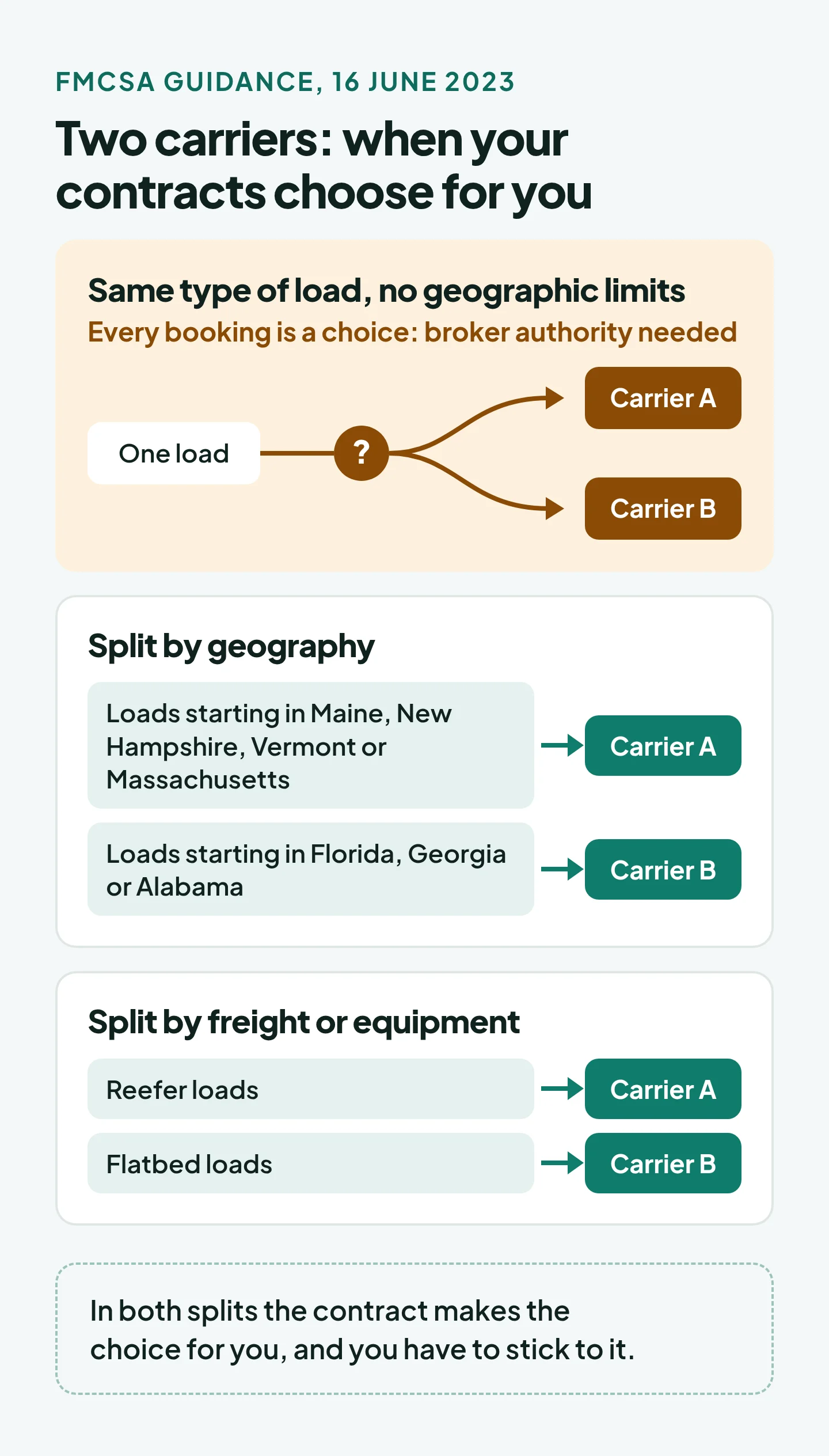
FMCSA is blunt here. If your agreements have you sourcing the same type of load for two carriers with no geographic limits, you cannot represent both without broker authority, because every booking is a choice between them. It gives two ways to represent several carriers without choosing:
- Split by geography. Carrier A’s agreement covers loads starting in Maine, New Hampshire, Vermont or Massachusetts, Carrier B’s covers loads starting in Florida, Georgia or Alabama.
- Split by freight or equipment. One carrier takes hazmat and the other does not, or one runs reefers and the other flatbeds.
In both, the contract makes the choice for you, and you have to stick to it. FMCSA calls this the “maximum flexibility permissible,” and it accepts that some dispatch services will need to drop carriers or apply for authority. It also says more carrier control means less risk. So having the carrier approve each load helps, in our reading, but it would not rescue two overlapping contracts.
Seven situations, and where they fall
| Situation | Likely result under the guidance |
|---|---|
| You dispatch one owner-operator under a written agreement, book through brokers, and the carrier pays your invoice | Generally fine |
| You dispatch six trucks, all on one carrier’s authority, and decide which truck takes which load | No choice between carriers, so no allocation problem |
| One reefer carrier and one flatbed carrier, with agreements that say so | Can work: FMCSA’s own example |
| Two dry-van carriers near Atlanta. A load comes up and you decide who gets it | Allocation: broker authority needed |
| A broker offers a good load, you accept it, then call around for a truck | Points to broker authority, and the trade may call it double brokering |
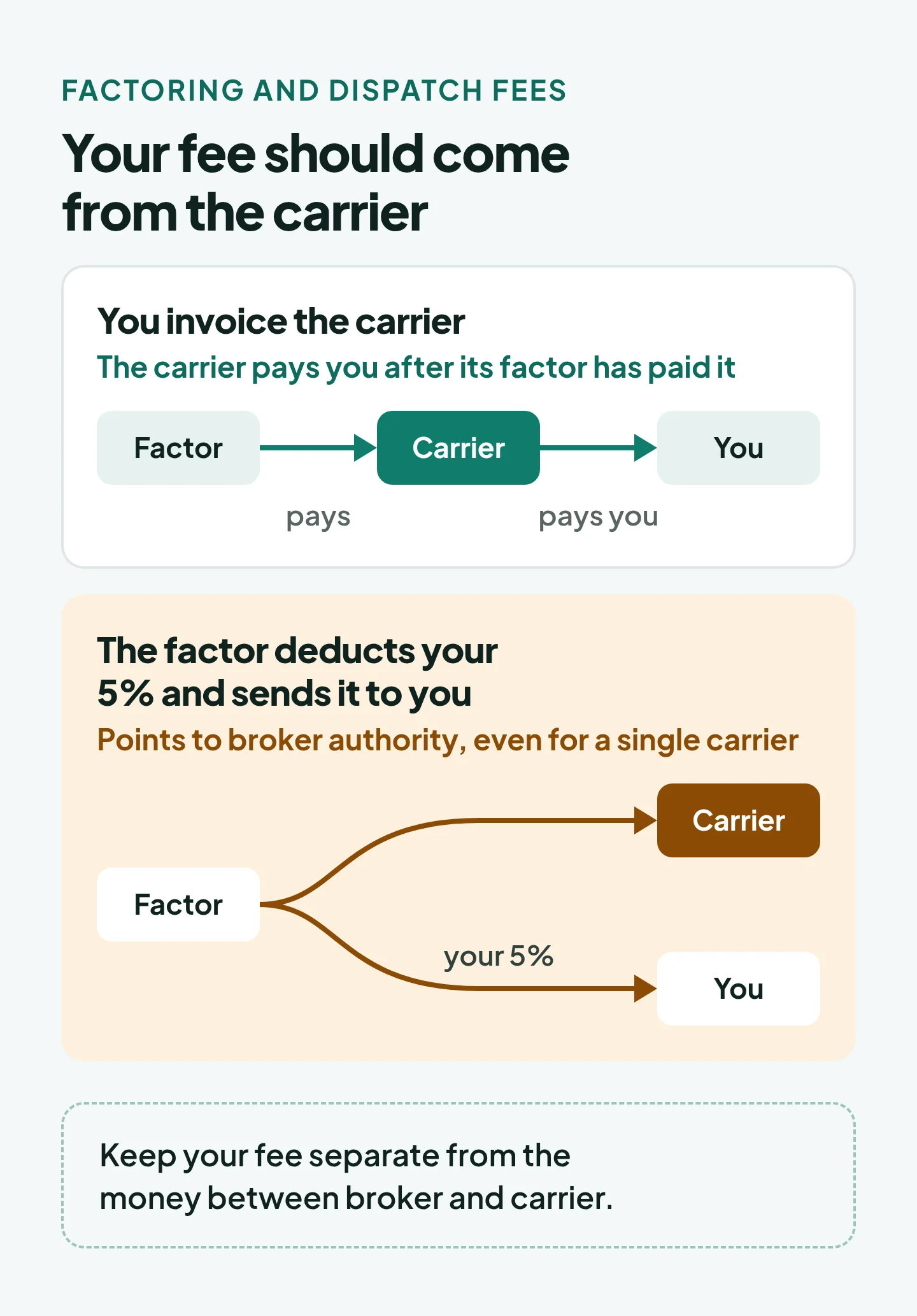
| A factoring company deducts your 5% and sends it to you | Points to broker authority, even for a single carrier |
| A shipper likes your service and asks you to handle its freight | Points to broker authority the moment you deal with it directly |
The factoring case catches honest people, since carriers often like the convenience. Keep your fee separate: you invoice the carrier, and the carrier pays you after its factor has paid it. Load boards can pull the same way. DAT’s guide, read on 1 November 2026, says “only carriers with operating authority (MC/DOT) can own an account,” and a carrier can add a seat for its dispatcher, so you work under your client’s name. Say so on every call. And since being a named party on the shipping contract points to broker authority, rate confirmations should name the carrier, not your company.
What it costs to get this wrong
49 U.S.C. 14916 makes anyone who knowingly allows unregistered or unbonded brokering liable for a civil penalty and, separately, to the injured party “for all valid claims incurred without regard to amount.” That liability is joint and several, and it reaches a company’s individual officers, directors and principals, so forming a company may not shield you. The statute says up to $10,000 per violation. FMCSA’s inflation-adjusted figure in Appendix B to Part 386 is up to $13,676, and another line in that appendix sets a $13,676 minimum for operating as a broker without registration. Unless noted otherwise, each day counts as a separate violation. FMCSA said in the 2023 guidance that a gap in the statute stops it assessing section 14916 penalties itself, so it has to pursue them through the Justice Department in federal court.
If your business really is matching freight with several carriers, the fix is to become a broker. That means a $300 application, a $75,000 bond or trust and the other steps in our guide to getting your own broker authority. Once registered you work for shippers and carriers as a broker, under the broker rules, rather than as a dispatcher.
Pending: offshore dispatch services
H.R. 5688, which the committee substitute names Dalilah’s Law, mainly concerns commercial driver’s licenses. But section 7 of the substitute text put to the House Transportation and Infrastructure Committee would bar motor carriers from using a “foreign dispatch service” within a year of enactment. That means a contracted agent based outside the United States, Mexico and Canada. Carriers would have to certify they use none when applying for or renewing authority, and a carrier that knowingly broke the ban would face a civil penalty of at least $50,000 per violation. The committee ordered the bill reported by 35 to 26 on 18 March 2026, which was the latest action on Congress.gov when we checked on 1 November 2026. Another amendment passed at that markup and Congress.gov does not yet carry the amended bill, so the final wording may differ. It is not law.
The other line: driver safety
Brokering is the line independent dispatchers hear about. Hours of service is the one that hurts people, and it applies to company dispatchers too.
- Driving limits. Under 49 CFR 395.3 a property driver needs 10 consecutive hours off before starting, can drive 11 hours, cannot drive past 14 consecutive hours after coming on duty, and generally needs a 30-minute break after 8 hours of driving.
- Scheduling. A carrier may not schedule a run that would need speeding to make it on time (49 CFR 392.6).
- Fatigue. A carrier may not require or permit someone to drive when illness or fatigue makes it unsafe (49 CFR 392.3).
- Coercion. 49 CFR 390.6 bars carriers, shippers, receivers and intermediaries, “including their respective agents,” from coercing a driver into breaking these rules. Coercion includes threatening to withhold work after the driver says a trip would break them. A driver has 90 days to complain to FMCSA.
- ELD pressure. 49 CFR 390.36 forbids a carrier from using electronic logging device data in a way it knew or should have known would push a driver into a violation.
- Encouraging a violation. Anyone who aids, abets, encourages or requires a violation is covered by 49 CFR 390.13.

Appendix B puts non-recordkeeping violations of Parts 390 to 399 at up to $19,246 each. In practice this means doing the math before you say yes. A 700-mile run takes 11 hours 40 minutes at an average 60 mph, so it does not fit in one 11-hour driving day, however keen the broker is. Book it as two days or pass on it. And if a driver says a trip is not legal, threatening to take away the next load is exactly what the coercion rule describes.
What a dispatch agreement should say
The guidance is close to a checklist for this contract. Sign before you book a single load, and have a transportation attorney review your template. As a minimum it should cover:
- Appointment. The carrier appoints you as its agent, by legal name and USDOT number. Check both in FMCSA’s public records first, including that the authority is active.
- Scope. The lanes, equipment or freight you source for this carrier, written so they do not overlap with your other clients.
- Limits. You work through brokers, do not solicit shippers, and do not reassign loads to another carrier.
- Fee and payment. The percentage or flat fee, what it is calculated on, and that the carrier pays you directly.
- Insurance and liability. FMCSA says the contract should specify both. Spell out who answers for a missed pickup, a cargo claim or a booking error.
- Load approval. Who has the final say on each load. It should sit with the carrier and driver, who answer for the hours and can judge fatigue.
- Disclosure and records. You identify yourself as a dispatch service acting for this carrier. State who keeps the load records and for how long.
- Term and exit. How long it runs, notice to end it, and what happens to loads in transit. FMCSA notes these are often long-term relationships.
Carriers should read the same list from the other side. If you are launching your own trucking company and plan to use a dispatcher, you stay responsible for your drivers’ hours and your authority. Watch for anyone who asks for your factoring login, wants to be paid by the broker, or will not tell you who else they dispatch for.
How to get into the job
Federal rules set no education, exam or CDL requirement for dispatchers. O*NET places the job in its lower preparation bands, usually a high school diploma or GED with some on-the-job training. The practical skills are phone negotiation, geography, reading a rate against a carrier’s costs, and knowing the hours-of-service rules well enough to spot an impossible load. Our guide to how to become a truck dispatcher takes the route step by step, from training to your first clients.
In short: start as a company dispatcher if you can, since a carrier teaches you lanes and customers on its own authority. Before going independent, work out how many trucks you need and whether you can serve them without two carriers competing for the same freight. No course is legally required, and none changes the broker test, so ask any course what it teaches about the 2023 guidance. If selling freight to shippers is what really draws you, look at brokerage instead.
Common questions
How much does a truck dispatcher make?
As an employee in truck transportation, the median was $57,010 a year, or $27.41 an hour, in May 2025, with the bottom 10% under $38,650 and the top 10% over $80,440 (BLS, read 14 November 2026). An independent dispatcher’s income depends on the fee and the number of trucks: in our worked example, three trucks at 5% net about $40,000 before tax.
Is a freight dispatcher the same as a truck dispatcher?
Usually, yes. Freight dispatcher, trucking dispatcher and truck dispatcher are used for the same job: finding loads and running trucks for a carrier. BLS counts all of them in one occupation, 43-5032. Some brokerages also use “dispatcher” for staff who track loads they have already booked; that is a brokerage job, done under the brokerage’s authority.
Does a truck dispatcher need a license?
Not for dispatching itself. FMCSA says it has no authority over a dispatch service unless the service also meets the test for a broker, freight forwarder or motor carrier, as set out in its 16 June 2023 guidance. Once you choose between carriers for a load, deal with shippers, or take your pay from a broker or factoring company instead of the carrier, the guidance points to broker authority and the $75,000 bond or trust.
Facts checked against primary sources on 1 November 2026: the eCFR (Titles 29 and 49, as of 29 October 2026), the US Code, the Federal Register, IRS, House committee documents, Bureau of Labor Statistics data, O*NET and Congress.gov. The BLS wage figures and the broker bond rule (49 CFR 387.307) were checked again on 14 November 2026. Dispatch fees and the DAT statement come from each company’s own page on that date. Every figure is checked against the linked source. This page is general information, not legal, tax or financial advice.
Sources
- Federal Register: Definitions of Broker and Bona Fide Agents, final guidance (16 June 2023, 88 FR 39368)
- eCFR: 49 CFR 371.2, definitions of broker and bona fide agent
- 49 U.S.C. 14916, unlawful brokerage activities
- eCFR: 49 CFR Part 386, Appendix B, penalty schedule
- eCFR: 49 CFR 360.3T, filing fees
- eCFR: 49 CFR 387.307, property broker bond or trust (read 14 November 2026)
- eCFR: 49 CFR 395.3, maximum driving time
- eCFR: 49 CFR 392.6, schedules to conform with speed limits
- eCFR: 49 CFR 392.3, ill or fatigued operator
- eCFR: 49 CFR 390.6, coercion prohibited
- eCFR: 49 CFR 390.5T, definition of coercion
- House Transportation and Infrastructure Committee: amendment in the nature of a substitute to H.R. 5688 (March 2026)
- eCFR: 49 CFR 390.36, harassment of drivers prohibited
- eCFR: 49 CFR 390.13, aiding or abetting violations
- Bureau of Labor Statistics: OEWS tables, May 2025 (occupation 43-5032; figures rechecked 14 November 2026)
- O*NET: 43-5032.00 Dispatchers, Except Police, Fire, and Ambulance
- O*NET: employment trends and BLS 2025-2035 projections, 43-5032
- eCFR: 29 CFR 782.6, mechanics and activities that do not affect safety (dispatchers)
- eCFR: 29 CFR 541.600, salary required for exemption
- IRS: Self-employment tax
- IRS: Instructions for Forms 1099-MISC and 1099-NEC
- Congress.gov: H.R. 5688, 119th Congress
- DAT: How to become a truck dispatcher
- Truck Dispatch Experts: published rates (updated 1 March 2026)
- TruckLeap: published pricing (read 1 November 2026)
- BuddyLoads: published fees (updated October 2026)
- eCFR: 49 CFR 386.12, complaints
- IRS: Topic 554, self-employment tax