To become a freight broker in the United States, you get what most people call a freight broker license: property broker authority from FMCSA. You register with FMCSA, put a $75,000 surety bond (Form BMC-84) or trust fund (Form BMC-85) on file, name a process agent on Form BOC-3, and pay the annual Unified Carrier Registration fee. FMCSA charges $300 for the authority itself, and that fee is the same in every state. Since May 2026 you apply in Motus, FMCSA’s new registration system, which checks your identity with a photo ID and a face scan. Federal rules set no exam, degree or course. If nothing is flagged, we estimate four to six weeks from forming the business to active authority. This guide sits in our getting licensed hub. It covers each step and its real cost, the bond rule in force since 16 January 2026, and the two ways to start without your own authority.
This is general information, not legal, tax or financial advice. Check your own situation with FMCSA, your state and a qualified professional before you file or sign anything.
The short version
- Who needs authority: anyone who, for pay, arranges or offers to arrange the transportation of property by an authorized motor carrier. That is the broker definition in 49 CFR 371.2.
- Government fees: $300 for broker authority. UCR is $46 for 2026 and $55 for 2027. Getting an EIN is free.
- Financial security: $75,000, either as a bond (you pay a yearly premium) or as a trust fund (you deposit the full amount).
- Paperwork: a Motus application, a BMC-84 or BMC-85 filed by your surety or trustee, and a BOC-3.
- Waiting: FMCSA’s review, for which it publishes no processing time, then a 10-day window in which anyone can protest your application.
- No-authority routes: work as an employee of a licensed brokerage, or as a commissioned freight agent under its authority.
Three ways in: agent, employee or your own authority
“Becoming a freight broker” can mean three different jobs. Only one of them needs you to register with FMCSA. Pick your route before you spend anything.
| Employee broker | Freight agent | Own authority | |
|---|---|---|---|
| Whose authority and bond | The employer’s | The brokerage you contract with | Yours |
| Your FMCSA filings | None | None | Motus application, BMC-84/85, BOC-3, UCR |
| Who signs shipper and carrier contracts | The brokerage | The brokerage | You |
| Who pays carriers and carries the credit risk | The brokerage | The brokerage (often shared with the agent by contract) | You |
| How you are paid | Salary, often plus commission | A share of the margin on your loads | The whole margin, less all costs |
| Best for | No experience, wants training | Has shipper relationships, wants independence | Has customers, capital and back-office plans |
Employee. Large brokerages hire entry-level carrier and customer sales reps and train them. You learn pricing, carrier vetting and claims on someone else’s bond. It is the cheapest way to find out whether you like the work.
Freight agent. An agent brings in freight and books it under a licensed brokerage’s name, contracts and bond, and keeps an agreed share of the margin. In the usual arrangement the brokerage is the legal party to each shipment and the agent works under its authority. FMCSA’s rules don’t address brokers’ agents directly, though. If you start signing contracts, billing shippers or paying carriers in your own name, assume you are brokering and need your own authority, and have a transportation attorney read the agreement. Read the agent agreement closely: commission split, who absorbs bad debt, non-compete terms and who owns the customer accounts.

Own authority. You become the legal broker. You contract with shippers and carriers, pay carriers and answer for claims against your bond. The rest of this guide is about this route.
One trap for people starting out as “truck dispatchers”: in its June 2023 final guidance, FMCSA said a dispatch service that arranges loads for several carriers and decides which carrier gets which load is not a bona fide agent and must get broker authority. Taking payment from the broker or a factoring company, dealing with shippers directly, or accepting a load before you have a truck for it all point the same way. 49 U.S.C. 14916 makes anyone who knowingly brokers, or lets their company broker, without registration or the required bond liable for a civil penalty and for all valid claims, and that liability reaches the company’s officers, directors and principals personally, jointly with the company. The statute says up to $10,000 per violation. After inflation adjustments FMCSA’s current figure is up to $13,676 per violation (49 CFR Part 386, Appendix B). A second statute, 49 U.S.C. 14901, sets a minimum penalty for operating as a broker without registration: $10,000 in the statute, $13,676 per violation after adjustment. The same appendix counts each day a violation continues as a separate violation.
What changed in 2026
Many guides that rank for this topic were written before these changes. Four matter to a new broker.
- Motus replaced the old registration systems. FMCSA announced Motus in a Federal Register notice on 29 April 2026. It went live for registrants on 19 May 2026. Motus replaces the Unified Registration System (URS) and the FMCSA Portal, and new applicants for a USDOT number and operating authority must use it.
- Identity and business verification are now part of applying. Every new applicant must pass identity proofing: a photo of a government-issued ID and a face scan, taken on a smartphone or tablet. FMCSA has also partnered with CLEAR to verify the business itself: its legal name, principal place of business, ownership and officials.
- The broker bond rules tightened on 16 January 2026. If a bond or trust is drawn below $75,000, your authority is suspended within 7 business days unless you fix it. Trust funds are now limited to cash, irrevocable letters of credit and Treasury bonds. The details are in the bond section below.
- MC numbers did not go away. FMCSA said the Phase II release of Motus “will not include … the elimination of MC/FF numbers, or changes to the Form BOC-3 filing process”. New brokers still receive an MC docket number alongside the USDOT number. Our guide to MC numbers under Motus covers how they now work.
Freight broker license requirements
FMCSA grants broker authority only when every item below is on record. Federal rules add no exam, degree, experience minimum or required course.
| Requirement | Who files it | Rule |
|---|---|---|
| Motus application with identity and business checks | You | FMCSA Motus |
| $300 filing fee per authority type | You | 49 CFR 360.3T(f)(1) |
| $75,000 BMC-84 bond or BMC-85 trust | Your surety or trustee | 49 CFR 387.307 |
| BOC-3 process agent for each state with an office or contracts | You or a blanket company | 49 CFR 366.4T |
| Bond and BOC-3 within 20 days of the Register notice | Surety and you | 49 CFR 365.109T |
| UCR, every year | You | 49 CFR 367.50 |
All rules in the table were read on 14 November 2026. The steps below take them in order.
Step by step: getting your own broker authority
1. Form the business and get an EIN
You can apply as a sole proprietor, but many new brokers form an LLC or corporation first. That way the authority, bond and bank account are all in the company’s name from day one, and you avoid a name change later. FMCSA charges $14 to change a broker’s name on its record (49 CFR 360.3T). The state filing fee and processing time depend on your state, so check your secretary of state’s website.
Then get an Employer Identification Number from the IRS. It is free and issued immediately online if approved. Use exactly the same legal name and address everywhere: state filing, EIN, bank, surety and Motus. Motus’s business verification checks your legal name, principal place of business, ownership and officials, and a mismatch is an easy way to get flagged.
2. Get bond quotes, or fund a trust
FMCSA will not register a broker until a bond or trust for the full $75,000 is in effect (49 CFR 387.307(a)). Ask two or three sureties for quotes before you apply, because underwriting can take days. After you apply and receive your USDOT and docket numbers, the surety files the BMC-84 with FMCSA. You don’t file it yourself.
3. Apply for a USDOT number and broker authority in Motus
FMCSA’s Move into Motus page sets out three steps for new registrants:
- Create a user profile. You need a Login.gov account. You then complete identity verification: scan a QR code with your phone or tablet, photograph your driver’s license, passport, ID card or resident card, and take a selfie. The April 2026 notice describes the five-step flow. Each profile belongs to one person, so set up your own rather than sharing a login.
- Create a company account. Enter the business details that will go through business verification.
- Apply. As a new registrant you apply for both a USDOT number and operating authority. Choose property broker authority (household goods brokerage has extra rules) and pay the $300 fee online through Pay.gov.
The $300 is per type of authority. If you also want carrier authority, that is a separate $300, because 360.3T(d)(1) requires a fee for each type sought. FMCSA’s fee FAQ puts it in capitals: “FILING FEES ARE NON-REFUNDABLE”. Under 360.3T(c) that holds even if the application is rejected, dismissed or withdrawn. The USDOT number itself has no separate fee in the schedule.
4. File your BOC-3
Form BOC-3 names a process agent: a person who can accept legal papers on your behalf. A broker must designate one for each state where it has an office or writes contracts (49 CFR 366.4T). That is narrower than the rule for carriers, who need an agent in every state they operate in or drive through.
You have two options. According to FMCSA’s BOC-3 page, a broker without trucks “can file Form BOC-3 on their own behalf”, and you may name yourself as the agent for a state where you live or have an office. Under 49 CFR 366.3T, every agent must reside in, or keep an office in, the state it is named for. Alternatively, you pay a blanket company to file one designation that covers every state. A blanket filing costs whatever the company charges but keeps you covered if you later open an office or sign contracts in another state. Either way, a P.O. box is not an acceptable agent address, and only one BOC-3 can be on file at a time.
5. Wait out the review and the 10-day protest period
FMCSA has not published a processing time for Motus applications. For applications still sent on the old paper forms, the April 2026 notice says to expect “a minimum timeframe of eight business days for the initial review and processing”, plus more time for any application flagged for extra vetting. FMCSA gives no upper limit. Once the application passes review, FMCSA publishes a summary in the FMCSA Register. Anyone who wants to oppose it then has 10 days to file a protest (49 CFR 365.203T).
Your bond and BOC-3 have a deadline too. The rule in force, 49 CFR 365.109T, says to file them within 20 days of the notice appearing in the Register. If you have lined up the surety in step 2, both filings can be in within days of applying. Authority becomes active only when the protest period has ended and both filings are on record. Check your status in Motus, and don’t book a load until it shows active.
6. Register for UCR
Brokers pay Unified Carrier Registration every year. By law a broker always falls in the smallest fee bracket. The fee is $46 for 2026, the same as for 2025, and rises to $55 for 2027 under FMCSA’s September 2026 final rule. The UCR Plan’s fee bracket page says 2027 registration opened on 1 October 2026 and must be paid before 1 January of the registration year, after which states can take enforcement action. If your authority goes active in late 2026, you will owe both years within weeks of each other.
7. Check your state
Broker authority itself is federal. Your state still governs company formation, foreign-entity registration if you are based in one state but incorporated in another, sales and income tax registration, and any local business license. Check with your secretary of state and state revenue department before your first invoice. Some websites say certain states license freight brokers separately. We could not confirm any such license on a state source, so ask your state before you start.
8. Set up before your first load

- Contracts. A broker-carrier agreement and a shipper-broker agreement, reviewed by a transportation attorney. These, not federal rules, set who pays for cargo loss and on what terms.
- Carrier vetting. Before tendering a load, confirm each carrier’s active authority and insurance filing in Motus. Our guide to carrier liability minimums and filings explains what a valid filing looks like.
- Records. 49 CFR 371.3 requires a record of every transaction, kept for three years: the consignor’s name and address; the originating carrier’s name, address and registration number; the bill of lading or freight bill number; your brokerage compensation and who paid it; any non-brokerage service you provided, what you were paid for it and by whom; and any freight charges you collected, with the date you paid the carrier. Each party to the transaction has the right to review the record. Pick a TMS or spreadsheet that captures all of these fields.
- Optional insurance. Federal rules require a broker to file the bond or trust, not liability or cargo insurance. Many shippers will still ask for contingent cargo and general liability cover in their contracts.
- Rating tools. If you quote LTL freight, a density-based freight class calculator helps you estimate a shipment’s class before you quote it.
- Cash. Carriers often want to be paid before your shipper pays you. Plan for that gap with working capital or a factoring line before you scale.
The $75,000 bond or trust and the January 2026 rule
The security exists to pay shippers and motor carriers if you fail to meet your contracts. Your registration stays in effect only while the bond or trust does, and a surety can cancel only on 30 days’ notice to FMCSA. The rules are in 49 CFR 387.307, and our BMC-84 bond guide covers premiums and collateral.
| BMC-84 surety bond | BMC-85 trust fund | |
|---|---|---|
| What you pay | A yearly premium to a surety | The full $75,000, tied up |
| Who can provide it | Surety companies accepted by FMCSA | Banks, trust companies, credit unions, insurers and other supervised institutions. Loan and finance companies were removed on 16 January 2026. |
| What it can hold | Not applicable | Cash, irrevocable letters of credit from a federally insured depository institution, and Treasury bonds, all able to be turned into cash within 7 calendar days |
| If a claim is paid | The surety pays the claimant. Read the indemnity agreement the surety asks you to sign: it usually lets the surety recover what it paid from you | The money comes out of your trust |
| Underwriting | Usually a credit check, and your credit drives the premium | None, but the money is locked up |
The November 2023 final rule added the suspension and insolvency provisions. A December 2024 extension moved the compliance date to 16 January 2026 because FMCSA wanted to run the process through its new online registration system, now Motus. Under the rule now in force:
- The surety or trustee must notify FMCSA within 2 business days when a payment takes the bond or trust below $75,000. This applies whether you agreed to the payment, failed to respond to a claim within 7 business days, or the payment was ordered by a court judgment. It also applies if the surety decides you are in financial failure and expects to pay claims that would breach the $75,000.
- FMCSA then sends you a notice. Your authority is suspended within 7 business days unless you show that the notice was an error, the bond or trust is back to $75,000, or the claims were paid without using the security.
- If the failure isn’t cured, the surety must start cancelling the bond, and FMCSA posts the notice in the FMCSA Register. Claimants then have 60 calendar days to file claims against the bond.
- Filing for bankruptcy under Title 11 does not on its own count as financial failure.
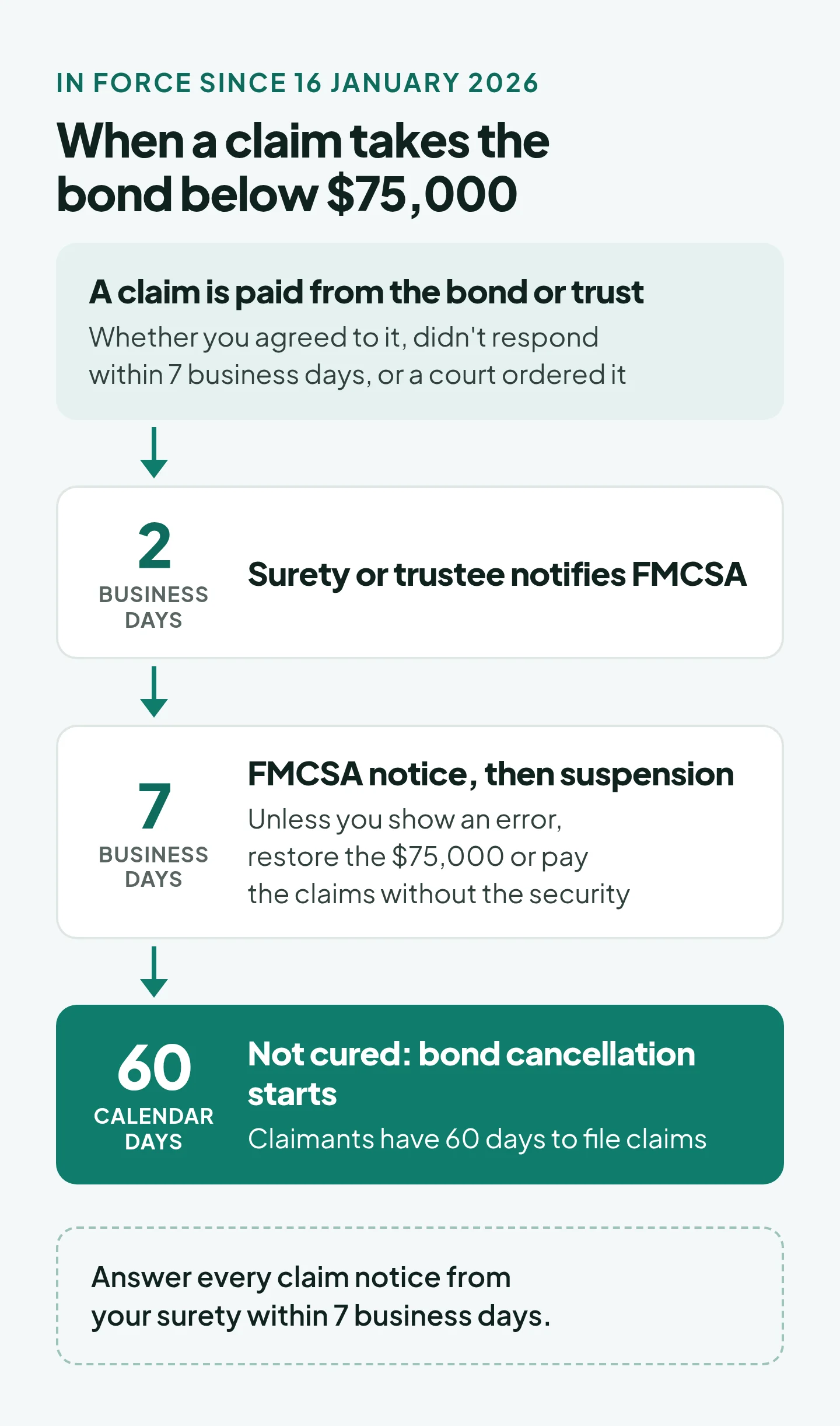
The practical lesson: answer every claim notice from your surety within 7 business days, and keep enough cash to settle a valid claim yourself rather than letting the bond pay it.
What the premium might be. Sureties price the bond as a percentage of the $75,000, mainly on your personal credit, and premiums are not public. Each percentage point is $750 a year. A quote of 2% would be $1,500 a year, and 8% would be $6,000. Those figures are arithmetic, not market quotes, so ask each surety for the yearly premium in dollars and what collateral, if any, it wants.
Freight broker license cost: every fee to become a freight broker
The freight broker license cost to FMCSA is $300, and it is the same in every state. The bigger costs are the bond premium and UCR, set out below with their rules as read on 14 November 2026.
| Item | Cost | Source |
|---|---|---|
| Broker operating authority | $300, one time, non-refundable | 49 CFR 360.3T(f)(1) |
| USDOT number | No separate fee | 360.3T fee schedule |
| EIN | $0 | IRS |
| UCR | $46 (2026), $55 (2027) a year | 49 CFR 367.40 and 367.50 |
| BOC-3 | $0 to FMCSA if self-filed; a blanket company’s fee otherwise | FMCSA BOC-3 page |
| BMC-84 bond | Yearly premium set by the surety | Your quotes |
| FMCSA bond filing fee | $10 per accepted bond, billed to the surety that files it | 49 CFR 360.3T(f)(51) |
| BMC-85 trust | $75,000 in qualifying assets | 49 CFR 387.307(b) |
| Business entity | Your state’s filing fee | Secretary of state |
| Name change later | $14 | 49 CFR 360.3T |
| Reinstating revoked authority | $80 | 49 CFR 360.3T |
| Contracts, software, optional insurance, working capital | Varies by vendor and volume | Your quotes |
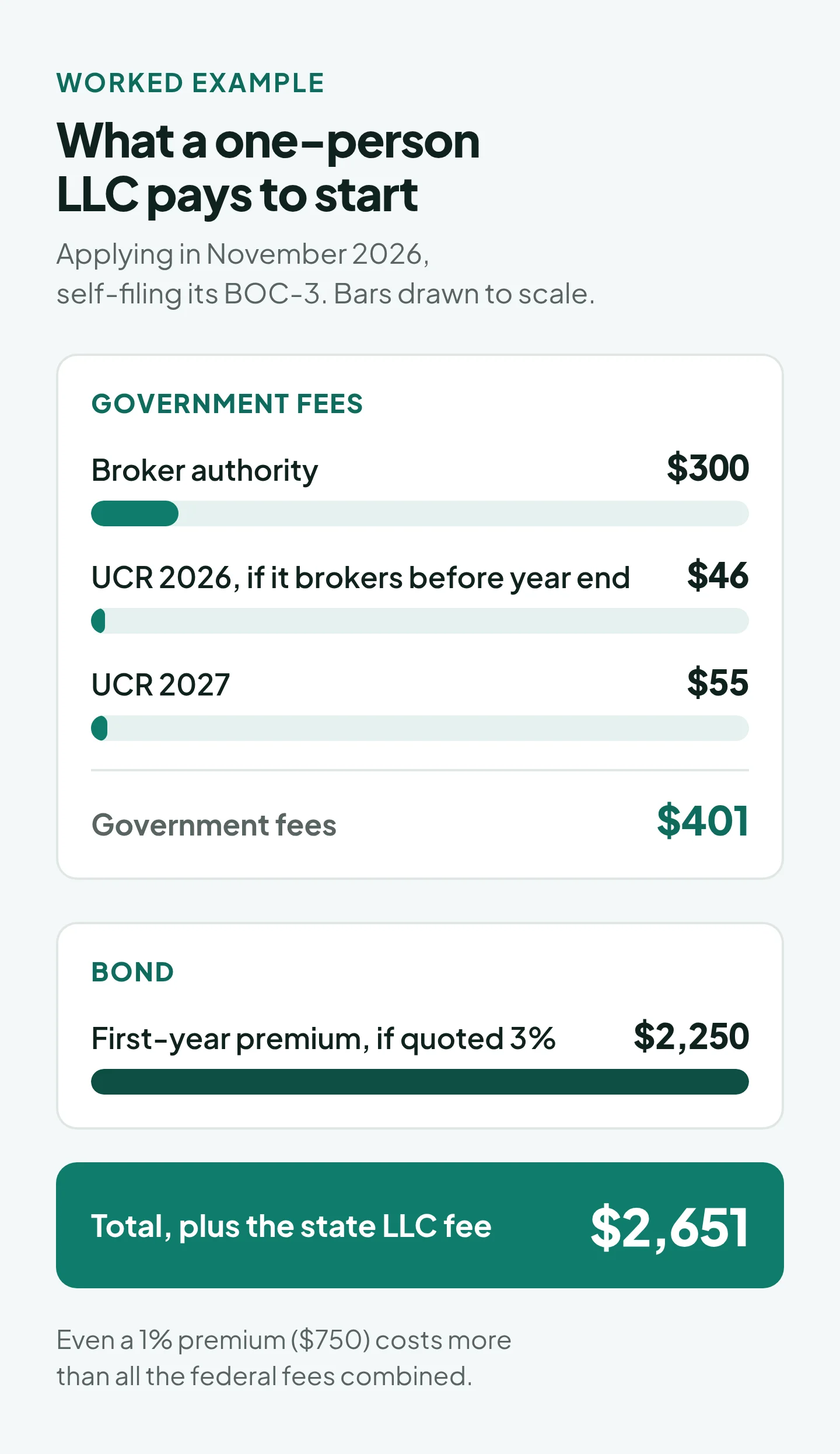
Worked example. A one-person LLC applies in November 2026 and self-files its BOC-3 for its home state. Its fixed federal costs are $300 for the authority, plus $46 for 2026 UCR if it brokers any loads before year end, plus $55 for 2027 UCR. That is $401 in government fees, before the state LLC fee and the first year’s bond premium. If its surety quotes 3%, the premium adds $2,250, for $2,651 plus the state fee. Even a 1% premium ($750) costs more than all the federal fees combined. After the start, the costs that decide whether the business survives are working capital and software, not filings.
How long it takes to get a freight broker license, week by week
FMCSA doesn’t publish an end-to-end processing time, so this schedule is our estimate. It allows about two weeks for review, adds the 10-day protest period, and assumes your application isn’t flagged for extra vetting.
| When | What happens | Your action |
|---|---|---|
| Week 1 | Business set-up | Choose your route, form the LLC or corporation, get the EIN, open a business bank account, request bond quotes |
| Week 2 | Application filed | Create a Login.gov account and Motus profile, pass identity verification, apply and pay $300. Tell the surety your USDOT and docket numbers so it can file the BMC-84, and file your BOC-3 |
| Weeks 2 to 4 | FMCSA review | Answer any FMCSA request quickly. Draft carrier and shipper contracts |
| Weeks 4 to 5 | Notice in the FMCSA Register; 10-day protest window | Confirm the bond and BOC-3 show on your Motus record. Set up your TMS, the software that runs each load, and carrier vetting checklist |
| Weeks 5 to 6 | Authority granted | Register and pay UCR. Book your first load only once Motus shows active authority |
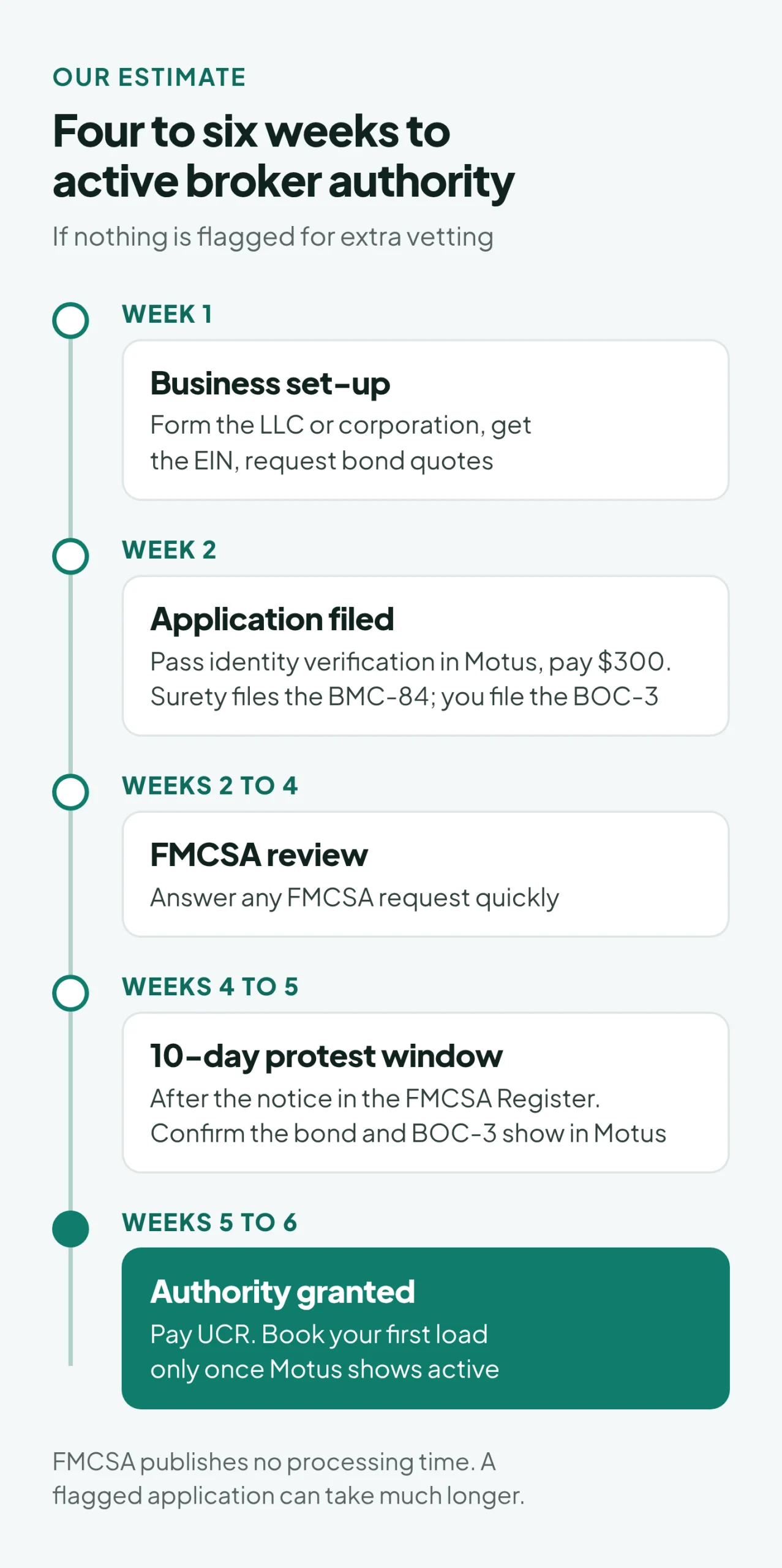
Entity formation can add days or weeks depending on your state. An application held for vetting can take much longer, and FMCSA does not commit to a maximum.
Mistakes that stall or cost you your authority
- Booking loads before the grant. Brokering before you are registered and bonded is unlawful brokerage. FMCSA’s penalty schedule sets a minimum of $13,676 per violation for operating without the registration 49 U.S.C. 13901 requires, and up to $13,676 per violation for knowingly brokering without registration or the bond (49 CFR Part 386, Appendix B, read 14 November 2026). Each day can count separately, and the company’s officers, directors and principals become personally liable for valid claims.
- Applying before the surety is lined up. Your application can’t be granted without the BMC-84 or BMC-85 on file, and the $300 is not refunded if it fails.
- Names that don’t match. Motus checks your legal name, address and officials. Use one spelling everywhere.
- Ignoring a surety’s claim notice. If you don’t respond within 7 business days, the surety can pay a claim it finds valid. If that takes the bond below $75,000, the suspension process starts.
- Letting the bond lapse. Your registration lasts only as long as the bond or trust. Pay renewals on time.
- Forgetting UCR. It is due every year before 1 January, and states enforce it.
- Weak records. 371.3 records must be kept three years, and carriers and shippers on a load can ask to see them. A 2024 proposal would tighten these rules. FMCSA reopened its comment period in February 2025, and no final rule had been published as of 14 November 2026.
- Stale details. A process agent designation can only be changed by filing a new BOC-3 (49 CFR 366.6T). When you move, rename the company or open an office in another state, update the BOC-3 and your Motus record together.
What freight brokers and agents earn
No federal series tracks broker owners’ profits. The closest official wage data is the Bureau of Labor Statistics category for cargo and freight agents, the people who arrange and track shipments. It is not specific to brokers. In May 2025 it counted 97,670 jobs. The median annual wage was $52,260, with the 10th and 90th percentiles at $38,340 and $79,810. Commission-heavy sales roles and agency owners can earn well above or below that range, because their pay is a share of margin, not a wage.
Common questions
Is there a freight broker license exam?
No. The “license” is FMCSA operating authority. The broker registration rules in Parts 365, 366, 371 and 387 set no test, degree or required course. Whether paying for broker training is still worthwhile is a separate question.
How much does a freight broker license cost?
FMCSA’s fee is $300, one time and non-refundable (49 CFR 360.3T, read 14 November 2026). On top come UCR, $46 for 2026 and $55 for 2027, and the yearly premium on the $75,000 bond, which the surety sets. The $300 is the same in Texas, California and every other state; on top of it come your state’s own business filing fees. See the cost table.
How long does it take to get a freight broker license?
FMCSA publishes no processing time for Motus applications. After review, the notice in the FMCSA Register starts a 10-day protest period (49 CFR 365.203T, read 14 November 2026), and the bond and BOC-3 must be on file before authority goes active. Our estimate is four to six weeks from forming the business if nothing is flagged; the timeline shows each week.
Can I run a brokerage from home?
Federal rules don’t require a commercial office. You need a real street address for any process agent (no P.O. boxes), and you must designate an agent for each state where you have an office or write contracts. Check your local zoning and business-license rules.
Do I have to pay $75,000 up front?
Only with a BMC-85 trust. With a BMC-84 bond you pay a yearly premium. The bond protects carriers and shippers, not you: under a typical indemnity agreement you repay the surety for claims it pays.
Do brokers need insurance?
Federal rules require brokers to file only the bond or trust. Contingent cargo, contingent auto and general liability are commercial choices, often required by shipper contracts.
Can I be a broker and a carrier?
Yes, with separate authorities and a separate $300 fee for each. Carrier authority brings its own insurance filings and the new entrant safety audit. Our guide to starting a trucking company covers that side.
Facts checked against primary sources on 14 November 2026: the eCFR (Title 49, Parts 360, 365, 366, 367, 371, 386 and 387, current through 12 November 2026), the Federal Register, FMCSA, the UCR Plan, the IRS, the U.S. Code and the Bureau of Labor Statistics. Every figure is checked against the linked source. This page is general information, not legal, tax or financial advice.
Sources
- eCFR: 49 CFR 371.2, broker definitions
- eCFR: 49 CFR 371.3, records to be kept by brokers
- eCFR: 49 CFR 360.3T, filing fees
- eCFR: 49 CFR 365.109T, FMCSA review of the application
- eCFR: 49 CFR 365.203T, time for filing a protest
- eCFR: 49 CFR 366.3T, eligible persons (process agents)
- eCFR: 49 CFR 366.4T, required states for process agents
- eCFR: 49 CFR 366.6T, cancellation or change of designation
- eCFR: 49 CFR 367.40 and 367.50, UCR fees
- eCFR: 49 CFR 367.40, UCR fees for 2026
- eCFR: 49 CFR 387.307, property broker surety bond or trust fund
- eCFR: 49 CFR Part 386, Appendix B, penalty schedule
- Federal Register: Availability of Motus, FMCSA's New Registration System (29 April 2026)
- Federal Register: Fees for the Unified Carrier Registration Plan and Agreement (1 September 2026)
- Federal Register: Broker and Freight Forwarder Financial Responsibility, final rule (16 November 2023)
- Federal Register: Broker and Freight Forwarder Financial Responsibility, extension of compliance date (31 December 2024)
- Federal Register: Definitions of Broker and Bona Fide Agents, final guidance (16 June 2023)
- Federal Register: Transparency in Property Broker Transactions, proposed rule (20 November 2024)
- FMCSA: Move into Motus
- FMCSA newsroom: Motus launch (19 May 2026)
- FMCSA FAQ: What is the cost for obtaining operating authority?
- FMCSA: Form BOC-3, Designation of Agents for Service of Process
- UCR Plan: fee brackets
- IRS: Get an Employer Identification Number
- U.S. Code: 49 U.S.C. 14901, general civil penalties
- U.S. Code: 49 U.S.C. 14916, unlawful brokerage activities
- BLS: Occupational Employment and Wages, May 2025, Cargo and Freight Agents (43-5011)