A freight broker arranges a truck and does not take on the move itself. A freight forwarder sells the transportation as its own, issues its own bill of lading and answers for the freight from pickup to delivery, even though other carriers do the moving. So in US law a broker is an intermediary and a forwarder is a carrier, with two practical results: who a shipper claims against when cargo is lost, and what a new company must file. Both need FMCSA registration and $75,000 in financial security, but they hold different authorities. This guide, part of our freight careers and training hub, covers the legal test, the ocean and air companies that call themselves forwarders under different rules, a worked claim, and the cost of each license.
This is general information, not legal, tax or financial advice. Check your own situation with FMCSA, the Federal Maritime Commission and a qualified professional before you file or sign anything.
The short version
- The legal test is responsibility. Who agreed to answer for the shipment? Who holds the freight is a weaker guide.
- Broker: arranges transportation by a motor carrier for pay. It is not a carrier, and Part 371 of the federal rules bars it from presenting itself as one.
- Forwarder (FMCSA): consolidates shipments, takes responsibility from receipt to destination and uses other carriers. The cargo liability statute treats it as both the receiving and the delivering carrier.
- Money to enter: $300 for either authority and $75,000 in security for either. A forwarder that runs its own pickup vehicles should plan on filing liability insurance too.
- The trap: “freight forwarder” also describes ocean and air businesses regulated by other agencies. An export forwarder that books a domestic truck for a customer can cross into unlicensed brokering.
Side by side
| Freight broker | Freight forwarder (FMCSA) | |
|---|---|---|
| Legal definition | 49 U.S.C. 13102(2): sells, negotiates or arranges transportation by motor carrier | 49 U.S.C. 13102(8): assembles and consolidates shipments, assumes responsibility for the transportation, uses a carrier for any part of it |
| Status | Intermediary | “Carrier” under 13102(3) |
| Modes covered | Motor carrier only | Carriers under the statute; a person using air carrier transportation is excluded |
| Bill of lading | Normally the carrier issues it | Must issue a receipt or through bill, origin to final destination (49 CFR 373.201) |
| Cargo claim goes to | The motor carrier, unless the broker agreed to more | The forwarder |
| Registration | Property broker authority | Forwarder authority with an FF docket number |
| Filing fee | $300 (49 CFR 360.3T) | $300 |
| Bond or trust | $75,000, Form BMC-84 or BMC-85 | $75,000, Form BMC-84 or BMC-85 |
| Federal cargo insurance | None | None for property forwarders; household goods forwarders file cargo cover (FMCSA filing chart) |
| Own records rule | Keeps a transaction record for three years, which each party may review (49 CFR 371.3) | Part 371 does not apply |
| How it earns | The gap between the shipper rate and the carrier rate | Its own rate to the shipper, less what it pays the underlying carriers |
The legal line: who is responsible
Start with the definitions. 49 CFR 371.2 calls a broker a person who, for compensation, “arranges, or offers to arrange, the transportation of property by an authorized motor carrier”. The statute adds that a broker is someone other than a motor carrier, and our guide to what a freight broker does and how it gets paid walks through a brokered load.
The forwarder definition has three parts, and all three must be true. A forwarder holds itself out to the general public to provide transportation of property for pay, and in the ordinary course of business it:
- “assembles and consolidates, or provides for assembling and consolidating, shipments” and handles the break-bulk and distribution;
- “assumes responsibility for the transportation from the place of receipt to the place of destination”; and
- uses a carrier subject to the statute for any part of the move.
Read part one closely. “Provides for” means a forwarder can hire out the consolidation. The usual shorthand is that forwarders physically handle freight and brokers never do. That is a fair description of daily operations, but it is not the statutory test. Part two is what separates a forwarder from a broker.
The next definition settles the status. Under 13102(3) the word “carrier” means “a motor carrier, a water carrier, and a freight forwarder”. The definition does not ask a forwarder to own a truck, yet it is a carrier all the same. The federal cargo liability statute, known as the Carmack Amendment, then says in 49 U.S.C. 14706(a)(2): “A freight forwarder is both the receiving and delivering carrier.”
How courts draw the line
What you call your company does not decide this. In Essex Insurance v. Barrett Moving & Storage (11th Cir. 2018), a mover hauled part of an MRI machine itself, handed the rest to another carrier and argued it was only a broker for that part. A magistrate judge had entered a $560,000 judgment against it and the other carrier. The court held that “a party is not a broker under the Carmack Amendment if it has agreed with the shipper to accept legal responsibility for that shipment”. It called the question “necessarily a case-specific analysis” and sent the case back because the evidence, including the company’s own website, pointed both ways.
A broker whose quotes say “we will deliver your freight” or “our fleet” can end up with a carrier’s liability, and the opinion names the protection: make clear in writing that you are “merely acting as a go-between” on that shipment. Separately, 49 CFR 371.7 bars a broker from representing “its operations to be that of a carrier”. Other federal circuits are not bound by Essex, though it followed district court decisions in the Eleventh Circuit and elsewhere.
One word, several regimes
The FMCSA definition above is a narrow legal term. In international trade, “freight forwarder” is a job title, and the company using it may have no FMCSA authority at all. Air moves are carved out by the definition’s last sentence, and 49 U.S.C. 13531 gives FMCSA forwarder jurisdiction only “to the extent transportation is provided in the United States”.
| Business | Regulator | What it legally is | Credential |
|---|---|---|---|
| FMCSA freight forwarder | FMCSA | Carrier; responsible from receipt to destination | FF authority, $75,000 security |
| Ocean freight forwarder | Federal Maritime Commission | Books space on US export shipments and handles the documents on behalf of shippers (46 U.S.C. 40102); if its name appears on the bill with the shipper’s, it must be identified as the shipper’s agent (46 CFR 515.42) | FMC license (46 CFR 515.3), $50,000 |
| NVOCC (non-vessel-operating common carrier) | Federal Maritime Commission | Common carrier that operates no vessels; a shipper in its dealings with the ocean carrier | FMC license, $75,000, published tariff (46 CFR 520.3) |
| Indirect cargo air carrier | DOT and TSA | Undertakes air transportation indirectly, using direct air carriers (14 CFR 296.3) | DOT exemption terms, and a TSA security program (49 CFR 1548.5) to tender cargo on covered aircraft |
| Customs broker | CBP | Transacts customs business for others (19 CFR 111.1) | CBP license (19 CFR 111.2) |
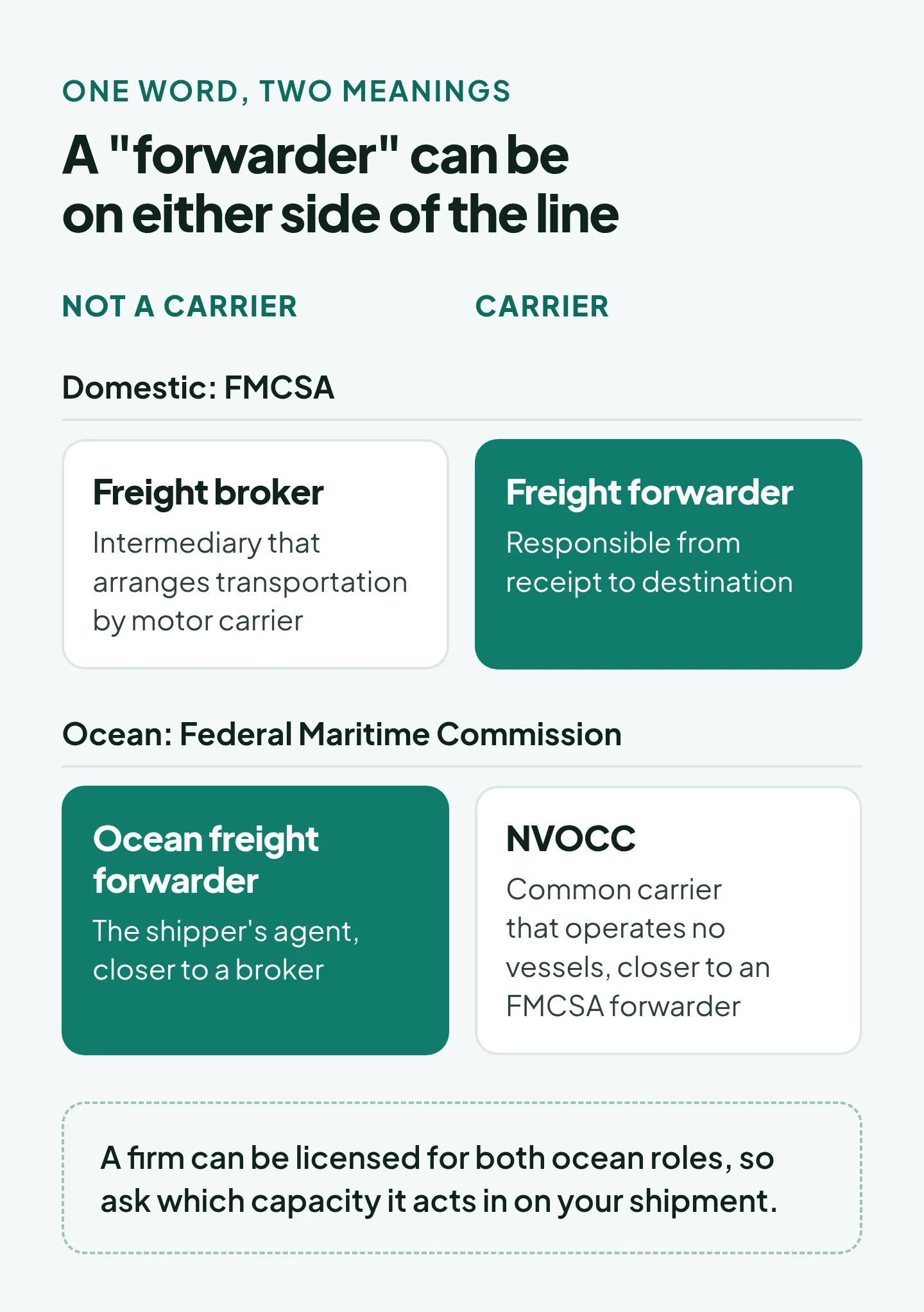
Ocean freight has its own split. A licensed ocean forwarder is the shipper’s agent, so on the question of who answers for the cargo it sits closer to a broker. An NVOCC is a carrier, closer to an FMCSA forwarder. A firm can be licensed for both roles, so ask which capacity it acts in on your shipment. A forwarder is not a customs broker unless it holds that separate license, and the word “broker” there has nothing to do with freight brokerage.
When a forwarder needs broker authority
A company with forwarder authority that simply finds a truck for a customer, without taking responsibility for the move, is doing what the broker definition describes. We read that as brokerage needing broker authority. We found no FMCSA statement on the exact point, so ask FMCSA or counsel about your own model.
Congress did write three exceptions into 49 U.S.C. 14916, the unlawful brokerage statute. The rule that you may broker only with registration and security does not apply to:
- an NVOCC or ocean forwarder “when arranging for inland transportation as part of an international through movement involving ocean transportation between the United States and a foreign port”;
- a licensed customs broker, but only for a movement under a customs bond or a transaction involving customs business; and
- an indirect air carrier holding a TSA-approved Standard Security Program, only to the extent it acts as an air carrier.
An ocean forwarder arranging the truck from a Columbus factory to the Port of Norfolk for an export booking fits the first exception. The same company booking a truck from Columbus to Atlanta for the same customer, with no ocean leg, does not. That second load is ordinary brokerage.
Section 14916 makes anyone who knowingly authorizes unregistered brokering liable for a civil penalty and for “all valid claims”, and the liability reaches the company and its officers, directors and principals jointly and severally. The statute says $10,000 per violation, and the inflation-adjusted cap in Appendix B to 49 CFR Part 386 is $13,676. The same appendix sets a minimum of $13,676 per violation for operating as a motor carrier, broker or forwarder without the registration required by 49 U.S.C. 13901.
Who pays when cargo is lost
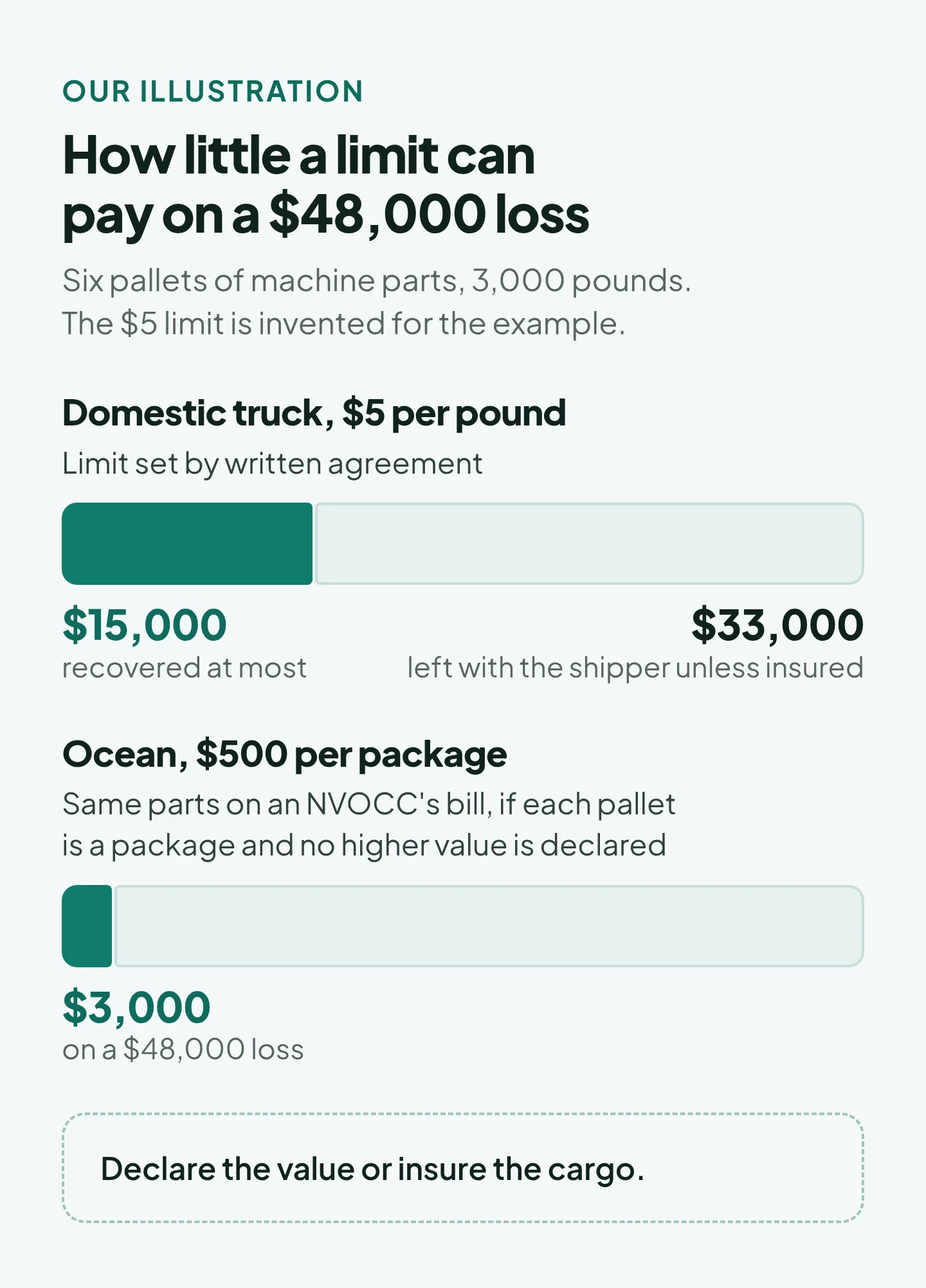
Take one illustrative shipment: six pallets of machine parts, 3,000 pounds, worth $48,000, moving from Ohio to Georgia. The truck is stolen on the way. The numbers are ours and the limit is invented for the example, but the legal routes are real.
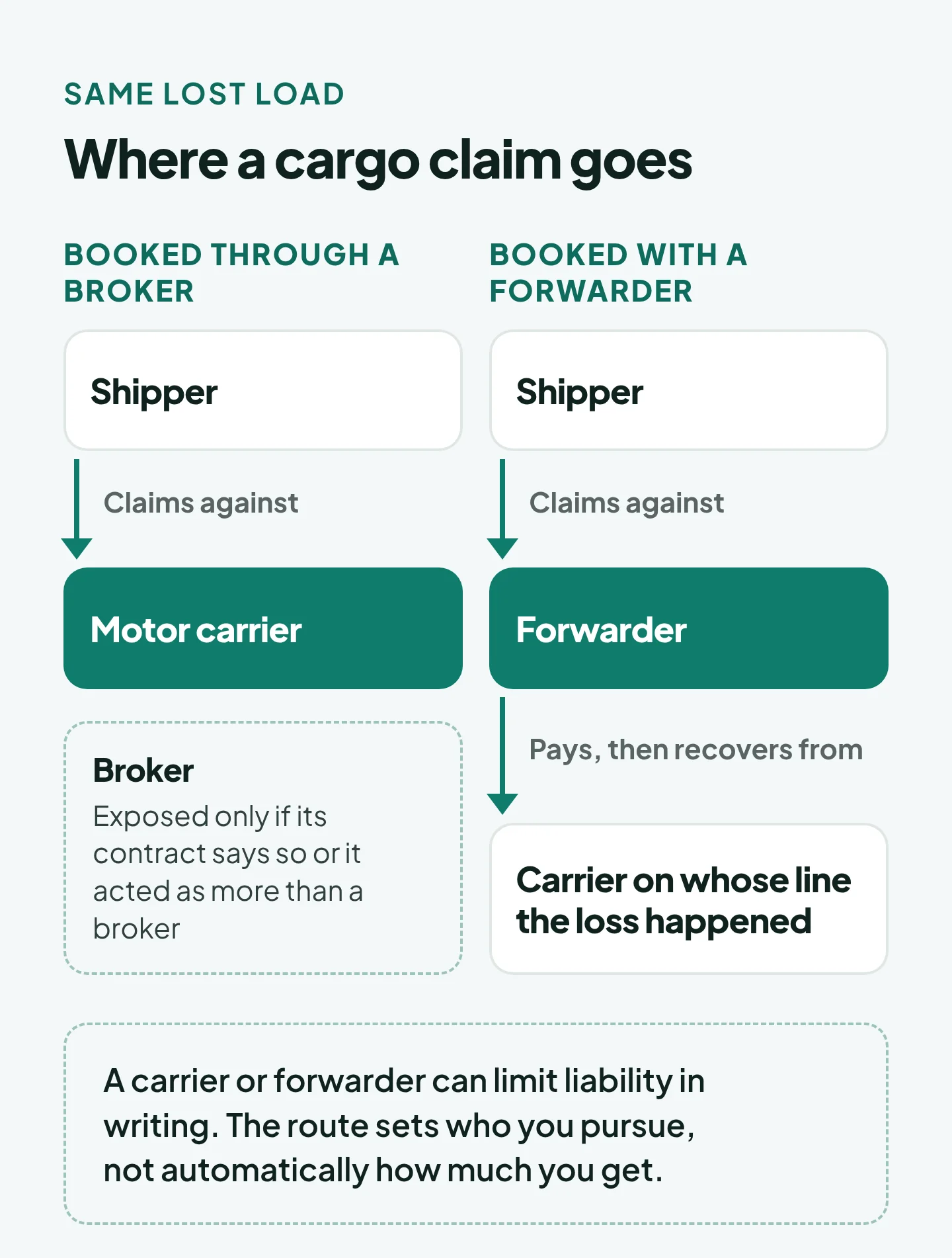
Booked through a broker. The shipper claims against the motor carrier, because Carmack liability sits on carriers and the statute does not name brokers. The broker is exposed only if its contract says so or it acted as more than a broker. Say the carrier’s terms limit liability to $5 per pound by written agreement, as 14706(c) allows. The shipper recovers at most $15,000 and carries the other $33,000 itself unless it bought cargo insurance.
Booked with a forwarder. The shipper claims against the forwarder, on the forwarder’s own bill. The forwarder cannot point at the truck line, because the statute makes it the receiving and delivering carrier. It pays, then recovers from the carrier on whose line the loss happened under 14706(b). The shipper has one party to deal with, plus the claim rules every motor carrier and forwarder must follow: written acknowledgment within 30 days and a payment, denial or firm offer within 120 days, or a status update every 60 days after that. Carmack also bars a carrier from setting less than 9 months to file a claim or less than 2 years to sue.
A forwarder can limit its liability in just the same way, so the $5 per pound cap could apply here too. The difference is who you pursue, not automatically how much you get. The parties can also contract out of Carmack in writing under 49 U.S.C. 14101(b), except for certain household goods moves. Always read the limit on the bill and the service agreement. Our bill of lading guide shows where that wording appears.
The ocean version is harsher. Send the same parts to Rotterdam on an NVOCC’s bill of lading and the Carriage of Goods by Sea Act can apply. Its section 4(5), reproduced in the notes to 46 U.S.C. 30701, caps carrier liability at $500 per package unless the shipper declares a higher value on the bill. If each pallet is a package, that is $3,000 on a $48,000 loss. How a pallet is counted depends on the bill and the court, so declare the value or insure the cargo.
Injuries are a separate question. In Montgomery v. Caribe Transport II (May 2026), the Supreme Court held that federal law does not preempt a state negligent-hiring claim against a broker that selected an unsafe carrier. The case concerned a broker. 49 U.S.C. 14501(c)(1) names brokers and forwarders in the same phrase, so we would treat a forwarder picking its truck lines as facing the same risk, but we found no ruling on that yet.
Licensing, bonds and insurance
For the domestic side, the entry costs are nearly identical. The federal fee schedule charges $300 for property broker authority or forwarder authority, per authority type. The security is also the same, and FMCSA’s filing chart lists Form BMC-84 or BMC-85 for both: 49 CFR 387.405 sets the forwarder amount “identical to that prescribed for brokers”, and 49 CFR 387.403T(c) pulls in the whole of the broker bond rule. FMCSA said so directly when it rewrote that rule, in force since January 2026: “any time this rule and this preamble refer to brokers, the same requirements are also applicable to freight forwarders” (88 FR 78656). Our guide to the $75,000 bond and its premiums covers how the security works. For the step-by-step filing, see how to become a freight broker.
| Cost or requirement | Broker | FMCSA forwarder | Ocean forwarder | NVOCC |
|---|---|---|---|---|
| Federal application fee | $300 | $300 | $1,304 | $1,304 |
| Financial security | $75,000 | $75,000 | $50,000 | $75,000 |
| Experience rule | Officer with 3 years, or proven knowledge (statute) | Same (statute) | Qualifying individual with 3 years (46 CFR 515.11) | Same |
Five details behind those numbers:
- Experience. 49 U.S.C. 13903(c) and 13904(c) carry the same officer requirement. A Federal Register search on 1 November 2026 found no FMCSA proposal to implement it for either, while the FMC applies its three-year rule at licensing.
- Liability insurance. 49 U.S.C. 13906(c)(3)(B) ties a forwarder’s filed security to judgments from vehicles it operates or directs in transfer, collection or delivery. FMCSA’s Form OP-1(FF) instructions, revised in 2017 and the last forwarder-specific guide we found, asked forwarders that operate vehicles for a BMC-91 or BMC-91X filing at the motor carrier minimums: $750,000 for non-hazardous freight in vehicles of 10,001 pounds or more and $300,000 for lighter fleets. Forwarders that own and direct no vehicles and do no transfer, collection or delivery could request a waiver. New applicants now register in Motus, the system FMCSA announced in April 2026, so its screens may differ from that form. FMCSA’s current filing chart shows $0 for forwarders of property with no vehicle type, and 387.403T(b) names only household goods forwarders, so the sources do not line up neatly. Plan on the insurance if you run vehicles, and confirm the point when you apply.
- Cargo insurance. FMCSA’s current chart lists $0 for forwarders of property. Household goods forwarders file on Form BMC-34 or BMC-83, and 387.303T(c) sets the amounts at $5,000 per vehicle and $10,000 per occurrence. An FMCSA FAQ last updated in 2014 agrees: “Non-household goods freight forwarders are not required to obtain cargo insurance.” The 2017 instructions still say all forwarders must carry those amounts, so we follow the newer chart and the rule text. Section 13906(c)(3)(C) lets FMCSA change this, since it “may require” cargo security. No filing is required today, but a company that accepts carrier liability without cargo legal liability cover is exposed on every load.
- UCR. For 2027 a broker pays a flat $55. A forwarder pays by vehicle count, from $55 for up to 2 vehicles to $54,165 for 1,001 or more (49 CFR 367.50).
- Process agents. 49 U.S.C. 13303 requires carriers, brokers and forwarders to designate an agent. The 2017 OP-1(FF) instructions list a BOC-3 filing as a step for forwarders: those running vehicles need an agent in each state they operate in or through, and the rest in each state where they keep an office or establish contracts. The Part 366 rules themselves mention only motor carriers and brokers.
Can one company be both?
Yes. The fee is charged per authority type, so a company wanting both pays $300 twice and gets a docket for each. Essex is the warning: courts look at the capacity in which a company acted on the particular shipment. If you hold both, your quote, booking confirmation and bill must show which hat you wear on each load. Mixing them is how a broker margin ends up carrying a carrier’s liability.
The statute sets the security for brokers and forwarders in separate subsections, 13906(b) and (c), and we could not confirm whether one $75,000 filing can serve both authorities. Budget for two until your surety and FMCSA say otherwise. Adding carrier authority is a third step: both 13903(d) and 13904(d) bar a forwarder or broker from hauling as a motor carrier without registering separately.
Which one to use, start or work for
Shippers: use a broker for straightforward domestic truckloads, where you want a truck and a price and are comfortable handling claims with the carrier. Use a forwarder when you want less-than-truckload freight consolidated, or one party responsible for a multi-leg move. For ocean freight, use an NVOCC or, on US exports, an FMC-licensed ocean forwarder, and add a licensed customs broker for US entry. The short truck move between the port and your dock is called drayage. If you are comparing consolidated options, our density-based class calculator gives you the class most LTL quotes depend on.
New business owners: domestic brokerage is the lighter start. A forwarder has the same fee and bond but takes on carrier liability, needs cargo legal liability cover in practice, and usually needs dock space, in-house or contracted, because consolidation is part of the definition. An ocean license needs a qualifying individual with three years of OTI experience, so that person must be in place before you apply. Calling yourself a “logistics company” changes none of this.
People looking for a job: brokerage work is sales and carrier relationships on domestic trucks. International forwarding work leans toward documents, customs and multimodal routing. They are different skills, and moving between them means learning a second rulebook, as the tables above show.
Checks before you hire one
- Ask which capacity. Are you acting as broker, forwarder, NVOCC or agent on this shipment? Get the answer in writing.
- Check the registration. Look for an active docket and the bond on file with an MC number and authority lookup. A forwarder’s docket starts with FF, so search it by name or USDOT number. For ocean, ask for the FMC license number and confirm it with the commission.
- Read whose bill of lading it is. The issuer is usually the party you will claim against.
- Find the limit. Ask for the dollar limit per pound or package, and the document that sets it.
- Ask about insurance. Request a certificate for cargo legal liability, and buy your own all-risk cover for anything the limit will not make whole.
Common questions
Is a freight forwarder a carrier?
Under FMCSA law, yes: 49 U.S.C. 13102(3) lists it as one. A licensed ocean forwarder is not. It acts as the shipper’s agent, and the NVOCC is the carrier in that world.
Does a freight forwarder need an MC number?
Not an MC number as such. An FMCSA forwarder has its own authority with an FF docket, plus a USDOT number. An ocean forwarder needs an FMC license instead.
Do brokers ever touch the freight?
Part 371 does not ban it in so many words, but taking custody or issuing your own bill moves you toward carrier status. Stay out of the freight unless you hold the right authority, and ask your insurer how custody affects your cover.
Is a 3PL a broker or a forwarder?
It can be either, or neither. “3PL” is a business label, not an authority. The Essex court quoted the rule that the inquiry is the capacity in which it acts on the particular transaction.
Does a forwarder clear customs?
Only if it is a licensed customs broker or uses one. Under 19 CFR 111.2, transacting customs business for others needs a license.
Facts checked against primary sources on 1 November 2026: the eCFR (Titles 14, 19, 46 and 49, current through 29 October 2026), the U.S. Code, the Federal Register, the Supreme Court’s Montgomery opinion and the Eleventh Circuit’s Essex opinion. FMCSA’s insurance filing chart (last updated 26 March 2026), its cargo insurance FAQ (last updated 8 May 2014) and the Form OP-1(FF) instructions (revision of 10 January 2017) were read again on FMCSA’s own site on 11 November 2026 and match what this page says. The worked example is illustrative. Every figure is checked against the linked source. This page is general information, not legal, tax or financial advice.
Sources
- 49 U.S.C. 13102, definitions
- 49 U.S.C. 14706, Carmack Amendment
- 49 U.S.C. 13903, registration of freight forwarders
- 49 U.S.C. 13904, registration of brokers
- 49 U.S.C. 13906, financial security
- 49 U.S.C. 14916, unlawful brokerage
- 49 U.S.C. 14501, federal preemption
- 49 U.S.C. 13531, freight forwarder jurisdiction
- 49 U.S.C. 13303, service of notice
- 49 U.S.C. 14101, contracts
- 46 U.S.C. 40102, shipping definitions
- 46 U.S.C. 30701 notes, Carriage of Goods by Sea Act
- eCFR: 49 CFR 371.2, broker definitions
- eCFR: 49 CFR 371.3, broker records
- eCFR: 49 CFR 371.7, misrepresentation
- eCFR: 49 CFR 373.201, forwarder bills of lading
- eCFR: 49 CFR 370.5, acknowledgment of claims
- eCFR: 49 CFR 370.9, disposition of claims
- eCFR: 49 CFR 387.307, broker bond or trust
- eCFR: 49 CFR 387.403T, forwarder requirements
- eCFR: 49 CFR 387.405, forwarder limits
- eCFR: 49 CFR 387.303T, minimum limits
- eCFR: 49 CFR 360.3T, filing fees
- eCFR: 49 CFR 366.1T, process agents
- eCFR: 49 CFR 367.50, UCR fees from 2027
- eCFR: Appendix B to 49 CFR Part 386, penalties
- eCFR: 46 CFR 515.3, OTI licensing
- eCFR: 46 CFR 515.5, OTI fees
- eCFR: 46 CFR 515.11, OTI eligibility
- eCFR: 46 CFR 515.21, OTI financial responsibility
- eCFR: 46 CFR 515.42, forwarder compensation and disclosure
- eCFR: 46 CFR 520.3, tariff publication
- eCFR: 14 CFR 296.3, indirect cargo air carriers
- eCFR: 49 CFR 1548.5, indirect air carrier security program
- eCFR: 19 CFR 111.1, customs business
- eCFR: 19 CFR 111.2, customs broker license
- Federal Register: Broker and Freight Forwarder Financial Responsibility, 16 November 2023
- Federal Register: Availability of Motus, FMCSA's New Registration System, 29 April 2026
- Essex Insurance v. Barrett Moving & Storage, No. 16-11526 (11th Cir. 2018)
- Montgomery v. Caribe Transport II, No. 24-1238 (U.S. 2026)
- FMCSA FAQ: cargo insurance for freight forwarders
- FMCSA instructions for Form OP-1(FF), revised 2017
- FMCSA insurance filing requirements chart
- Federal Maritime Commission: ocean transportation intermediaries