An owner-operator is a truck driver who owns or leases the truck and runs it as a business. Most work in one of two ways: leased on to a motor carrier, hauling under its USDOT number and authority, or under their own authority as a one-truck carrier. Either way you are paid for the work of the truck, not by the hour, and fuel, repairs, the truck payment and your own taxes come out of that money. In 2025 carriers paid contracted owner-operators an average of $2.08 a mile, according to ATRI. At fleet-average costs, that leaves about $66,000 before tax and benefits. This guide, part of our starting a trucking company hub, shows that sum line by line, explains how the pay plans work, and covers what to check in a lease before you sign.
This is general information, not legal, tax or financial advice. Have a transportation attorney or an accountant review your own numbers and any contract before you sign.
The short version
- What it is: a driver who supplies the truck as well as the labor and runs it as a business. The term has no definition in the federal leasing rules, which speak of the “owner” or “lessor” of the equipment.
- Two models: leased on (the carrier supplies the authority, the primary liability cover and usually the freight) or own authority (you supply all of it).
- Pay: a share of revenue, a rate per mile or a flat rate per load. One large carrier’s annual report gives 62% to 70% of revenue for contractors who supply a tractor, and 73% to 77% for those who also supply a trailer, plus all of the fuel surcharge.
- What you keep: depends on miles and costs more than on the pay plan. In our worked example, 16,000 fewer miles costs about $20,600 a year.
- Biggest tax surprise: self-employment tax of 15.3%, paid by you, with no employer paying half.
- Biggest trap: a carrier-run lease-purchase program. A federal task force told Congress in January 2025 to ban them.
Owner-operator vs company driver
The Bureau of Labor Statistics describes long-haul owner-operators as drivers who buy or lease their own trucks and run their own businesses, finding and keeping clients as well as driving. The real dividing line is who carries which risk.
| Item | Company driver | Leased owner-operator | Own authority |
|---|---|---|---|
| Truck | The carrier’s | Yours | Yours |
| USDOT number and authority | The carrier’s | The carrier’s | Yours |
| Primary liability insurance | The carrier’s | The carrier’s | Yours, at least $750,000 for general freight |
| Finding freight | The carrier | Mostly the carrier | You, through brokers, load boards or shippers |
| Fuel, repairs, tires | The carrier | You, unless the lease says otherwise | You |
| If the truck is parked | Depends on the pay plan | You earn nothing and the payment is still due | You earn nothing and the payment is still due |
| Drug and alcohol testing | The carrier’s program | Normally the carrier’s program | Your own, through a consortium |
| Payroll taxes | Withheld; employer pays half | You pay both halves | You pay both halves |
The $750,000 floor is in 49 CFR 387.9. For the testing row, 49 CFR 382.103 makes a driver who employs himself or herself meet both the employer and the driver rules, and that driver must sit in a random pool of two or more.
How many owner-operators are there? It depends on what you count. ATRI, using FMCSA registration data, reports 566,855 single-truck, single-driver for-hire carriers registered in December 2025, 2.2% below the December 2022 peak. That counts registrations, not busy trucks, and a driver leased to a carrier generally wouldn’t appear in it. BLS says self-employed workers are 7% of about 2.2 million heavy truck driver jobs, or roughly 155,000. Treat both as rough sizes of different groups.
Leased on or your own authority
Our guide to launching a motor carrier covers the authority route step by step, so here is only the choice itself.
Leased on. You sign a written lease that hands the truck to the carrier for the term. 49 CFR 376.12(c) says the carrier has “exclusive possession, control, and use” of the equipment during the lease and takes complete responsibility for operating it. The truck displays the carrier’s identification, and the carrier handles the customers, the billing and most of the compliance. You give up rate control and, unless the carrier agrees otherwise, the freedom to haul for anyone else. What you get is regular settlements and far less paperwork.
Own authority. You apply in FMCSA’s Motus system ($300), and you take on the insurance filing, BOC-3, UCR, IRP, IFTA, your own testing program and the new entrant safety audit. You pick your freight and keep the whole rate. You also carry the whole risk: dead weeks, broker credit, and payment terms that are often longer than a lease’s. Price the insurance first. A new authority has no loss history, so don’t plan on the fleet average.
Leasing on first is one way to learn cost per mile and cash flow before moving across. If you already have shipper contacts, or a specialty that brokers will pay for, the lease may teach you little.

How owner-operators get paid
49 CFR 376.12(d) lets a lease pay in almost any form: a percentage of gross revenue, a flat rate per mile, a rate that varies by direction or commodity, or “any other method” the parties agree. The three common plans are below.
| Plan | How it works | Good when | Watch for |
|---|---|---|---|
| Percentage of revenue | You get a share of what the customer pays | Rates are strong; you can choose loads | Share of what? Linehaul only, or the whole invoice |
| Per mile | A set rate per mile | You want predictable income; intermodal and dedicated work | Whether empty miles pay, and how miles are measured |
| Flat or all-in rate | One figure per load, fuel included | You want the math done for you | Fuel risk now sits with you |
Here is what large carriers themselves publish. None of it is a market average, and the terms can change.
| Carrier and date | What it says |
|---|---|
| Landstar, 2025 Form 10-K | Generally 62% to 70% of revenue with a tractor; 73% to 77% with tractor and trailer. 100% of fuel surcharges passed through ($229 million in 2025). Contractors pay substantially all operating costs. |
| Schneider, own site, 18 December 2025 | Percentage option: 65% of linehaul revenue plus 100% of fuel surcharge and accessorials. It also describes flat-rate and mileage models. |
| J.B. Hunt, own site, 12 March 2026 | Truckload: a set percentage of each load plus a percentage of fuel surcharge. Intermodal: a set rate per mile. Up to 100% of fuel surcharge; weekly settlements. No percentages published. |
Compare offers on the same load
A higher headline percentage can pay less. Take a made-up 1,000-mile load billed at $2,000 linehaul plus $500 fuel surcharge.
| Offer | Calculation | You receive |
|---|---|---|
| 65% of linehaul, 100% of fuel surcharge | $1,300 + $500 | $1,800 |
| 70% of the whole invoice | 70% of $2,500 | $1,750 |
| $1.70 a mile, loaded miles only | 1,000 × $1.70 | $1,700, less if the next load needs a long empty run |
On a percentage plan, the lease must promise you a copy of the rated freight bill before or at settlement, and on any pay plan you may examine the rate documents behind it, though the carrier can delete shipper and consignee names. That right is in 376.12(g). Use it: a percentage is only worth what the invoice really says.
How much do owner-operators make?
An owner-operator has no salary in the usual sense: the carrier or broker pays the truck, and your pay is whatever is left after the truck’s costs. We found no government figure for owner-operator income. BLS’s $58,640 median for heavy truck drivers (May 2025) leaves out the self-employed. Income figures around the web usually come without a source we could trace. So we built an estimate from the most detailed public data we found, ATRI’s 2026 operational costs report.
Most headline numbers are gross revenue, and gross is not income. A truck grossing $180,000 can leave its owner less than a company driver earns.
How much do truckers make per mile?
A company driver’s per-mile figure is pay. An owner-operator’s is revenue for the whole truck, so the two only compare after costs. ATRI’s 2025 figures are fleet averages spread over all miles driven, not a rate printed on anyone’s settlement. Its July 2026 report puts driver wages at 81.8 cents a mile and benefits at 21 cents, $1.028 in all, the first year combined pay passed a dollar a mile.
| Who | Per mile, 2025 | What it is |
|---|---|---|
| Fleet driver, wages | $0.818 | ATRI average across carriers |
| Fleet driver, wages and benefits | $1.028 | ATRI average |
| Owner-operator, leased on | $2.08 | ATRI average contract rate, before the truck’s costs |
| Owner-operator, after costs | About $0.77 | Our worked year below, before tax |
BLS publishes no per-mile figure. For heavy and tractor-trailer drivers it gives a median of $28.19 an hour and $58,640 a year (May 2025, employees only; read 14 November 2026). Per-mile pay on a real job depends on how miles are counted, whether empty miles pay, and the freight, so ask for it in writing.
A worked year, leased on
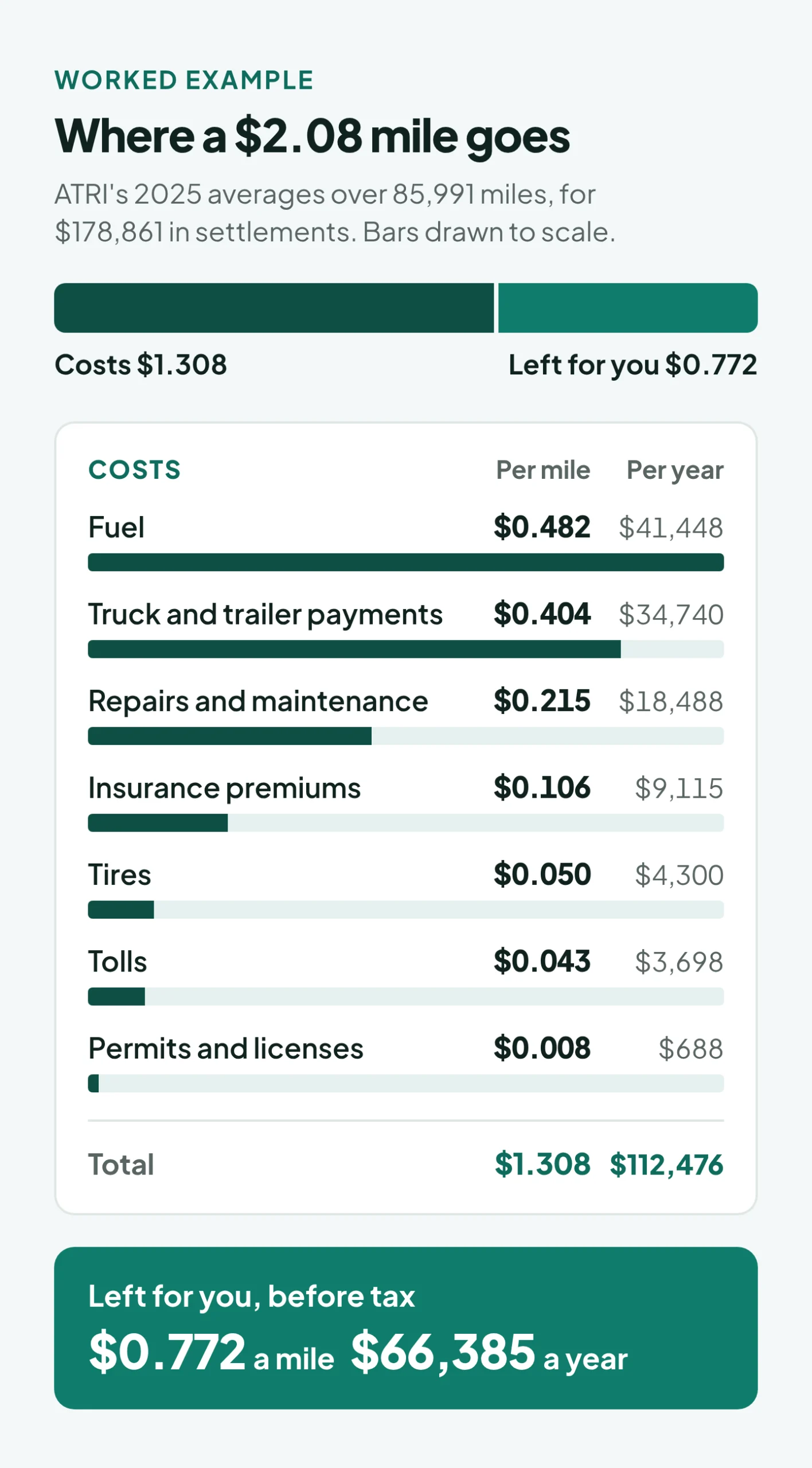
Inputs: ATRI’s average of 85,991 miles per truck in 2025, its $2.08 average contract rate, and its average non-driver costs per mile. Annual lines are rounded to the dollar, so they add up to $1 more than the total.
| Line | Per mile | Per year |
|---|---|---|
| Settlements (85,991 miles at $2.08) | $2.080 | $178,861 |
| Fuel | $0.482 | $41,448 |
| Truck and trailer payments | $0.404 | $34,740 |
| Repairs and maintenance | $0.215 | $18,488 |
| Insurance premiums | $0.106 | $9,115 |
| Tires | $0.050 | $4,300 |
| Tolls | $0.043 | $3,698 |
| Permits and licenses | $0.008 | $688 |
| Total costs | $1.308 | $112,476 |
| Left for you, before tax | $0.772 | $66,385 |
Now take off payroll tax and compare like with like. The self-employment line is 15.3% on 92.35% of net earnings; the company lines are the employee’s 7.65% share. The fleet column is ATRI’s average $0.818 wages and $0.210 benefits per mile, multiplied by the same 85,991 miles.
| Measure | Owner-operator (example) | Fleet driver, same miles (ATRI) | Median heavy truck driver (BLS) |
|---|---|---|---|
| Pay before tax | $66,385 | $70,341 | $58,640 |
| Social Security and Medicare | $9,380 | $5,381 | $4,486 |
| Left after payroll tax | $57,005 | $64,960 | $54,154 |
| Employer-paid benefits | None | About $18,058 (ATRI average) | Not in the figure |
At fleet-average costs, the average contract rate pays less than the fleet’s own average driver package at the same mileage, and it is only a little ahead of the BLS median. That squares with ATRI’s table: in 2025 the $2.08 contract rate sat below the $2.21 average cost of running a truckload mile. The same $2.08 was the rate in 2022, while truckload costs rose from $2.15.
Treat this as a benchmark. Its limits:
- ATRI doesn’t say whether its $2.08 applies to all miles or only loaded miles, or how fuel surcharge is treated. The survey form in its appendix asks carriers for average base pay per mile, without bonuses. If the rate is loaded miles only, or excludes surcharge, real earnings would differ.
- The costs come mostly from fleets. A tractor-only lease has no trailer payment, and a carrier may buy insurance at a better price. Against that, ATRI found truckload fleets under 5 trucks spent 8.8 cents a mile more on fuel than fleets over 1,000, and had the highest repair costs, which it links to spending less on equipment.
- ATRI’s mileage is a fleet average, not a figure for one-truck operators. Yours may be lower.
- It ignores advances, escrow, the tax deductions below, and any truck that is already paid off.
- These are 2025 figures. ATRI’s July 2026 report says diesel spiked to over $5.50 a gallon in spring 2026, and cites DAT and U.S. Bank data showing dry van contract rates up 9% and spot rates up 31% year over year in May 2026, on lower volumes. Rerun the sum with today’s fuel price and rates.
What moves the number
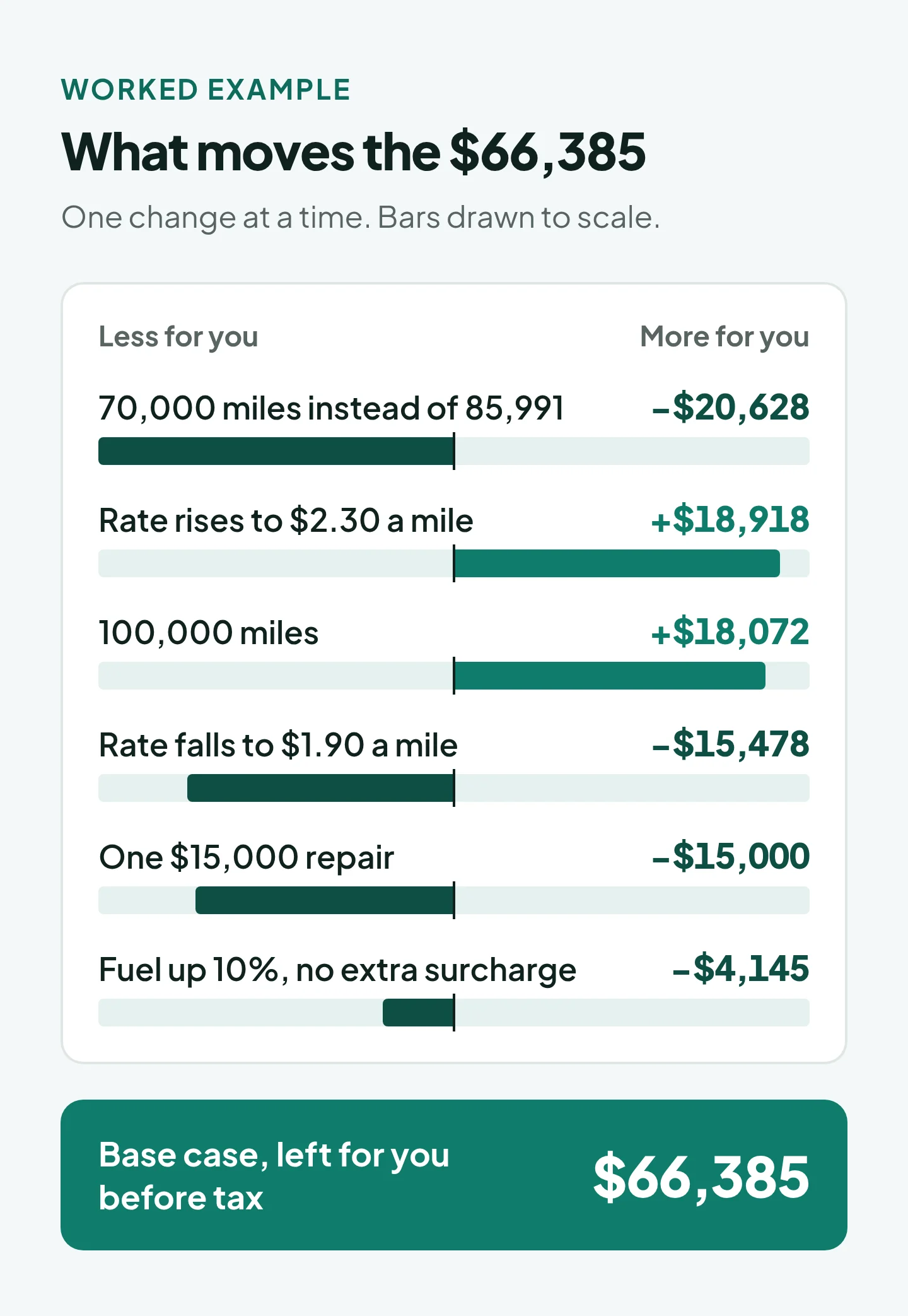
Fuel, repairs, tires and tolls rise and fall with miles. Truck payments, insurance and permits mostly don’t, about $44,543 a year here. That is why a slow month hurts so much. Changing one thing at a time:
| Change | Left for you, before tax | Difference |
|---|---|---|
| Base case | $66,385 | None |
| 70,000 miles instead of 85,991 | $45,757 | -$20,628 |
| 100,000 miles | $84,457 | +$18,072 |
| Rate falls to $1.90 a mile | $50,907 | -$15,478 |
| Rate rises to $2.30 a mile | $85,303 | +$18,918 |
| Fuel up 10%, no extra surcharge | $62,240 | -$4,145 |
| One $15,000 repair | $51,385 | -$15,000 |
Turnover gives one hint of how hard this is to sustain. Landstar, which publishes it, reported contractor truck turnover of about 31% in 2025 in the same 10-K, down from 35% in 2024, and a third of the 2025 figure came from contractors with under a year’s tenure. Its contractor fleet fell from 8,843 to 8,514 trucks. That is one company in a weak freight market, and turnover includes people moving elsewhere, not only those leaving the business.
The same math with your own authority
Work out your own minimum rate before you quote anything. At ATRI’s $1.308 cost and 85,991 miles, paying yourself $60,000 a year adds $0.70 a mile, so you need about $2.01 on every mile you drive. ATRI puts non-tank empty miles at 16.5%, so divide by 0.835: you need about $2.40 per loaded mile. Your insurance may well be above the 10.6-cent average, and you will carry costs a carrier would have absorbed, so treat that as a floor.
Taxes: the part that catches new owners
- Self-employment tax. The rate is 15.3%: 12.4% Social Security on earnings up to $184,500 in 2026, and 2.9% Medicare. It applies from $400 of net earnings. You can deduct the employer-equivalent portion when figuring adjusted gross income.
- Estimated payments. Nobody withholds for you. If you expect to owe $1,000 or more, the IRS expects quarterly payments, and underpaying can bring a penalty. Move a fixed share of every settlement into a tax account.
- Meals on the road. The transportation-industry rate is $80 a day in the continental US for travel from 1 October 2026 (IRS Notice 2026-60). Drivers under DOT hours-of-service limits can deduct 80% of meals, not 50%, and the self-employed can use the standard allowance. For example, 200 days away is $16,000 of allowance and a $12,800 deduction. You need a tax home and travel records, so ask your accountant.
- Qualified business income. The deduction of up to 20% is now permanent, but limits apply, and it doesn’t reduce self-employment tax.
- Heavy vehicle use tax. If a truck with a taxable gross weight of 55,000 lb or more is registered in your name, you file Form 2290, up to $550 a year on a full-weight tractor. Check whether the lease reimburses it.
What to check in a lease
The federal truth-in-leasing rule, 376.12, is mostly about disclosure. It makes the carrier put terms in writing and follow them. It does not set a minimum rate, guarantee miles or stop a bad deal. Go through a draft clause by clause.
| Clause | What the rule requires | What to ask |
|---|---|---|
| Pay, 376.12(d) | Stated in the lease or an attached addendum, delivered before any trip | Percentage of what? Do empty miles pay? Can the addendum change, and on what notice? |
| Costs, 376.12(e) | Must say who pays fuel, fuel taxes, empty miles, permits, tolls, detention, plates and loading | Who keeps detention and accessorial pay? |
| Payment, 376.12(f) | Within 15 days of submitting the delivery documents | How often are settlements? What is on the settlement sheet? |
| Freight bill, 376.12(g) | A copy on percentage pay, and a right to see rate documents | How do I ask, and how fast will I get it? |
| Charge-backs, 376.12(h) | Every item listed, with how it is calculated; copies of documents to verify it | What is the markup on insurance, fuel cards, trailer rental and plates? |
| Forced buying, 376.12(i) | You can’t be required to buy or rent from the carrier as a condition of the lease | Is any product “optional” in name only? |
| Insurance, 376.12(j) | Must state the carrier’s public liability duty, who provides other cover and any charge-back; written itemization before cargo or damage deductions | What deductible do I pay after a claim? |
| Escrow, 376.12(k) | Amount and uses stated; accounting; interest at least quarterly, at no less than the 13-week Treasury bill yield; returned within 45 days of termination | How much is taken each week, and what can be taken from it at the end? |
| Term, 376.12(b) | Start and end stated | How much notice to leave? What happens to money still owed? The rule sets no notice period. |
Ask for three things before signing: a blank sample settlement, a copy to take home, and time to have it read. The federal task force covered below reported that drivers in lease-purchase deals are typically not permitted to take contracts home. A carrier that refuses has told you something. If a carrier breaks the rules later, 49 U.S.C. 14704 lets an injured party sue for damages or an injunction.
Insurance needs a separate look. The carrier’s filing covers you under dispatch, so you will usually need non-trucking liability for off-dispatch driving, and physical damage cover for your own truck. Ask too what pays if you are hurt: as a contractor you may fall outside workers’ compensation, which varies by state. Our trucking liability guide explains what the federal minimums cover.
Why to avoid carrier lease-purchase programs
In a lease-purchase, you lease a truck from your carrier, or a company tied to it, and pay from your settlements, with a promise that you can own it at the end. That differs from buying a truck with a loan from a bank or dealer.
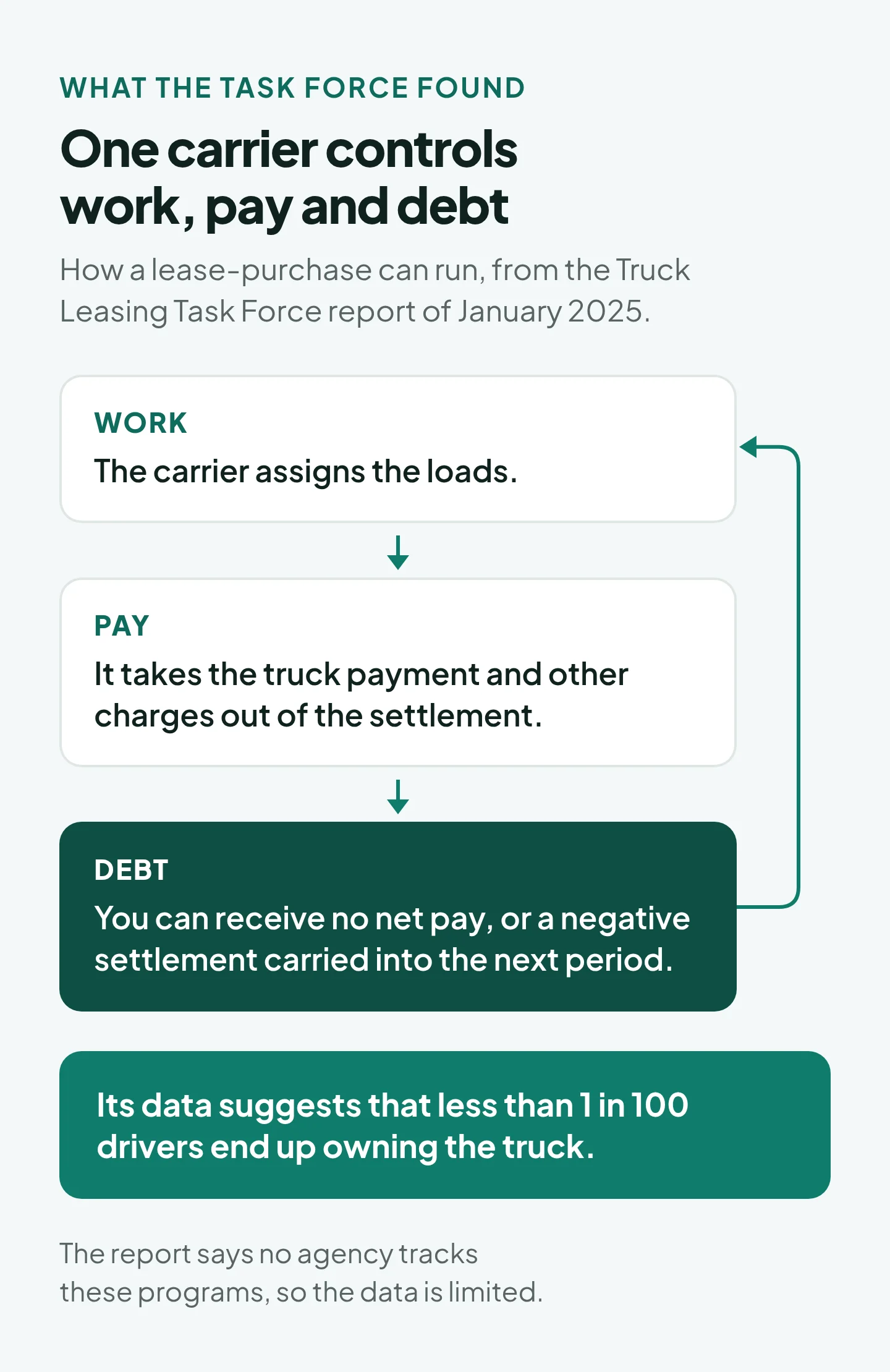
Congress had a federal Truck Leasing Task Force study these deals. Its January 2025 report called on Congress to ban them as “irredeemable tools of fraud and driver oppression”. Its main findings:
- The carrier controls the driver’s work, pay and debt at once. It assigns the loads, then takes the truck payment and other charges out of the settlement.
- Drivers can receive no net pay, or a negative settlement carried into the next period. The report says drivers all know the phrase “going in the hole”.
- Data the task force collected “suggests that less than 1 in 100 drivers who participate in a lease-purchase end up owning the truck”. The report also says no agency tracks these programs, so the data is limited.
- One carrier offered buyout numbers in defense of the model: about 34 a year over two decades, from a fleet that in recent years held about 1,500 owner-operators. It gave no count of participants.
- The report argues that these drivers are usually misclassified as contractors, because they have little real say over how the truck runs.
The report isn’t the last word. A Congressional Research Service report of September 2026 says the American Trucking Associations reportedly believes carriers were underrepresented on the task force, which had one carrier among nine members, and that some drivers have started businesses this way. The recommendation is also not law, as far as we could find. The same report lists H.R. 5423, which would ban predatory agreements, and section 5101 of H.R. 8870, as ordered to be reported, which would direct DOT to prohibit “predatory” programs within two years.
If you are still tempted, get answers in writing. What is the total of all payments? What are the truck’s age, mileage and price? How many people entered the program in the past three years, and how many took title? What happens to your payments if the carrier cuts your miles or ends the lease? If the answers are vague, walk away.
Contractor or employee?
Signing a contractor agreement does not settle your legal status. The leasing rule stays neutral: nothing in the control language of 376.12(c) is “intended to affect” whether you are a contractor or an employee. For safety rules, the answer is different again. Under 49 CFR 390.5T, an independent contractor counts as an “employee” of the carrier while operating a commercial vehicle.
For federal wage law, the test is in flux. The Labor Department’s 2024 rule is still on the books for private lawsuits, but its Wage and Hour Division said in May 2025 that it would stop applying that analysis in investigations. In a proposed rule of 27 February 2026, it would replace that rule with a version of its 2021 test. Control and the opportunity for profit or loss would be the two core factors. Comments closed on 28 April 2026, and the department’s rulemaking page showed no final rule when we checked. The proposal says that requiring an owner-operator to follow federal safety rules on drug and alcohol testing or meet agreed delivery deadlines doesn’t count as control either way.
States can differ: the Congressional Research Service notes that California has a state classification law and that a similar regulation is being implemented in New Jersey. A practical test is whether you can turn down loads, choose your routes and profit from your own decisions. If not, your deal may look more like a job with the costs of a business.
How to become an owner-operator
- Get the credentials and the record. You must be at least 21 for interstate work, with a Class A CDL for a tractor-trailer and a current medical card. Hauling from ports also takes a Transportation Worker Identification Credential for unescorted access to secure areas. Federal rules set no minimum experience, but carriers and insurers set their own, so ask before you buy a truck.
- Learn your numbers while employed. Track your miles, empty miles and weeks out. Build the worked year above with real insurance, truck and fuel quotes. If the result doesn’t beat your current pay and benefits, stop here or change the plan.
- Choose the model. Lease on or apply for authority. For the second route, itemize the startup bill with our guide to what it costs to start a trucking company.
- Shortlist carriers before you buy. Ask about tractor age and spec limits, average miles for contractors on your lane, and a sample settlement. Requirements differ, and a truck one carrier rejects is an expensive surprise.
- Set up the business. Form an LLC or corporation if your advisers recommend it, get a free EIN, and open a separate bank account. You need the EIN to file Form 2290, the heavy vehicle use tax return.
- Buy the truck carefully. Compare a bank or dealer loan with any lease, on total cost. Pay for an independent inspection on a used truck. Budget for repairs: one large bill can erase months of profit.
- Insure it. Get quotes for physical damage, non-trucking liability if leased, and injury cover. Own-authority operators add primary liability and cargo.
- Build a cash cushion. Hold at least two months of operating costs, about $18,700 at ATRI’s averages, plus living costs and a repair fund. On your own authority, brokers often pay weeks after delivery. Freight factoring can close that gap, at a price.
- Have the contract read, then sign. Use the checklist above. Keep a copy of the lease, receipts and every settlement.
- Run it as a business from week one. Set aside tax, fund a maintenance account, and review cost per mile every month. If you hire help finding loads, know where a truck dispatcher’s legal limits lie.
Is being an owner-operator worth it?
It can be, but the data doesn’t support the idea that buying a truck is an automatic raise. To beat the averages above you need an edge: more miles, lower costs, better freight, a paid-off truck or a specialty. If you are good at maintaining a truck, willing to watch every cost and able to survive a bad quarter, the control and upside can justify the risk.
It is a weak choice if your main reason is that recruiters quote a big gross number, you have no savings, or your only way in is a carrier’s lease-purchase. Company driving with a savings plan is a better first step in those cases.
Common questions about owner-operator pay
What is the average owner-operator salary?
No official average exists: BLS wage surveys leave out the self-employed. In our worked year at ATRI’s 2025 averages, a leased-on owner-operator keeps about $66,400 before tax and about $57,000 after self-employment tax. The same truck keeps about $45,800 at 70,000 miles, or about $85,300 at $2.30 a mile. Most “salary” figures online are gross revenue.
How much do owner-operators make a year in gross revenue?
At ATRI’s 2025 averages, 85,991 miles at $2.08, a truck brings in about $178,900 in settlements. About $112,500 of that goes to fuel, the truck, repairs, insurance, tires, tolls and permits before you are paid.
How much does an owner-operator make per mile after costs?
About 77 cents a mile before tax in our worked year: $2.08 in, $1.308 out. Your own figure moves with miles, fuel price and the truck payment, so work out your cost per mile every month from your settlements and receipts.
Do owner-operators make more than company drivers?
Not on average, by the numbers above. At the same mileage, the fleet driver’s average package is about $70,300 in wages plus about $18,100 in benefits, against the owner-operator’s $66,400 before tax with no benefits. Owner-operators who come out ahead usually have more miles, lower costs, better freight or a paid-off truck.
Facts checked against primary sources on 1 November 2026: 49 CFR Parts 360, 376, 382, 387, 390 and 391, 26 CFR 1.199A-1, 49 U.S.C. 14704, ATRI’s 2026 operational costs report, the BLS Occupational Outlook Handbook, the Truck Leasing Task Force report, the Congressional Research Service, the Federal Register, IRS publications and notices, the Department of Labor, and the carriers’ own filings and sites, dated in the text. ATRI’s 15 July 2026 release, the BLS May 2025 wage data and the IRS self-employment tax rates rechecked on 14 November 2026. Worked examples are our own estimates. Every figure is checked against the linked source. This page is general information, not legal, tax or financial advice.
Sources
- ATRI: An Analysis of the Operational Costs of Trucking, 2026 Update
- ATRI news release: 2026 operational costs report, 15 July 2026
- eCFR: 49 CFR 376.12, lease requirements
- eCFR: 49 CFR 382.103, applicability
- eCFR: 49 CFR 387.9, minimum financial responsibility
- eCFR: 49 CFR 390.5T, definitions
- eCFR: 49 CFR 391.11, driver qualifications
- 49 U.S.C. 14704, rights and remedies
- Truck Leasing Task Force report to Congress, January 2025
- BLS Occupational Outlook Handbook: Heavy and Tractor-trailer Truck Drivers
- BLS OEWS May 2025: Heavy and tractor-trailer truck drivers (53-3032)
- Landstar System, Form 10-K for fiscal 2025
- Congressional Research Service R48759, September 2026
- Federal Register: DOL proposed independent contractor rule, 27 February 2026
- DOL Wage and Hour Division: misclassification rulemaking
- IRS Notice 2026-60, special per diem rates
- IRS Publication 463
- IRS: Self-employment tax
- IRS: Estimated taxes
- IRS: Instructions for Form 2290
- eCFR: 49 CFR 360.3T, FMCSA fee schedule
- eCFR: 49 CFR 376.2, leasing definitions
- eCFR: 26 CFR 1.199A-1, qualified business income deduction
- IRS: Schedule SE (Form 1040)
- IRS: business tax provisions webinar script
- Schneider: What is an owner-operator?, 18 December 2025
- J.B. Hunt: owner-operator compensation plans, 12 March 2026