
Freight factoring, also called trucking factoring, means selling your unpaid freight invoices to a finance company for cash now, usually within a day, instead of waiting weeks for a broker or shipper to pay. The factor keeps a fee, commonly quoted from about 2% to 5% of the invoice, then collects from your customer. The percentage is the easy part. What decides whether a deal is fair is what happens when an invoice goes unpaid, how much of your money sits in reserve, and what it costs to leave. This guide, part of our insurance and finance hub, leans on a public company’s SEC filings and factoring contracts filed with the SEC more than on sales pages, so you can see what factoring earns and how the clauses read.
This is general information, not legal, tax or financial advice. Have an attorney read any factoring agreement before you sign it.
The short version
- What it is: a sale of your invoices. Your customer pays the factor instead of you, and that redirect is legally binding once they get notice.
- What it costs: we found no neutral price survey. Vendors and trade press quote roughly 2% to 5% and up, and C.H. Robinson’s factoring program with Triumph lists estimated rates of 1.5% to 2.5%. Triumph, a bank-owned factor that publishes its accounts, earned about 1.26% of invoice value across all its clients in the third quarter of 2026. Small carriers should expect to pay more than that blend.
- Recourse: under recourse you buy back invoices that don’t get paid. “Non-recourse” normally covers only your customer’s failure to pay for credit reasons, not disputes, short pays or missing paperwork.
- Biggest traps: all-invoices clauses, monthly minimums, automatic renewal, exit fees tied to the size of the credit line, liens on all your assets, and reserves held after you leave.
- Federal protection: almost none. The Truth in Lending Act doesn’t cover business credit. California and New York do require price disclosures from many non-bank factors.
- Compare first: a broker’s quick pay can suit the odd load, usually with no long-term contract and no lien.
How factoring works on one load
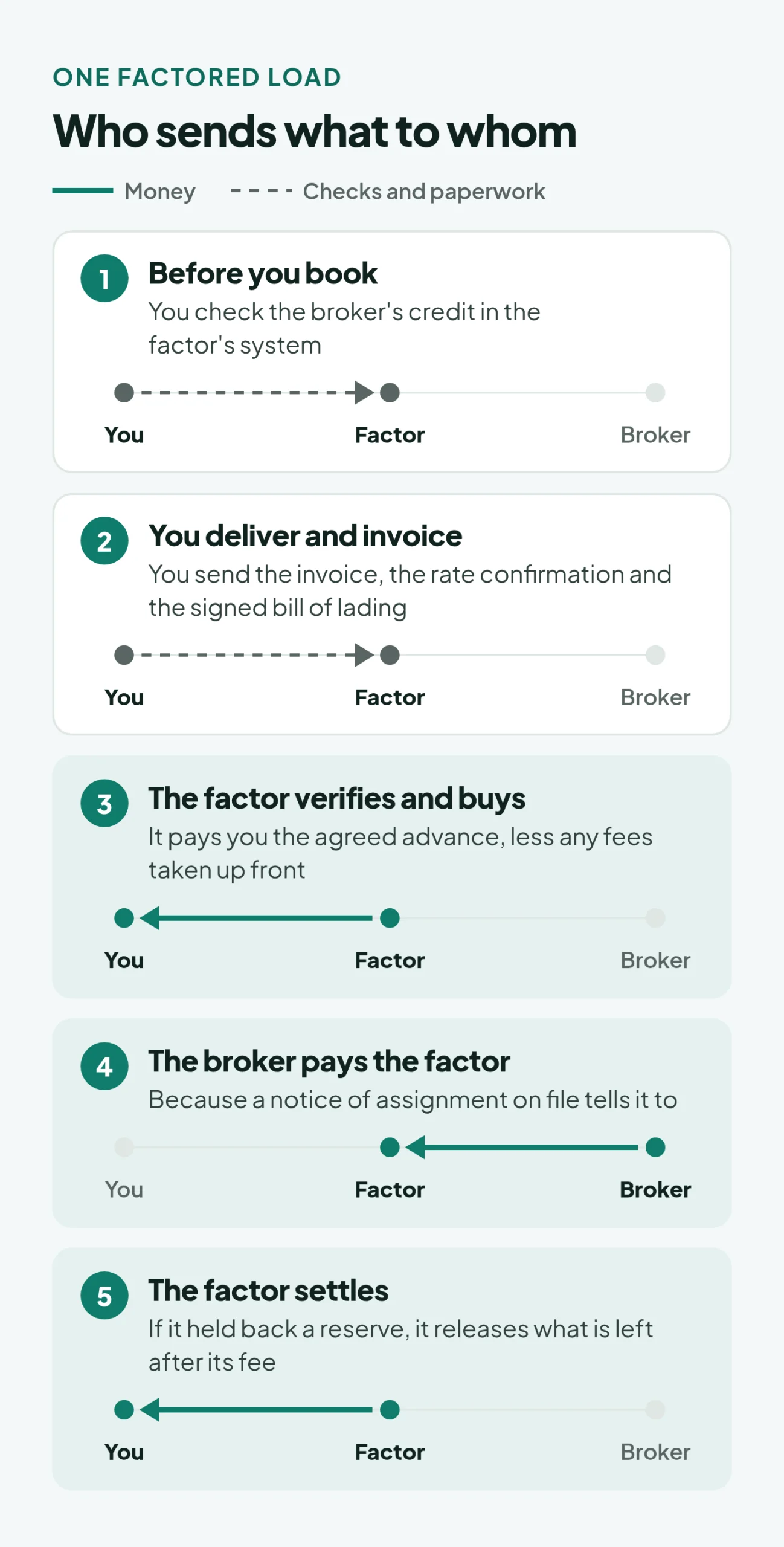
Say you deliver a load for a broker on a $2,500 rate confirmation, on 30-day terms. With a factor:
- Before you book, you check the broker’s credit in the factor’s system. Factors underwrite your customers as well as you. Triumph’s 2025 annual report says account debtors, meaning the brokers and shippers who owe the invoices, are “the substantive underlying credit risk”.
- You deliver and invoice. You send the factor the invoice, the rate confirmation and the signed bill of lading.
- The factor verifies and buys. It pays you the agreed advance, less any fees taken up front.
- The broker pays the factor, because a notice of assignment on file tells it to.
- The factor settles. If it held back a reserve, it releases what is left after its fee.
The same $2,500 invoice can pay out very differently. These are two simple structures at the same 3% fee:
| 97% advance, no reserve | 90% advance, 10% reserve | |
|---|---|---|
| Cash when you submit the invoice | $2,425 | $2,250 |
| Held back | $0 | $250 |
| Fee | $75, taken up front | $75, taken at settlement |
| Cash when the broker pays | $0 | $175 |
| Total you receive | $2,425 | $2,425 |
The total is the same, but the second deal puts $175 less in your hands on day one. Across a month of loads, that is real working capital. Both structures exist: a Triumph agreement filed with the SEC set a 90% advance, while DAT advertises no reserves on its Outgo product.
To open an account, expect to supply your authority and insurance details, a W-9, banking details and your broker setup documents. Application lists differ by factor. Many ask for a certificate of insurance, so sort out your liability and cargo coverage first. Use the same legal name everywhere, because a mismatch stalls funding.
What factoring really costs
The numbers that can be checked
Most rate tables online come from companies selling factoring. Most prices are negotiated privately, and we found no neutral survey. Here is what the public record does show:
| Figure | Source | What it tells you |
|---|---|---|
| About 1.26% of invoice value | Triumph 10-Q, third quarter 2026 | Our calculation: $56.95 million of Factoring segment revenue on $4.503 billion of invoices bought. A blend across all client sizes, including large fleets. |
| 13.82% annualized yield | Same filing | Revenue as a share of the average money Triumph had out. Your fee buys short-term money, so this is the fairer comparison with a loan. |
| $2,210 average transportation invoice | Same filing | Up from $1,690 a year earlier. A percentage fee grows with freight rates: 3% was $51 then and is $66 now. |
| About 35 days to collect | Our estimate from the same filing | $1.72 billion of average Factoring receivables divided by about $49 million of purchases a day. This is why a fee tied to days outstanding matters. |
| “Generally 2% or more“ | DAT, factoring rates page | A vendor’s own general description of the market, seen on 1 November 2026. It publishes no exact Outgo rate on that page. |
| Around 2% to 5% and up | OOIDA’s Land Line, July 2023 | Trade press, not a survey. |
| 1.5% and 2.5% | C.H. Robinson Financial | Estimated rates for its factoring program with Triumph: 1.5% on C.H. Robinson loads and 2.5% on other freight, seen on 1 November 2026. Triumph approves final terms, and some carriers may qualify for less. |
| 2% for quick pay | Same page | What one large broker charges to pay in as little as 2 business days instead of its standard 28. |
Don’t read 1.26% as a price you can get. Triumph’s annual report says its pricing and features “vary by client type”, and a large fleet has far more bargaining power than one truck. The figure is useful for a different reason: it shows that a quote of 4% or 5% is several times what one large factoring book earns on average, and well above the estimated rates in C.H. Robinson’s program, so it is worth asking why.
Turn the fee into a number you can compare
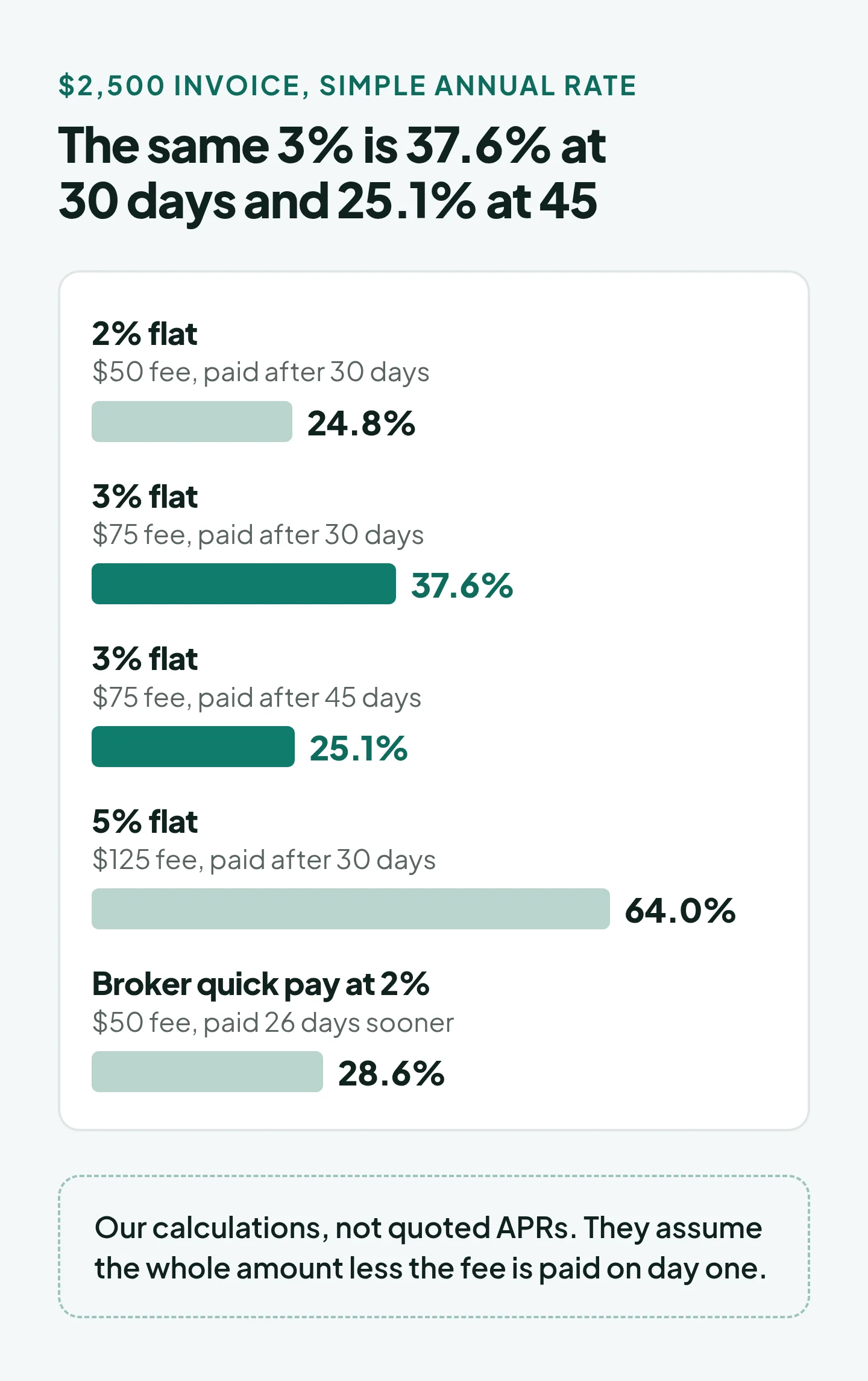
A flat percentage hides time. The same 3% is a very different price depending on how fast your customers pay. To compare it with a loan or a quick-pay offer, divide the fee by the cash you received and scale to a year:
| Deal on a $2,500 invoice | Fee | Paid after | Simple annual rate |
|---|---|---|---|
| 2% flat | $50 | 30 days | 24.8% |
| 3% flat | $75 | 30 days | 37.6% |
| 3% flat | $75 | 45 days | 25.1% |
| 5% flat | $125 | 30 days | 64.0% |
| Broker quick pay at 2%, paid 26 days sooner | $50 | 26 days sooner | 28.6% |
These are our calculations, assuming the whole amount less the fee is paid on day one. They are not quoted APRs. A reserve pushes the true rate higher, because you have the use of less money. The rate falls if your brokers pay slowly, which is why a flat fee suits carriers with slow payers.
Why the lowest headline rate can cost more
Some factors run two meters. In the Triumph agreement above, the client paid a 0.5% factoring fee and a finance rate of prime plus 3.5%. Others step the fee up the longer an invoice stays open. Add per-transfer charges and a low headline can overtake a higher flat rate. Here is an invented example, with seven $2,210 invoices a month ($15,470) that take 35 days to pay:
| Offer A: “1.9%” | Offer B: 3% flat | |
|---|---|---|
| Base fee | 1.9% for the first 30 days | 3% |
| Extra for days 31 to 45 | 0.5% | None |
| Payment charge | $15 per ACH, one per invoice | Free |
| Monthly cost | $371 + $105 = $476 | $464 |
| True cost of each invoice dollar | 3.08% | 3.00% |
Ask for one number: total dollars on a typical month of your invoices, paid at your real days to pay. The fee schedule on that SEC-filed agreement shows what to look for: a $300 setup fee, $18 per wire, $3 per ACH, and an expedited fee of $25 or 1% of the advance, whichever is greater. It dates from 2016 and is not a freight contract, so treat those amounts as an illustration of the fee types, not as current prices.

What it costs a one-truck carrier in a year
Take the 2025 averages from ATRI’s 2026 operational costs report: 85,991 miles a truck and $2.08 a mile paid to contracted owner-operators. That is about $178,900 of revenue if every mile pays that rate. Factoring all of it costs about $3,580 at 2% or $5,370 at 3%, which works out at 4 to 6 cents a mile. ATRI’s truckload respondents averaged a 0.4% operating margin that year. So a factoring fee can be larger than the whole operating margin on average freight. The fee has to go in your cost per mile when you price freight, not come out of what you hoped to keep.
Recourse vs non-recourse
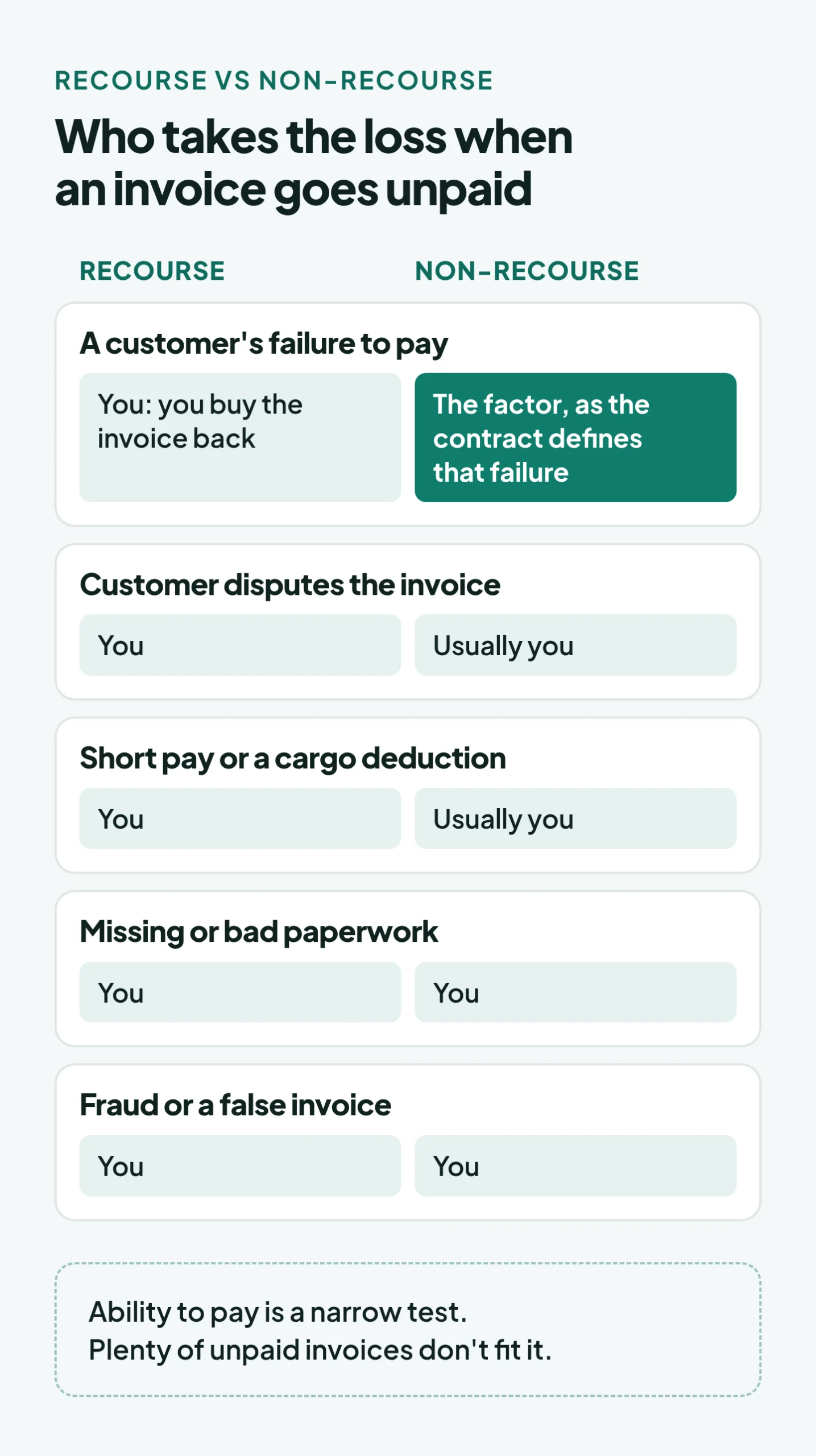
The difference is who takes the loss when an invoice goes unpaid.
| Recourse | Non-recourse | |
|---|---|---|
| Who carries a customer’s failure to pay | You: you buy the invoice back | The factor, as the contract defines that failure |
| Customer disputes the invoice | You | Usually you |
| Short pay or a cargo deduction | You | Usually you |
| Missing or bad paperwork | You | You |
| Fraud or a false invoice | You | You |
| Price | Often lower | Often higher, or lower advance |
Triumph’s annual report gives the cleanest definitions: non-recourse means it keeps “the credit risk associated with the ability of the account debtor” to pay, and recourse means the client agrees to repurchase invoices that aren’t paid. Its smaller owner-operator accounts are typically non-recourse and its larger ones recourse, so a one-truck carrier shouldn’t assume recourse is the only offer.
Now the catch. Ability to pay is a narrow test. DAT, which sells a non-recourse product, says common exclusions include invoices your customer disputes and invoices sent directly to customers. Expect a valid non-recourse claim to look like this: the broker closed down or went bankrupt, the invoice was clean, and the factor had approved that broker first. Plenty of unpaid invoices don’t fit that.
The law points the same way. Under UCC 9-404, a factor who buys your invoice takes it subject to the terms of your deal with the broker, and to claims arising from it. If the broker has a valid cargo claim, it can generally reduce what it pays the factor, unless it agreed to give up that right. The factor then looks to you, and the signed contract decides how. In that Triumph agreement, a disputed invoice could be charged back with Triumph “under no obligation to determine” whether the dispute was genuine.
Pin down these points before you sign:
- How many days until an unpaid invoice is charged back? That Triumph agreement allowed 120. Shorter periods hit your cash faster.
- Does “non-recourse” apply to every approved broker, or only to a list, and only up to a credit limit?
- Does the protection need a bankruptcy filing, or does a broker that has simply stopped paying count?
- How is a chargeback collected: from the reserve, from your next funding, or by a bill?
- What is the fee on a chargeback, and do you get the fee back on an invoice you repurchase?
If a broker does fail on a recourse deal, you repay the factor and then chase the money yourself. Your claim goes against the broker’s $75,000 bond or trust. That single amount has to answer for every claim on that broker, and if payments take it below $75,000 the surety must tell FMCSA (49 CFR 387.307). Before you haul for an unfamiliar name, look up its authority and run it through your factor’s credit check. A decline is useful information even if you don’t factor that load.
Reserves: your money in their hands
A reserve is the part of each invoice the factor keeps back until the customer pays. It is your money, but it isn’t in your account. Triumph’s third-quarter 10-Q shows $379.4 million of customer reserves held against $2.235 billion of factored receivables across the company at 30 September 2026, kept “to settle any payment disputes or collection shortfalls”. Customers can also draw on those balances, so the ratio isn’t an average advance rate.
Check three things. When is reserve money released: per invoice, weekly, or at the factor’s discretion? Can the factor raise the required reserve? Triumph’s agreement allowed that for invoices unlikely to be paid in time. And how long does it stay after you leave? That agreement let Triumph keep the reserve account for 90 days after termination, or until complete termination if later, and it called the account “a non-Deposit Account maintained by Triumph for bookkeeping purposes”. Leave with a large reserve and no signed payout date, and your exit can be a cash crisis of its own.
Contract traps, clause by clause
No federal rule sets these terms, so the contract decides. Here is what to find and what to ask for. The dollar examples come from two agreements in SEC filings: the Triumph agreement above, with a media staffing company (2016, a $4 million line), and Factors Southwest and an ammunition maker (2020). Neither is a small-carrier contract, but the clause types are the ones to look for.

| Clause | How it bites | What to ask for |
|---|---|---|
| All-invoices commitment | You must factor every invoice, so you can’t take a broker’s cheaper quick pay or collect from a fast payer yourself | Spot factoring, or a right to pick loads |
| Monthly minimum | Pay the shortfall in a slow month. Factors Southwest billed any gap to a $15,615 monthly minimum | No minimum, or one that fits your worst month |
| Automatic renewal | Miss the window and you are in for another term. Triumph’s was one year with annual renewals and 30 days’ notice. FreightWaves reports 30 to 60 days as common, and Land Line has seen 120 or more | Month-to-month, or a calendar reminder set well ahead of your contract’s notice deadline |
| Early exit fee | Triumph’s was 5% of the maximum line, not of what you used. On a $100,000 line that is $5,000. Factors Southwest’s was the monthly minimum times the months left, so a $200 minimum with 8 months left would cost $1,600 | A flat, capped fee, or none. A 30-day free-exit window, as Triumph’s agreement had |
| Blanket lien | Triumph’s collateral was “all of Client’s assets”, including equipment and bank accounts, not just invoices | Limit it to accounts and their proceeds |
| Power of attorney | Lets the factor sign and act in your name. Land Line warns broad clauses can reach insurance claims | Limit it to endorsing payments and collecting purchased invoices |
| Misdirected payments | If a broker pays you by mistake, you must turn it over fast: next banking day at Triumph, and cashing it at Factors Southwest cost an extra 10% | Never deposit it. Report it the same day |
| Data access | Land Line reported in 2023 that one factor’s contract required access to all ELD data, including equipment location | Strike it, or limit it to proof of delivery |
| Tax covenants | Triumph’s client promised to be current on all taxes. Factors care because a federal tax lien can cut off their protection on the 46th day after filing, or sooner if they learn of it | Stay current on payroll tax and Form 2290. Expect funding to stop if you don’t |
| Personal guaranty | You can owe the debts of your LLC personally | Limit it to a validity guaranty covering fraud and breach, if you can |
One more trap sits outside the factor’s paperwork. FMCSA’s 2023 broker guidance says a dispatch service that takes compensation for a load from a broker or factoring company, or is involved in that money flow, should get broker authority: that is one of the listed factors. Keep your dispatcher out of the factoring account and pay them yourself.
The UCC lien and leaving cleanly
When you sign, the factor files a UCC-1 financing statement with the state. It is public, and it lasts five years unless ended sooner or continued. It matters because secured parties rank by time of filing or perfection. A new factor will want to be first, and an earlier blanket lien from a merchant cash advance or a lender can block you. Search your own name in your state’s UCC records, usually kept by the secretary of state, before you apply.
To switch without losing a week of funding, work in this order:
- Give written notice inside the contract’s window, in the way the contract requires.
- Get a payoff letter that states what you owe, including any exit fee, and when your reserve will be paid.
- Have the new factor pay off the old one, if that is the deal, and get a letter of release that tells your brokers to stop paying the old factor.
- Send brokers the new notice only once that release exists. Two conflicting notices can freeze your payments.
- Confirm the UCC-3 termination is on file, and keep a copy.
If the factor drags its feet, the UCC gives you tools. For sold accounts, once the customers have paid, a factor must send or file a termination statement within 20 days of your authenticated demand (UCC 9-513(c)). If it doesn’t, you can file one yourself and it must say you authorized it (9-509(d)), and you can claim $500 plus actual damages (9-625(b) and (e)). Check your contract before you count on this. Both SEC-filed agreements held back lien termination until the client signed a general release, and both called that a waiver of the client’s 9-513 rights. Ask to strike that clause. States enact their own versions of the UCC, so check your state’s wording with your attorney.
Notice of assignment
The notice of assignment is why factoring works. Under UCC 9-406(a), a broker can settle its debt by paying you only until it receives notice. After that it must pay the factor, and a broker that pays you anyway risks paying twice.
- A broker can ask for proof. Under 9-406(c), if the broker asks and the factor doesn’t supply reasonable proof of the assignment, the broker may keep paying you.
- A “no factoring” clause usually fails. Under 9-406(d), a term that bars or penalizes assignment is generally ineffective, though the section has exceptions. Read your broker-carrier agreement anyway.
- Notices do get fought over. Triumph’s 10-K describes a $19.4 million receivable after USPS paid a large carrier directly and disputed the notices, citing “purported deficiencies”. It was resolved as part of a $47.5 million settlement in 2025.
Brokers keep their own records too. Under 49 CFR 371.3, each party to a brokered shipment can review the record of that transaction, which includes what the broker collected and when it paid the carrier. That can help in a short-pay dispute, though broker contracts often ask you to waive it. FMCSA proposed changes to this rule in 2024, reopened comments in February 2025, and the Federal Register showed no final rule when we checked on 14 November 2026.
State disclosure laws
The Truth in Lending Act excludes credit for business purposes, so no federal APR disclosure comes with a factoring quote. Some states have stepped in:
- California covers factoring on offers of $500,000 or less (Financial Code 22800). Its rules for factoring example transactions require an estimated APR.
- New York covers factoring and exempts deals over $2.5 million (Financial Services Law 802), measured on the total you may receive under the agreement. The required table shows funding provided, estimated APR, finance charge, payment, estimated term, repurchase costs, collateral and avoidable fees.
Both laws exempt banks (California Financial Code 22801 and New York’s section 802), so a factor that is itself a bank may not have to give you this. Whether either law reaches your deal depends on the facts, and other states have their own commercial financing laws that we have not reviewed here. Ask every factor for a written estimated APR anyway. One that can’t or won’t produce it has told you something.
How to compare factoring companies for trucking
There is no neutral, public ranking of factoring companies for trucking, and we don’t publish one. What you can compare is what each company puts in writing. Ask two or three factors for the full agreement, with every schedule and the fee schedule, not a rate sheet. A quote that names only a percentage tells you little, because the clauses above decide most of the real cost.
- Price the same invoices. Send each factor the same real month of your invoices, with the days your customers actually took to pay. Ask for the total in dollars and an estimated APR, then turn each answer into a yearly rate the same way.
- Read the fee schedule line by line. Add every per-invoice, transfer, credit-check or monthly charge to the percentage. New York’s disclosure table has a separate line for avoidable fees for this reason (23 NYCRR 600.12).
- Find out who you are signing with. Search the company’s legal name in the FDIC’s BankFind Suite. Banks are exempt from California’s and New York’s disclosure rules, so a factor that is itself a bank may not have to give you the state disclosure. Check the legal name on the contract, because the brand you see and the company you sign with can differ.
- Check the lien before it is filed. Search your own name in your state’s UCC records, then ask each factor in writing what its UCC-1 will cover: invoices only, or all your assets.
- Ask how a broker gets checked and paid. Ask how you check a broker’s credit before you book, how the factor verifies an invoice, and what its notice of assignment looks like. Your brokers will see that notice.
Then put the answers side by side. A factor that won’t put one of these in writing has answered the question.
| Compare | Where to look | The better answer |
|---|---|---|
| Total cost | Fee schedule | Lowest dollars on your own invoices, all fees in |
| Fee steps | Fee schedule | A flat fee, or steps you can live with if a broker pays late |
| Advance and reserve | Purchase terms | A small reserve, released on a fixed date |
| Recourse | Definitions, buyback clause | A clear list of what is charged back, and when |
| Volume | Commitment, minimums | Pick your loads, no monthly minimum |
| Term and exit | Term, termination | Short notice, a small capped exit fee or none |
| Collateral | Security interest | Accounts and their proceeds only |
| Guaranty | Guaranty, signature page | A validity guaranty only, if any |
Factoring vs the alternatives
| Option | Good for | Watch out for |
|---|---|---|
| Whole-book factoring | Steady cash on every load, plus collections and credit checks done for you | A fee on every load, plus contract terms |
| Spot or per-load factoring | A cash gap on some loads, with slow payers only | Often a higher rate per invoice |
| Broker quick pay | Occasional use. C.H. Robinson charges 2%; other brokers’ terms vary | Only for that broker. Conflicts with an all-invoices clause or a notice of assignment |
| Cash reserve | The cheapest money. Our trucking startup guide suggests two months of operating costs | Takes time to build |
| Bank line of credit | Established companies with financial statements | Hard to get in year one. It may need a lien on receivables, which clashes with factoring |
| Merchant cash advance | Rarely the right answer | Can bring frequent debits and a lien that blocks a factor |
All of these cover the wait for payment, not the truck itself. Buying or replacing a tractor is a loan or lease decision, which our guide to semi-truck financing walks through.
If you are a broker
Brokers factor too, selling shipper invoices so they can pay carriers before shippers pay them. Triumph’s 10-Q describes buying receivables payable to freight brokers from their shipper clients. If you are starting a brokerage, three things differ from the carrier side.
- You stay on the hook to carriers. A recourse buyback of a shipper invoice doesn’t reduce what you owe the carrier, so one slow shipper can hit you twice.
- You receive notices too. Every factored carrier will send you one. Check it against a known contact before you change bank details, because a fake notice is an easy way to steal a payment. You can demand reasonable proof under 9-406(c).
- Your shippers set the limit. Factors cap exposure to one debtor. Triumph’s 10-K says it limits the receivables it buys from individual debtors. If most of your freight comes from one shipper, ask what the cap is before you rely on it.
Should you factor?
Factoring makes sense when the cash gap would otherwise stop you from taking loads. New carriers often have no credit history, and a bank won’t lend against invoices that don’t exist yet. The fee can be worth paying if it keeps a truck moving.
It makes less sense if your customers pay within two weeks, if you run mostly direct freight with strong shippers, or if your margin can’t absorb another 2% to 3%. And it’s no fix for loads priced below your cost, since it only brings that loss forward.
A sensible way to start is short: choose a contract you can leave on short notice without a fee, keep your reserve small, and renegotiate or drop factoring once you have a clean payment history. Before you sign, ask each factor to answer these in writing:
- What is my total monthly cost in dollars on this sample of my invoices?
- What is the estimated APR at my real days to pay?
- Must I factor every invoice, and is there any monthly minimum?
- What exactly is covered by non-recourse, and when is an invoice charged back?
- How much is held in reserve, and when is it released, including after I leave?
- What does it cost to leave, on what date, with how much notice?
- What collateral does the UCC-1 cover, and how fast will you file the UCC-3?
- Does the owner sign a personal guaranty, and of what?
Facts checked against primary sources on 1 November 2026: Triumph Financial’s Form 10-Q for 30 September 2026 and Form 10-K for 2025, factoring agreements filed with the SEC, the Uniform Commercial Code, 49 CFR Parts 371 and 387, the U.S. Code, the Federal Register, and California and New York statutes and regulations. Pricing from DAT and C.H. Robinson is as shown on their websites that day. Trade press figures are identified in the text. ATRI’s figures were checked against its full 2026 report, which sits behind a free download form. Our own estimates are labeled. Every other figure is checked against the linked source. The status of FMCSA’s broker transparency proposal and the sources in the section on comparing factoring companies were rechecked on 14 November 2026. This page is general information, not legal, tax or financial advice.
Sources
- Land Line: Factoring, beware of the fine print (July 2023)
- California Financial Code 22800
- California Financial Code 22801, exemptions
- ATRI: Analysis of the Operational Costs of Trucking, 2026 update
- C.H. Robinson Financial: factoring, quick pay and standard pay
- DAT: Recourse vs non-recourse factoring
- DAT: Freight factoring rates
- eCFR: 49 CFR 371.3, records kept by brokers
- eCFR: 49 CFR 387.307, property broker surety bond or trust fund
- Federal Register: Definitions of Broker and Bona Fide Agents (16 June 2023)
- Federal Register: Transparency in Property Broker Transactions (20 November 2024)
- FreightWaves: Understanding factoring contracts and spotting the traps (October 2025)
- 10 CCR 913, California factoring disclosures for example transactions
- 23 NYCRR 600.1, definitions
- 23 NYCRR 600.12, factoring disclosure formatting
- UCC 9-322
- UCC 9-404
- UCC 9-406
- UCC 9-509
- UCC 9-513
- UCC 9-515
- UCC 9-625
- 15 U.S.C. 1603, Truth in Lending exempted transactions
- 26 U.S.C. 6323, validity and priority of federal tax liens
- New York Financial Services Law 802
- Triumph Financial Form 10-Q, quarter ended 30 September 2026
- First Amended and Restated Factoring and Security Agreement, Factors Southwest and Ammo, Inc., June 2020 (SEC exhibit)
- Triumph Financial Form 10-K for 2025
- Factoring and Security Agreement, Triumph Business Capital and The Maslow Media Group, 4 November 2016 (SEC exhibit)
- FDIC BankFind Suite
- Transparency in Property Broker Transactions, reopening of comment period, Federal Register, 18 February 2025