This freight class calculator is also a freight density calculator. Enter the length, width, height and weight of one handling unit, such as a pallet, crate or carton, and it returns its cubic feet, its density in pounds per cubic foot (pcf) and its class on the 13-tier NMFC density scale in force since 19 July 2025. That class is right for articles rated on the standard scale. For anything else it is only an estimate, so check the NMFC item. Below: how the scale works, how to measure, and where a density-only answer goes wrong. More tools are in our freight rates and tools hub.
The 2025 density scale
The National Motor Freight Traffic Association (NMFTA) publishes the National Motor Freight Classification (NMFC), the tariff most US less-than-truckload (LTL) carriers use to class freight. Disposition Bulletin 1371 scheduled the Docket 2025-1 changes for publication on 10 May 2025, effective 19 July 2025. Among other changes, the docket moved more than 150 items onto one standard scale, which NMFTA calls its “13-subprovision density scale”:
| Sub | Density (pounds per cubic foot) | Class |
|---|---|---|
| 1 | Less than 1 | 400 |
| 2 | 1 but less than 2 | 300 |
| 3 | 2 but less than 4 | 250 |
| 4 | 4 but less than 6 | 175 |
| 5 | 6 but less than 8 | 125 |
| 6 | 8 but less than 10 | 100 |
| 7 | 10 but less than 12 | 92.5 |
| 8 | 12 but less than 15 | 85 |
| 9 | 15 but less than 22.5 | 70 |
| 10 | 22.5 but less than 30 | 65 |
| 11 | 30 but less than 35 | 60 |
| 12 | 35 but less than 50 | 55 |
| 13 | 50 or greater | 50 |
Each tier starts exactly at its lower number. A unit at 15.0 pcf is class 70, not 85, and a unit at exactly 50 pcf is class 50. Charts that write the ranges as “12–15” and “15–22.5” leave the boundary unclear. The bulletin’s wording (“12 but less than 15”) does not.
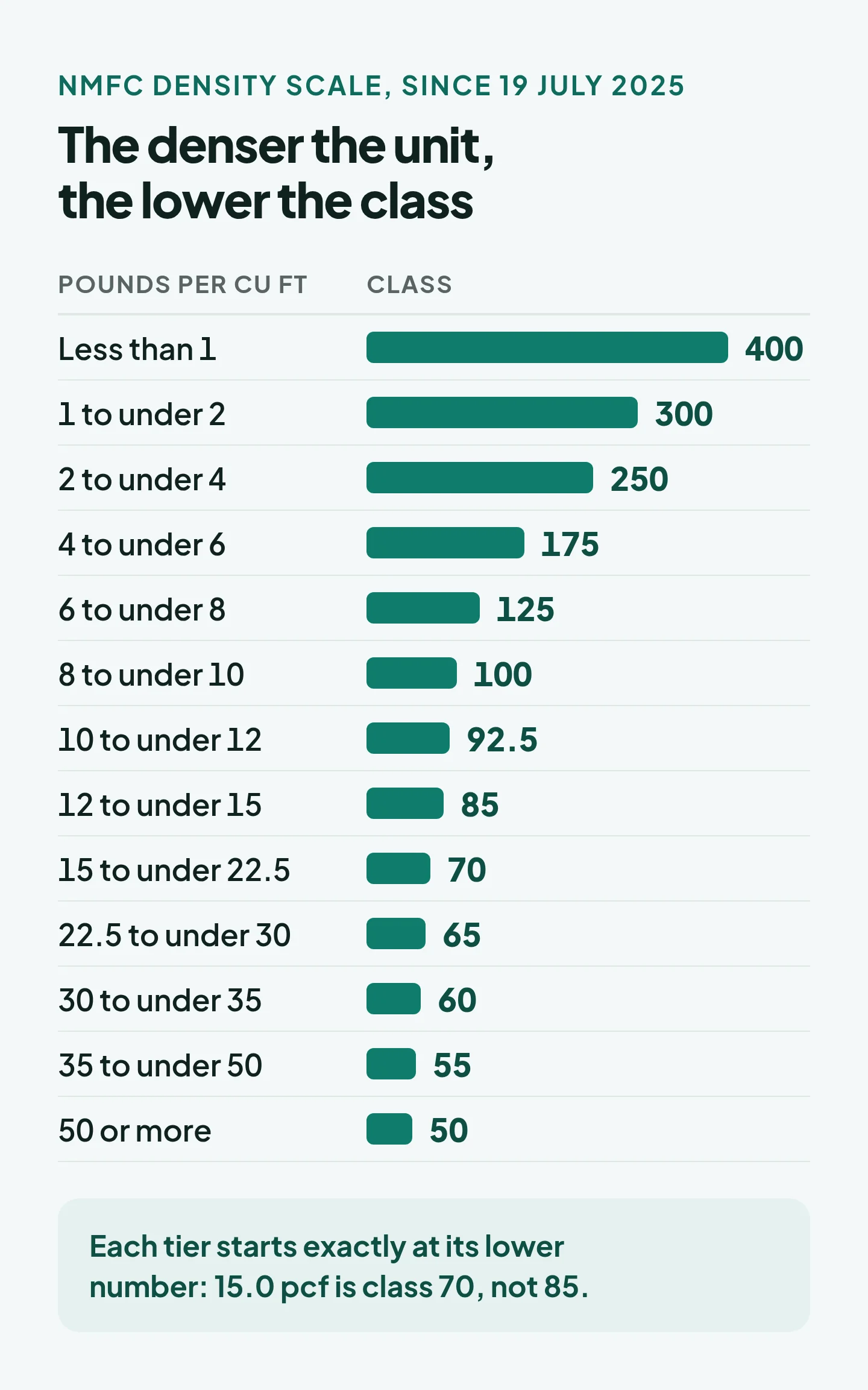
Two things are easy to miss. First, the scale runs from class 50 to class 400. Class 500 is not on it. Second, it is a scale that individual items adopt. An item says it is “subject to Item 170 and having a density in pounds per cubic foot of” and then lists the 13 tiers. Items that have not adopted it keep their own rules, which is why a calculator can only estimate.
How density is worked out
Density is weight divided by volume:
- Multiply length × width × height in inches to get cubic inches.
- Divide by 1,728 (12 × 12 × 12) to get cubic feet.
- Divide the weight in pounds by the cubic feet. The answer is pounds per cubic foot.
- Find that number in the table above.
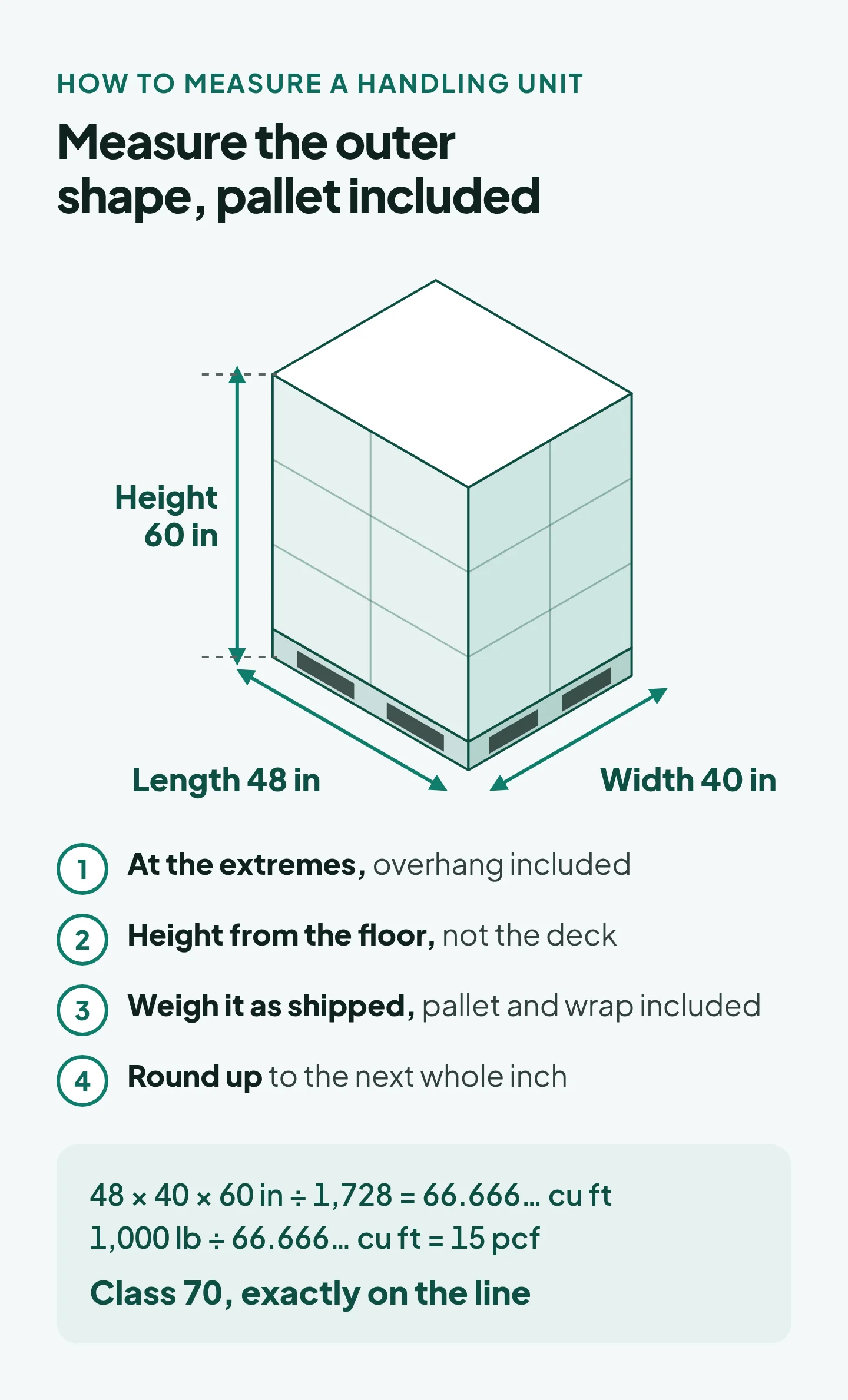
The calculator does the last division as weight × 1,728 ÷ cubic inches rather than dividing by a rounded cubic-feet figure. That matters at the breakpoints. A 48 × 40 × 60 inch pallet is 66.666… cubic feet. At 1,000 lb it is exactly 15 pcf and class 70. Round the cube to 66.67 first and you get 14.9993 pcf and class 85, which is wrong.
How to measure a handling unit
A handling unit is whatever the carrier moves as one piece: a pallet, a crate, a drum or a loose box. NMFTA’s own advice is to measure “down to the inch” and “always include pallets or packaging”. In practice:
- Measure at the extremes. Take each side at its longest point, including pallet overhang, a crooked top layer and anything sticking out. A carrier’s dimensioner sees the outer shape, not the neat box size on your spec sheet.
- Height starts at the floor. The pallet is part of the unit, so measure from the ground, not from the pallet deck.
- Weigh it as shipped. Freight, cartons, stretch wrap, corner boards and the pallet all count.
- Never round down. We could not find an NMFC rule that sets rounding, and NMFTA lists rounding measurements “too generously” among the common shipper mistakes. Rounding each fraction up to the next whole inch gives the cautious figure. The calculator does that by default, and you can untick the box to see the exact result.
Metric dimensions work if you convert them first. Multiply centimetres by 0.3937 to get inches and kilograms by 2.2046 to get pounds.
Pallet density: weight for each class
When freight ships on a pallet, the pallet is part of the handling unit, so its size and weight go into the density. The table below runs the 13 tiers from Bulletin 1371 backwards for one common shape: a 48 × 40 inch footprint stacked 48 inches high from the floor. That unit is 92,160 cubic inches, or 53.33 cubic feet, so each density breakpoint times 53.33 gives the gross weight where the class changes.
| Class | Density (pcf) | Weight of a 48 × 40 × 48 in pallet (lb) |
|---|---|---|
| 400 | Less than 1 | Under 53.3 |
| 300 | 1 but less than 2 | 53.3 to under 106.7 |
| 250 | 2 but less than 4 | 106.7 to under 213.3 |
| 175 | 4 but less than 6 | 213.3 to under 320 |
| 125 | 6 but less than 8 | 320 to under 426.7 |
| 100 | 8 but less than 10 | 426.7 to under 533.3 |
| 92.5 | 10 but less than 12 | 533.3 to under 640 |
| 85 | 12 but less than 15 | 640 to under 800 |
| 70 | 15 but less than 22.5 | 800 to under 1,200 |
| 65 | 22.5 but less than 30 | 1,200 to under 1,600 |
| 60 | 30 but less than 35 | 1,600 to under 1,866.7 |
| 55 | 35 but less than 50 | 1,866.7 to under 2,666.7 |
| 50 | 50 or greater | 2,666.7 or more |
Weights are rounded to one decimal place; the calculator uses the exact figures, so if your pallet is within a pound of a breakpoint, run it in the calculator. The table only holds for that exact size. A taller stack on the same footprint needs more weight for the same class: at 60 inches high the unit is 66.67 cubic feet, so class 70 starts at 1,000 lb, not 800 lb, as in the worked example below. For any other pallet size, enter it in the calculator rather than scaling these numbers by eye. And the same limits apply: if your NMFC item has its own scale, these weights do not decide its class.
Worked examples
The calculator is tested against every row below before it goes live. Each one can be checked by hand with the steps above.
| Handling unit | Cubic feet | Density (pcf) | Class |
|---|---|---|---|
| 48 × 40 × 45 in, 450 lb | 50.00 | 9.00 | 100 |
| 48 × 40 × 60 in, 1,000 lb | 66.67 | 15.00 | 70 (on the line) |
| 48 × 48 × 48 in, 128 lb | 64.00 | 2.00 | 250 (on the line) |
| 48 × 40 × 36 in, 1,399 lb | 40.00 | 34.98 | 60 |
| 48 × 40 × 36 in, 2,000 lb | 40.00 | 50.00 | 50 (on the line) |
| 12 × 12 × 12 in carton, 0.9 lb | 1.00 | 0.90 | 400 |
| 120 × 100 × 150 cm, 300 kg, exact | 63.57 | 10.40 | 92.5 |
| Same unit, sides rounded up to 48 × 40 × 60 in | 66.67 | 9.92 | 100 |
The last two rows are the same pallet. Converted exactly, 120 × 100 × 150 cm is 47.24 × 39.37 × 59.06 inches, which gives 10.40 pcf and class 92.5. Round each side up to the next inch and the cube grows by almost 5%, density drops to 9.92 and the class goes up to 100. Rounding alone moved it one class. If your freight sits just above a breakpoint, measure carefully and expect the carrier’s figure, not yours, to count.
The two 48 × 40 × 36 inch pallets show how sharp the steps are. One more pound on the 1,399 lb pallet takes it to 35.0 pcf and class 55. One pound less on the 2,000 lb pallet takes it to 49.98 pcf and also class 55.
Several pallets on one bill of lading
Density belongs to each handling unit, not to the whole shipment. NMFC Item 110, Sec. 8(d) reads, as quoted in NMFTA’s Docket 2026-2 file:
“Unless otherwise provided, where a shipment consists of multiple handling units the density shall be calculated on each handling unit, except that where shipping papers show only a total weight for all handling units tendered the density may be calculated by using the total weight and the total cube.”
So the way you write the bill of lading changes the answer. Take two pallets of the same article:
| Unit | Size and weight | Cubic feet | Density (pcf) | Class |
|---|---|---|---|---|
| Pallet A | 48 × 40 × 48 in, 600 lb | 53.33 | 11.25 | 92.5 |
| Pallet B | 48 × 40 × 30 in, 900 lb | 33.33 | 27.00 | 65 |
| Both, total weight only | 1,500 lb | 86.67 | 17.31 | 70 |
With each pallet’s weight and size on the bill, A is rated at 92.5 and B at 65. With only the 1,500 lb total, the carrier may class the whole shipment at 70. Run the calculator once for each different unit. The quantity box is only for identical units: ten identical pallets have the same density as one, so they get the same class.
Docket 2026-2 proposed changing this rule so carriers would class each unit separately even when only a total weight is shown, as long as they could identify each unit’s weight and size. Disposition Bulletin 1374 (9 October 2026) lists that subject as disapproved, so the wording above still stands.
When density does not decide the class
A density calculator answers one question: where does this unit fall on the standard scale? These are the cases where that is not the class you will be billed at.
Items with their own scale
Many NMFC items still set their own breakpoints, and those can use classes that are not on the 13-tier scale. Item 120700 (conveyors, elevators or lifts, NOI), which Docket 2026-1 extended to building-attached elevator parts from 23 May 2026, has four bands by greatest dimension, each with its own four-step density scale. A unit longer than 288 inches at under 8 pcf is class 300, while one no longer than 96 inches at 30 pcf or more is class 55. Classes 200, 110 and 77.5 also appear in that item. From 12 December 2026, Docket 2026-2 gives railings (Item 35255) one five-step scale for boxes or crates and another for other packaging, with classes from 60 to 300.
Items marked for handling, stowability or liability
Docket 2025-1 also marked about 200 items with NMFTA’s hand symbol. According to Bulletin 1371, the symbol means “class assignments predicated on unusual or significant handling, stowability, and/or liability considerations”. Fragile, awkward or high-value freight can carry a class that density alone would never predict.
Mixed pallets
When differently classed articles share one pallet or package, Item 640, Sec. 3(a) charges the whole unit at the class of the highest-classed article on it. The bill must name that article and add “and other articles classed the same or lower”, which can be shortened to “RS or L”. Sec. 3(b) lets separately packaged articles on a pallet be rated on their own weights, but only if, among other conditions, the bill and a packing slip give each article’s weight. NMFTA’s classification panel, the FCDC, has turned down rewrites of Item 640 twice: in Docket 2026-1 (Bulletin 1373, Subject 1) and in the Docket 2026-2 subject described above.
Finding your item number
The class that binds you comes from the NMFC item that describes your commodity, not from the calculator. NMFTA sells access to the classification through its ClassIT+ service. If you ship the same products often, look up each one once and record the item number and sub-provision on your product master and bill of lading. Then use the calculator to confirm which density tier each unit falls in.
What a wrong class costs
LTL base rates rise with class, so a class that is too low saves money only until the carrier checks. Carriers weigh and measure freight at their terminals. When the figures differ from your bill, they correct the class and weight and re-bill you, and many charge a fee as well. FedEx Freight’s US surcharge quicksheet, for example, lists a weight (reweigh) and freight (inspection) validation charge of $40 per shipment under Item 981 of its 100 Series Rules Tariff, with rates effective 5 January 2026. The full conditions are in the tariff itself.
Other carriers set their own amounts and thresholds in their rules tariffs, and these change most years. The base rate isn’t the whole bill either: LTL carriers commonly add a fuel surcharge as a percentage of linehaul, which our fuel surcharge calculator works out. The fee is usually the smaller cost. The bigger one is having the whole shipment re-rated at a higher class. If you are a broker quoting LTL for shippers, a reclass is often a margin you have to absorb or explain. That is one more reason to get the shipper’s dimensions in writing when you start out as a freight broker.
Before you book
- Find the NMFC item for each commodity and check that it uses the standard 13-tier scale. If it doesn’t, use the item’s own scale.
- Measure each handling unit at its extremes, from the floor, pallet included, and round up to the inch.
- Weigh each unit as it will ship.
- Write each unit’s weight and dimensions on the bill of lading, not just a total, unless you have checked that combining them helps.
- Keep a photo of each unit with a tape measure in shot. It is the quickest evidence if you dispute a reclass.
If you haul the freight yourself, the same habits apply once you set up your own trucking company and start taking LTL loads. Brokers and for-hire interstate carriers generally need operating authority first, and our guide to getting an MC number covers that step. For-hire carriers also need the liability cover explained in our guide to trucking liability insurance.
Freight density questions
Is freight density the same as freight class?
No. Density is a measurement: pounds per cubic foot of one handling unit. Class is the rating the NMFC item gives that unit. For items on the standard 13-tier scale, density alone sets the class. For items with their own scale, or items marked for handling, stowability or liability, the class can differ (see when density does not decide the class).
Does the pallet count in the weight and size?
Yes. NMFTA’s guidance is to “always include pallets or packaging”. Measure the height from the floor, not the pallet deck, and weigh the unit with the pallet, wrap and corner boards on it. Forgetting the pallet or packaging height is one of the common shipper mistakes NMFTA lists: it shrinks the cube, overstates the density and can put the unit in too low a class. A carrier’s dimensioner measures the unit as it stands, pallet included.
What density gets class 70 or lower?
On the standard scale, class 70 starts at 15 pcf, class 65 at 22.5 pcf, class 60 at 30 pcf, class 55 at 35 pcf and class 50 at 50 pcf, each from Bulletin 1371. Below 15 pcf the class rises in steps up to 400 for freight under 1 pcf.
Can I add up several pallets and calculate one density?
Only in one case. Item 110, Sec. 8(d) calculates density on each handling unit, unless the shipping papers show only a total weight, in which case the carrier may use total weight and total cube. The two-pallet example above shows how that can change the class.
Scale updates since 2025
The NMFC changes through public dockets. As of 31 October 2026:
- Docket 2025-1, effective 19 July 2025, brought in the 13-tier scale shown above.
- Docket 2026-1, effective 23 May 2026, moved more items onto the scale (springs, in new Item 177850) and folded others into existing items, such as elevator parts into Item 120700. It did not change the scale itself.
- Docket 2026-2 was heard on 29 September 2026. Bulletin 1374 schedules it for publication on 12 November 2026, effective 12 December 2026. It puts more articles on the same scale, for example by folding the China Group items into Item 47500 (ceramicware and china) and building woodwork into new Item 37620, and leaves Items 110 and 640 unchanged.
The breakpoints and classes in this calculator are the same in all three bulletins. We re-check them against each new NMFTA bulletin and update this page if they change.
This page is general information, not legal, tax or financial advice, and the class you are billed at is set by the carrier’s tariff. We check every rule and figure against the sources linked above. Facts checked against primary sources on 31 October 2026.
Formulas and sources
- Length used: NMFTA: Decoding density (measure to the inch, include pallets)
- Width used: NMFTA: Decoding density (measure to the inch, include pallets)
- Height used: NMFTA: Decoding density (measure to the inch, include pallets)
- Cubic inches per unit: NMFTA: Decoding density (measure to the inch, include pallets)
- Cubic feet per unit: NMFTA: Decoding density (measure to the inch, include pallets)
- Total cubic feet: NMFTA Docket 2026-2, Subject 1: present text of Item 110, Sec. 8(d)
- Total weight: NMFTA Docket 2026-2, Subject 1: present text of Item 110, Sec. 8(d)
- Density per handling unit: NMFTA Docket 2026-2, Subject 1: present text of Item 110, Sec. 8(d)
- Class on the 13-tier density scale: NMFTA Disposition Bulletin 1371, Docket 2025-1 (13-subprovision density scale)