You do not need freight broker training to get broker authority. This guide, part of our careers and training hub, shows who should pay for it. FMCSA sets no required course or exam, and no certificate replaces registration or the $75,000 bond or trust. But that is not the whole answer. A 2012 federal law says every broker must employ an officer with three years of relevant experience or proof of knowledge of the rules and industry practices, and FMCSA plans to write that into a rule. For most beginners, the best training is a paid job at a brokerage. A course makes sense in narrower cases, and full online courses we priced run from about $600 to $2,700.
This is general information, not legal, tax or financial advice. Check prices and terms with each provider, and your own situation with FMCSA and a qualified professional.
The short version
- Is training legally required today? No course is. The live question is the experience-or-knowledge duty in federal law, which FMCSA has not yet turned into a rule.
- Cheapest good route: an entry-level job at a brokerage. You are paid to learn, and the time may count as experience.
- When a course fits: you can’t take a brokerage job, or you want a structured overview before you commit money to your own authority.
- What to pay: published prices we checked run from $49 for a two-hour intro to $2,700 for a 100-hour online course.
- Best single test of a course: ask how it teaches Motus and the January 2026 bond rule. An outdated course fails here.
- Biggest red flag: “FMCSA-approved”, “license included” or a guaranteed job.
What federal law requires
“Training is not required” is true of courses, but it skips the part that may matter most to anyone planning their own authority.
49 U.S.C. 13904 covers broker registration. Subsection (a) says the Secretary shall register a person who “has sufficient experience to qualify the person to act as a broker”. Subsection (c), headed “Experience or Training Requirements”, says:
Each broker shall employ, as an officer, an individual who (1) has at least 3 years of relevant experience; or (2) provides the Secretary with satisfactory evidence of the individual’s knowledge of related rules, regulations, and industry practices.
Congress added this in 2012, in the MAP-21 highway law. FMCSA has not yet written a rule to carry it out. Neither Part 365 (how to apply) nor Part 371 (broker rules) mentions it, and the April 2026 Motus notice describes identity and business checks, not experience. We could not see inside the live Motus application, so we can’t say what, if anything, it asks.
That may change. Here is the record as of 14 November 2026:
- June 2023: the Transportation Intermediaries Association (TIA), the brokers’ trade group, petitioned FMCSA to enforce the provision. It suggested applicants show either relevant experience or a 30-to-90-hour course from an accredited school. TIA sells broker courses itself, so read that with its interest in mind. Land Line reported FMCSA’s grant letter of 11 March 2024. We have not seen the letter.
- Congress: Section 5006 of the House BUILD America 250 Act (H.R. 8870), as introduced, would order a final rule within two years of becoming law. The House Transportation and Infrastructure Committee voted 62-2 on 22 May 2026 to report an amended version, whose text we have not seen. That vote is still the latest action on record on 14 November 2026, and the bill is not law.
- Regulatory agenda: the current edition on reginfo.gov, which it labels 2026 and which Land Line called recently released in July 2026, lists “Standards for Broker and Freight Forwarder Qualifications/Knowledge” (RIN 2126-AD02) for the first time, at the proposed-rule stage, with a target of September 2026.
- Federal Register: that target passed. Searches on 1 and 14 November 2026 found no proposal under that number or title. So nothing is yet proposed, and no new duty has been added.
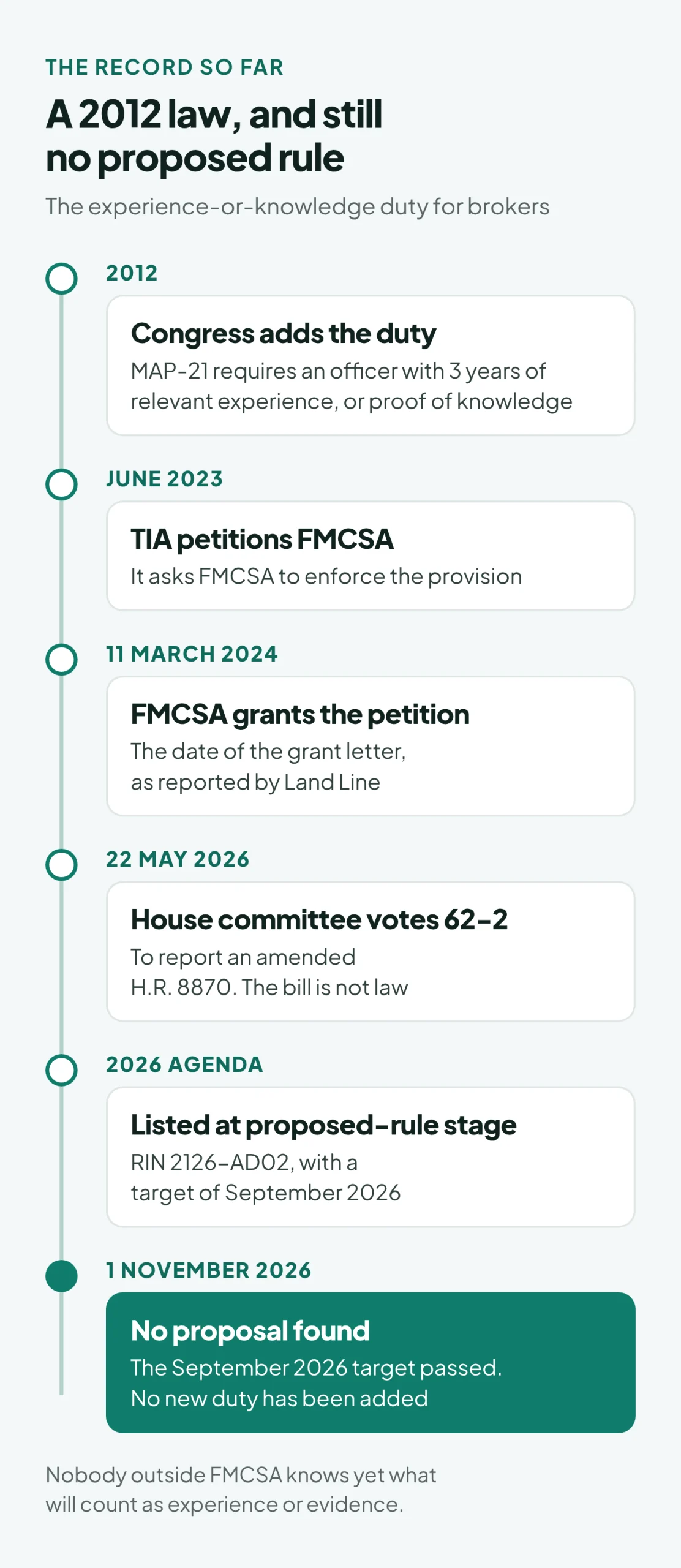
What this means for you. Nobody outside FMCSA knows yet what will count as “relevant experience” or “satisfactory evidence”, how a one-person company will meet an “officer” test, or whether brokers already registered will be affected. Don’t believe a course that claims to satisfy the coming rule. There is no rule to satisfy. If you plan to run your own brokerage, keep proof of what you do: job titles, dates, employer letters and course certificates. The law’s first option rewards experience, and a job is the plain way to build it. A certificate could at best support the second option, and that is our reading, not FMCSA’s.
Which route fits you
The Bureau of Labor Statistics classes cargo and freight agents, its nearest occupation, as needing a high school diploma, no prior work experience and short-term on-the-job training. In other words, employers are expected to do the teaching. Start there, then adjust for your situation.
| Your situation | Best first move | Out-of-pocket cost |
|---|---|---|
| No freight background, want a career | Apply for entry-level sales or carrier roles at brokerages | None; you are paid |
| Curious, not sure this is for you | The free reading list below, or a short intro class | $0 to about $50 |
| Can’t relocate or work a brokerage job | A structured online course, then apply for jobs or agent roles | About $600 to $2,700 |
| Have shipper contacts and want to be an agent | Ask the brokerage what training it gives before you buy any | Ask the brokerage |
| Leaving a brokerage to start your own firm | Skip the basics. Spend on a transportation attorney and start-up planning. Consider a new-brokerage course | Varies; TIA’s package is $1,700 |
| Already working in brokerage, want a credential | TIA’s Certified Transportation Broker program | Fee not confirmed; ask TIA |
The job route
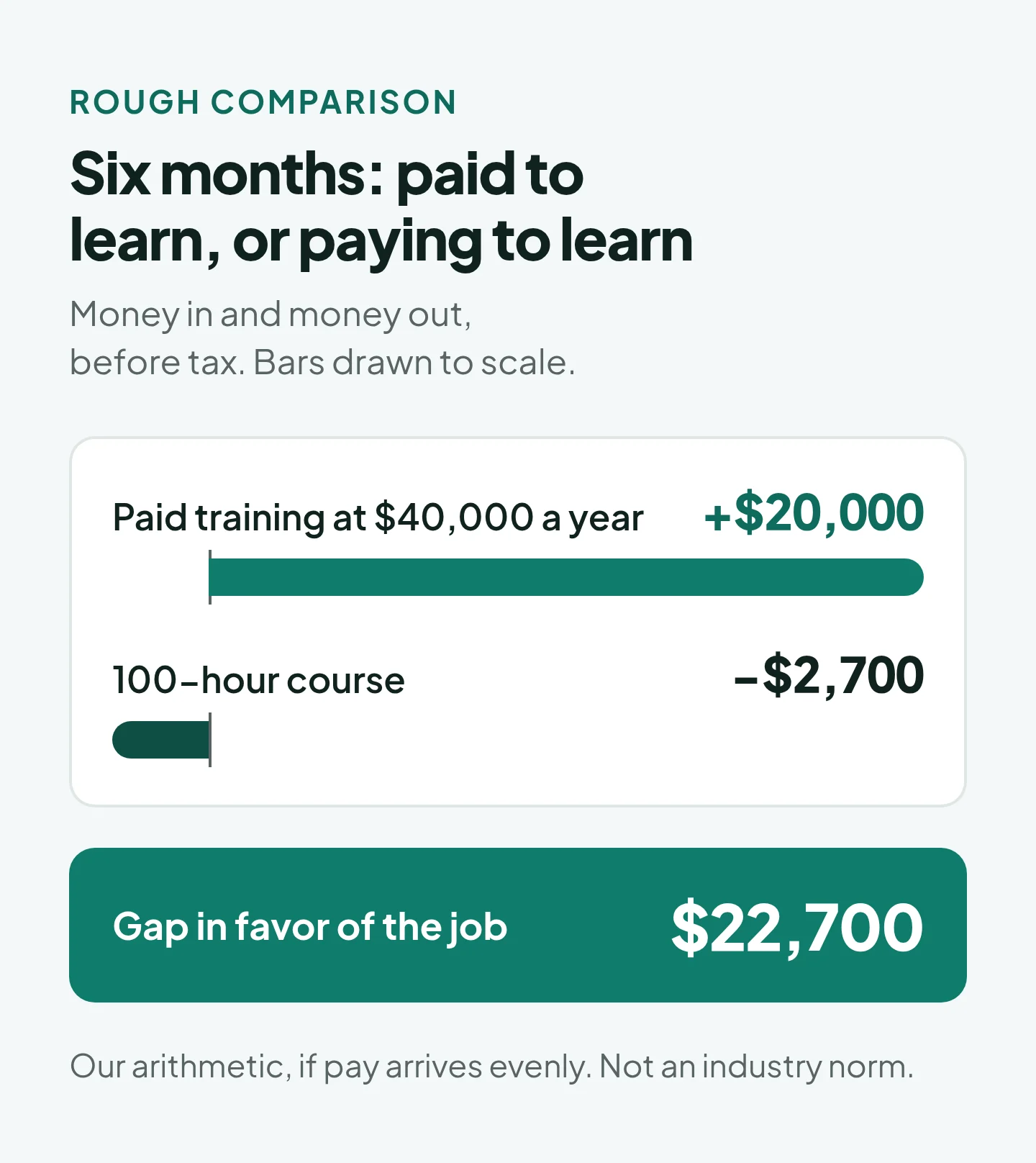
Two published examples, both checked on 1 November 2026. A TQL entry-level sales posting says “No experience necessary”, offers six months of direct training, and states $40,000 to $50,000 minimum first-year pay based on education. Schneider’s careers site says its freight brokers take a two-week in-person course and are paired with an experienced mentor. These are each company’s own statements, not industry norms, and we are not recommending either employer.
A rough comparison. Take a 100-hour course listed at $2,700 and self-paced over six months. Now take six months in a paid training program at the bottom of that posted range. If pay arrives evenly, $40,000 a year is about $20,000 for six months. The gap is roughly $22,700, before tax, in favor of the job, and the job also gives you live freight, real carriers and a reference. That arithmetic is ours, and it ignores anything you might earn elsewhere while you study. The posted job is in-office sales with cold calling, which is the point: you find out quickly whether you like it.
Read the employment paperwork before you sign, especially any non-compete or non-solicitation terms. They can limit what you do if you later leave to start your own firm or become an agent. To see what the role involves day to day, read how freight brokers work and get paid, and what brokers and agents earn before you weigh a course against a salary.
What freight broker training costs
We found no public outcome data for any course, and several providers publish no price. These are listed prices we could verify on the provider’s own page, or a partner’s, on 1 November 2026. It is a sample of what is public, not a ranking.
| Course | Listed price | Format and length | Note |
|---|---|---|---|
| Community College of Beaver County, Freight Broker 101-Introduction | $49 | 2-hour evening class on campus in Monaca, PA, 17 November 2026 | An introduction only |
| Freight 360, Freight Broker Basics | $749, or $599 with a DAT coupon | Online, one-year access | Freight 360’s own page confirms the $749. The coupon and coaching prices are from DAT’s page, which promotes the course. Group coaching is $349 a month extra, with one free month through DAT; 1-on-1 is $999 a month |
| McHenry County College | $999 | Format and hours not listed | Ask the format, hours and what is included |
| TIA New Broker Success Package | $1,700 | 8 weeks’ access, 8 weekly live coaching sessions, final exam | Includes TIA membership and a certificate of completion. For people launching a brokerage |
| Fayetteville Technical Community College | $2,100 | Online, delivered by Ed2Go | Listing says approved for WIOA funding through NCWorks |
| Wake Tech | $2,180 | 100 contact hours, online | The fall section we saw was canceled, so check for new dates |
| Rutgers (linked above) | $2,700 | 100 hours, self-paced over 6 months, delivered by Ed2Go | Materials included |
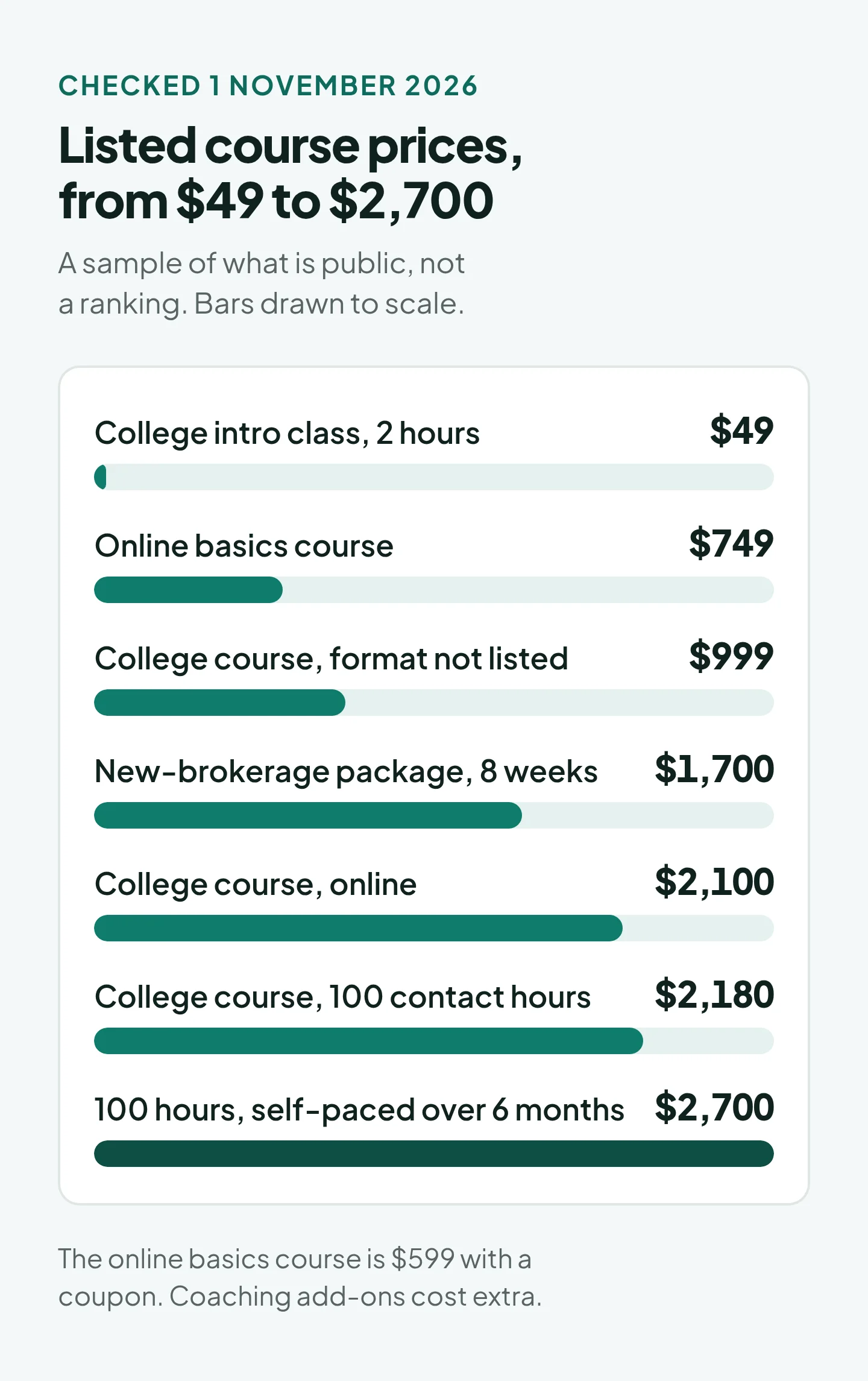
Two lessons from that table. First, price says little about content: the Fayetteville and Rutgers listings use the same delivery partner and differ by $600, so before you buy, ask whether a cheaper college resells the same course. Second, coaching add-ons can pass the course price fast: at $349 a month, group coaching passes the price of a $749 course in the third paid month. Add them to the total before you compare. We could not confirm current tuition for some private schools that rank for this keyword, because their prices are not on an open page. Ask for the full price in writing, including fees and materials. Truck dispatcher courses are a separate market with a different job at the end; our guide to becoming a truck dispatcher looks at what they cost and teach.
What a good course teaches
A course worth paying for should do more than walk you through the application. Use this as a checklist against the syllabus.
- Current registration. Motus, identity proofing and Login.gov, not just the old OP-1 and URS. Our step-by-step guide to getting broker authority shows what current looks like, free.
- The bond rule in force since 16 January 2026. Why a claim can suspend your authority within days, and how the $75,000 BMC-84 bond differs from the trust option.
- Live legal questions. The 2024 transparency proposal, and FMCSA’s 2023 guidance on bona fide agents and dispatchers.
- Sales. How to find and win shippers. Knowing the rules doesn’t bring in freight, and a course that skips this has skipped the job.
- Carrier vetting and fraud. Authority and insurance checks, identity theft and double brokering, in practice.
- Pricing and negotiation. How to read a lane, set a margin and quote without losing money. LTL work also needs density basics, which you can try with a freight class calculator.
- Contracts and claims. Broker-carrier and shipper agreements, and who pays when cargo is lost.
- Cash flow. Paying carriers before shippers pay you, credit checks and factoring.

How to check a provider before you pay
The FTC’s guide to choosing a vocational school or certificate program applies here. It says to ask employers what training would help. Call two brokerages near you and ask whether they value a given course at all. Then:
- Ask who teaches, and check them. Which brokerage did they run or work for, and when? Look the company up with an MC number lookup. A broker who stopped brokering a decade ago may not know Motus.
- Ask when the course was last revised, and ask for the Motus lesson. Listing pages can lag: one college page we checked still lists Internet Explorer 7 and Adobe Flash as requirements. That may be a stale page, not a stale course, so ask to see a sample.
- Ask for numbers. What share finish? How many graduates work in brokerage, and at what pay? The FTC suggests these questions. If the provider has no figures, treat that as no evidence.
- Check the license. The FTC says most states require career colleges and technical schools to be licensed or certified. Ask which state agency covers the school, and check for complaints with that agency and the attorney general in the state where the school is based.
- Get the refund terms in writing, including whether you can cancel within a few days. The FTC says not to enroll if a school won’t let you review its documents.
- Price the whole thing. Course, coaching, software, membership and any upsell after enrollment.
Red flags
- “FMCSA-approved” or “FMCSA-certified”. We found no such approval for broker courses in the rules. Ask for the document.
- “Get licensed in our course.” Only FMCSA grants authority, and only after your application, bond and BOC-3. A course can’t bypass that.
- “Meets the new FMCSA experience rule.” As of 14 November 2026, there is no such rule.
- A guaranteed job. In the FTC’s words: “No school can guarantee you a job when you graduate.”
- Income promises and countdown pricing. The FTC lists pay claims among common problems, warns that recruiters may be paid by enrollment, and tells you to ask whether a recruiter is rushing you.
What “freight broker certification” means
There is no federal freight broker certification. FMCSA registers brokerage businesses; it does not certify individual brokers, set a broker exam or approve broker courses. When an ad says “get certified”, it means one of the things in the table below, and only one of them is required.
| What gets called certification | Who issues it | What it shows | Required? |
|---|---|---|---|
| Broker authority (an MC number) | FMCSA | The business is registered and has its $75,000 bond or trust | Yes, to broker under your own name |
| Course certificate of completion | The school or course seller | You finished that course | No |
| Certified Transportation Broker (CTB) | TIA, a trade group | You passed TIA’s course and final exam | No |
| TIA New Broker certification | TIA | You finished TIA’s new-broker package | No |
Broker authority is a registration of the business, not proof that anyone was trained. An employee of a brokerage works under the company’s authority and needs none of their own.
What a course certificate does. It shows you took a course. It is not a license, and no federal rule gives it any status today. We checked again on 14 November 2026: Part 365 and Part 371 of the eCFR (current through 12 November 2026) still contain no training, exam or experience test for brokers, and the Federal Register showed no proposal under RIN 2126-AD02. In practice a certificate does three things. It gives an employer something to look at on a resume, though the entry-level posting above asks for no experience at all. It is a record of study you can keep. And if FMCSA one day accepts “satisfactory evidence of the individual’s knowledge” under 49 U.S.C. 13904(c) (read 14 November 2026), a certificate might count. Nobody knows yet whether it will, or which courses, so don’t pay extra for a course because it promises that.
TIA runs the Certified Transportation Broker (CTB) program. Its certification page (read 14 November 2026) calls it “the highest broker certification that exists in the industry”, which is the seller’s description, and lists a CTB term running from 17 August to 5 December 2026. TIA’s Trimester 1 2026 syllabus sets out a 16-week online course of 180 clock hours, a prerequisite test (21 of 30 correct, two attempts) and a three-section final exam. TIA pitches it at transportation and brokerage professionals, so it isn’t a sensible first step. We could not confirm the current fee: ask TIA, and ask your employer to pay.
How to pay less, or nothing
- Your employer. If you have a logistics job, ask for tuition help first.
- WIOA funding. Workforce programs fund some freight broker courses. Approval depends on the program and place; the Fayetteville listing above is one example. Ask your local American Job Center before you enroll.
- GI Bill. TIA said in July 2024 that its CTB and New Broker courses were approved for GI Bill funds. Confirm that for your course with the VA comparison tool. Don’t assume a college listing qualifies.
- Federal student aid. Don’t assume it applies to a non-credit course. Ask the school in writing.
A free reading list to start with
Read these first, whichever route you choose. If they bore you, you have saved yourself a course fee.
- 49 CFR 371.3: the records a broker must keep for each load, and who can ask to see them.
- 49 CFR 371.7: why you must never present your business as a carrier.
- 49 CFR 387.307 and the 2023 final rule explaining it: the bond or trust, and what happens when it is drawn down.
- 49 U.S.C. 14706: the law on carrier liability for cargo, and the starting point for reading a cargo claim.
That covers the legal skeleton. It won’t teach you to sell or to negotiate, and neither will reading more. That is why a job, or a good live course, teaches what self-study can’t.
Common questions
Do I need a certificate to work as a freight broker?
No. Employers set their own hiring standards, and an employee works under the company’s authority. An entry-level posting may not ask for one at all.
Is there a freight broker certification exam?
Not a federal one. Getting broker authority takes an application, the $75,000 bond or trust and a BOC-3 filing, with no test. The exams that exist are private: TIA’s CTB ends in a three-section final exam. Neither it nor any course certificate is needed to work in brokerage or to register a brokerage.
How long does training take?
In the listings above, anything from two hours to six months. Employer training we saw ran from two weeks of classes plus mentoring to six months. Neither makes you proficient by itself. That comes from handling live freight.
Is an online course as good as in-person?
For rules and paperwork, usually. For sales and negotiation, you need practice with feedback, so look for live coaching, role-play or a mentor. We found no public outcome data comparing the two.
Does a freight agent need training?
No federal rule requires it. A brokerage may train you, or may expect you to bring freight and know the work already. Ask before you sign, and read the agent agreement closely.
Is freight broker training worth it?
It is worth it if it gets you something a paid job can’t: a route in where no brokerage is hiring, or a structured launch plan when you already have customers. If you have neither need, keep the money. That cash may do more for you as working capital.
Facts checked against primary sources on 1 November 2026; the federal law, the eCFR, the rulemaking record, the status of H.R. 8870 and TIA’s certification page were rechecked on 14 November 2026. Sources: the U.S. Code, the eCFR (Title 49, Parts 365, 371 and 387), the Federal Register, the Unified Agenda at reginfo.gov, the Bureau of Labor Statistics, the FTC, and each provider’s own page or, for Freight 360’s coupon and coaching prices, DAT’s. The status of H.R. 8870 comes from Congress.gov data, and its text from govinfo.gov. The grant of TIA’s petition rests on trade press, and is marked as such above. Every figure is checked against the linked source. This page is general information, not legal, tax or financial advice.
Sources
- U.S. Code: 49 U.S.C. 13904, registration of brokers
- Unified Agenda (2026 edition): RIN 2126-AD02, Standards for Broker and Freight Forwarder Qualifications/Knowledge
- eCFR: 49 CFR Part 365, rules governing applications for operating authority
- eCFR: 49 CFR Part 371, brokers of property
- eCFR: 49 CFR 371.3, records to be kept by brokers
- eCFR: 49 CFR 371.7, misrepresentation
- eCFR: 49 CFR 387.307, property broker surety bond or trust fund
- U.S. Code: 49 U.S.C. 14706, liability of carriers under receipts and bills of lading
- Federal Register: Availability of Motus, FMCSA's New Registration System (29 April 2026)
- Federal Register: Broker and Freight Forwarder Financial Responsibility, final rule (16 November 2023)
- Federal Register: Transparency in Property Broker Transactions, proposed rule (20 November 2024)
- Federal Register: Definitions of Broker and Bona Fide Agents, final guidance (16 June 2023)
- BLS: Education and training assignments by detailed occupation
- FTC: Choosing a Vocational School or Certificate Program
- TIA: New Broker Success Package info sheet
- TIA: Certified Transportation Broker syllabus, Trimester 1 2026
- TIA: Certification Courses (read 14 November 2026)
- TIA: course catalog now accepting GI Bill funds (July 2024)
- VA: GI Bill Comparison Tool
- TQL: entry-level sales representative posting
- Schneider: how to become a freight broker
- DAT: Freight 360 course and coaching prices
- Community College of Beaver County: Freight Broker 101-Introduction
- McHenry County College: Freight Broker/Agent Training
- Fayetteville Technical Community College: Freight Broker/Agent Training
- Wake Tech: course offerings
- Rutgers: Freight Broker/Agent Training
- Land Line: FMCSA grants TIA's petition on training for brokers (19 April 2024)
- Congress.gov: H.R. 8870, BUILD America 250 Act, actions
- GovInfo: H.R. 8870 as introduced, Section 5006
- Freight 360: Freight Broker Basics course page
- Land Line: Is FMCSA going to set some standards for brokers? (21 July 2026)