A freight broker is a person or company that, for pay, arranges for a licensed trucking company to haul someone else’s freight. As a broker, it doesn’t own the goods or agree to move them itself. It usually earns the spread between the two prices: on an example load, a shipper pays $2,400, the carrier gets $2,080, and the broker keeps $320 before its own costs. A broker of interstate freight needs federal authority from FMCSA and a $75,000 bond or trust on file. This explainer, part of our careers and training hub, covers the legal definition, the work on a typical load, what margins look like in public company filings, and what a broker answers for since a May 2026 Supreme Court ruling.
This is general information, not legal, tax or financial advice.
The short version
- What a broker sells: an arranged shipment, not a truck. The carrier moves the freight.
- Who pays: normally the shipper pays the broker, and the broker pays the carrier.
- What a broker keeps: at RXO, a large public brokerage, between about 11% and 14% of revenue in recent periods, before overhead. In C.H. Robinson’s North American business, about $15 of every $100 was left after paying carriers, and about $5 after staff and other costs.
- The hard part: carriers are often paid before shippers pay, so a growing broker needs cash.
- The main risks: a shipper that doesn’t pay, a carrier cost spike on a fixed-price contract, and, since May 2026, negligent-selection lawsuits that federal law doesn’t block.
What a freight broker is, legally
Federal rules define a broker as “a person who, for compensation, arranges, or offers to arrange, the transportation of property by an authorized motor carrier” (49 CFR 371.2). The statute behind it, 49 U.S.C. 13102, is wider: it also covers anyone who sells, negotiates for or advertises such transportation. Four points follow from that wording.
- Offering counts. You don’t have to complete a load. Advertising that you will arrange one is enough.
- The line is legal responsibility. A motor carrier is not acting as a broker when it arranges shipments it is authorized to carry and has “accepted and legally bound” itself to transport. A broker promises to arrange the move. A carrier promises to make it.
- Handling money is not the test. FMCSA’s June 2023 guidance says handling money between shippers and carriers “strongly suggests” a need for broker authority but isn’t essential. You can be a broker without ever touching the freight payment.
- Apps change nothing. The same guidance says technology hasn’t changed the fundamental nature of brokerage. A digital freight platform that arranges loads for pay is still brokering. A load board that only publishes leads, and takes no other part in the transaction, doesn’t need authority.
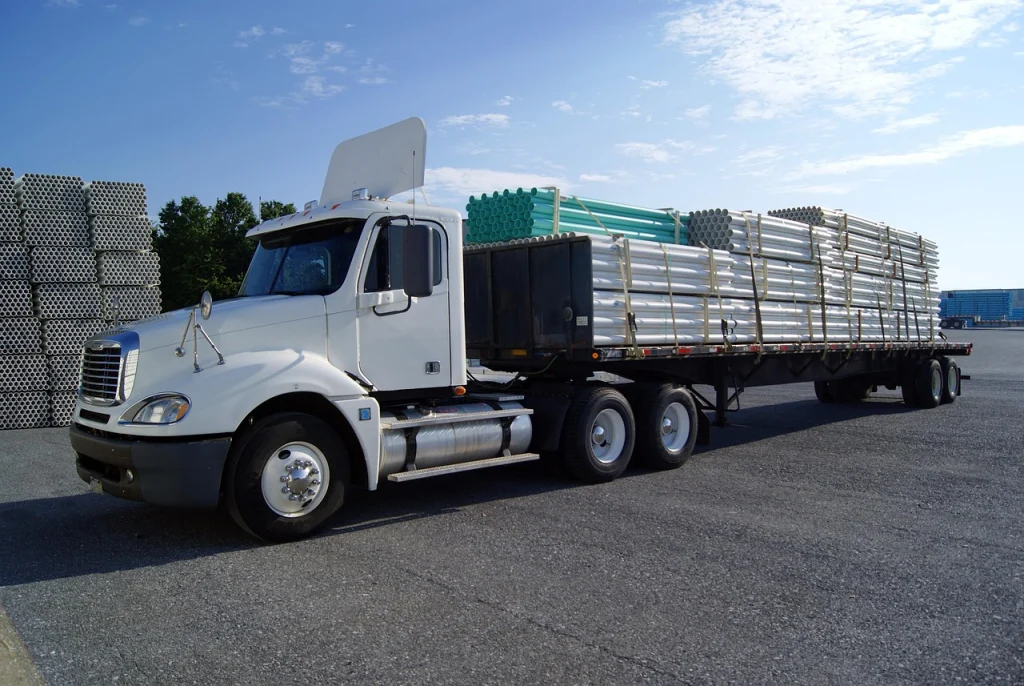
The trade is small next to the carriers it serves. FMCSA data quoted in its November 2024 proposed rule counted 28,773 brokers and 787,189 motor carriers at the end of 2023, with brokers down from 31,885 a year earlier. The Supreme Court’s Montgomery opinion says brokers arrange “about a third of all freight”. Its sources for that passage are an FMCSA statistics guide and a friend-of-the-court brief, so read the share as an estimate.
What a broker does on a load
Here is the work on one truckload, from first call to final payment.
- Quote. The shipper gives the lane, dates, weight and equipment. The broker prices it from current market rates and its own carrier costs. For less-than-truckload freight, the quote also depends on the shipment’s class, which a density-based freight class calculator can estimate.
- Book. The shipper accepts. A shipper-broker agreement, if one is signed, sets payment terms and who answers for what.
- Source a carrier. The broker calls carriers it knows or posts the load on a load board, then negotiates a rate.
- Vet. It confirms the carrier’s authority is active and its insurance is on file, and looks at its safety record. Since the 2026 ruling below, this step carries more legal weight.
- Confirm. A rate confirmation fixes the price, pickup and delivery details and any extra charges, such as whether a lumper fee is paid back. A broker-carrier agreement usually sits behind it.
- Track. The carrier picks up and issues the bill of lading. The broker follows the load and updates the shipper.
- Fix problems. A late truck, a breakdown, a refused delivery, a damage report: these reach the broker first, because the shipper hired the broker.
- Close out. The carrier sends proof of delivery, the broker invoices the shipper and pays the carrier, and the transaction goes into the record 49 CFR 371.3 requires. Many brokers run all this through transportation management software.

On most days the job is sales on one side, purchasing on the other, and problem-solving in between.
How freight brokers get paid
In the Supreme Court’s words, brokers “net the difference between the price that a company will pay to move goods and the cost of hiring a carrier.” That difference is the gross margin.
A worked load
These numbers are illustrative, not market rates.
| Line | Amount |
|---|---|
| Shipper pays the broker | $2,400 |
| Broker pays the carrier | $2,080 |
| Gross margin | $320 |
| Margin as a share of the shipper’s price | 13.3% |
| Markup on the carrier’s price | 15.4% |
The last two rows are the same $320 measured two ways. When someone quotes a broker’s “percentage”, ask which one they mean. Public companies report margin on revenue.
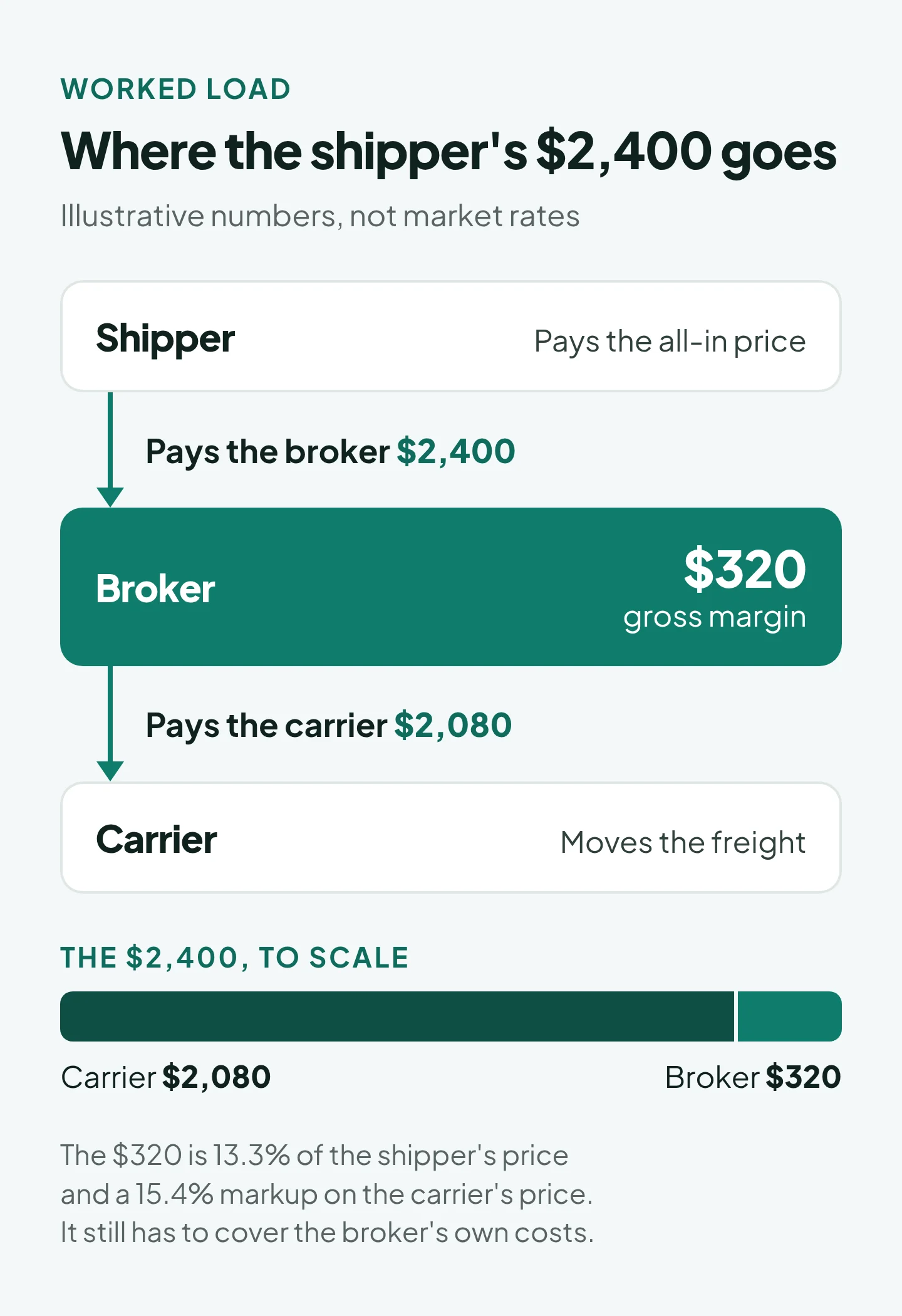
The $320 is not profit. It has to pay staff, software, load board subscriptions, the bond premium, insurance, bad debts and the cost of carrying unpaid invoices.
What margins look like in public filings
FMCSA’s 2024 proposal concluded that brokerage margins “generally align with the self-reported industry averages of approximately 15 percent”. Most brokerages are private, so the best hard numbers come from the few that report to the SEC. These are very large companies, and a small brokerage’s numbers can differ.
| Company and period | Measure | Result |
|---|---|---|
| RXO, full year 2024 | Truck brokerage gross margin | 13.8% |
| RXO, full year 2025 | Truck brokerage gross margin | 13.3% ($560 million on $4,225 million) |
| RXO, Q2 2026 | Brokerage gross margin | 10.7% |
| RXO, Q3 2026 | Brokerage gross margin | 12.6% |
| C.H. Robinson, 2025, North American Surface Transportation | Adjusted gross profit on revenue, our calculation; includes LTL | 14.8% ($1,706 million on $11,563 million) |
Sources: RXO’s Q4 2025, Q2 2026 and Q3 2026 earnings releases, and C.H. Robinson’s 2025 Form 10-K. RXO’s release of 29 October 2026 also says C.H. Robinson has agreed to buy it, with closing expected in the first half of 2027.
C.H. Robinson’s segment shows how little of the gross figure survives. Of every $100 of 2025 revenue in that business, about $85 went to purchased transportation, leaving about $15. After personnel and other overhead, about $5 remained as income from operations.
Why margins swing: contract and spot
Shippers buy either at contract rates agreed in advance or at spot rates for one load. Brokers often buy the other way around. C.H. Robinson’s 10-K says it purchases most truckload capacity on a spot basis “even when we are working with the customer on a contractual basis”, and that most of its rate commitments run a year or less, allow for renegotiation and carry no specific volume commitment.
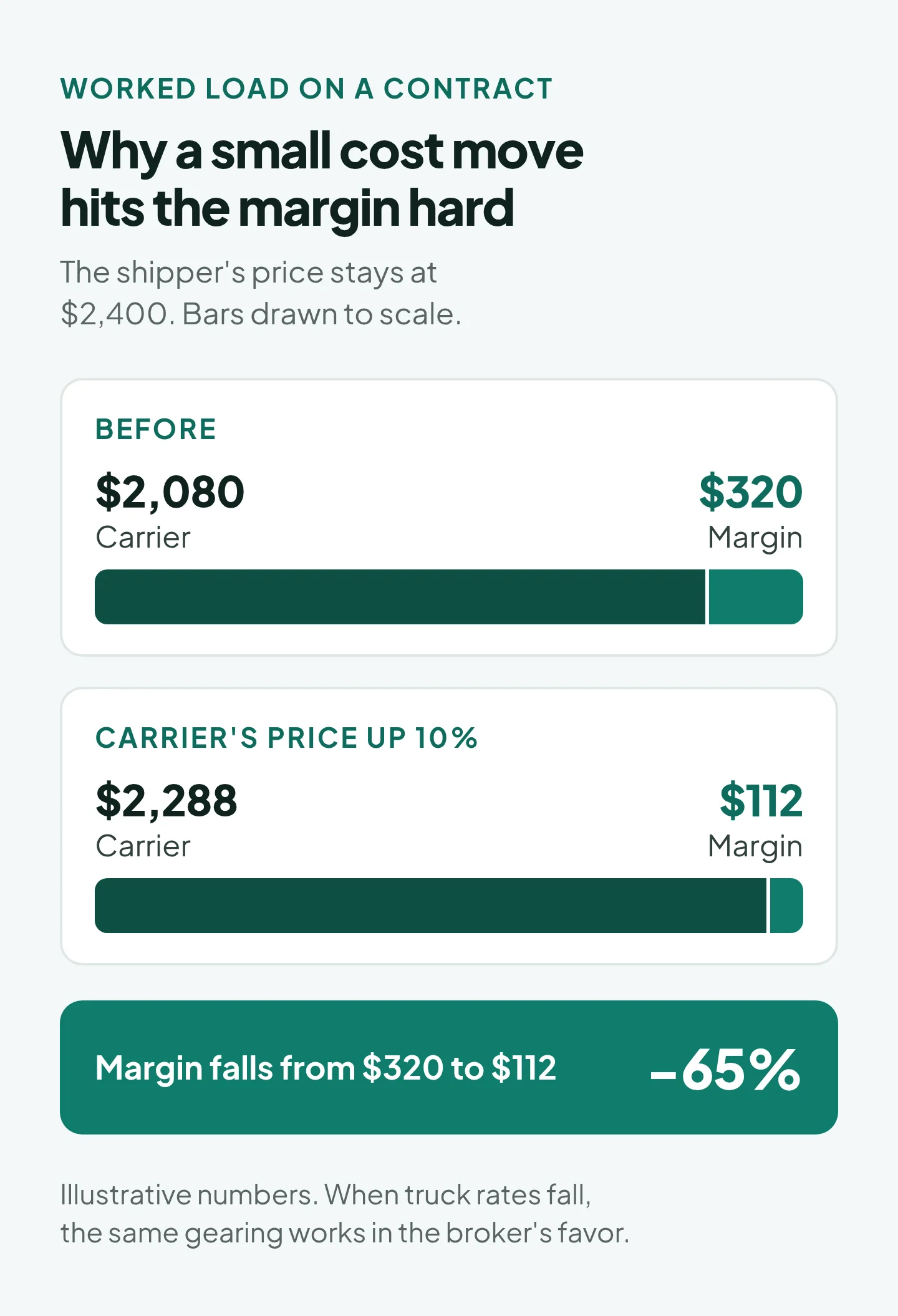
So the broker can be selling at an agreed price while buying at a moving one. The same filing warns that when contract rates fall below market, it may have to move freight at a loss. Take the worked load on a contract at $2,400. If tight capacity lifts the carrier’s price 10% to $2,288, the margin drops from $320 to $112, a fall of 65% from a 10% cost move. When truck rates fall, the same gearing works in the broker’s favor.
RXO’s filings show it happening. In February 2026 it said tightening capacity “impacted our buy rates and squeezed our Brokerage gross margin”. In the third quarter of 2026 it reported a truckload spot mix of 51% of volume, up from 29% a year earlier, and said this helped drive its biggest sequential rise in gross profit per load in more than four years. In a rising market, spot freight can be repriced load by load. A contract rate has to be renegotiated or wait for renewal.
Getting paid late and paying early
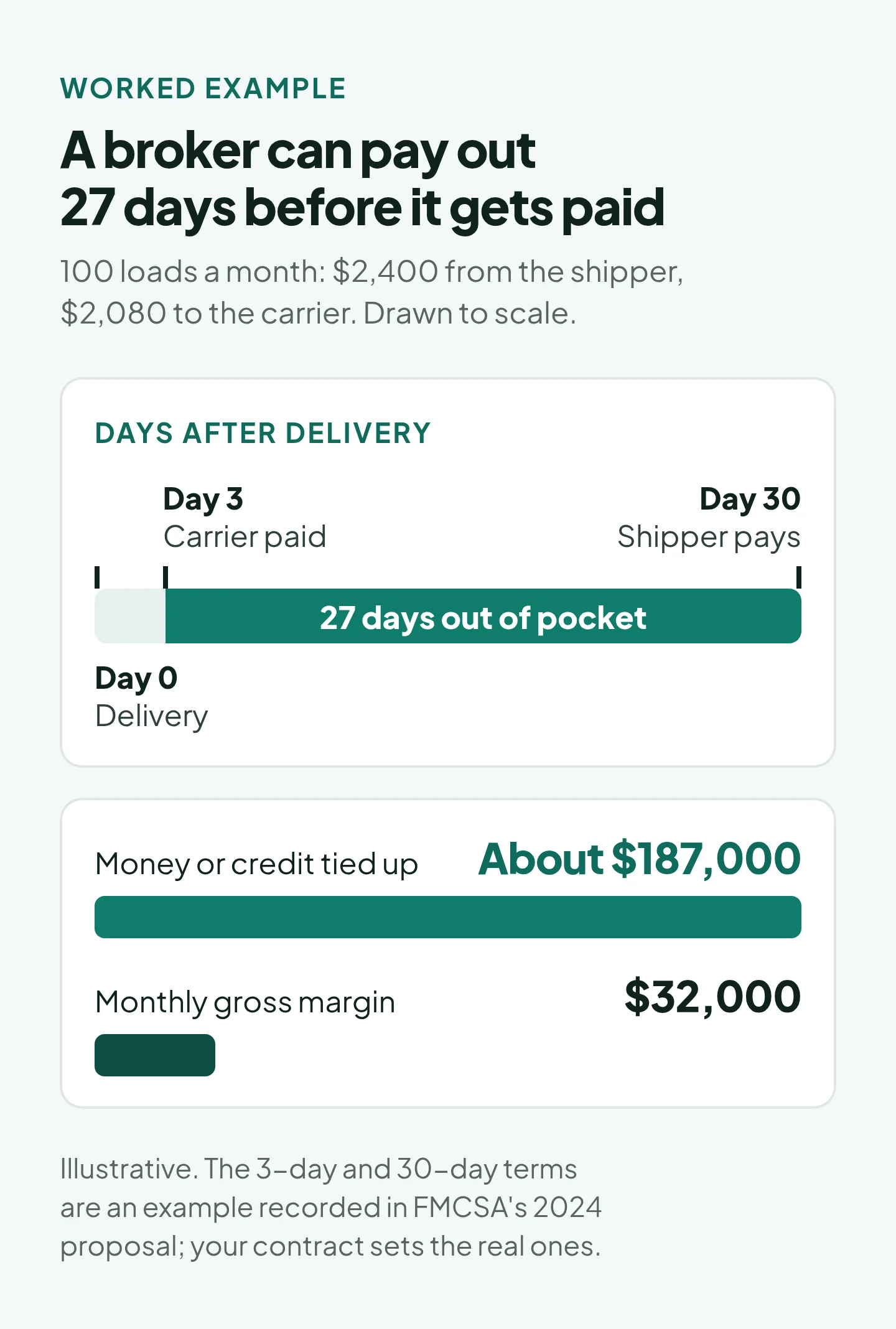
A profitable broker can still run out of cash. Brokers told FMCSA they carry significant risk because they may pay a carrier within 3 days of delivery while the shipper has 30 days to pay, an example recorded in the 2024 proposal. Carriers told FMCSA the opposite story: slow payment and disputed chargebacks. C.H. Robinson’s 10-K says its model generally has a higher days sales outstanding than days payables outstanding, so higher freight rates can raise its working capital needs.
Using those 3-day and 30-day terms, a broker moving 100 of our loads a month has paid carriers for about 27 days of loads that shippers haven’t yet paid for. That is 90 loads at $2,080 each, or about $187,000 of its own money or credit tied up, against $32,000 of monthly gross margin. Faster growth makes the gap wider. Part 371 sets no number of days for paying a carrier, so the contract governs. A broker can cover the gap with a credit line or freight factoring. Early payment can also be priced: C.H. Robinson’s 10-K says carriers can take a cash advance of up to 60% at pickup or, for a discount, expedited final payment on proof of delivery.
How people inside a brokerage are paid
“Freight broker” often means an individual, not the licensed company. There are three common setups, and our step-by-step guide to getting broker authority explains the filings for the third.
- Employee. A salary, often with commission on gross margin. The brokerage carries the authority, bond and credit risk.
- Freight agent. An independent contractor who books freight under a brokerage’s authority and keeps a share of the margin. Splits are private contract terms, and we found no public data on them. At an assumed 60% split, the agent would keep $192 of our $320 and the brokerage $128. Check who absorbs bad debt before you compare two offers.
- Owner. Keeps the whole margin and pays every cost, including the bond, the bad debts and the cash gap.
What those setups earn in dollars is on our freight broker salary page. No federal exam or course is required to do the job.
Broker, carrier, forwarder, agent, dispatcher
These roles get mixed up constantly, and the differences have legal consequences.
| Role | What it does | Takes on the move itself? | Federal status |
|---|---|---|---|
| Freight broker | Arranges transportation by a carrier | No | Broker authority and $75,000 bond or trust |
| Motor carrier | Hauls freight for pay | Yes | Carrier authority and liability insurance on file |
| Freight forwarder | Consolidates shipments and uses carriers to move them | Yes: it assumes responsibility from receipt to destination | Forwarder authority; counted as a “carrier” in 49 U.S.C. 13102 |
| Freight agent | Sells and books loads for a brokerage | No | Usually none of its own; works under the brokerage’s authority |
| Truck dispatcher | Finds loads for carriers | No | None, unless it crosses into brokering |
| Customs broker | Handles import entry and customs business | No | Licensed under 19 CFR Part 111; a separate field |
| 3PL | Business term for an outsourced logistics provider | Depends on the service | Not an FMCSA authority type; the actual activity decides what is required |
The dispatcher line is easy to cross. FMCSA’s 2023 guidance lists this among the signs that a dispatch service should get broker authority: accepting a shipment that more than one of its carriers could haul and assigning it to one of them.
What a broker answers for
Cargo loss and damage
The federal cargo liability statute, 49 U.S.C. 14706, places liability on carriers, and its text doesn’t name brokers. A broker’s cargo exposure usually comes from what it signs. A shipper contract can make the broker responsible for loss.
The wording of its promises matters too. A broker that agrees to transport goods itself, instead of arranging transportation, is moving toward the “legally bound” language that describes a carrier. 49 CFR 371.7 also bars a broker from presenting its operations as a carrier’s, and its advertising must show its broker status. Have a transportation attorney read the contract.
Non-payment: the $75,000 security
49 CFR 387.307 requires a $75,000 surety bond or trust fund that provides for payments to shippers or motor carriers if the broker fails to carry out its contracts. It sounds large, but at our illustrative $2,080 carrier rate it covers about 36 unpaid loads. For a broker doing 100 loads a month, that is about 11 days of carrier payments. A carrier owed money by a collapsing broker can be competing with many others for the same $75,000. Our guide to the BMC-84 freight broker bond explains how claims work and what they cost the broker.
Carrier selection after Montgomery
This is the biggest recent change. On 14 May 2026 the Supreme Court unanimously decided Montgomery v. Caribe Transport II, settling a split among federal appeals courts. A truck driver badly hurt in a crash sued C.H. Robinson, claiming it negligently hired the carrier involved. The lower courts threw the claim out under the federal law that preempts state rules on trucking prices, routes and services. The Supreme Court reversed: such claims survive under that law’s exception for state safety authority “with respect to motor vehicles” (49 U.S.C. 14501(c)(2)(A)).
Keep the ruling in proportion:
- It didn’t find anyone liable. It decided that the claim can go forward, and sent the case back. An injured person must still prove negligence under state law.
- Two justices expect careful brokers to win. Justice Kavanaugh, joined by Justice Alito, wrote that brokers should be able to defend these suits successfully if they “acted reasonably and arranged transportation with reputable trucking companies”. He also warned that litigation and insurance costs may be significant even when brokers win.
- Federal rules set no vetting standard. The same concurrence notes that FMCSA requires brokers to pick a registered carrier but doesn’t otherwise impose safety standards on broker hiring. For interstate loads, state negligence law now fills that gap.
- In-state loads are a separate question. A different subsection, 14501(b), covers brokers’ intrastate services and has no safety exception. The Court noted the oddity but ruled on the subsection before it.
The practical lesson: write down your vetting criteria and save a record of each check. Federal rules don’t require liability cover for brokers. Contingent auto and cargo policies are a commercial choice, and our trucking and broker insurance guide explains them.
Records, transparency and rebates
Under 49 CFR 371.3 a broker must keep a record of each transaction for three years, including what it was paid and by whom, and “each party to a brokered transaction has the right to review the record”. That is the rule behind the long fight over broker transparency. FMCSA’s 2024 proposal says broker-carrier contracts frequently waive this right. It proposes that records be supplied within 48 hours of a request and that they show the dates shippers and carriers were paid.
A Federal Register search on 1 November 2026 showed no final rule and no new proposal since the comment period was reopened in February 2025. The White House regulatory office’s list of rules under review, dated 31 October 2026, shows a new FMCSA proposal under this rule, received on 27 August 2026. Its text isn’t public yet, so the current 371.3 stands for now.
Two more limits apply. Under 49 CFR 371.9 a broker can’t give a shipper or its staff anything of value beyond inexpensive promotional items. It also can’t take compensation from a carrier on a shipment it owns, has a material interest in, or controls through shared ownership with the shipper.
Why shippers and carriers use brokers
| Who | What they gain | What they give up |
|---|---|---|
| Shipper | One call instead of many; access to carriers it doesn’t know; capacity on lanes or in weeks when its own carriers are full | The margin, a step away from the carrier, and reliance on the broker’s vetting |
| Carrier | Freight without its own sales team; loads for the trip home; payment from one account | The margin, lower visibility of what the shipper paid, and exposure to the broker’s credit |
A shipper with steady volume on the same lanes may do better contracting directly with carriers. Brokers earn their margin where freight is irregular, urgent or spread across many lanes, and with small carriers that can’t afford to chase customers.
How to check that a broker is real
Before a load moves, shippers and carriers should confirm that the company holds active broker authority with its bond on file, and that the name and contact details match FMCSA’s record. A broker may only operate in the name on its registration (49 CFR 371.7), so a mismatch is a warning sign. Our guide to checking an MC number walks through the lookup.
Watch for “double brokering” too. FMCSA’s 2023 guidance says the term has no definition in statute or regulation, and that most commenters worried about it mean entities acting as brokers without proper authority. Under 49 U.S.C. 14916, knowingly allowing brokerage without registration and the required security exposes the company, and its officers, directors and principals personally, to civil penalties and to an injured party’s valid claims.
Common questions
How much does a freight broker make per load?
No official average exists. A margin of 12% on a $2,400 load would be $288 before overhead. Thin or negative margins happen on individual loads, especially on fixed-price contracts when truck rates rise.
Who pays the freight broker?
Usually the shipper, as part of the all-in price. The rules allow brokerage on behalf of a carrier, consignor or consignee (371.2), and the broker must record who paid it.
Can a broker own trucks?
Yes, but carrier and broker work need separate registrations, each with its own number (49 U.S.C. 13901). Under 49 CFR 371.13 a broker in any other business must keep brokerage revenue and expenses separate from that business.
Does a freight broker need a license?
Yes, in the sense of FMCSA operating authority for interstate brokerage. There is no federal exam. The authority fee, the bond and the Motus application are covered in our guide above.
Facts checked against primary sources on 1 November 2026: the eCFR (Title 49, Parts 371 and 387, current through 29 October 2026), the U.S. Code, the Federal Register, the White House regulatory review list, the Supreme Court’s slip opinion and SEC filings. Worked examples are illustrative. Every figure is checked against the linked source. This page is general information, not legal, tax or financial advice.
Sources
- eCFR: 49 CFR 371.2, broker definitions
- eCFR: 49 CFR 371.3, records to be kept by brokers
- eCFR: 49 CFR 371.7, misrepresentation
- eCFR: 49 CFR 371.9, rebating and compensation
- eCFR: 49 CFR 371.13, accounting
- eCFR: 49 CFR 387.307, property broker surety bond or trust fund
- U.S. Code: 49 U.S.C. 13102, definitions
- U.S. Code: 49 U.S.C. 13901, requirements for registration
- U.S. Code: 49 U.S.C. 14501, federal authority over intrastate transportation
- U.S. Code: 49 U.S.C. 14706, liability of carriers
- U.S. Code: 49 U.S.C. 14916, unlawful brokerage activities
- Supreme Court: Montgomery v. Caribe Transport II, LLC, No. 24-1238 (14 May 2026)
- Federal Register: Definitions of Broker and Bona Fide Agents, final guidance (16 June 2023)
- Federal Register: Transparency in Property Broker Transactions, proposed rule (20 November 2024)
- Federal Register: Transparency in Property Broker Transactions, comment period reopened (18 February 2025)
- RXO: fourth-quarter 2025 earnings release (6 February 2026)
- RXO: second-quarter 2026 earnings release (6 August 2026)
- RXO: third-quarter 2026 earnings release (29 October 2026)
- C.H. Robinson: Form 10-K for fiscal 2025
- OIRA: regulatory actions under EO 12866 review, RIN 2126-AC63 (list dated 31 October 2026)