To start a for-hire trucking company in 2026, you form a business and get an EIN. You then apply in FMCSA’s Motus system for a USDOT number and operating authority ($300). Your insurer files proof of at least $750,000 in liability cover, and a process agent files your BOC-3. Before you haul a load you also need a drug and alcohol testing program, which for an owner-operator means joining a consortium. Then come UCR, IRP plates, an IFTA license, Form 2290 for a heavy truck, and an ELD. Within 12 months of getting your USDOT number, FMCSA audits your records, and any one of 16 specific violations fails that audit automatically. This guide, part of our starting a trucking company hub, takes each step in order, with what it costs, how to fund it, a plan for your first 90 days and a DOT compliance checklist for after you launch.
This is general information, not legal, tax or financial advice. Rules differ by state and by what you haul; confirm your own situation with FMCSA, your state and a qualified adviser.
The guide assumes the most common case: one tractor-trailer, general freight (no hazmat), crossing state lines, with you as owner and driver. Hazmat, passengers, household goods and intrastate-only operations have extra or different rules. Hotshot rigs and box trucks may fall under some of the weight limits below, so check each one.
The 10 steps at a glance
- Decide: your own authority, or lease on first. Leasing onto a carrier lets you run under its authority while you learn the business side.
- Form the business and get an EIN. Both come before your FMCSA application.
- Line up insurance quotes before you apply, so the filing can go in fast.
- Apply in Motus for a USDOT number and motor carrier operating authority ($300).
- Have your insurer file proof of coverage, and your process agent file your BOC-3 within 20 days of your application being published.
- Set up drug and alcohol testing: join a consortium, take a pre-employment test and register in the Clearinghouse.
- Register for UCR ($46 for 2026 and $55 for 2027 at one or two trucks).
- Get IRP apportioned plates and an IFTA license from your home state.
- File Form 2290 and pay the heavy vehicle use tax if the truck is 55,000 lb or more.
- Install a registered ELD, build your files and prepare for the new entrant safety audit from day one.
Steps 3 to 6 overlap. Your authority goes active only after the protest period ends and the insurance and BOC-3 filings are on record. Testing must be in place before you drive.
Your own authority or lease on first
There are two ways to run your own truck. You can get your own authority, and become the motor carrier. Or you can lease on to an existing carrier as a leased owner-operator and haul under its USDOT number and authority. Under a lease, the carrier usually supplies the primary liability filing and the loads. You still own and maintain the truck. Federal rules in 49 CFR 376.12 say what the written lease must spell out, including pay, chargebacks and who carries which insurance.
Your own authority gives you your own customers and rates, plus every cost and compliance job in this guide. Many people lease on first to learn freight pricing and cash flow, then file for their own once they have savings and a clean record. The rest of this guide assumes you want your own authority.
You also need a commercial driver’s license for the truck you drive. A tractor pulling a trailer rated over 10,000 lb, with a combined rating of 26,001 lb or more, is a Group A vehicle under 49 CFR 383.91, so you need a Class A CDL. You also need a current DOT medical certificate. Under 391.45 a driver has to be re-examined at least every 24 months, and sooner if the examiner sets a shorter period. If you plan to haul in and out of ports, add a TWIC card, the federal credential for unescorted access to secure areas of regulated port facilities.
Step-by-step setup
Form the business and get an EIN
Most owner-operators form an LLC or a corporation with their state. A sole proprietorship is legal too, but it gives you no separation between business debts and personal assets. The choice affects taxes and liability, so this is worth an hour with an accountant. Use the exact legal name everywhere. Insurance filings must carry the carrier’s full, correct legal name, and a mismatch can hold up your authority.
Then get an Employer Identification Number from the IRS, free at IRS.gov/EIN. The Form 2290 instructions say plainly that you must have an EIN to file and cannot use your Social Security number. Open a separate business bank account at the same time.
Apply in Motus for a USDOT number and authority
FMCSA has moved registration to a new online system called Motus. Its April 2026 Federal Register notice says first-time registrants apply there for both the USDOT number and operating authority, and that the old Unified Registration System (URS) will be switched off. The same notice brings in identity checks. You need a smartphone or tablet and a government-issued ID, and you take a photo of the ID and of your face. FMCSA also verifies the business itself: legal name, address, ownership and officers. If you file paper forms instead, the notice says to expect at least eight business days for the first review.
The fee is $300 for each type of operating authority you request, under the FMCSA fee schedule in 49 CFR 360.3T. The same schedule lists no fee for the USDOT number itself. If you also want broker authority, that is a separate $300 application.
MC numbers have not gone away. The Motus notice says the Phase II launch does not eliminate MC docket numbers. FMCSA also held back its planned “safety registration” and its BOC-3 changes. Our guide to what an MC number is in 2026 explains what new applicants receive and how to look a carrier up.
Insurance filing, BOC-3 and the protest period
After FMCSA accepts your application, it publishes a summary in the FMCSA Register. Anyone can then protest for 10 days under 49 CFR 365.203T, although a property carrier’s application can be opposed only on fitness grounds (365.107). The deadline that matters more is yours. The current rule, 365.109T, gives you 20 days from publication to get two filings on record:
- Proof of liability insurance (Form BMC-91 or BMC-91X). Your insurer files it, not you. For non-hazardous freight in a vehicle rated 10,001 lb or more, the federal minimum is $750,000 under 49 CFR 387.9. Some hazardous materials raise that to $1 million or $5 million.
- Form BOC-3, which names a legal process agent in each state you are authorized to operate in and each state you pass through (49 CFR 366.4T). With ordinary nationwide authority that means agents across the country, so most carriers pay a “blanket” process-agent company to file it. The price is set by the market, not by FMCSA.
This is why insurance quotes come before the application. A new authority has no loss history, so getting a quote can take longer than the filing itself. Our explainer on trucking liability insurance minimums and filings covers the BMC-91, the MCS-90 endorsement, and what cargo and physical damage cover add. Federal law does not require cargo cover for general freight. Brokers and shippers usually require it by contract.
Once the protest period has passed and both filings are accepted, FMCSA grants the authority. Your operating authority stays in “new entrant” status for 18 months and becomes permanent only after you complete the New Entrant Safety Assurance Program (365.110). More on that below.
Drug and alcohol testing, the Clearinghouse and your C/TPA
Owner-operators often get this step wrong, and it is the first item on the audit’s automatic-fail list. If you drive your own truck, you are both the employer and the driver. 49 CFR 382.103(b) says you must meet the requirements for both roles. You also cannot run a random testing pool of one. A carrier that employs only itself as a driver must be in a random pool of two or more covered drivers. In practice that means joining a consortium run by a consortium/third-party administrator (C/TPA).
- Join a consortium through a C/TPA. It manages the random pool, schedules tests and keeps records. Get written proof of enrollment.
- Take a pre-employment drug test and receive a verified negative result before you drive for your company (382.301). A narrow exception applies to a driver who was recently covered by another compliant testing program.
- Register in the Drug and Alcohol Clearinghouse as an employer, and name your C/TPA there (382.711). For an owner-operator this is not optional. 382.705(b)(6) requires a self-employed driver to designate a C/TPA to handle the employer reporting about their own testing. Register as a driver too, so you can give consent to queries.
- Run the pre-employment Clearinghouse query before any driver, including you, performs safety-sensitive work (382.701). After that, query every driver you employ at least once a year.
Under 382.305, the minimum random testing rates are 50% of driver positions for drugs and 10% for alcohol. In a consortium those rates apply across the whole pool, so you might be picked several times a year or not at all.
Unified Carrier Registration (UCR)
Interstate carriers register for UCR every year with their base state and pay a fee based on fleet size. The UCR Plan’s fee brackets are:
| Vehicles owned or operated | 2026 fee | 2027 fee |
|---|---|---|
| 0 to 2 | $46 | $55 |
| 3 to 5 | $138 | $167 |
| 6 to 20 | $276 | $333 |
| 21 to 100 | $963 | $1,163 |
Registration is due before January 1 of each registration year, and the 2027 portal opened on 1 October 2026. If you start running now, you need 2026 registration for this year’s operations and 2027 registration before 1 January.
IRP plates and IFTA fuel tax
Both programs use the same weight test. Under the International Registration Plan (IRP), a truck that crosses state lines needs apportioned registration if it is a power unit with two axles over 26,000 lb, a power unit with three or more axles at any weight, or part of a combination over 26,000 lb. That is the Plan’s definition as printed in the Texas DMV’s IRP packet. You register in your home (“base”) state, which splits your registration fees among the states by the share of miles you drive in each. With no mileage history yet, your first year is based on the Plan’s average per-vehicle distance chart, not your own estimate. Texas, for example, asks for your USDOT number, proof of insurance and, for a truck of 55,000 lb or more, the stamped Form 2290 Schedule 1. Expect similar lists elsewhere.
The International Fuel Tax Agreement (IFTA) uses the same three tests to define a “qualified motor vehicle” (section R245 of the IFTA Articles of Agreement). You get one license and two decals per truck from your base state. Each quarter, you file one return showing miles and gallons in every state, so keep every fuel receipt and your miles by state from the first load. The return and payment are due on the last day of the month after the quarter ends, or the next business day if that falls on a weekend or holiday. The base state can charge a penalty of $50 or 10% of the late tax, whichever is greater (R1220). Upcoming dates:
- July to September 2026: due 2 November 2026 (31 October is a Saturday)
- October to December 2026: due 1 February 2027 (31 January is a Sunday)
- January to March 2027: due 30 April 2027
Form 2290: heavy vehicle use tax
If your truck’s taxable gross weight is 55,000 lb or more, you owe the federal heavy vehicle use tax on IRS Form 2290. The tax year runs from 1 July 2026 to 30 June 2027. You file by the last day of the month after the month you first use the truck on public roads. A truck first used in November 2026 must be reported by 31 December 2026, and one first used in December by 1 February 2027.
The full-year tax on the July 2026 revision of Form 2290 is $100 at 55,000 lb. It rises by $22 for each extra 1,000 lb, up to $550 for any truck over 75,000 lb. A tractor-trailer registered to run at 80,000 lb is in that top bracket. For trucks first used after July, the tax is prorated by month. Worked example: an 80,000 lb tractor-trailer first driven in November 2026 owes 8/12 of $550, which is $366.67, filed by 31 December. If you e-file, the stamped Schedule 1 can be ready within minutes of the IRS accepting the return, and your state needs that stamped Schedule 1 to register the truck. A truck you expect to drive 5,000 miles or less on public highways in the tax period (7,500 for farm vehicles) can be reported as suspended, with no tax due unless it goes over that limit.
ELD, driver file and vehicle inspection
- Electronic logging device. 49 CFR 395.8 requires an ELD to record hours of service. Exceptions include drivers who need logs on no more than 8 days in any 30-day period, and trucks manufactured before model year 2000. The device must be on FMCSA’s registered ELD list (395.22), so check the list before you sign a contract. Check FMCSA’s revoked list too: on 12 November 2026 FMCSA removed 133 devices from the registered list, and its release tells safety officials to treat a driver using a revoked device on or after 24 November 2026 as having no ELD and to place the driver out of service.
- Driver qualification file. Yes, even for yourself. 391.51 lists what goes in it, including your application, motor vehicle record, road test or CDL equivalent, and medical certificate.
- Annual vehicle inspection. Every truck and trailer needs a periodic inspection at least once every 12 months, with the record kept on file (396.17). It is one of the 16 automatic audit failures if 51% or more of the vehicles examined lack one.
- Biennial MCS-150 update. Every 24 months you update your registration. The last digit of your USDOT number sets the month, and the next-to-last digit sets whether it falls in odd or even years. If you don’t, your USDOT number can be deactivated (390.19T).

What it costs to start
Many guides say “$10,000 to $30,000 to start” without a source. We don’t give a single total, because the truck, the insurance quote and your cash cushion swing it far more than any fee does. Here is what can actually be pinned down, and our four itemized one-truck budgets show how the lines add up.
Government fees and taxes
| Item | Amount | Source |
|---|---|---|
| USDOT number | No fee listed | 49 CFR 360.3T |
| Motor carrier operating authority | $300 per authority type | 49 CFR 360.3T |
| UCR, 0 to 2 vehicles | $46 (2026), $55 (2027) | UCR Plan |
| Form 2290 heavy vehicle use tax | $100 to $550 a year, prorated by first month of use | IRS Form 2290 |
| IRP apportioned plates | Set by each state, split by miles | Your base state |
| IFTA license and decals | Set by your base state | IFTA R355 |
| EIN | Free | IRS |
Several items have no official price: the BOC-3 blanket filing, consortium membership and testing, the ELD subscription, and state business formation fees. Get two or three quotes for each.
Running costs per mile (ATRI benchmark)
The most detailed public cost benchmark comes from the American Transportation Research Institute (ATRI). Its 2026 operational costs report puts the average cost of running a truck in 2025 at a record $2.336 per mile, or $106.69 per hour. For truckload carriers it was $2.21 per mile.
| Cost line (2025, industry average) | Per mile |
|---|---|
| Fuel | $0.482 |
| Truck and trailer lease or purchase payments | $0.404 |
| Repair and maintenance | $0.215 |
| Truck insurance premiums | $0.106 |
| Permits and licenses (specialized permits, not truck registration) | $0.008 |
| Tires | $0.050 |
| Tolls | $0.043 |
| Driver wages | $0.818 |
| Driver benefits | $0.210 |
| Total | $2.336 |
Read these as a benchmark, not a quote. ATRI’s data mostly comes from established fleets; fleets of 251 to 1,000 trucks were the largest group of respondents. Small operators pay more on some lines. In truckload, ATRI found that fleets with more than 1,000 trucks spent 8.8 cents a mile less on fuel than fleets with fewer than 5 trucks. In the specialized sectors, the smallest fleet groups still had the highest per-mile insurance costs. A new authority with no loss history should expect an insurance quote well above the 10.6-cent average.
Worked example: one truck, one month
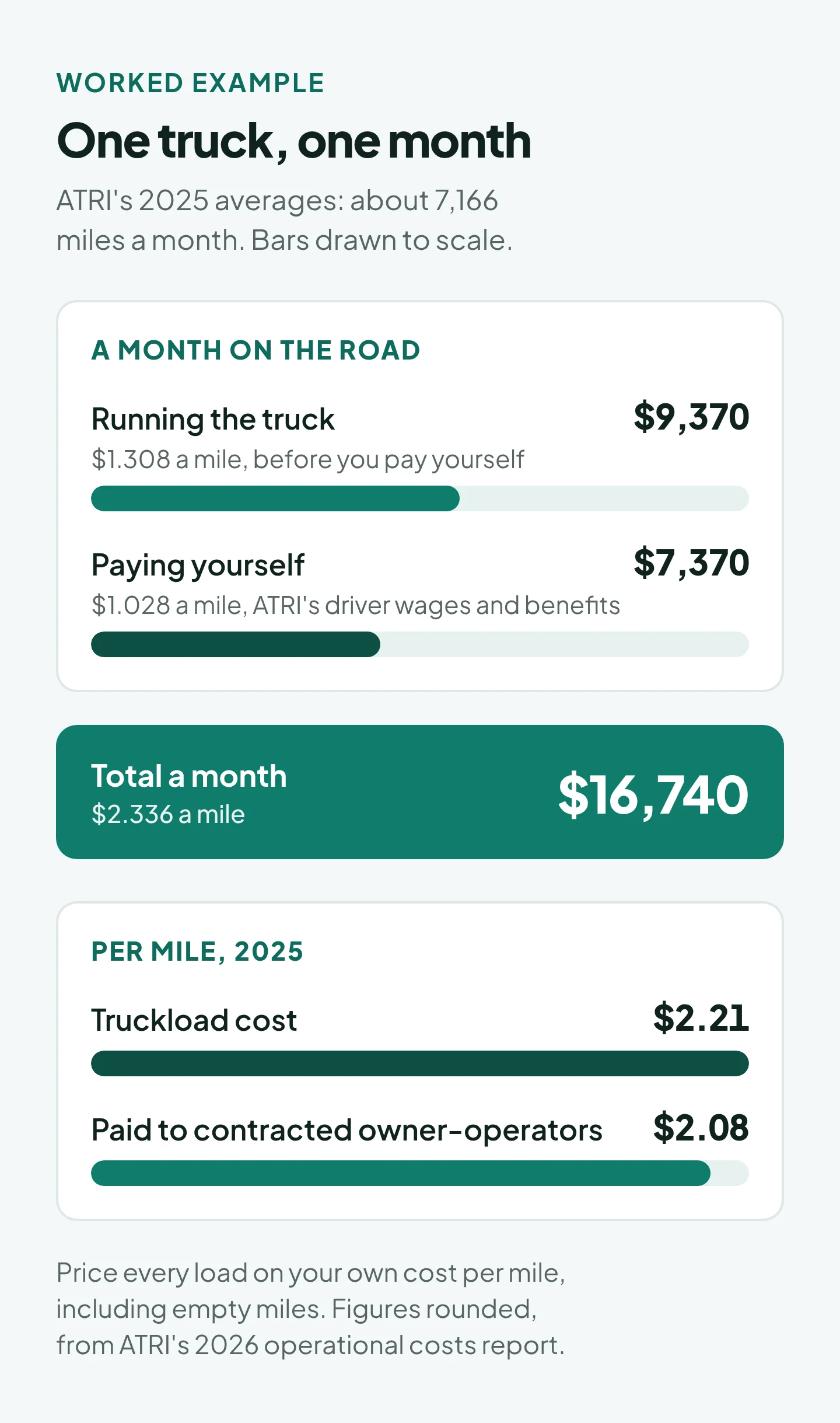
ATRI’s respondents averaged 85,991 miles per truck in 2025, about 7,166 miles a month. At ATRI’s average non-driver cost of $1.308 a mile ($2.336 minus $1.028 for driver wages and benefits), the truck costs about $9,370 a month to run before you pay yourself. Paying yourself at ATRI’s driver wage and benefit rate adds about $7,370, for roughly $16,740 a month in total.
Now set that against what the truck earns. ATRI reports that carriers paid contracted owner-operators an average of $2.08 a mile in 2025, below the $2.21 truckload cost. In the same year, ATRI’s truckload respondents averaged a 0.4% operating margin, and its flatbed respondents lost money. Non-tank deadhead (empty miles) averaged 16.5%. Claims of 20 to 30% profit margins don’t fit that data. Price every load on your own cost per mile, including empty miles, or you will lose money on freight that looks well paid.
Working capital: the cost people forget
Fuel, tolls and repairs are paid now. Freight is often paid weeks later. If a broker pays 30 days after delivery, the first month’s costs (about $9,370 in the example above, plus your living costs) come out of your own pocket before any money arrives. Add the insurance down payment and a repair reserve. This is how a new carrier can run out of cash in months two and three, even with the truck fully booked. Plan to hold at least two months of operating costs in the bank on the day your authority goes active.
Funding: grant myths and real options
Pages promising free government money to start a trucking company are wrong. The Small Business Administration says on its grants page: “SBA does not provide grants for starting and expanding a business.” FMCSA’s big safety grant program, MCSAP, can’t be paid to carriers either. Under 49 CFR 350.205, “Only States are eligible to receive MCSAP grants directly from FMCSA.” Real federal grants are listed on Grants.gov, which is free to search. Anyone who charges a fee to “unlock” a government grant is a red flag. The SBA adds that it only contacts people from email addresses ending in @sba.gov.
The money that does exist for new carriers is mostly loans:
- SBA microloans: up to $50,000 through nonprofit intermediary lenders. The SBA says the average is about $13,000 and the longest term is seven years. Microloans can pay for equipment and working capital, but not existing debt or real estate (SBA microloans).
- SBA 7(a) loans: up to $5 million through banks and other lenders, for equipment, working capital and other business uses (SBA 7(a)). Lenders look hard at credit, experience and a business plan, and a brand-new authority is a harder sell than a carrier with a year of history.
- Equipment financing or leasing from dealers and lenders, secured on the truck. Compare the total cost and the terms, not just the monthly payment.
- Leasing onto a carrier while you build savings and a track record needs far less startup capital than your own authority.
Write a trucking business plan first
A lender will want a business plan, and writing one tests whether the numbers work before you spend money. The SBA’s plan your business pages offer business plan templates and a startup cost calculator. For a trucking company, the plan should answer five questions with your own figures: which freight and lanes you will run, and for whom; what you will pay for the truck, insurance and the startup filings in the costs section above; your cost per mile, using the ATRI benchmark until you have your own data; the rate per mile you need to cover that cost and pay yourself; and how many weeks of expenses you can carry while invoices are unpaid (working capital).
Your first 90 days
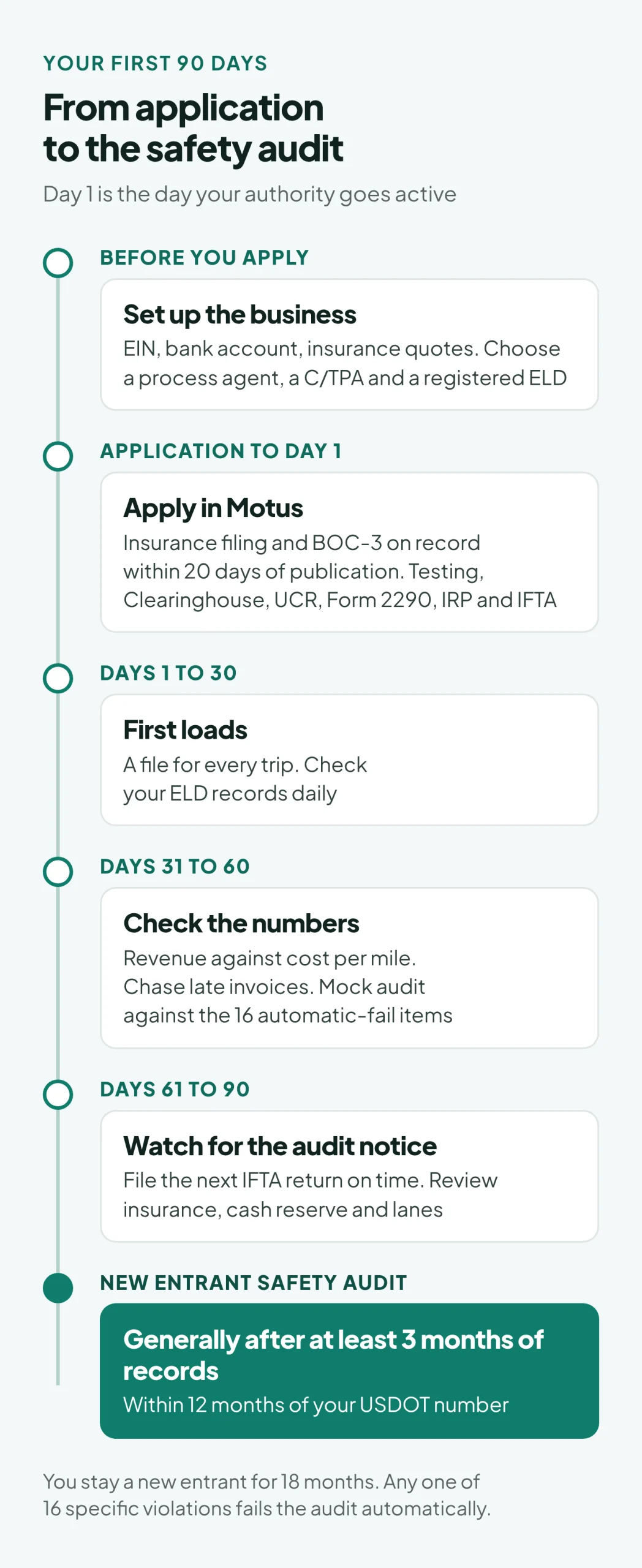
Day 1 is the day your authority goes active and you can haul for hire. How long the setup takes depends mostly on your insurer and FMCSA.
| When | What to do |
|---|---|
| Before you apply | Form the business, get the EIN, open the bank account, collect insurance quotes, choose a process agent, a C/TPA and an ELD from the registered list. |
| Application to Day 1 | Apply in Motus. Within 20 days of publication, get the insurance filing and BOC-3 on record. Join the consortium, pass the pre-employment test and register in the Clearinghouse. Register for UCR. File Form 2290 early enough to have the stamped Schedule 1, which your state will usually ask for, then apply for IRP plates and IFTA. |
| Days 1 to 30 | Set up broker accounts and run your first loads. Start a file for every trip: rate confirmation, bill of lading, proof of delivery, fuel receipts and miles by state. Check your ELD records daily and fix errors right away. |
| Days 31 to 60 | Compare each load’s revenue with your real cost per mile. Chase every invoice past its terms. Do a mock audit against the 16 automatic-fail items below. Keep the annual inspection report, driver file and testing records in one place. |
| Days 61 to 90 | Watch for the safety audit notice. FMCSA generally waits until you have at least 3 months of records. File the next IFTA return on time. Review insurance, cash reserve and lane choices before renewal or adding a truck. |
Passing the new entrant safety audit
Every new carrier is a “new entrant” for 18 months (49 CFR 385.307). During that time FMCSA watches your roadside inspections and runs a safety audit. The regulation says the audit comes once you have operated long enough to have records to review, a period that “will generally be at least 3 months”. The outer limit is in the definitions section, 385.3: a property carrier must be audited within 12 months of receiving its USDOT number. The rule says the audit will generally take place at your business premises (385.315).
You fail if the auditor finds you lack basic safety management controls. You also fail automatically on any one of the 16 violations in 49 CFR 385.321. For a one-truck property carrier these are the ones that matter:
| Automatic failure | What it means for you |
|---|---|
| No drug and alcohol testing program (382.115) | No consortium, no policy, no pre-employment result on file |
| No random testing program (382.305) | Not in a random pool, or a “pool of one” |
| Using a driver after a refused test, a positive drug test or alcohol of 0.04 or more (382.211, 382.215, 382.201) | Any driver, including you |
| Knowingly using a driver without a valid CDL, or a disqualified driver (383.3(a), 383.23(a), 383.37(b), 383.51(a), 391.15(a)) | Check every driver’s license status before dispatch |
| Knowingly using a physically unqualified driver (391.11(b)(4)) | An expired or missing medical certificate |
| Operating without the required insurance (387.7(a)) | A lapse in your $750,000 cover, even for a day |
| Not requiring records of duty status (395.8(a)) | Fails when records are missing for 51% or more of the days examined |
| Driving a vehicle placed out of service before repairs (396.9(c)(2)) | Moving the truck after a roadside out-of-service order |
| Not fixing out-of-service defects a driver reported (396.11(a)(3)) | Your own inspection reports count |
| Using a vehicle with no periodic inspection (396.17(a)) | Fails when 51% or more of vehicles examined lack one |
The table groups related items and leaves out only insurance for passenger carriers (387.31(a)). Apart from the two 51% thresholds, a single occurrence fails you.
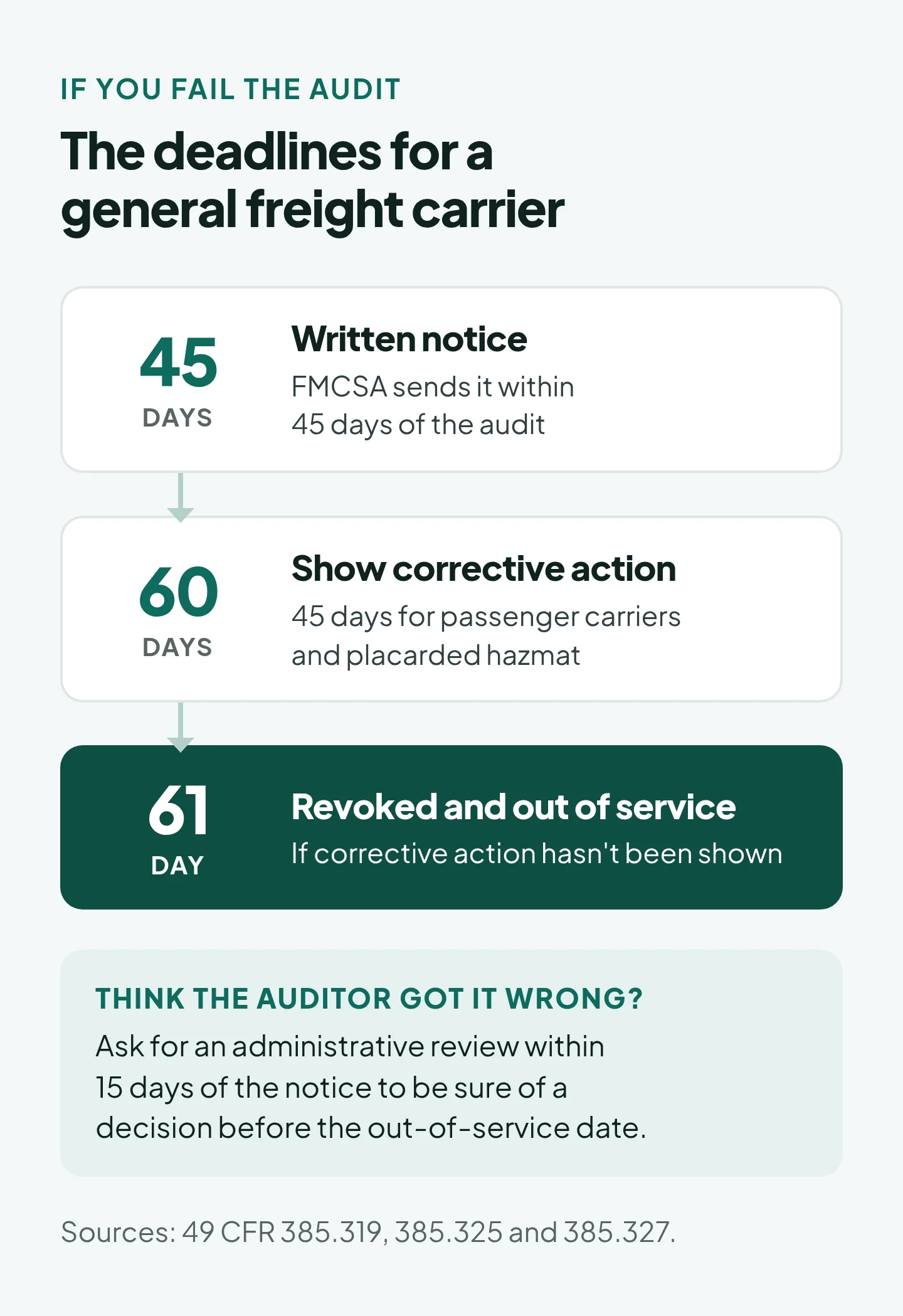
If you fail: FMCSA sends written notice within 45 days of the audit (385.319). A general freight carrier then has 60 days to show corrective action (45 for passenger carriers and carriers of placarded hazmat). Otherwise its registration is revoked and it is placed out of service on day 61 (385.325). If you think the auditor got it wrong, you can ask for an administrative review. To be sure of a decision before the out-of-service date, file within 15 days of the notice (385.327). If you refuse an audit and don’t agree to it in writing within 10 days of FMCSA’s notice, revocation takes effect on the 11th day (385.337).
Earlier triggers: FMCSA can bring the audit forward if roadside data shows trouble (385.308). Triggers include a driver without a valid CDL, operating an out-of-service vehicle, a positive or refused test, operating without the required insurance, or an out-of-service rate of 50% or more over at least three inspections in 90 days.
The practical prep is one binder, paper or digital, holding the business records in the documents checklist below, plus driver vehicle inspection reports with repairs noted once you run more than one truck, and your accident register. Keep it current from your first load and you have covered the paperwork behind the 16 automatic failures.
DOT compliance checklist for a new carrier
DOT compliance does not end once your authority is active. The safety audit checks whether you keep doing the same tasks on a schedule, and the same records come up at roadside inspections and in later reviews. This checklist covers the recurring federal tasks for a one-truck property carrier, with the rule behind each one. Your state may add its own.
| Task | When | Rule |
|---|---|---|
| Use an ELD on the registered list, not a revoked one | Before the first trip, then check the lists again | 395.22(a) |
| Keep logs and supporting documents | 6 months, plus a backup copy of ELD records | 395.8(k), 395.22(i) |
| Driver qualification file, including your own | While you drive, and 3 years after | 391.51 |
| Pull and review each driver’s driving record | At least every 12 months | 391.25 |
| Clearinghouse query | Before a driver starts, then at least once a year | 382.701 |
| Stay in a random testing pool | All year | 382.305 |
| Written drug and alcohol policy given to each driver | Before testing starts and at each hire | 382.601 |
| Once you run two or more trucks: fix defects on a driver vehicle inspection report and certify the repair | Before the vehicle runs again; keep 3 months | 396.11(a) |
| Periodic (annual) inspection | At least every 12 months | 396.17 |
| Maintenance and repair records | 1 year, and 6 months after a vehicle leaves | 396.3 |
| Accident register | 3 years after each accident | 390.15 |
| MCS-150 update | Every 24 months | 390.19T |
| UCR registration | Every year, before 1 January | UCR |
| IFTA return | Every quarter | IFTA |
| Form 2290 | Each tax year from 1 July; by 31 August for a truck used in July | Form 2290 |
A few details behind the table. The rule sets the yearly random testing minimums at 50% of average driver positions for drugs and 10% for alcohol, which FMCSA can change by notice (382.305(b)); as an owner-operator you meet this through your consortium. For the yearly Clearinghouse check, a limited query is enough if the driver has given consent, but if it shows a record you must run a full query within 24 hours or take the driver off safety-sensitive work (382.701(b)). Driver vehicle inspection reports do not apply to a motor carrier operating only one commercial motor vehicle (396.11(a)(5)); once you add a second truck, a driver writes one only when a defect is found or reported (396.11(a)(2)). The accident register lists, for each crash, the date, place, driver, injuries, deaths and any hazmat released, with copies of the accident reports (390.15(b)).
On the MCS-150, FMCSA has suspended enforcement and USDOT number deactivation for biennial updates due on or after 1 June 2026, with no end date given (FMCSA, page last updated 10 September 2026). The rule itself is unchanged, so file your update in Motus when it falls due.
Finding freight and getting paid
Most new carriers start with freight brokers through load boards, then add direct shippers over time. Before you haul for a broker, check that it has active broker authority and its bond or trust fund on file. A broker must keep a $75,000 surety bond or trust fund in effect to hold its registration (49 CFR 387.307), which pays shippers or carriers if the broker fails to carry out its contracts. Our guide on how freight brokers get licensed explains how that security works. Read the broker-carrier agreement before your first load, especially the payment terms, the cargo claim rules, and any clause that bars you from working directly with the broker’s shipper.
Get every load in writing on a rate confirmation, and keep a signed bill of lading for every delivery. If you take less-than-truckload or partial loads, the rate often depends on NMFC freight class. Our NMFC class calculator shows how a shipment’s density sets its class, which helps you spot freight that has been described wrong.
Factoring, which means selling your invoices at a discount for faster payment, is common among new carriers because it closes the cash gap described above. Read the contract first: recourse terms (you buy back invoices that don’t pay), all-loads requirements, extra fees and termination terms vary widely. Many brokers also offer their own quick-pay option for a fee.
Documents checklist
In the truck:
- CDL and medical certificate
- IRP cab card and apportioned plate
- IFTA license copy and two decals on the cab
- Proof of insurance
- ELD data-transfer instruction sheet, malfunction instruction sheet and blank paper logs for at least 8 days (49 CFR 395.22(h); the user manual no longer has to be carried under a 22 June 2026 final rule)
- Annual inspection report or decal for the truck and trailer
- Rate confirmation and bill of lading for the current load
At your place of business:
- Business formation documents and EIN letter
- USDOT and operating authority grant, Motus login details
- Insurance policy with MCS-90 endorsement, and BOC-3 confirmation
- UCR receipt for each registration year
- Form 2290 stamped Schedule 1
- Consortium enrollment, drug and alcohol test results, written testing policy
- Clearinghouse registration with your C/TPA designated, and query records
- Driver qualification file for every driver, including you
- ELD records and supporting documents, and IFTA trip and fuel records
- Maintenance, inspection and repair records for every vehicle
Facts checked against primary sources on 31 October 2026: the eCFR (Title 49, Parts 360, 365, 366, 376, 382, 383, 385, 387, 390, 391, 395 and 396, current through 28 October 2026), the Federal Register, the IRS Form 2290 and its July 2026 instructions, the UCR Plan, the IFTA Articles of Agreement, the Texas DMV, the SBA and ATRI’s 2026 operational costs report. The ELD rules, the new entrant audit and the DOT compliance checklist (eCFR Parts 382, 385, 390, 391, 395 and 396, current through 12 November 2026), FMCSA’s 12 November 2026 ELD release, FMCSA’s biennial update notice and the SBA planning pages were rechecked on 14 November 2026. Every figure is checked against the linked source. This page is general information, not legal, tax or financial advice.
Sources
- Federal Register: Availability of Motus, FMCSA's New Registration System (29 April 2026)
- eCFR: 49 CFR 360.3T, filing fees
- eCFR: 49 CFR 365.109T, FMCSA review of the application
- eCFR: 49 CFR 365.203T, time for filing a protest
- eCFR: 49 CFR 365.107, types of applications (protest grounds)
- eCFR: 49 CFR 365.110, New Entrant Safety Assurance Program
- eCFR: 49 CFR 366.4T, required states for process agents (BOC-3)
- eCFR: 49 CFR 376.12, lease requirements
- eCFR: 49 CFR 382.103, applicability (owner-operators)
- eCFR: 49 CFR 382.301, pre-employment testing
- eCFR: 49 CFR 382.305, random testing
- eCFR: 49 CFR 382.701, Clearinghouse queries
- eCFR: 49 CFR 382.705, reporting to the Clearinghouse
- eCFR: 49 CFR 382.711, Clearinghouse registration
- eCFR: 49 CFR 383.91, CDL vehicle groups
- eCFR: 49 CFR 385.3, definitions (12-month audit limit)
- eCFR: 49 CFR 385.307, new entrant safety monitoring
- eCFR: 49 CFR 385.308, expedited safety audits
- eCFR: 49 CFR 385.315, safety audit location
- eCFR: 49 CFR 385.319, safety audit completion
- eCFR: 49 CFR 385.321, automatic failure of the new entrant safety audit
- eCFR: 49 CFR 385.325, outcomes of a corrective action notice
- eCFR: 49 CFR 385.327, administrative review
- eCFR: 49 CFR 385.337, refusal to permit a safety audit
- eCFR: 49 CFR 387.9, minimum levels of financial responsibility
- eCFR: 49 CFR 387.307, property broker surety bond or trust fund
- eCFR: 49 CFR 390.19T, MCS-150 biennial update
- eCFR: 49 CFR 391.45, medical examination
- eCFR: 49 CFR 391.51, driver qualification files
- eCFR: 49 CFR 395.8, records of duty status and ELDs
- eCFR: 49 CFR 395.22, motor carrier ELD responsibilities
- eCFR: 49 CFR 396.17, periodic inspection
- eCFR: 49 CFR 350.205, MCSAP funding eligibility
- IRS: Instructions for Form 2290 (Rev. July 2026)
- IRS: Form 2290 (Rev. July 2026)
- IRS: About Form 2290
- IRS: Get an Employer Identification Number
- UCR Plan: fee brackets
- IFTA, Inc.: Articles of Agreement (26 August 2026)
- Texas DMV: TxIRP Information Packet
- FMCSA Drug and Alcohol Clearinghouse
- ATRI: An Analysis of the Operational Costs of Trucking, 2026 Update
- SBA: Grants
- SBA: Microloans
- SBA: 7(a) loans
- Grants.gov
- eCFR: 49 CFR 382.601, drug and alcohol policy
- eCFR: 49 CFR 390.15, accident register
- eCFR: 49 CFR 391.25, annual driving record review
- eCFR: 49 CFR 396.3, inspection, repair and maintenance records
- eCFR: 49 CFR 396.11, driver vehicle inspection reports
- Federal Register: ELD in-vehicle information packet change (22 June 2026)
- FMCSA: 133 ELDs removed from the registered list (12 November 2026)
- FMCSA: Temporary suspension of the biennial update requirement
- SBA: Plan your business