
A freight broker bond is a $75,000 surety bond, filed with FMCSA on Form BMC-84, that a registered property broker must keep in effect unless it files a $75,000 BMC-85 trust fund instead. You don’t pay $75,000. You pay a surety a yearly premium, quoted as a percentage of the bond, and each 1% is $750. The public record points to about $750 to $1,500 a year for an established broker with strong credit. A new brokerage with ordinary credit should plan on about $1,500 to $3,750. Weak credit costs more, and any first-time applicant can face a collateral demand: one seller asks for $25,000 in cash. Treat these as estimates until a surety quotes you in writing. The bond protects carriers and shippers, not you: if it pays a claim, expect to repay the surety. This guide is part of our getting licensed hub.
This is general information, not legal, tax or financial advice. Have an attorney read any indemnity or trust agreement before you sign it.
The short version
- Amount: $75,000, set by 49 U.S.C. 13906(b)(3) and 49 CFR 387.307, regardless of how many branch offices or sales agents you have. It is the same in every state.
- Your cost: a yearly premium, plus collateral in some cases. The $75,000 is the limit of what the surety can pay out, not a sum you hand over.
- Who files: the surety, not you. FMCSA won’t register you until the bond or trust is in effect.
- Term: the bond runs continuously until someone cancels it, on 30 days’ written notice to FMCSA.
- Biggest risk: since 16 January 2026, a payment that takes the bond below $75,000 starts a suspension process. You get 7 business days from FMCSA’s notice to fix it.
- Alternative: a BMC-85 trust. It needs $75,000 in cash, irrevocable letters of credit or Treasury bonds.
What the BMC-84 bond is
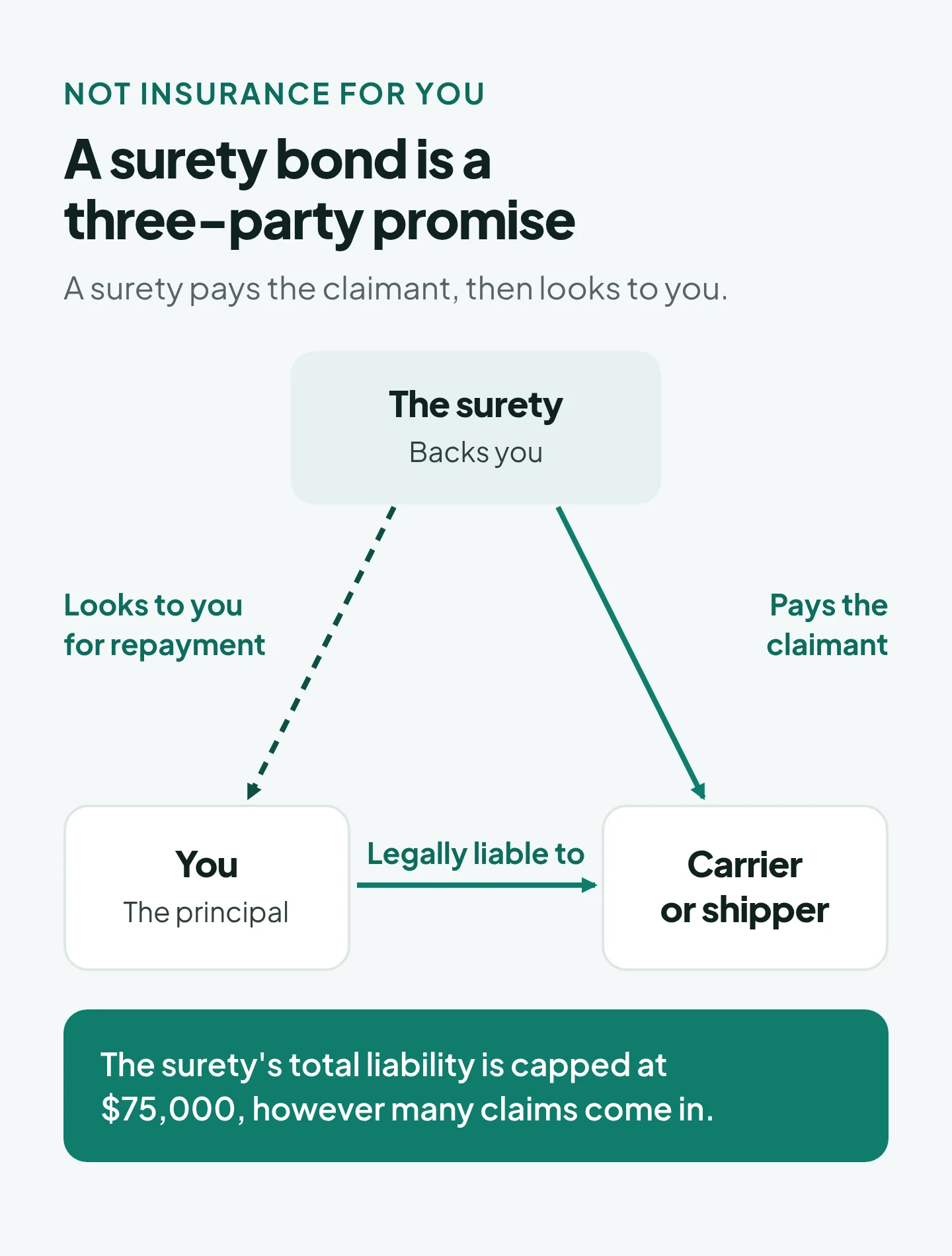
A surety bond is a three-party promise. You are the principal. The surety is the company that backs you. On the Form BMC-84 (revision of 14 May 2024), the two of you are bound to the United States for $75,000, for the benefit of motor carriers and shippers you become legally liable to.
That is why a bond is not insurance for your business. An insurance policy pays so you don’t have to. A surety pays the claimant, then looks to you. The form caps the surety’s total liability at $75,000, however many claims come in.
The wording on scope differs by source, and it matters if you are a claimant. The statute says the security pays claims arising from a broker’s failure to pay freight charges. The regulation and the form are wider: failure to carry out contracts, agreements or arrangements for supplying transportation. Unpaid carriers are the plain case. Whether a shipper’s cargo-damage claim qualifies depends on the facts and the contract, so ask an attorney. Contingent cargo cover is a separate, commercial purchase. The bond itself is one filing among several on the full path to broker authority.
Congress raised the requirement from $10,000 to $75,000 for most property brokers in the 2012 MAP-21 law, and from $25,000 for household goods brokers (88 FR 78656). FMCSA amended its rules on 1 October 2013. Small-broker groups have twice asked for an exemption, and FMCSA last refused in December 2021 (86 FR 71538). Don’t plan around a cheaper option.
What a freight broker bond costs
The arithmetic is simple. The price is harder, because each surety underwrites you individually and sellers publish only ranges.
| Rate | Yearly premium | Per month |
|---|---|---|
| 1% | $750 | $63 |
| 2% | $1,500 | $125 |
| 3% | $2,250 | $188 |
| 5% | $3,750 | $313 |
| 8% | $6,000 | $500 |
| 12% | $9,000 | $750 |
These figures are arithmetic, not quotes. Monthly amounts are rounded, and not every surety offers monthly payment. Here is what the record does say, oldest evidence first.
| Source and date | What it says | In dollars a year |
|---|---|---|
| Motor carrier coalition, in FMCSA’s December 2021 notice | Less than $2,000 on average | Under $2,000 |
| Trade group, in FMCSA’s January 2023 proposal | 1% to 2% for a creditworthy broker | $750 to $1,500 |
| Surety, same document | 2% to 5%, driven by the credit of the business and its indemnitors | $1,500 to $3,750 |
| Second surety, same document | 1% to 4% for license and permit bonds generally | $750 to $3,000 |
| Surety Bond Authority, updated 28 May 2026 | One range for all applicants, based on a soft credit pull | $1,500 to $3,500 |
| Cornerstone Surety Bonds, verified 16 June 2026 | Illustrative: about 1% to 2% for an experienced broker with strong credit, 3% to 5% with average credit, a higher rate for new or credit-challenged applicants | $750 to $3,750, or more |
The Federal Register rows are comments from interested parties, not FMCSA findings, and some are years old. The company rows are sales pages, reported as published on the date shown. None is a price list. Our $1,500 to $3,750 planning range is the surety comment’s 2% to 5%, which lines up with the Surety Bond Authority range and Cornerstone’s average-credit band. It is our reading, not a market survey, and Cornerstone says new applicants can pay more.
What moves your price
- Owner credit. Cornerstone calls the owners’ personal credit the main driver, and Surety Bond Authority prices on a soft pull of the owners’ credit.
- Who stands behind the bond. One surety told FMCSA that pricing turns on the credit of the business and its “qualified indemnitors”. Those are the people or companies who sign to repay the surety. An industry association president, in an affidavit quoted in the 2021 notice, tied a yearly cost of about $2,000 or less to a personal guarantee by the owner.
- Record. Cornerstone also lists time in business, broker experience, company financials on higher-risk files and any prior claims.
Collateral can dwarf the premium
Premium is not always the whole bill. Surety Bond Authority says that first-year applicants who have not held this bond before put up $25,000 in cash, typically refunded at the second-year renewal if there were no losses (page updated 28 May 2026). That is one company’s policy, not a rule. Ask every surety whether it wants collateral, in what form, and exactly when you get it back.
FMCSA itself charges the surety a $10 service fee per accepted bond. Ask whether any filing or broker fee is added on top of the premium.
Three worked examples
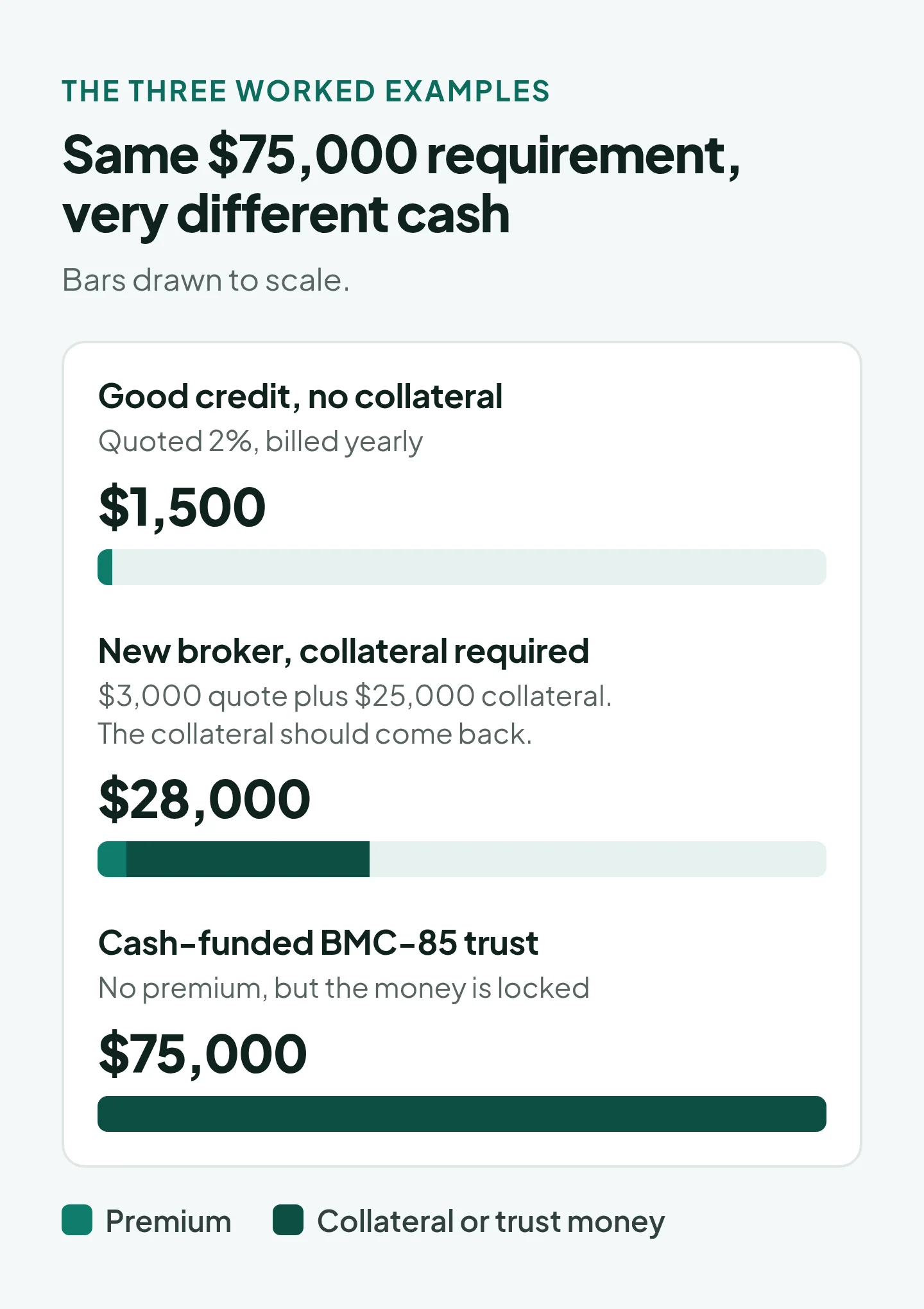
Good credit, no collateral. An owner with a long, clean credit file is quoted 2%. The bill is $1,500 a year. Over three years that is $4,500, assuming the rate holds.
New broker, collateral required. A first-time owner is quoted $3,000 and asked for $25,000 in collateral. Cash out the door on day one is $28,000, though the collateral should come back. If that cash would otherwise earn the 1-year Treasury par yield of 4.36% on 30 October 2026, the lost return is about $1,090 a year, so the true first-year cost is closer to $4,090.
Cash-funded trust. A broker with savings puts $75,000 into a BMC-85 trust. There is no premium, but the money is locked. At 4.36%, $75,000 would earn about $3,270 a year elsewhere. If the trust holds Treasury bonds and the agreement lets you keep the interest, much of that comes back, less the trustee’s fee. Ask the trustee both questions. Either way, that $75,000 can’t cover carrier payments while you wait for slow shippers. New brokers often need that cash, which is why factoring your invoices comes up so early.
Bond or BMC-85 trust?
| BMC-84 surety bond | BMC-85 trust fund | |
|---|---|---|
| What backs it | A surety’s promise | $75,000 in cash, irrevocable letters of credit from a federally insured depository institution, or Treasury bonds |
| Cash needed | Premium, plus any collateral | Enough to fund the trust, unless a letter of credit does it |
| Liquidity rule | Not applicable | Assets must convert to cash within 7 calendar days |
| Who can provide it | A surety company, or a risk retention group | A financial institution listed in 387.307(c). Loan and finance companies were removed |
| Claims | Surety pays, then seeks repayment under your indemnity | Paid from the trust, so you need to restore it |
| Suspension rules | Same | Same |
Trusts took on limits that bonds did not. FMCSA’s November 2023 final rule limited trust assets and trustees, with compliance later moved to 16 January 2026. In that rule, FMCSA wrote that about 93% of the BMC-85 market sat with the top five trustees, and that 97% of trustees served five or fewer brokers.
Be careful with any “trust” that costs a small yearly fee and asks you for almost no money. A surety told FMCSA that when providers at a May 2016 roundtable were asked whether they collected $75,000 to hold in trust, none said they did, and that they took a small annual fee instead (88 FR 830). The rule now says the trust must contain assets totaling $75,000. Ask where those assets are, who funded them and which listed institution is the trustee.
We could not confirm a current market price for a compliant trust, so get the trustee’s fee in writing. For most new brokers without $75,000 to spare, the bond is the practical choice.
How to get the bond
- Set up the company first. The bond should carry the exact legal name on your application.
- Get two or three quotes before you apply. Ask for each in dollars, in writing.
- Apply for authority in Motus. Your USDOT and MC docket numbers let the surety complete and file the BMC-84.
- Sign the indemnity and pay. The surety files. The rule in force, 49 CFR 365.109T, gives 20 days from the application notice in the FMCSA Register, but there is no reason to wait. The same 20 days apply to your BOC-3 process agent filing.
- Confirm it shows on your record. Don’t book a load until FMCSA shows active authority.
Before you sign, get answers to these:
- Is this the total yearly cost, with every fee included?
- Is collateral required? When and how is it returned?
- Who signs the indemnity, and does it reach my spouse or my other companies?
- What does renewal cost, and can the rate change?
- How do I hear about claims, and who is my contact? You have 7 business days, so the notice must reach someone who reads it.
What happens when someone claims on the bond
Under 49 U.S.C. 13906(b)(2), the bond pays if you consent, if you don’t respond to adequate notice and the surety finds the claim valid, or if the claimant wins a judgment. The surety must respond to a claim within 30 days and explain any denial in writing. Attorney’s fees can’t be deducted from the $75,000, and the winner of a lawsuit against the surety recovers reasonable costs and fees. This is how the suspension process then runs.
| Stage | Deadline | What happens |
|---|---|---|
| Claim notice | 7 business days for you to respond | No response, and the surety may pay a claim it finds valid |
| Payment or determination | Surety tells FMCSA within 2 business days | Triggered by a payment that takes the bond below $75,000, or a finding that you are failing and claims will breach it |
| FMCSA notice | 7 business days from service | Show the notice was an error, restore the bond to $75,000, or prove the claims were paid without the bond |
| No response | Suspension entered | You can still ask FMCSA to lift it with the same evidence |
| Not cured | Surety starts cancellation | FMCSA posts the notice in the FMCSA Register |
| Claims window | 60 calendar days from that notice | Surety must accept claims, then pay uncontested claims within 30 days after the window closes |
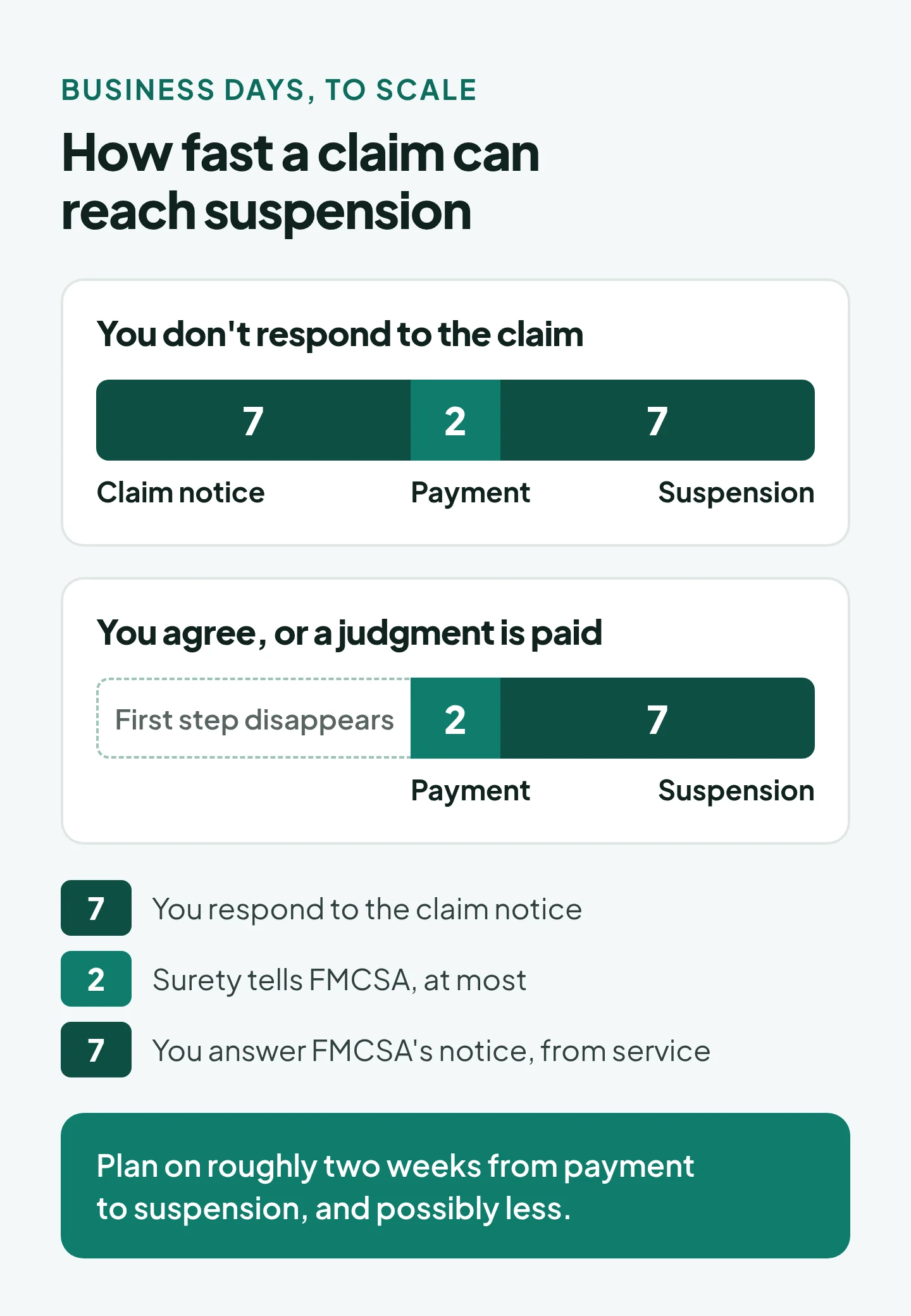
The clock can be short. If you agree to a payment, or a judgment is paid, the first step disappears. That leaves up to 2 business days for the surety, then 7 for you once FMCSA serves its notice. Plan on roughly two weeks from payment to suspension, and possibly less. The cheapest fix is often paying a valid claim yourself before the bond is touched, which is one more reason to hold cash.
This happens often enough to plan for. In its 2023 proposal, FMCSA’s best estimate, on data it called limited, was that about 1.3% of brokers, roughly 440 in 2022, would see a drawdown in a year, with an average claim of about $1,700. It also estimated that 17% of those brokers might face claims above $75,000. A $1,700 claim is small. On the wording of the rule it can still start the process, because any payment from a bond sitting at exactly $75,000 takes it below the minimum.
A bankruptcy filing changes the path. The surety notice rule does not apply once a broker has filed under Title 11, and a bankruptcy filing is not itself a “financial failure” under the section.
When $75,000 is not enough
If you are a carrier owed money by a failing broker, the $75,000 is shared. When uncontested claims exceed what is available, the statute has the surety pay a pro rata share. FMCSA’s 2023 proposal records a September 2018 case in which a surety asked a federal court how to split one $75,000 bond among 646 claimants. That is an average of about $116 per claimant. Separately, a carrier representative told FMCSA it collected about 10% of what it was owed.
So file inside the 60-day window, with your rate confirmation, proof of delivery and invoice. For future loads, look up a broker first and check its credit before you haul. A bond protects you partly and late.

Renewing, switching and cancelling
- There is no expiry date to watch in the rule. Bonds stay in effect continuously until terminated. “Renewal” is your yearly premium bill. Miss it and the surety can cancel.
- Cancellation takes 30 days. Either you or the surety can file Form BMC-36. The period runs from FMCSA’s actual receipt.
- Switching sureties is allowed. A replacement bond ends the old surety’s liability on the replacement date, but not for contracts you made before that date. File the new one before the old one ends, so you never have a gap.
- Your registration lasts only as long as the bond. Brokering without the required security breaks 49 U.S.C. 14916. FMCSA’s penalty schedule sets up to $13,676 per violation for knowing violations, generally counting each day as a separate violation, and officers, directors and principals are jointly and severally liable, including for valid claims. A petition to reinstate revoked authority costs $80 under 49 CFR 360.3T, on top of a new bond.
- Closing down? Ask the surety how long it holds any collateral after cancellation, because claims can still arrive for loads moved while the bond was active.
Three claims not to rely on
- “The bond rose to $150,000 in July 2026.” At least one trucking website says this, without a citation. It is wrong. The current regulation, as of 29 October 2026, still says $75,000, and the statute fixes the same figure. FMCSA’s only 2026 change to 387.307 we found was a July 2026 correction of cross-references.
- “You have 7 calendar days to replenish.” Many pages repeat this, and the executive summary of FMCSA’s 2023 final rule uses those words. The regulation text says 7 business days from service of the notice. The 7 calendar days applies to how quickly trust assets must convert to cash. Respond at once in any case.
- “FMCSA said over 90% of trust providers no longer qualify.” Several websites repeat this, and some credit FMCSA. We read the rule’s preamble and it is not there: it says FMCSA had no data on how many loan and finance companies served as trustees. We could not open the rule’s separate regulatory analysis, so treat the figure as unconfirmed.
Common questions
Does the bond cost more in some states?
The amount is federal and identical everywhere. Rates are set by each surety, based mainly on you. We found no public state-by-state price data.
Can I get a bond with bad credit?
Often yes, at a higher rate or with collateral, and some sureties will decline. We found no reliable published rate for this group, so get a written quote. If the numbers don’t work, starting as a freight agent under another broker’s bond costs nothing in bond premium, and the agent route lets you build a record first.
Does each agent or branch need a bond?
No. The statute requires $75,000 per broker, regardless of the number of branch offices or sales agents. Agents work under the brokerage’s bond, and a claim caused by an agent’s load still lands on that one bond.
Do freight forwarders need the same bond?
Yes. 49 CFR 387.405 sets the forwarder minimum equal to the broker amount, and the BMC-84 form covers both. Forwarders and brokers differ in other ways. If you hold both authorities, ask your surety how it wants to file.
Do I get the premium back if nobody claims?
Not because nobody claimed. A premium is the price of the surety’s backing, not a deposit. Collateral is different, and should come back on the terms in your agreement. Ask about refunds for mid-year cancellation before you pay.
Facts checked against primary sources on 1 November 2026: the eCFR (Title 49, Parts 360, 365, 386 and 387, current through 29 October 2026), the Federal Register, the U.S. Code, FMCSA Form BMC-84 and U.S. Treasury yield data. Premium figures come from public comments and company pages, dated above, and are not quotes. Every figure is checked against the linked source. This page is general information, not legal, tax or financial advice.
Sources
- eCFR: 49 CFR 387.307, Property broker surety bond or trust fund
- U.S. Code: 49 U.S.C. 13906, Security of motor carriers, brokers, and freight forwarders
- U.S. Code: 49 U.S.C. 14916, Unlawful brokerage activities
- FMCSA Form BMC-84, revision of 14 May 2024 (OMB copy)
- Federal Register: Broker and Freight Forwarder Financial Responsibility, final rule (16 November 2023, 88 FR 78656)
- Federal Register: Broker and Freight Forwarder Financial Responsibility, proposed rule (5 January 2023, 88 FR 830)
- Federal Register: Extension of Compliance Date (31 December 2024)
- Federal Register: SBTC exemption application denied (16 December 2021, 86 FR 71538)
- Federal Register: Amendments to implement MAP-21 (1 October 2013, 78 FR 60226)
- Federal Register: General technical amendments (21 July 2026, 91 FR 45653)
- eCFR: 49 CFR 360.3T, Filing fees
- eCFR: 49 CFR 365.109T, FMCSA review of the application
- eCFR: 49 CFR 387.405, Limits of liability
- eCFR: Appendix B to Part 386, Penalty schedule
- U.S. Treasury: Daily par yield curve rates, October 2026
- Surety Bond Authority: Freight Broker Bond (company page, updated 28 May 2026)
- Cornerstone Surety Bonds: Freight Broker Bond (company page, verified 16 June 2026)