A bill of lading (BOL) is the document a motor carrier issues when it picks up freight. It is the receipt for the goods, it carries the terms of the move, and it is the first thing anyone reaches for when a load arrives short or damaged. Our free one-page bill of lading form is below: type into it or print it blank. The main federal rule, 49 CFR 373.101, requires only five kinds of information, but other rules can add to that, carriers expect more, and the National Motor Freight Classification (NMFC) calls for the item number, sub-provision and class on freight moving under it. This guide, part of our software and paperwork hub, goes through the form box by box, with a filled-in example and the record-keeping periods.
This is general information, not legal, tax or financial advice. Check your carrier’s tariff and your own contracts, and ask a transportation attorney about anything with real money at stake.
Download the free template
Download the bill of lading template (PDF, one US Letter page). No email or sign-up. It is a straight bill of lading in short form, marked not negotiable, with fillable fields and tick boxes. It also prints cleanly in black and white for filling out by hand.
It suits ordinary domestic truck freight, LTL or truckload, when the carrier has no form of its own. Four things to know before you rely on it:
- A carrier’s own terms beat your form. FedEx Freight’s 100-Y rules tariff (effective 5 January 2026), for one, says terms on a pre-printed bill tendered by a shipper and signed by its driver do not apply unless an officer of the carrier agreed in writing. A blank template sets out shipment details. It does not rewrite the carrier’s rules.
- The NMFC reference is conditional. NMFTA’s posted terms state that only participants in the NMFC at the time of transport may use those provisions, so the form applies them only where the carrier participates. A small truckload carrier may not participate, so ask. Participants can also vary them: FedEx Freight’s tariff says its references to NMFC bill of lading terms mean the version of 1 August 2016, without the amendments that took effect later that month. Check which terms your carrier uses before relying on the sections quoted below.
- It is not for household goods moves. A mover working for an individual must issue a bill of lading with the items set out in 49 CFR 375.505, 17 in all.
- It is not an order bill. If the goods are consigned “to the order of” someone, the bill is negotiable (49 U.S.C. 80103) and needs different handling. See types of bill below.
What a bill of lading does
It does three jobs at once.
- Receipt. It records what the carrier took, how many pieces and in what visible condition.
- Contract terms. It names the parties and brings in the carrier’s rates and rules or a separate contract. Under 49 U.S.C. 14706, the Carmack Amendment, the receiving carrier and the delivering carrier are liable for actual loss or injury to the property.
- Evidence. It tells the driver where the freight goes and who pays, and the signed delivery copy becomes your proof of delivery.
The legal duty to issue it sits with the carrier: 49 CFR 373.101 says every covered motor carrier “shall issue a receipt or bill of lading”. In practice the shipper or broker usually prepares the form and the driver signs it. Skipping it does not help a carrier. Section 14706 says failure to issue one “does not affect the liability of a carrier”.
49 U.S.C. 80116 makes it a crime, with up to five years in prison, to falsely make, alter or copy a bill of lading knowingly or with intent to defraud, or to issue one that was.
What the rules require on the form
The legal minimum is short. The commercial minimum is not. Each layer below adds to the one above.
| Layer | What it asks for | Who it binds |
|---|---|---|
| 49 CFR 373.101 | Names of consignor and consignee; origin and destination; number of packages; description of freight; weight, volume or measurement if that affects the rating | For-hire, non-exempt motor carriers, for interstate or foreign shipments |
| 49 U.S.C. 80103(b)(2) | The words “nonnegotiable” or “not negotiable” on a nonnegotiable bill | Common carriers issuing bills in interstate commerce |
| NMFC bill of lading rule, Item 250100 | Description that matches the tariff, including article, package, special markings, exceptions, NMFC item number, sub-provision and class (NMFTA FAQ) | Shipments moving under the NMFC, unless the carrier’s tariff or a contract says otherwise |
| Carrier tariff or contract | Whatever it adds: freight terms, value declarations, handling-unit counts | Parties to that carrier’s service |
| 49 CFR 172.202, 172.204 and 172.604 | Hazmat description, emergency phone number and shipper’s certification | Anyone offering hazmat, when a shipping paper is required |
The NMFC layer changed recently. NMFTA’s FAQ says Supplement 2025-2, effective 6 December 2025 (Disposition Bulletin 1372 gives the same date for that docket’s supplement), added “digital” to the bill of lading rule, so it now covers printed, digital and electronic bills and, in Sec. 2(c), calls for descriptions that mirror the tariff. The rule now sits at Item 250100 and the uniform terms at Item 250150, and forms have been catching up: ABF Freight’s May 2025 form points to “NMFC item 360”, while its July 2026 blind bill of lading form cites Item 250100. A form that still cites Item 360 is using the old number, so check it against the carrier’s current one.
How to fill out a bill of lading, box by box
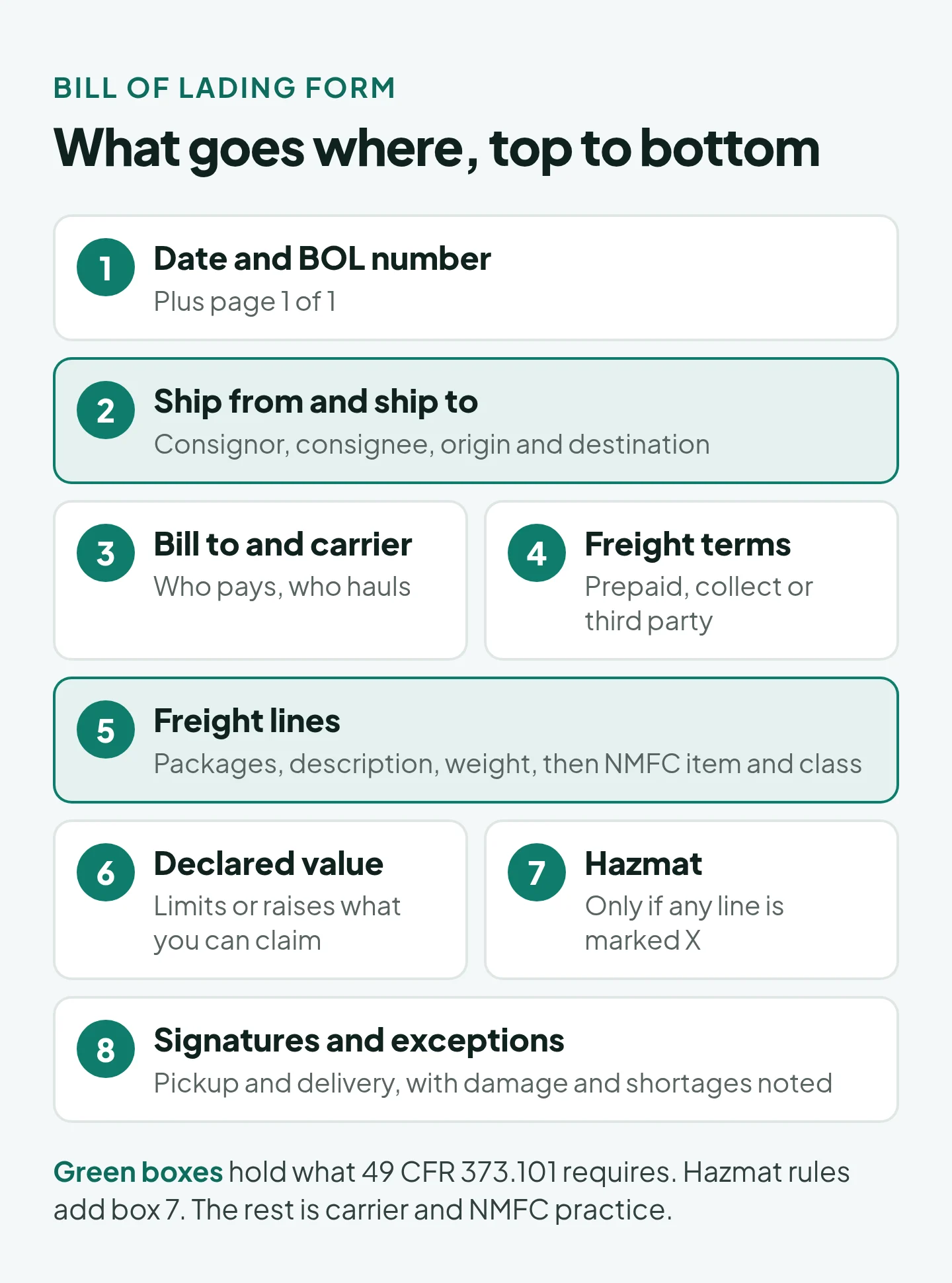
The numbers match the diagram above.
1. Date and BOL number
Use the date the carrier picks up. The posted NMFC terms count the nine-month deadline for loss claims from the date of the bill. FedEx Freight’s Item 960 counts from delivery, or from the scheduled delivery date if the freight never arrives. Give each bill a unique number, and if you run several pages, show “Page 1 of 2”. A broker needs that number or the freight bill number on file under 49 CFR 371.3.
2. Ship from and ship to
Enter the full legal name of the consignor and consignee, street address and a contact who answers the phone. Add your order or PO number in the reference line. Flag a residential or limited-access address here and in the special instructions, because carriers price those differently and may bill the extra after delivery.
3. Bill to and carrier
Fill in third party bill-to only if someone other than the shipper or consignee pays, usually a broker or a logistics provider. Then enter the carrier’s name exactly as it appears on its authority, its Standard Carrier Alpha Code (SCAC) if it has one, and its USDOT or MC number. For truckload, add trailer and seal numbers at pickup, because a recorded seal number is your evidence of whether the trailer was opened. The PRO number is the carrier’s tracking number, and on LTL it is often added by the carrier.
4. Freight terms and special instructions
Mark one box. Prepaid means the shipper pays the carrier, collect means the consignee pays, and third party means the bill-to party pays. Do not leave it blank. Under paragraph 6 of FedEx Freight’s own tariff Item 360, a US shipment with no terms stated moves as prepaid and the consignor pays, and paragraph 4 charges $50 to change the payer or payment status afterwards, if it accepts the change at all. Other carriers set their own rules.
If the shipper wants a collect load delivered with no comeback on it for unpaid charges, the template has the common “without recourse” signature line in box 6. Sign it only if that is the deal. Liability for charges is otherwise set by the terms you ship under: Sec. 7 of NMFTA’s posted version makes the consignor, consignee or shipper liable, and 49 U.S.C. 13706 has a separate rule for consignees acting only as agents.
List every paid service in the special instructions: liftgate, inside delivery, appointment, temperature range. A service missing from the BOL may be missing from the driver’s plan too. Book it with the carrier as well, because a note alone may not bind it. If the receiver uses a paid unloading crew, agree in writing who pays any lumper fee before the load moves.
5. Freight lines
This is the box that decides your invoice. Use one line for each commodity or class.
- Handling units: count and type of what the carrier actually moves, such as 2 pallets. FedEx Freight’s capacity rule warns that if the bill shows stacked skids rather than the handling units tendered, it will use the higher count.
- Packages: what is on those units, such as 40 cartons. This is the “number of packages” the federal rule asks for, and it is your count for a shortage claim.
- Weight: gross pounds per line, pallets and packaging included. Weigh it rather than estimating. Give units of different sizes their own lines: density is worked out per handling unit, but with only a total weight on the papers it may be worked out on the total weight and total cube (NMFC Item 110, Sec. 8(d), as quoted in NMFTA’s Docket 2026-2 analysis; a proposal to change that exception was disapproved in October 2026).
- HM: an X only for hazardous materials.
- Description: the words in the NMFC item, not your SKU name. Add “used” or “reconditioned” if true: FedEx Freight limits liability to 50 cents a pound per package, or $10,000 per incident if lower, when used goods are not described that way on the original bill.
- Dimensions: longest points, in inches, per unit. Our density and class calculator turns these into pounds per cubic foot.
- NMFC item, sub and class: look up the item. The class depends on it, and our freight class chart explains the scale. On a truckload priced per mile or flat, class usually does not matter, but the description still does.
Get this wrong and the carrier corrects it. Sec. 7(d) of NMFTA’s posted terms says that if the description, weight or density is incorrect, charges “must be paid based upon the articles actually shipped”, and Sec. 7(c) gives the carrier the right to inspect. Requests to fix a description later can need paperwork: FedEx Freight asks for documents it finds acceptable, such as the original invoice.
6. Declared value
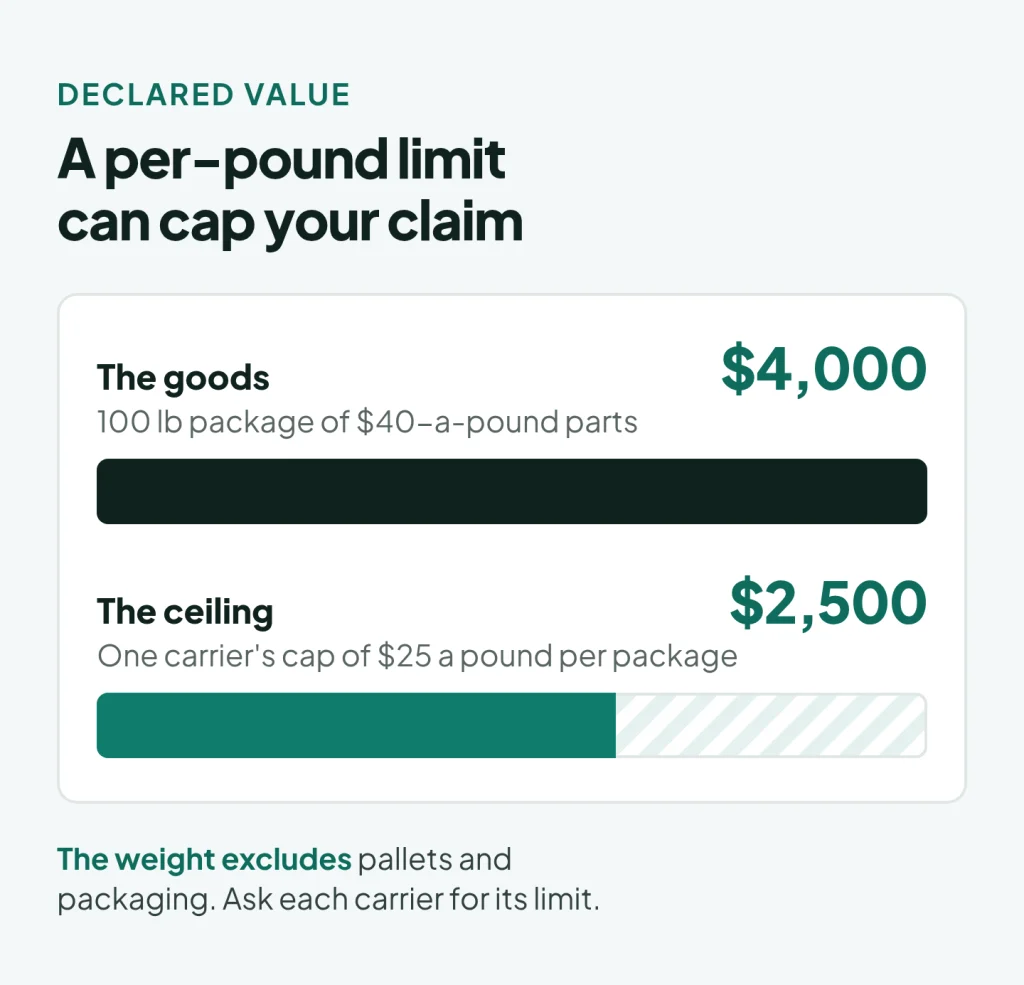
Carriers may limit liability to a value set by written or electronic declaration or written agreement, if reasonable, and must give you the rules behind the rate on request (49 U.S.C. 14706(c)(1)). So the number you write, or the number in the tariff when you write nothing, can cap your recovery. Sec. 5(a) of the posted terms multiplies a released value by the weight of the individual article lost or damaged, not the weight of the whole pallet.
A real example: FedEx Freight’s tariff caps new goods at actual cost, up to $25 a pound per package or $100,000 per incident, whichever is lower, unless you buy excess coverage and note it on the bill. The weight excludes pallets and packaging. A 100 lb package of $40-a-pound parts therefore has a $2,500 ceiling on $4,000 of goods. The same tariff lists articles worth more than $50 a pound per package among the items it will not accept. Ask each carrier for its limit. Some commodities also get a lower class only when a released value is shown on the bill, so check the NMFC item before you leave this blank.
7. Hazardous materials
If any line is regulated hazmat, the bill also serves as the shipping paper, and these rules apply on top. A carrier may not accept or transport the load without a compliant paper (177.817(a)), unless the material is excepted.
- Make hazmat lines stand out. Enter them first, in a contrasting color, or with an X in the HM column (49 CFR 172.201).
- Use the set sequence. Identification number, proper shipping name, hazard class, packing group, as in the regulation’s example “UN2744, Cyclobutyl chloroformate, 6.1, (8, 3), PG II”, plus total quantity with units and the number and type of packages (49 CFR 172.202). Do not use codes or abbreviations unless the rules allow them (172.201(a)(3)).
- Give an emergency number. It must be monitored whenever the material is in transportation, and a callback service does not qualify (49 CFR 172.604). Identify the registrant or contract number if you use a provider.
- Sign the certification. The template prints the wording from 49 CFR 172.204(a)(1). A principal, officer, partner or employee of the shipper, or its agent, must sign it, and on our form that is the shipper signature in box 8.
- Keep it where the rule says. The paper must be tabbed or on top, within the belted driver’s reach, or in the door pouch or on the seat when the driver is out of the cab (49 CFR 177.817).
Our form has one line of description per row, so use several rows if needed. Check Part 172, including its exceptions, or get help from your hazmat trainer before shipping.
8. Signatures, counts and exceptions
At pickup, the shipper signs and the driver signs. At delivery, the consignee signs. Each should print a name, date and time, and the driver and consignee should write the piece count. Then read the next section, because the boxes around the signatures decide who answers for a shortage.
Exceptions and shipper’s load and count
An exception is a note on the bill recording a problem: “1 pallet corner crushed”, “39 cartons, not 40”. Note it on every copy before signing, and have the other side initial. A clean signature on a damaged load makes a later claim much harder to prove: FedEx Freight’s Item 960 treats receipt with no written damage notice as prima facie evidence of good condition. Do not write only “subject to inspection”: give the count and the condition you can see. A note on the bill is not a claim, either: 49 CFR 370.3(c) says such notations alone do not meet the filing requirements, so file separately.

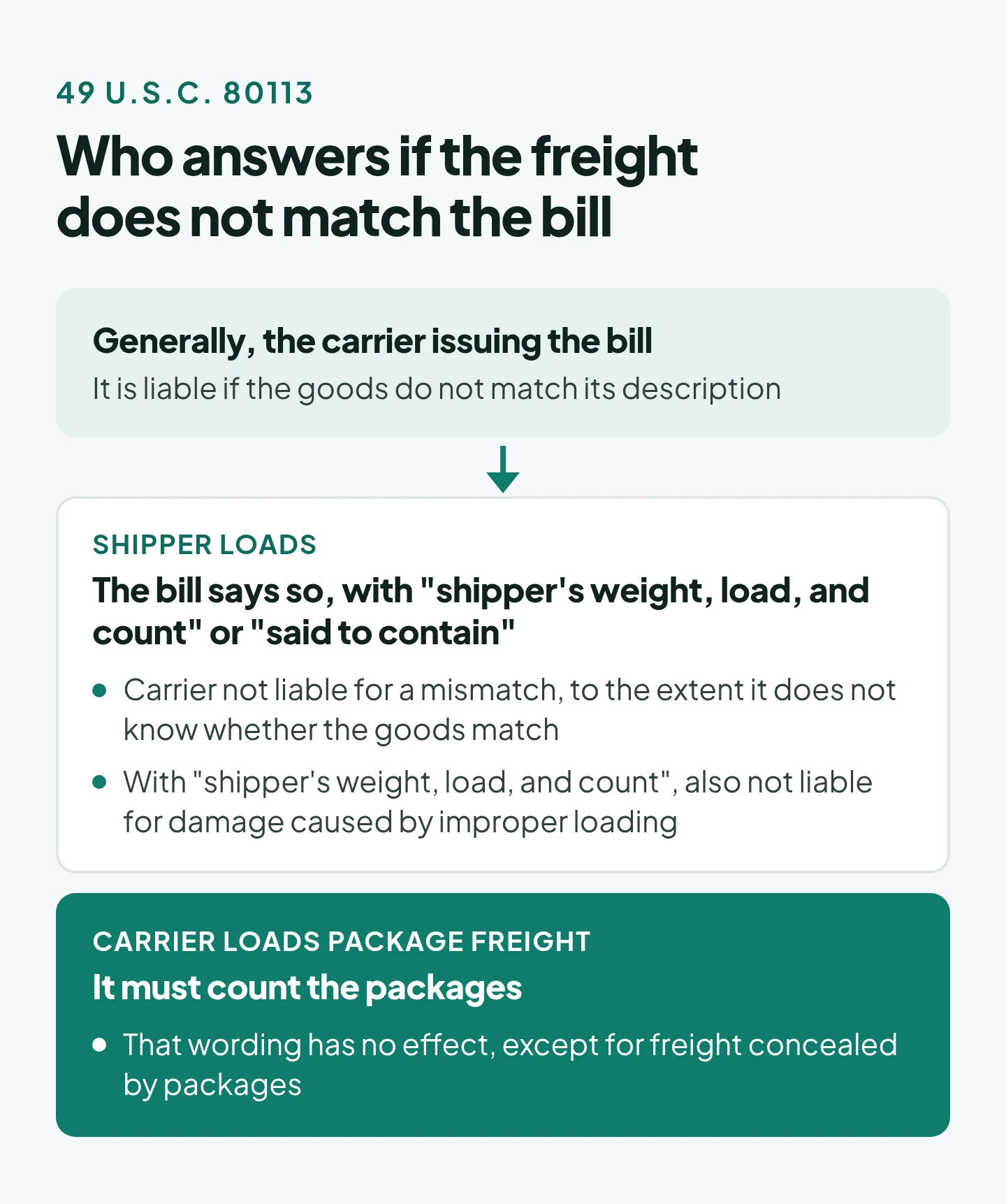
The “loaded by” and “counted by” boxes carry legal weight. Under 49 U.S.C. 80113, a carrier issuing a bill is generally liable if the goods do not match its description, to an owner or holder who gave value in good faith relying on that description. It is not liable for that when the shipper loaded the goods and the bill says so with words like “shipper’s weight, load, and count” or “said to contain”, to the extent the carrier does not know whether the goods match. If the shipper loads and the bill says “shipper’s weight, load, and count”, the carrier is also not liable for damage caused by improper loading. The reverse holds too: when the carrier loads package freight it must count the packages, and that wording has no effect except for freight concealed by packages.
So use these boxes truthfully. A driver who cannot see into a sealed trailer should get SLC on the bill. A shipper who watches a driver count should mark driver count. The driver’s signature also means less than people think: FedEx Freight’s tariff and ABF Freight’s July 2026 blind bill form both say it only acknowledges receipt of the freight.
Worked example: two pallets, LTL
A made-up shipment. Sample Hardware Co. in Dayton, Ohio sends two pallets of boxed goods, 40 cartons in all, to Sample Supply in Erie, Pennsylvania. Each pallet is 48 × 40 × 24 inches and weighs 500 lb gross. Each unit is 26.67 cubic feet, so density is 18.75 pcf. If the NMFC item uses the 13-tier density scale, that is sub 9, class 70.
| Box | Entry |
|---|---|
| 1. Date, number | 3 November 2026; BOL 26-1103-01; page 1 of 1 |
| 2. Ship from, ship to | Sample Hardware Co., street address, Dayton, OH, ZIP, contact and phone; Sample Supply, street address, Erie, PA, ZIP, receiving contact; PO 5512 |
| 3. Bill to, carrier | Bill to left blank (shipper pays); carrier name, SCAC and USDOT number as they appear on its record |
| 4. Terms, instructions | Prepaid; “Liftgate at delivery. Call receiving 24 hours ahead.” |
| 5. Freight line | 2 pallets; 40 cartons; 1,000 lb; HM blank; the NMFC item’s exact description; 48 × 40 × 24; item number, sub 9; class 70 |
| 6. Declared value | Blank, after checking the carrier’s limit covers the goods |
| 7. Hazmat | Blank |
| 8. Signatures | Loaded by shipper, counted by driver; driver writes “2 pallets” and signs; consignee writes “2 pallets, 1 stretch wrap torn, 40 cartons counted”, signs and dates |
The torn wrap note costs the consignee nothing and gives it a record if cartons turn out to be damaged when opened.
Types of bill of lading
| Type | What it is | Use it when |
|---|---|---|
| Straight | Nonnegotiable. Goods go to the named consignee. | Nearly all domestic truck freight |
| Order | Negotiable: “to the order of” a consignee. A carrier that delivers without taking and canceling it can be liable (49 U.S.C. 80111). | Sales financed against the bill, usually with a bank. Agree the form with the carrier first. |
| Short form | Shipment details on the front, with terms brought in by reference to the tariff or NMFC | Standard practice, and what our template is |
| Long form | The terms printed on the back or attached | When the shipper or carrier wants them on the document |
| VICS-format | A retail-industry bill layout | When a retailer’s routing guide calls for it |
| Household goods | Contract under 49 CFR 375.505 | Moves for individuals |
| Ocean or air | Different legal regimes: an ocean bill or air waybill | Any ocean or air leg. Do not adapt a truck form. |
If you are a broker or a new carrier
Brokers. You arrange the move, so the carrier hauling it goes in the carrier box, not you. 49 CFR 371.7(b) says a broker must not represent its operations as a carrier’s, so sign nothing as carrier. If the name on a BOL at pickup does not match the carrier on your rate confirmation, stop and call before the freight moves: it can mean re-brokering you did not agree to. Keep the BOL or freight bill number with the rest of your broker transaction records. Each party to the deal has the right to review them.
Carriers. The BOL does not replace your invoice. 49 CFR 373.103 separately requires a freight or expense bill showing the exact rates, total charges and remittance address, among other items. Your BOLs also feed other files: 49 CFR 395.11 lists a bill of lading among the supporting documents for hours of service, and drivers must submit them within 13 days. If you are setting up a new carrier, build the habit on the first load: photograph the signed BOL before leaving the dock.
If you are paid a percentage as a leased owner-operator, 49 CFR 376.12(g) requires your lease to say the carrier will give you a copy of the rated freight bill at or before settlement, and 376.12(f) ties the 15-day payment window to delivery documents. Factoring companies generally want the signed BOL with your invoice, so our guide to freight factoring is worth reading before you agree to terms.
Contracts. Under 49 U.S.C. 14101(b), a shipper and carrier may expressly waive rights in a written contract, including Carmack rights. Where a contract exists, Sec. 9 of the posted NMFC terms lets bill of lading terms fill the gaps only where they do not conflict. Read the contract and the BOL together.
Electronic bills of lading
A paper form is not required. 49 CFR 390.32 lets anyone generating, keeping or exchanging documents under FMCSA’s rules use electronic methods and electronic signatures, provided the record is accurate and can be retained and reproduced, and it requires proof of consent under 15 U.S.C. 7001(c). The same data still has to be captured.
Hazmat is the exception. Section 390.32 covers FMCSA’s chapter of the CFR, and hazmat rules are PHMSA’s. The electronic shipping paper provision in 172.201(a)(5) is written for rail, and we found no electronic-only option for highway shipping papers in the regulations as of 1 November 2026. We could not check individual special permits. PHMSA did allow electronic emergency response information from 3 September 2026 (49 CFR 172.602(b)(1); 91 FR 49325), but that is a separate document. Keep a paper shipping paper in the cab.
How long to keep a bill of lading
| Who | Record | Minimum | Source |
|---|---|---|---|
| Motor carrier or broker | Copies of bills of lading, freight bills and shipping orders | 1 year | 49 CFR Part 379, Appendix A, section I |
| Broker | Transaction record, including BOL or freight bill number | 3 years | 49 CFR 371.3(b) |
| Motor carrier | Bills of lading used as hours-of-service supporting documents | 6 months | 49 CFR 395.8(k) |
| Hazmat shipper | Shipping paper | 2 years; 3 for hazardous waste | 49 CFR 172.201(e) |
| Hazmat carrier | Shipping paper | 1 year; 3 for hazardous waste | 49 CFR 177.817(f) |
Those are minimums, and legible copies count (49 CFR 390.31). Appendix A also sets longer periods for related records: bills issued for collection and their supporting data for 3 years after settlement, and claim files for 1 year after settlement. Keep claims in mind as well. A carrier cannot set less than nine months to file a claim or less than two years to sue, and the two years run from its written notice disallowing the claim (14706(e)). A claim that drags on can outlast a one-year file. Our suggestion is to keep signed BOLs for at least three years, and longer if a claim or dispute is open. Your tax adviser may want them for longer.
A claim must be in writing, identify the shipment, assert liability and ask for a specified or determinable amount (370.3(b)). The carrier must acknowledge it within 30 days and pay, decline or make a firm offer within 120 days, or report status every 60 days after that (370.5, 370.9).
Common mistakes
- Writing a total only. Put units, packages and weight on the line, or you have no count to claim against.
- Using a product name. “Widgets” invites a re-class. Copy the NMFC description.
- Estimating weight. The carrier bills on what actually shipped.
- Signing a clean bill for visible damage. Note it first, and take a photo.
- Putting instructions in remarks and assuming they bind. FedEx Freight’s tariff says remarks are informational only.
- Reusing an old form. An older template may have no room for item and sub-provision.
Common questions
Who fills out the bill of lading?
The legal duty to issue it is the carrier’s. In practice the shipper, or a broker or logistics provider for the shipper, completes it, and the driver checks and signs at pickup.
Is a bill of lading the same as a proof of delivery or a freight bill?
No. The BOL covers the shipment. The signed delivery copy is commonly used as proof of delivery, though some carriers issue a separate one. The freight bill is the carrier’s invoice.
Is a bill of lading the same as a rate confirmation?
No. A rate confirmation is between broker and carrier and sets the price. The BOL travels with the freight.
Do I need one for an intrastate or private shipment?
Section 373.101 covers for-hire, non-exempt carriers on interstate and foreign shipments, and 373.105 allows a simplified system for low-value packages. A private fleet moving its own goods is outside Part 373, and intrastate moves depend on state law. Most operators use a BOL anyway because it is the record everyone expects, and hazmat paper rules still apply. Ask your state if you are unsure.
Can a bill of lading be changed after pickup?
Yes, by a corrected bill or written request the carrier accepts, usually with supporting documents and sometimes a fee. Never alter a signed copy yourself. Issue a correction and keep both.
Facts checked against primary sources on 1 November 2026: the eCFR (Title 49, current through 29 October 2026), the U.S. Code, the Federal Register, NMFTA, and the FedEx Freight and ABF Freight documents named above, which are examples of carrier practice, not recommendations. NMFC terms here come from NMFTA’s posted copy from NMF 100-AV. NMFTA’s Item 250100 FAQ was read in full on NMFTA’s help centre on 11 November 2026 and matches what this page says. The full current NMFC is sold by NMFTA, so check your edition. Every figure is checked against the linked source. This page is general information, not legal, tax or financial advice.
Sources
- eCFR: 49 CFR 373.101, 373.103, 373.105 (receipts and bills)
- eCFR: 49 CFR 371.3 and 371.7 (broker records, misrepresentation)
- eCFR: 49 CFR Part 379, Appendix A (record retention)
- eCFR: 49 CFR 172.201, 172.202, 172.204, 172.602, 172.604 (hazmat shipping papers)
- eCFR: 49 CFR 177.817 (shipping papers on the highway)
- eCFR: 49 CFR 390.31 and 390.32 (copies, electronic documents and signatures)
- eCFR: 49 CFR 395.8 and 395.11 (supporting documents)
- eCFR: 49 CFR 376.12 (lease requirements)
- eCFR: 49 CFR 375.505 (household goods bill of lading)
- eCFR: 49 CFR 370.3, 370.5 and 370.9 (claims)
- U.S. Code: 49 U.S.C. 14706 (Carmack Amendment)
- U.S. Code: 49 U.S.C. 14101 (contract carriage)
- U.S. Code: 49 U.S.C. 13706 (liability for rates)
- U.S. Code: 49 U.S.C. 80103 (negotiable and nonnegotiable bills)
- U.S. Code: 49 U.S.C. 80111 (liability for delivery)
- U.S. Code: 49 U.S.C. 80113 (nonreceipt, misdescription, improper loading)
- U.S. Code: 49 U.S.C. 80116 (criminal penalty)
- U.S. Code: 15 U.S.C. 7001 (electronic records consent)
- Federal Register: Hazardous Materials: Reducing Undue Paperwork Burdens to Domestic Carriers (4 August 2026, 91 FR 49325)
- NMFTA: Uniform Straight Bill of Lading Terms and Conditions (NMF 100-AV, Item 250150)
- NMFTA: NMFC Changes FAQ, updates to Item 250100
- NMFTA: Docket 2026-2 analysis (quotes NMFC Item 110, Sec. 8(d))
- NMFTA: Disposition Bulletin 1374, Docket 2026-2 Subject 1 (disapproved, 9 October 2026)
- NMFTA: Notice of Disposition, Docket 2025-2 (Bulletin 1372)
- FedEx Freight: 100-Y Rules Tariff (example of carrier terms; effective 5 January 2026)
- ABF Freight: bill of lading form (May 2025; older example citing NMFC Item 360)
- ABF Freight: blind bill of lading form (Rev. 07.09.26; cites NMFC Item 250100)