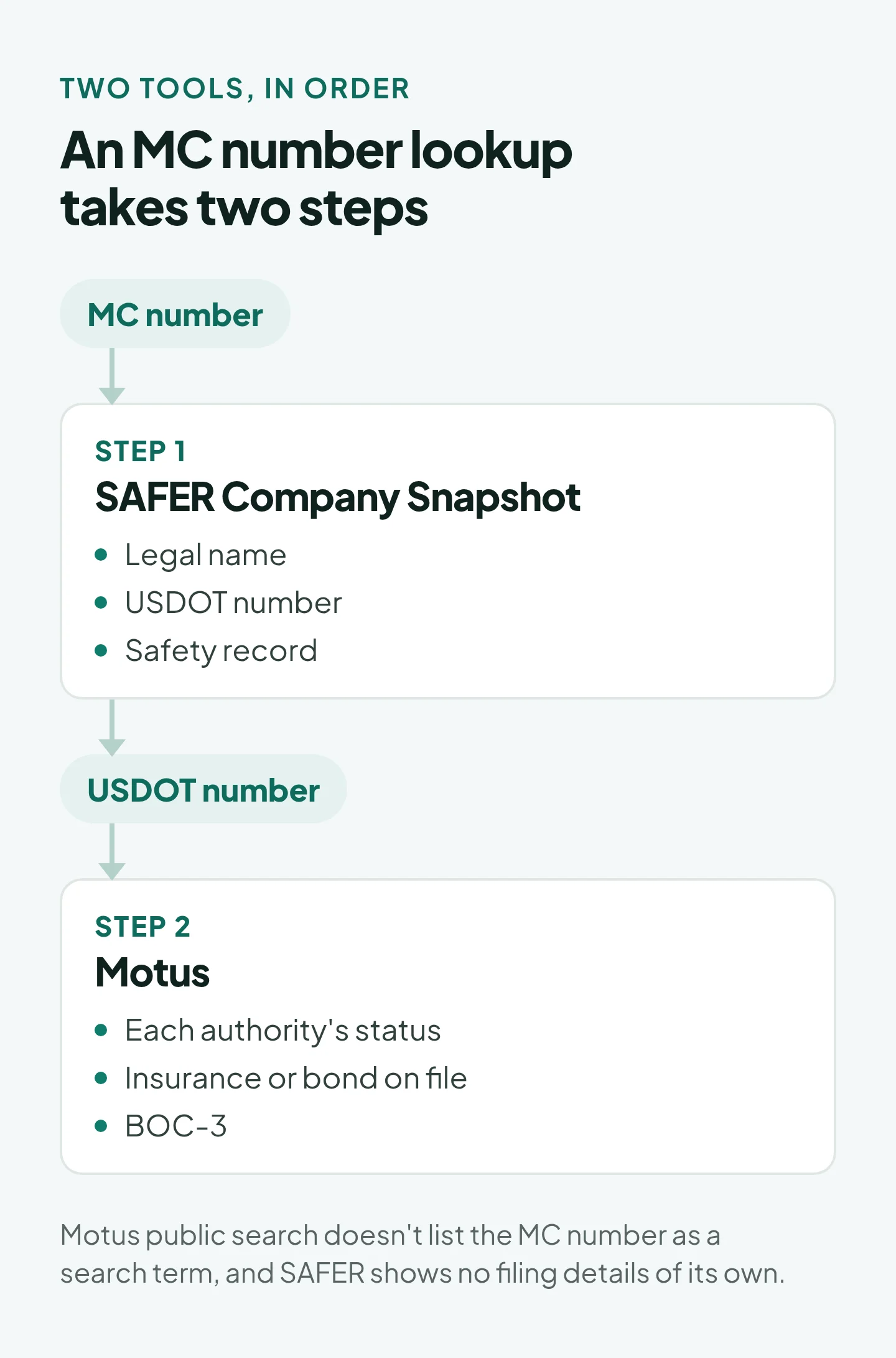
To look up an MC number or a USDOT number, enter it in FMCSA’s free SAFER Company Snapshot, which searches by USDOT number, MC/MX number or company name. That gives you the company’s legal name, USDOT number and safety record. Then open its record in Motus, FMCSA’s registration system, to see each authority’s status, the insurance or bond on file and the BOC-3. You need both steps: Motus public search doesn’t list the MC number as a search term, and SAFER shows no filing details of its own. The old Licensing and Insurance (L&I) site now serves as a history file. This guide to MC and DOT number lookup, part of our getting licensed hub, shows how to read each screen and what to do when something doesn’t match.
This is general information, not legal, tax or financial advice. A clean record does not guarantee that a company is who it says it is, or that it is safe to use.
Which FMCSA tool does what
All five are free to use. Some lookup guides still send you to L&I for authority and insurance, and an FMCSA FAQ last updated in May 2023 still points there for authority status. FMCSA’s L&I FAQ says otherwise: since 14 May 2026, L&I is for reviewing historical records, and Motus filings do not appear there.
| Tool | Search by | Use it for |
|---|---|---|
| SAFER Company Snapshot | USDOT number, MC/MX number or name | Turning an MC number into a company and USDOT number; authority summary; 24-month inspection and crash counts; safety rating |
| Motus public search | USDOT number, legal name or DBA name | Current authority status and history; insurance, bond and BOC-3 filings |
| L&I carrier search | USDOT number, MC, FF or MX docket, or name | Older records only. Don’t use it to confirm current cover |
| Safety Measurement System (SMS) | Carrier name or USDOT number, or the SMS Results link in SAFER | Inspection, crash and investigation detail |
| FMCSA Register | Not searched by company; it is a daily publication | FMCSA’s daily decisions and notices |
How to look up an MC number, step by step
- Get the number from the paperwork. Use the rate confirmation or carrier packet, not a number read to you over the phone. Note the exact company name printed beside it. If your only source is a truck door, 49 CFR 390.21T requires the name and USDOT number there, while the MC number is optional.
- Open SAFER Company Snapshot. Choose MC/MX Number, enter the number and search. If you have an FF (freight forwarder) number, SAFER’s search doesn’t offer it, so search by name or USDOT number instead.
- Compare the identity details. Check the legal name, DBA name, physical address, phone, entity type and every number in the MC/MX/FF field against the paperwork.
- Check the top of the snapshot. Read USDOT Status, Out of Service Date and Operating Authority Status. Note the “as of” date. On the live snapshot we read on 11 November 2026, it showed data as of 9 November, two days behind.
- Open the Motus record. On the live snapshot we read on 11 November 2026, the “Licensing and Insurance details” link and the “pending insurance cancellation” link both go to the company’s Motus page. If they don’t work, copy the USDOT number into Motus public search.
- Read each authority separately. Find the one that matches the job: “Broker of Property (Except Household Goods)” for a broker, “Motor Carrier of Property (Except Household Goods)” for a carrier. Confirm its docket number and status.
- Open the filings. Confirm an active BMC-91 or BMC-91X (or a BMC-82 surety bond) for a carrier, or a BMC-84 or BMC-85 for a broker, then check the BOC-3 and the authority history.
- Save a dated copy. Keep a PDF or screenshot of both records with the load file, so you can show what the record said on the day you booked.
Searching Motus by USDOT number is the reliable route. Motus’s help text calls it the quickest way and says the number must match exactly. For a name, it says to enter the start of the company’s name, but results can run wide: one two-word search in an archived copy returned 1,313 records, many of them only similar names. If you see a number such as “USDOT 1234567 B”, the letter is a registration suffix (B for broker, C for property carrier authority). Search on the digits.
How to do a DOT number lookup
A USDOT number lookup uses the same SAFER search with a different button. On the Company Snapshot search page we read on 14 November 2026, USDOT Number is the option already selected, beside MC/MX Number and Name. The USDOT number is also the one number that works in both SAFER and Motus, so if you have it, start with it. If you need a number of your own rather than a check on someone else’s, our USDOT number guide explains who needs one and how to get it.
- Find the USDOT number. It is on the carrier packet and, for an interstate carrier, on both sides of the power unit with the carrier’s name, as 49 CFR 390.21T requires.
- Search SAFER by USDOT number. Leave USDOT Number selected and enter the digits only. Drop any suffix letter such as B or C.
- Check the two status lines. USDOT Status shows whether the number is live; Operating Authority Status shows whether the company may haul or broker interstate for-hire freight. The table below explains each value.
- Read the operation fields. SAFER’s help page defines Carrier Operation as interstate, intrastate hazardous materials or intrastate non-hazardous; Operation Classification as authorized for-hire, exempt for-hire, private and others; plus power units, drivers and the MCS-150 form date and mileage.
- Open the Motus record. Paste the same USDOT number into Motus public search to see authority, insurance and the BOC-3.
| In a lookup | USDOT number | MC number |
|---|---|---|
| What it identifies | The company’s safety record | An operating authority (docket) |
| Who has one | Interstate commercial vehicle operators, some intrastate ones, brokers with authority | For-hire carriers and brokers that need authority |
| Search in SAFER | Yes | Yes |
| Search in Motus | Yes | No |
| Proves for-hire authority | No | Only with an Active status |
A USDOT number on its own doesn’t mean a company may take your load. FMCSA’s “Do I Need a USDOT Number?” page (last updated 3 September 2025, read 14 November 2026) ties the federal number to commercial vehicles in interstate commerce: 10,001 lb or more, more than 8 passengers for pay, more than 15 passengers (both counts include the driver), or hazardous materials that need a safety permit. It also lists 39 jurisdictions, Puerto Rico among them, that require a USDOT number of their intrastate carriers, and tells readers to check with their state agency. So a record showing intrastate operation and NOT AUTHORIZED can be normal for a local hauler, but it doesn’t fit an interstate for-hire load. SAFER also has a State Carrier ID field for numbers a state assigns.
How to read SAFER results
SAFER shows two statuses, and they answer different questions. USDOT Status says whether the identifying number is live. Operating Authority Status says whether the company may do for-hire interstate work. A company can be ACTIVE on the first and NOT AUTHORIZED on the second. Don’t lean on the Entity Type field either: one archived snapshot read CARRIER/BROKER while its authority line listed only motor carrier of property. The definitions below are SAFER’s own, shortened.
| Field and value | What it means | What to do |
|---|---|---|
| USDOT Status: ACTIVE | The USDOT number is active. It says nothing about for-hire authority | Keep going |
| USDOT Status: INACTIVE | Biennial MCS-150 update not completed | Ask why. FMCSA has paused this inactivation for updates missed since 1 June 2026, so check Motus too |
| USDOT Status: OUT-OF-SERVICE | Under an out-of-service order and not authorized to operate | Stop. Don’t book |
| Authority: AUTHORIZED FOR… | Lists the operating authorities the carrier or broker is allowed to use | Read the list. It must cover the work you are hiring for |
| Authority: NOT AUTHORIZED | No operating authority, or not authorized for interstate for-hire work. SAFER notes this doesn’t apply to private or intrastate operations | Don’t use for an interstate for-hire load unless the move is truly exempt |
| Authority: OUT-OF-SERVICE | Under an out-of-service order | Stop |
Further down, the inspection and crash tables cover the previous 24 months. SAFER’s FAQ says snapshot data updates daily, but those counts update weekly, and it keeps no history of past safety ratings. Crashes are listed “without any determination as to responsibility”, so one crash tells you little on its own.
The safety rating is one of four results under 49 CFR 385.3: Satisfactory, Conditional, Unsatisfactory or unrated. An unrated carrier has simply never been assigned a rating, which is not a bad mark. A Conditional rating means FMCSA found safety management controls lacking.
Don’t expect a simple score from SMS. Under the FAST Act, SMS no longer shows the public some property carrier compliance and safety performance data. You see inspection and crash data, investigation results and measures that aren’t compared with other carriers, while the Crash Indicator and Hazardous Materials Compliance categories stay hidden. FMCSA also warns readers not to “draw conclusions about a carrier’s overall safety condition simply based on the data displayed in this system.” Unless a carrier has an Unsatisfactory rating or has been ordered to stop, FMCSA says it is authorized to operate.
How to read a Motus record
Motus lists each operating authority on its own line, with its type, docket number and status. Open an authority and the live record shows its Current Status with a Status Reason (for example Active, Granted), the minimum insurance required, the filings, the BOC-3 details and the authority history. FMCSA’s fact sheet on Motus changes confirms that the status names are unchanged and that Motus adds the reason. The full list of reasons below comes from the Motus application’s code, read in an archived copy, so the wording on screen may differ slightly. The public histories we read showed only Granted, Reinstated and Revoked.
| Status | Reasons in the Motus application | What it means for you |
|---|---|---|
| Active | Granted, Reinstated, Bond/Trust Fund Restored, Administrative Correction | The authority is live. Check the history if it was recently reinstated or restored |
| Pending | FMCSA Review, Within Protest Period, Financial Responsibility Filings, Process Agent (Form BOC-3) Filings, Protested | Not yet usable. The company can’t legally take the work under this authority |
| Inactive | Voluntary Suspension, Involuntary Suspension, Bond/Trust Fund Below Minimum, Out of Service, Revoked, ETA Expired, Eligible for Reinstatement, Administrative Correction | Not usable. Don’t book until it returns to Active |
Three things catch people out.
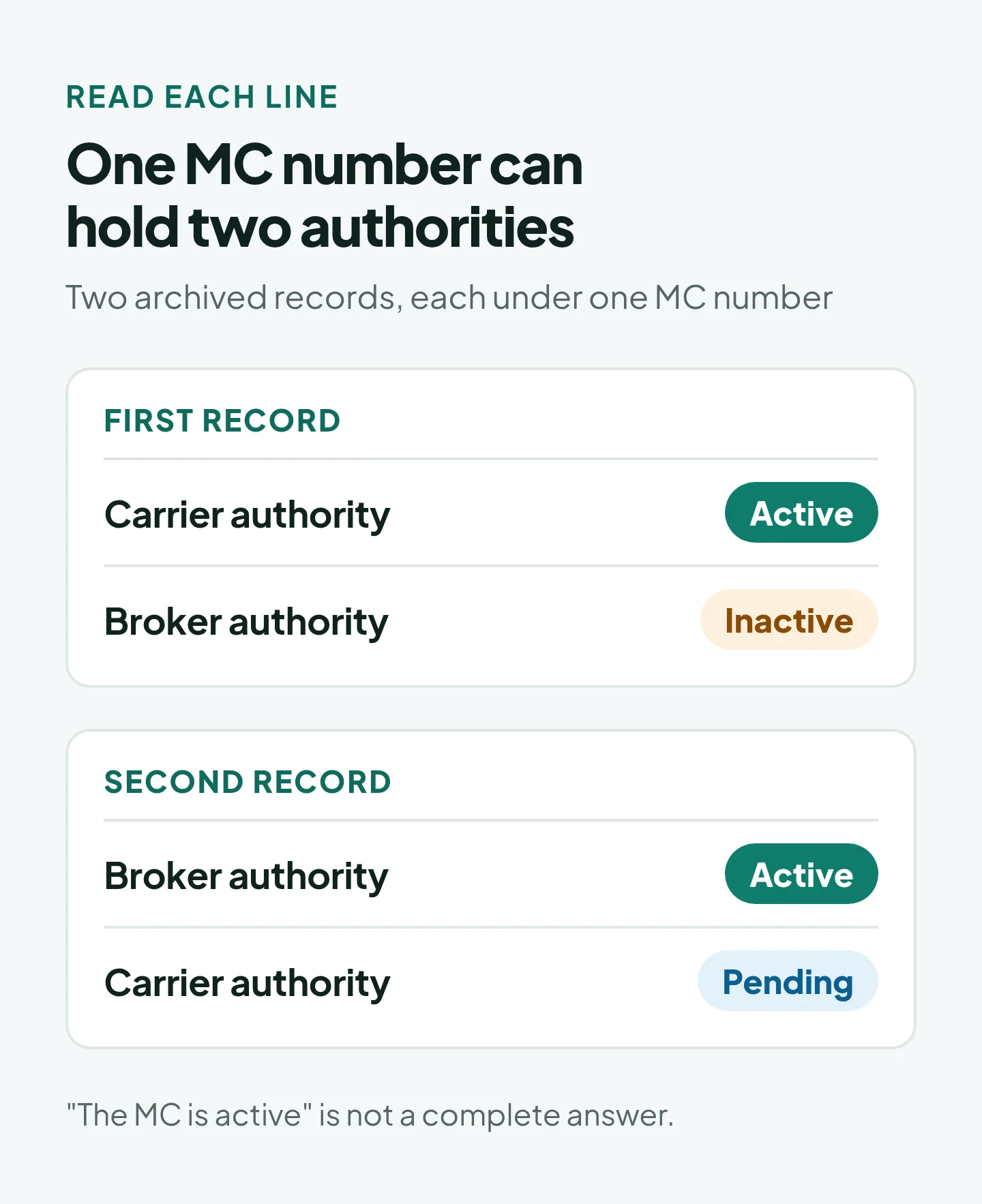
- One MC number can hold two authorities with different statuses. Older dockets can combine carrier and broker authority. In archived records we read, one MC number had carrier authority Active and broker authority Inactive; another had broker Active and carrier Pending. “The MC is active” is not a complete answer.
- One company can hold several MC numbers. Under Motus, each newly granted authority gets its own docket number, so a new carrier that also brokers will have two.
- A new number doesn’t tell you the company’s age. New USDOT and docket numbers are randomized rather than sequential, according to the same FMCSA fact sheet. Use the grant date in the authority history instead.
What the insurance record proves
A filing shows that an insurer or surety told FMCSA the cover exists. Each one lists the form, policy number, insurer, amount filed, effective date, date received and any cancellation date. In archived records, filings showed as Active, Canceled or Replaced, and pre-Motus filings carried their original received dates.
| Company | Filing to look for | Federal minimum | What it doesn’t cover |
|---|---|---|---|
| Carrier of general freight, 10,001 lb or more | BMC-91 or BMC-91X, or a BMC-82 surety bond (FMCSA filing chart) | $750,000 (49 CFR 387.303T) | Cargo. The form is for bodily injury and property damage liability |
| Carrier of general freight, fleet only under 10,001 lb | BMC-91 or BMC-91X, or a BMC-82 surety bond | $300,000 | Cargo |
| Broker | BMC-84 bond or BMC-85 trust | $75,000 (49 CFR 387.307) | Full payment if valid claims exceed $75,000 |
Two gaps matter. First, 49 CFR 387.303T sets a federal cargo requirement only for household goods carriers, so a clean Motus record says nothing about general freight cargo cover. Ask for a certificate from the insurer or its agent, and confirm the cargo limit and any exclusions there. Our guide to trucking liability insurance explains the layers.
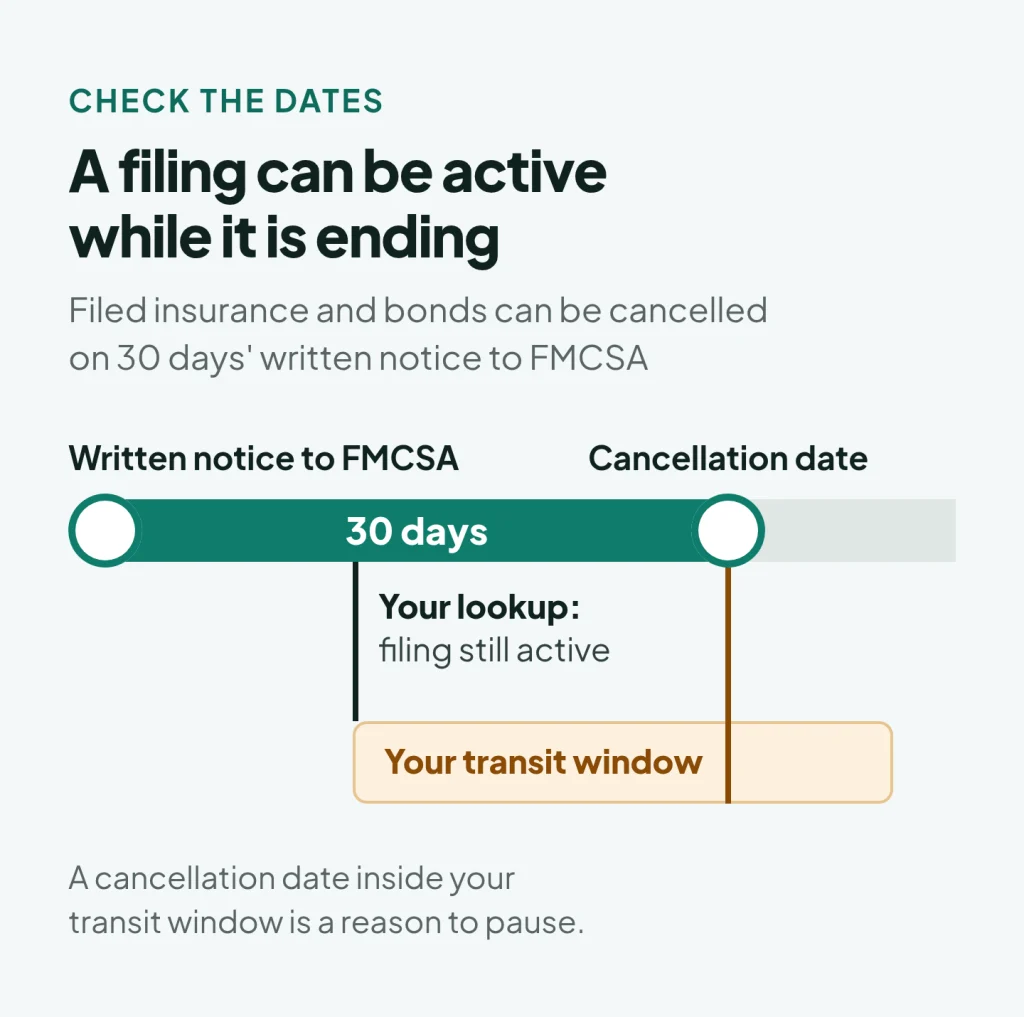
Second, a filing can be active while it is ending. Filed insurance and bonds can be cancelled on 30 days’ written notice to FMCSA (49 CFR 387.313T(d)). SAFER’s snapshot carries a link for checking pending insurance cancellations. A cancellation date inside your transit window is a reason to pause.
Checking a carrier before you tender
- Motor carrier of property authority is Active, not just broker authority. Passenger or household goods authority doesn’t fit general freight.
- The USDOT status is ACTIVE, with no out-of-service date.
- An active BMC-91 or BMC-91X (or BMC-82 surety bond) meets the minimum, or your higher contract limit, with no cancellation date ahead.
- A BOC-3 is on file.
- The legal name matches the packet, the W-9 and the certificate of insurance.
- The safety rating isn’t Unsatisfactory, and a Conditional rating gets a documented review before you use the carrier.
- Fleet size is believable for the job. A snapshot showing one power unit and a packet promising 40 trucks doesn’t add up.
- The cargo fits. Hazmat, for example, has different minimum limits under 49 CFR 387.9.
A very new authority isn’t illegal. New carriers are under 18 months of new entrant monitoring, and a broker can set its own minimum age. Whatever line you choose, write it down and apply it the same way each time. The new broker’s wider setup is in our freight broker guide.

Checking a broker before you accept a load
- Broker of property authority is Active. A carrier-only MC number is not broker authority.
- An active BMC-84 or BMC-85 shows for the full $75,000, and a BOC-3 is on file.
- The name on the rate confirmation matches the registered name. Under 49 CFR 371.7, a broker may not offer brokerage service “in any name other than that in which its registration is issued”, and must show its broker status in advertising.
- The contact person’s email domain and phone connect to that company. Call a number from the record or the company’s own website, not the one in the email.
- The history shows no recent Bond/Trust Fund Below Minimum event.
That last check matters more since January 2026. If claims pull the security below $75,000 and the broker doesn’t fix it, FMCSA suspends the authority within 7 business days of notice (49 CFR 387.307(e)). Our freight broker bond guide explains what the bond pays and how claims work. Don’t treat the bond as full payment protection: $75,000 is shared among everyone with a valid claim.
You may be dealing with a freight agent rather than the broker itself. Agents usually book under the brokerage’s name and authority, so check the brokerage, then confirm with it directly that the agent works there.
Red flags and what to do
Lookups catch paperwork problems. They don’t always catch stolen identities, because a fraudster can quote a real company’s real MC number. That’s why the identity checks matter as much as the status.
| What you see | Possible explanation | Next step |
|---|---|---|
| No result for the MC number | A typo, or a fake or FF number | Recheck the digits, then search SAFER by name and Motus by USDOT number or name. No match means no deal |
| The number belongs to a different company name | A DBA, a typo or impersonation | Check the DBA field. If it isn’t there, stop |
| Email or phone doesn’t match the record | New staff, an outdated record or impersonation | Call the registered company on an independently found number |
| A “dispatcher” sends the packet | An honest service or a middleman | Vet the carrier itself. See our truck dispatcher guide |
| Truck or driver doesn’t match the booked carrier at pickup | A leased unit, or the load was re-brokered | Hold the load and call the carrier you booked. A leased truck should normally show that carrier’s name and USDOT number |
| Reinstated recently, or many Canceled filings | A past lapse, or routine renewals | Read the dates. Gaps between filings deserve a question |
| A new authority shares its address, phone or officers with a company that lost its authority | A possible reincarnated carrier | Compare both Motus records and ask directly. If the answer doesn’t hold up, walk away |
If you think a company’s identity has been stolen, tell the real company first; it needs to know. FMCSA takes complaints through its National Consumer Complaint Database or 1-888-368-7238, and that page points to a separate broker and carrier fraud and identity theft page. If a Motus record looks wrong, call FMCSA on 1-800-832-5660 before you draw conclusions.
When a real company has no MC number
A missing MC number isn’t automatically a problem. Private carriers, carriers of exempt commodities and intrastate-only operators don’t need one, as our guide to who needs an MC number sets out. Leased drivers run under their carrier’s authority, so check the carrier, not the owner-operator. Freight forwarders have FF numbers instead.
Some lookup pages say new applicants no longer get MC numbers. That is wrong. FMCSA’s April 2026 Motus notice says this release of Motus does not end MC and FF numbers. If a company needs authority and offers only a USDOT number, ask for its docket number.
Why brokers should keep the evidence
On 14 May 2026, the Supreme Court decided Montgomery v. Caribe Transport II (No. 24-1238) unanimously. It held that federal law doesn’t preempt a state negligent-hiring claim against a broker for its choice of motor carrier. Such a claim falls within the statute’s safety exception. The plaintiff, injured in a crash, alleged that the carrier had a Conditional safety rating when the broker hired it.
The Court decided only that the claim can go forward. It did not say the broker was negligent, and it did not define what a proper check looks like; that is left to state law. It also did not decide how a separate provision on brokers’ intrastate services, which has no safety exception, applies to these claims. In a concurrence, Justice Kavanaugh wrote that brokers “should be able to successfully defend” such suits if they acted reasonably and used reputable carriers. A saved snapshot, a Motus record and a written carrier policy show what you checked and when. Ask a transportation attorney to review your process.
Common questions
Is an MC or DOT number lookup free?
Yes. SAFER states that Company Snapshot searches are free, whether you search by USDOT number, MC number or name, and public users don’t need an account to search. SAFER’s more detailed Company Safety Profile costs the public $20 per company.
Can I find a company’s MC or USDOT number from its name?
Yes. Choose Name in SAFER. Matches link to a snapshot showing the USDOT number and the MC/MX/FF numbers. Motus public search also takes a legal or DBA name. Then confirm the address, because similar names are common.
Are free third-party lookup sites reliable?
They can be convenient, but they repackage public data on their own schedule and some still describe the pre-Motus system. Use them to screen if you like, then make the decision on FMCSA’s own records.
Should I search by DOT number or MC number?
Use the USDOT number when you have it: SAFER and Motus both search by it, while Motus public search doesn’t take an MC number. Use the MC number to confirm that the docket on the paperwork belongs to the same company, and read that authority’s own status.
Can I run lookups in my own software?
FMCSA’s QCMobile API documents a docket-number route and requires an API key. It’s useful for checking many carriers, but test what it returns before relying on it for authority or insurance. We read the documentation on FMCSA’s site on 11 November 2026.
How often should I recheck?
No federal rule sets a schedule. Authority and insurance can change at any time, so a sensible habit is to check at setup and again before each tender, or to use a monitoring service that alerts you to changes.
Facts checked against primary sources on 1 November 2026: the eCFR (Title 49, current through 29 October 2026), the Federal Register, the Supreme Court’s opinion and FMCSA. On 11 November 2026 we read SAFER (Company Snapshot, FAQ and help), SMS, the QCMobile documentation, L&I and a live Motus record and search page, plus FMCSA’s L&I FAQ, its Motus fact sheet and its insurance filing chart, on FMCSA’s own sites. On 14 November 2026 we reread SAFER’s search page and field definitions and FMCSA’s page on who needs a USDOT number. The list of Motus status reasons still comes from an archived copy of the Motus application’s code. Every figure is checked against the linked source. This page is general information, not legal, tax or financial advice.
Sources
- FMCSA SAFER Company Snapshot
- FMCSA Motus public search
- FMCSA FAQ: How can I check the status of my operating authority?
- FMCSA FAQ: What can I do in Licensing and Insurance (L&I)?
- FMCSA Licensing and Insurance carrier search
- eCFR: 49 CFR 390.21T
- FMCSA: Registration modernization FAQs
- FMCSA: Temporary suspension of USDOT inactivation in Motus
- SAFER Web: Frequently asked questions
- SAFER Web: Help and definitions
- eCFR: 49 CFR 385.3
- FMCSA Safety Measurement System
- FMCSA: Changes to FMCSA registrations in Motus
- eCFR: 49 CFR 387.303T
- eCFR: 49 CFR 387.307
- eCFR: 49 CFR 387.313T
- eCFR: 49 CFR 387.9
- eCFR: 49 CFR 385.307
- eCFR: 49 CFR 371.7
- FMCSA: National Consumer Complaint Database
- Federal Register: Availability of Motus, FMCSA's New Registration System (29 April 2026, 91 FR 23144)
- FMCSA: Broker and carrier fraud and identity theft
- Supreme Court: Montgomery v. Caribe Transport II, LLC, No. 24-1238 (14 May 2026)
- FMCSA QCMobile API documentation
- FMCSA: Insurance filing requirements chart
- FMCSA: Do I Need a USDOT Number?