Freight class is a number from 50 to 500 that tells a less-than-truckload (LTL) carrier how costly your freight is to move. It comes from the National Motor Freight Classification (NMFC), and the lower the class, the denser and cheaper to carry the freight usually is. Since 19 July 2025 the standard chart has 13 density tiers, running from class 400 for freight under 1 pound per cubic foot (pcf) down to class 50 at 50 pcf or more. That chart is below, followed by the part most charts leave out: the 18 classes, the NMFC item numbers and sub numbers people call “codes”, and why your item can override the chart. This reference sits in our freight rates and tools hub.
The freight class chart
This is the Freight Classification Development Center’s (FCDC) standard density scale. Its most recent statement is in the FCDC procedures dated March 2026, and it has not changed since Disposition Bulletin 1371 set it out for Docket 2025-1.
| Sub | Density (pounds per cubic foot) | Class |
|---|---|---|
| 1 | Less than 1 | 400 |
| 2 | 1 but less than 2 | 300 |
| 3 | 2 but less than 4 | 250 |
| 4 | 4 but less than 6 | 175 |
| 5 | 6 but less than 8 | 125 |
| 6 | 8 but less than 10 | 100 |
| 7 | 10 but less than 12 | 92.5 |
| 8 | 12 but less than 15 | 85 |
| 9 | 15 but less than 22.5 | 70 |
| 10 | 22.5 but less than 30 | 65 |
| 11 | 30 but less than 35 | 60 |
| 12 | 35 but less than 50 | 55 |
| 13 | 50 or greater | 50 |
Read the wording exactly. Each tier includes its lower number, so 15.0 pcf is class 70, not 85. To turn your own measurements into density, use the freight class calculator, or do it by hand as shown further down.
This chart applies only to NMFC items that have adopted the scale. For those items, the NMFC lists these same 13 tiers under the item number, as Subs 1 to 13. For any other item, it may give you the wrong class.
Why there are 18 classes but 13 tiers
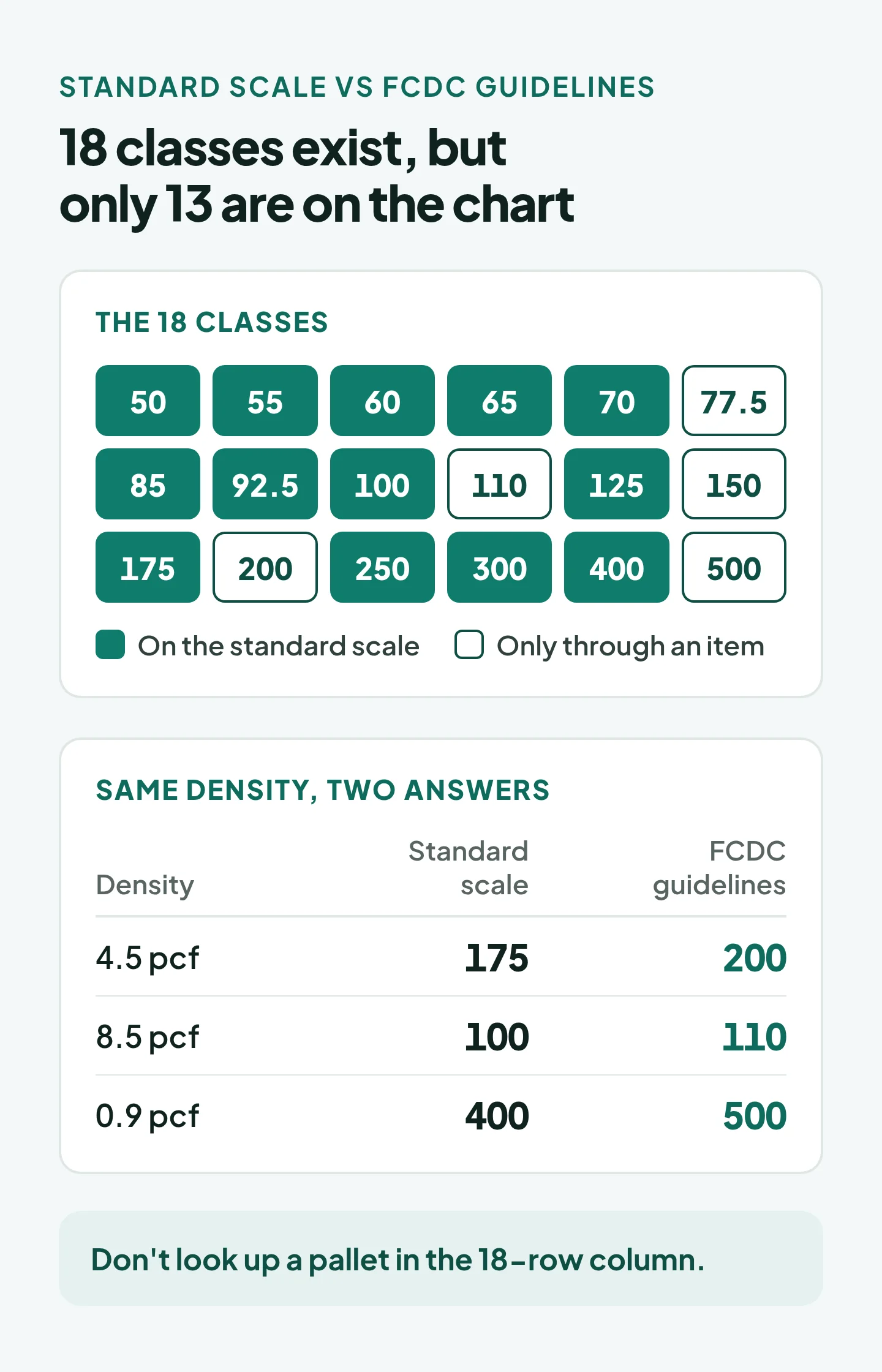
NMFTA, which publishes the NMFC, says an item gets a class “from 50 to 500”. The chart above stops at 400. Both are right, because the NMFC works with two density tables that are easy to confuse.
- The standard density scale (13 tiers) applies to commodities with no unusual handling, stowability or liability characteristics.
- The FCDC density guidelines (18 classes) are a tool the FCDC itself uses when setting classes for commodities that do have those characteristics. It can then adjust the class from the guideline “by one or more classes”.
Here are both from those FCDC procedures, side by side:
| Class | Standard scale: density range (pcf) | FCDC guidelines: minimum average density (pcf) |
|---|---|---|
| 50 | 50 or greater | 50 |
| 55 | 35 but less than 50 | 35 |
| 60 | 30 but less than 35 | 30 |
| 65 | 22.5 but less than 30 | 22.5 |
| 70 | 15 but less than 22.5 | 15 |
| 77.5 | Not on the scale | 13.5 |
| 85 | 12 but less than 15 | 12 |
| 92.5 | 10 but less than 12 | 10.5 |
| 100 | 8 but less than 10 | 9 |
| 110 | Not on the scale | 8 |
| 125 | 6 but less than 8 | 7 |
| 150 | Not on the scale | 6 |
| 175 | 4 but less than 6 | 5 |
| 200 | Not on the scale | 4 |
| 250 | 2 but less than 4 | 3 |
| 300 | 1 but less than 2 | 2 |
| 400 | Less than 1 | 1 |
| 500 | Not on the scale | Less than 1 |
Classes 77.5, 110, 150, 200 and 500 are still real classes. They are just not on the standard scale, so you reach them only through an item that assigns them.
Don’t look up a pallet in the 18-row column. The two tables disagree at many densities. At 4.5 pcf the standard scale says 175 and the guidelines say 200. At 8.5 pcf it is 100 against 110. At 0.9 pcf it is 400 against 500. Any chart online with 18 rows and a class 500 band is built on the guideline breaks or something like them, and it isn’t what a carrier applies to a standard-scale item.
What changed in 2025
The chart last changed in 2025, and that version is still in force in November 2026. The tier breaks themselves moved only at the top. The scale before Docket 2025-1, as printed in Bulletin 1368 in March 2024, had 11 tiers, ending at “30 or greater” for class 60.
| Density (pcf) | 11-tier scale (before 19 July 2025) | 13-tier scale (now) |
|---|---|---|
| Under 30 | Same as today (Subs 1 to 10) | Subs 1 to 10, no change |
| 30 but less than 35 | Sub 11, class 60 | Sub 11, class 60 |
| 35 but less than 50 | Sub 11, class 60 | Sub 12, class 55 |
| 50 or greater | Sub 11, class 60 | Sub 13, class 50 |
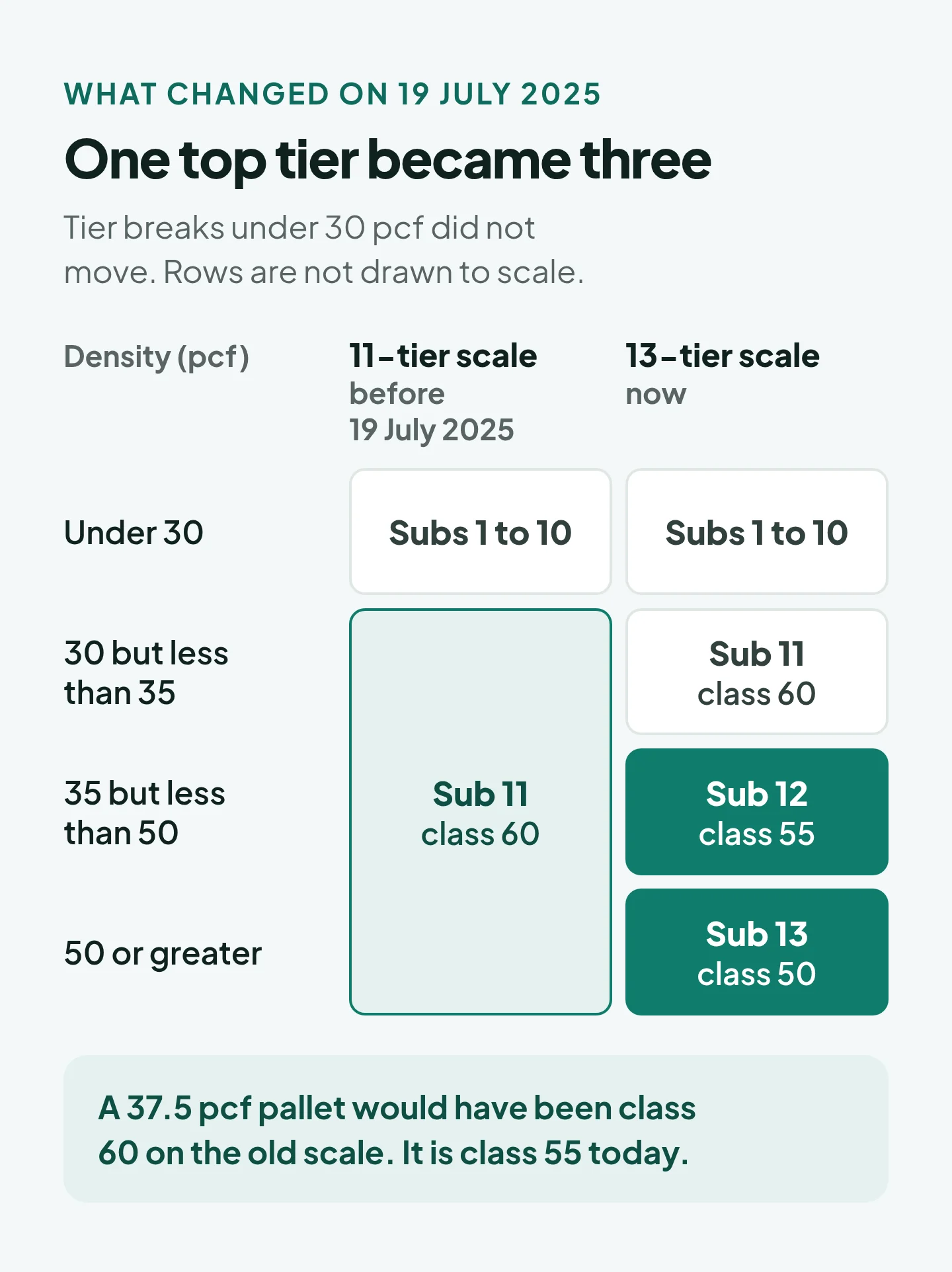
So classes 50 and 55 are not new. Both were already in the density guidelines in the August 2021 FCDC procedures (a copy hosted by Old Dominion), and Bulletin 1368 shows items with their own breaks reaching class 55 more than a year before the change. What is new is that the standard scale reaches them, so very dense freight on a scale item now rates below class 60.
The larger change was to the items. Bulletin 1371 did three things that matter here:
- Moved items onto the scale. Items across the NMFC adopted the 13 tiers. Subject 1 alone lists 69 of them. NMFTA had estimated in June 2024 that as many as 3,500 single-class items could move, though that was a forecast and not a final count.
- Canceled and merged item numbers. Per NMFTA’s FAQ on the changes, listings under generic headings with no known handling, stowability or liability concerns would be canceled and referenced within a 13-sub density item under that heading. An item number that was right in 2024 may no longer exist.
- Flagged the exceptions. Subject 3 added a hand symbol to about 200 items, meaning their classes rest on “unusual or significant handling, stowability, and/or liability considerations”.
Later dockets have kept moving items while leaving the 13 breaks alone. Docket 2025-2 took effect on 6 December 2025, and Docket 2026-1 on 23 May 2026. Docket 2026-2 is scheduled to be issued on 12 November 2026 and take effect on 12 December 2026. Anything you classed last year is worth checking again.
NMFC codes: item numbers and subs
“NMFC code” isn’t a term with one fixed meaning. In practice it means the item number that describes your commodity, plus a sub number where the item has several. NMFTA’s FAQ says subprovisions are used within item descriptions to further evaluate a commodity’s transportation characteristics. The item is fixed by what the product is. The sub can change with each shipment if it depends on density.
NMFTA sells access to the NMFC, so there is no free official list to copy here. The public disposition bulletins do show how items are written, though, and they fall into three patterns:
| Pattern | Real example | How the class is set |
|---|---|---|
| Standard scale | Item 59420, toilet preparations or personal care products, without a hazard label | Subs 1 to 13, the chart above |
| Item’s own density breaks | Item 121505, front end loaders for tractors or trucks, on pallets or lift truck skids | Sub 1, under 12 pcf: class 125. Sub 2, 12 pcf or greater: class 77.5 |
| One flat class | Item 21320, balloons, NOI, not inflated, other than toy or novelty, in packages (from 12 December 2026) | Class 150 at any density |
Sources: Bulletin 1371 records Item 59420 adopting the 13-sub scale. Bulletin 1374 prints Items 121505 and 21320, and it puts toy or novelty balloons in new Item 21310 on the full scale. So two kinds of balloon end up with two different patterns. NOI stands for “not otherwise indexed”, as a 1987 GAO decision on an NMFC dispute spells out. It marks a general listing for articles without a more specific one.
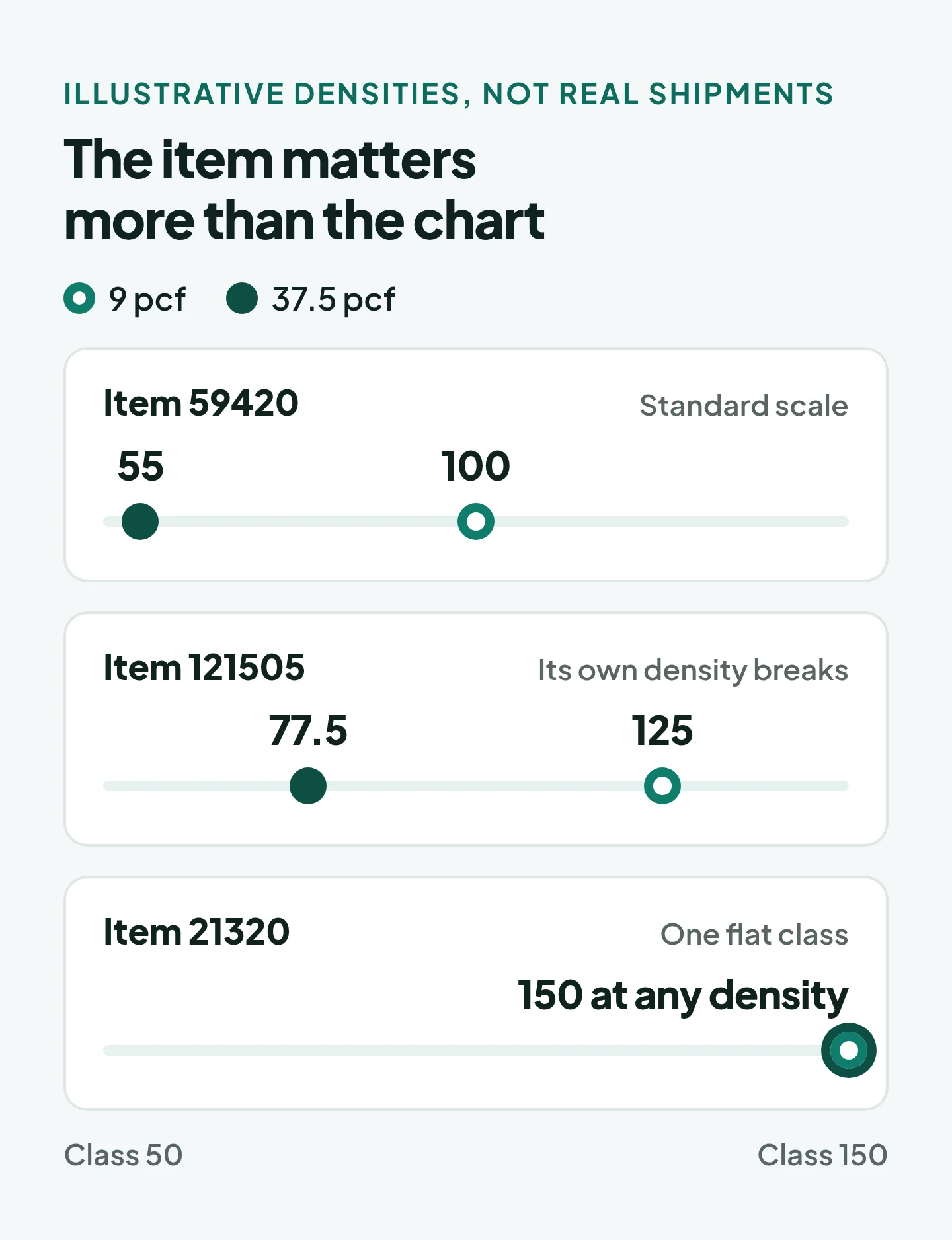
Here is why the item matters more than the chart. These are illustrative densities, not real shipments:
| Density | Item 59420 | Item 121505 | Item 21320 |
|---|---|---|---|
| 9 pcf | Sub 6, class 100 | Sub 1, class 125 | Class 150 |
| 37.5 pcf | Sub 12, class 55 | Sub 2, class 77.5 | Class 150 |
How to find your class
- Find the item. Match the product and its packaging to an NMFC description. Packaging is part of many descriptions (“in boxes”, “in packages”), so check it matches how you actually ship.
- See how the item sets its class. Is it the 13-tier scale, its own breaks, or a flat class? If it is flat, you’re done.
- Measure each handling unit. NMFTA’s FAQ gives the method: the greatest straight-line length, width and height in inches, “including all projections”, as tendered to the carrier. Weigh the unit as tendered too.
- Work out density. Multiply length × width × height, divide by 1,728 for cubic feet, then divide the weight by the cubic feet.
- Read the sub from the item. Record the item number, sub and class for the shipping papers.
NMFTA’s own example is a pallet of boxes measuring 48 × 40 × 45 inches and weighing 450 lb. That is 86,400 cubic inches, or 50 cubic feet, and 450 ÷ 50 = 9.00 pcf. On a standard-scale item, that’s Sub 6 and class 100. A heavier example shows the 2025 change: a 48 × 40 × 36 inch pallet at 1,500 lb is 40 cubic feet and 37.5 pcf. That’s class 55 today. On the old scale it would have been class 60.
With several pallets, density is calculated on each handling unit (Item 110, Sec. 8(d)). If the shipping papers show only a total weight, it may be calculated on the total weight and total cube instead. Pallets holding differently classed articles have their own rule in Item 640. Docket 2026-2 proposed rewriting both rules, and Bulletin 1374 disapproved that, so the present wording stands. The calculator page linked above works through both.
Where to look up an item
- ClassIT+. This is NMFTA’s lookup tool. On 1 November 2026 its pricing page listed one seat at $371 a year for non-members and $321 for members, with no free version and no monthly payment.
- The NMFC book. NMFTA sells it too, but a book falls behind as supplements come out. ClassIT+ updates automatically on each effective date.
- NMFTA Interpretations. NMFTA’s classification assistance page explains how to ask FCDC staff for an opinion: you order through NMFTA’s online store, one article per request, with product details and photos. NMFTA says these opinions “are not legally binding” and apply only to what you described.
- Your carrier or broker. Some will help with a class, but get the item number and sub in writing and check them yourself. NMFTA notes that shippers warrant the accuracy of the description, weight, piece count and NMFC on the bill.
If you ship the same products repeatedly, look each one up once and record the item number and how its class is set on your product records. If you run a brokerage, your shippers will expect you to catch a bad class before the carrier does, which belongs on your list when you set up as a freight broker.
What class does to your price
Class is not a price. The FCDC procedures say the NMFC “contains no rates or charges”. Each carrier applies class through its own tariffs and contracts, so higher classes generally cost more per hundredweight, but no single percentage separates one class from the next. Treat any “class 70 costs X” figure as one seller’s example.
The NMFC is also voluntary. NMFTA’s FAQ says participants are “neither constrained nor compelled” to follow it, and your contract with a carrier can change how class applies. The most common example is a freight-all-kinds (FAK) rate, where one negotiated rate covers mixed freight. NMFTA says FAKs “are not part of the NMFC”, and that the underlying item still matters for claims and audits. So an FAK doesn’t remove the need to know your real item.
If the class on the bill is wrong
The uniform straight bill of lading terms published in the NMFC give the carrier the right to inspect any shipment (Sec. 7(c)). If the description, “including weight or density”, is wrong or incomplete, charges are paid on the articles actually shipped (Sec. 7(d)). That version is from NMF 100-AV, so check your carrier’s current terms.
A carrier can also add a fee on top of the higher freight charge. FedEx Freight’s 2026 surcharge quicksheet, effective 5 January 2026, lists $40 per shipment for weight (reweigh) and freight (inspection) validation under Item 981. Its rules tariff holds the conditions. Other carriers set their own amounts.
Time limits come from 49 U.S.C. 13710(a)(3). Household goods and noncontiguous domestic trade aside, a carrier must issue a bill for additional charges within 180 days of receipt of the original bill to keep the right to collect them. A shipper must contest a bill within 180 days of receiving it to keep the right to contest it. Don’t let a reclass invoice sit.
What goes on the bill of lading
The federal rule doesn’t mention NMFC numbers. 49 CFR 373.101 requires a receipt or bill of lading showing the consignor and consignee, origin and destination, number of packages, a description of the freight, and its weight, volume or measurement if that matters for rating. The item and class come from NMFC practice and carrier rules. NMFTA’s advice is that the description “should match that of the listed NMFC item number and any sub-provisions”. Our bill of lading guide covers the form field by field.
Four errors in charts online
- The 18-row density chart. Usually guideline-style breaks shown as if they were the rating scale. Check for a class 500 row or a 13.5 pcf break.
- The chart that stops at class 60. Anything ending at “30 pcf or more” is the pre-July 2025 scale.
- Overlapping ranges. “12 to 15” and “15 to 22.5” leave 15.0 pcf unclear. The NMFC wording (“but less than”) doesn’t.
- A commodity column. A chart that says “car parts: class 70” is a guess at best. Docket 2025-1 rewrote listings across groups from automobile parts to furniture, and on a scale item the class depends on the density of that unit, not the product’s name.
Common questions
Who sets freight class?
The FCDC, which operates under NMFTA, maintains the NMFC through public dockets. Its procedures say it must weigh four characteristics: density, handling, stowability and liability. It can’t consider the economic impact of a change.
Does density always decide the class?
No. Items with handling, stowability or liability concerns, including those with the hand symbol, get classes based on those traits. NMFTA’s FAQ says these may have density breaks, but not ones based on the 13-sub progression.
Does a small carrier need to know this?
If you take partial or LTL loads, yes, since that freight is often rated and described this way. A new carrier setting out its paperwork should read this alongside our step-by-step trucking startup guide. The same applies to a box truck business or a hotshot operation that takes partial loads.
Will the chart change again?
It can. The 13 breaks are the same in Bulletins 1371 to 1374, and Docket 2026-2 moves more articles without changing them. NMFTA posts each docket and bulletin on its public docket files page, so check there before relying on any chart, this one included.
Facts checked against primary sources on 1 November 2026: NMFTA Disposition Bulletins 1368 and 1371 to 1374, the FCDC procedures of March 2026 and August 2021, NMFTA’s 2025 changes FAQ and ClassIT+ pricing page, the uniform bill of lading terms, the FedEx Freight quicksheet, GAO decision B-223311, 49 CFR 373.101 and 49 U.S.C. 13710. Every figure is checked against the linked source. This page is general information, not legal, tax or financial advice, and the class you are billed at is set by the applicable NMFC item and your carrier’s tariff or contract.
Sources
- NMFTA: ClassIT+ pricing
- NMFTA: 10 pointers to avoid bill of lading errors
- NMFTA: Everything you need to know about a bill of lading
- NMFTA: Major NMFC changes to take effect in 2025
- NMFTA: What is an FAK
- NMFTA: NMFC
- NMFTA: Classification assistance and interpretations
- NMFC: Uniform Straight Bill of Lading terms and conditions
- NMFTA Disposition Bulletin 1368 (Docket 2024-1, former 11-tier scale)
- NMFTA: 2025 NMFC Changes FAQ
- NMFTA Disposition Bulletin 1371 (Docket 2025-1)
- NMFTA Disposition Bulletin 1372 (Docket 2025-2)
- NMFTA Disposition Bulletin 1373 (Docket 2026-1)
- FCDC Procedures and density guidelines, March 2026
- NMFTA Docket 2026-2, Subject 1 (present text of Items 110 and 640)
- NMFTA Disposition Bulletin 1374 (Docket 2026-2)
- 49 CFR 373.101
- FedEx Freight surcharge quicksheet, effective 5 January 2026
- 49 U.S.C. 13710
- FCDC Procedures, August 2021 (copy hosted by Old Dominion Freight Line)
- GAO decision B-223311, Yellow Freight System, Inc. (3 August 1987)
- NMFTA: Public docket files