A USDOT number (often just called a DOT number) is the free identification number FMCSA gives a company so it can track that company’s safety record: inspections, crashes, audits and compliance reviews. You need one if you run a commercial motor vehicle in interstate commerce, which mostly means a truck or truck-and-trailer rated or weighing 10,001 pounds or more, a vehicle carrying more than 8 passengers for pay (or more than 15 not for pay), or a load of hazardous materials that needs placards. Every freight broker, freight forwarder and for-hire carrier needs one too, and many states require one for trucks that never leave the state. Since 19 May 2026 you apply in Motus, FMCSA’s registration system at motus.dot.gov, and FMCSA charges nothing for the number itself. This guide is part of our getting licensed hub.
This is general information, not legal, tax or financial advice. Check your own operation with FMCSA and your state before you register or haul.
The short version
- What it is: a company identifier for safety monitoring. It is not a license to haul for hire; that is operating authority, a separate registration.
- Who needs one: anyone operating a commercial motor vehicle in interstate commerce, every broker, forwarder and for-hire carrier, intrastate hazmat carriers that need a safety permit, and intrastate carriers in the 38 states and Puerto Rico that FMCSA lists as requiring one.
- Cost: $0 from FMCSA. Operating authority, if you need it, is $300 per type.
- Where: Motus, after Login.gov sign-in, identity verification and business verification.
- After you get it: put it on both sides of every power unit, update it every 24 months on the MCS-150, and, as a new interstate carrier, expect a safety audit within 12 months.
What is a DOT number?
FMCSA’s “Do I Need a USDOT Number?” page describes it as “a unique identifier when collecting and monitoring a company’s safety information acquired during audits, compliance reviews, crash investigations, and inspections.” Each roadside inspection, crash report and audit is filed against that number. It is what a shipper, broker or insurer sees when they look your company up, and it follows the company, not a truck or a driver.
The rule that issues it is 49 CFR 390.19T: you file a Motor Carrier Identification Report (Form MCS-150) “before it begins operations,” and once FMCSA processes it, it “will issue the motor carrier or intermodal equipment provider an identification number (USDOT Number).” In Motus you give that information in the online application instead of a separate paper form, and FMCSA’s April 2026 notice says Motus users will not be penalized for not using the paper forms.
Two things the DOT number is not:
- It is not operating authority. To haul other people’s regulated freight across state lines for pay, or to broker it, you also need authority, still identified by an MC number. Our MC number guide covers who needs authority, the $300 fee and the insurance and BOC-3 filings that make it active. Most for-hire carriers and all brokers hold both numbers.
- It is not a driver’s license. A CDL is a separate test, based on 26,001 pounds and the trailer’s weight (49 CFR 383.5). Plenty of trucks need a DOT number but no CDL.
Motus also shows a letter after the number for each registration you hold, such as C for property carrier authority, V for private carrier, B for broker and R for intrastate carrier. FMCSA’s registration modernization FAQ says these suffixes are displayed in Motus “but will not be a vehicle marking requirement.” Your trucks still show “USDOT” and the number alone.
Who needs a DOT number?
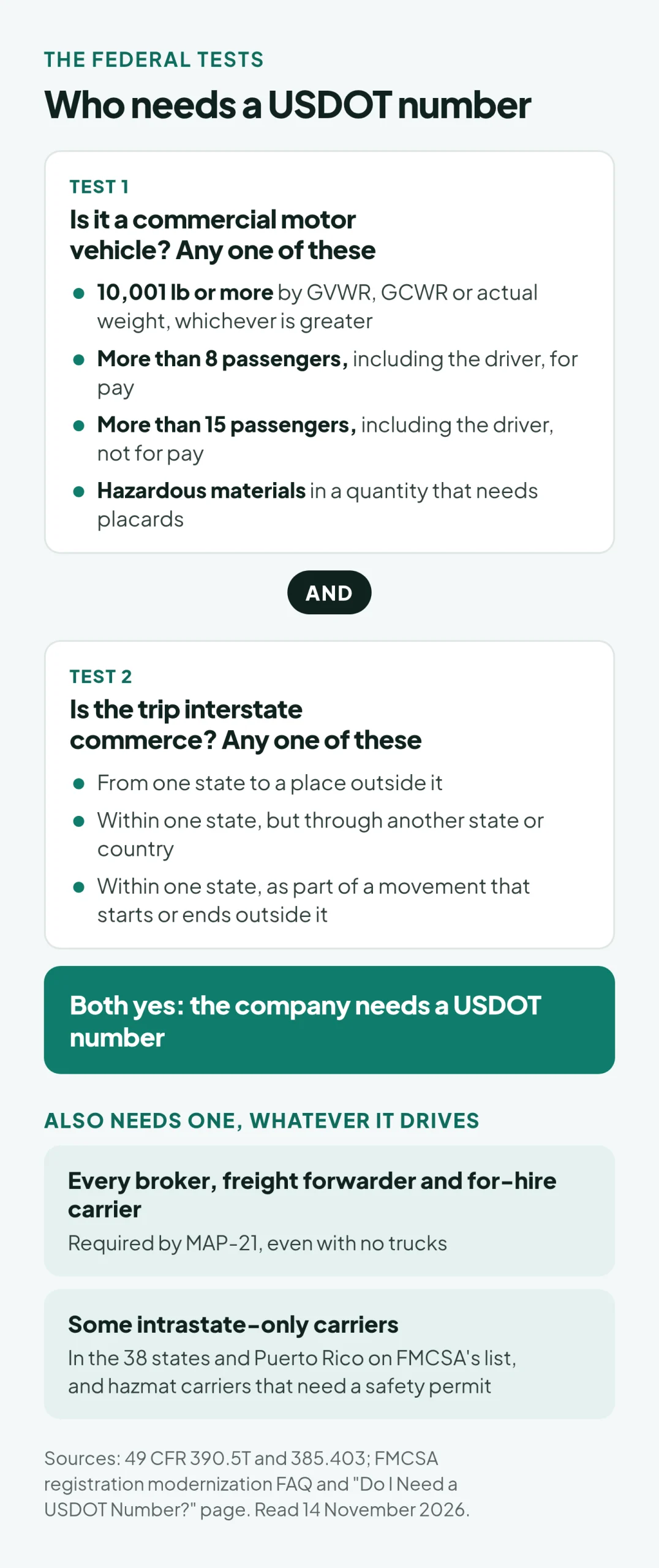
Federal law asks two questions. Is the vehicle a commercial motor vehicle? And is it used in interstate commerce? If both answers are yes, the company operating it needs a USDOT number.
The commercial motor vehicle test
Under 49 CFR 390.5T, a commercial motor vehicle is a self-propelled or towed vehicle used on a highway in interstate commerce to carry passengers or property when it meets any one of these:
- a gross vehicle weight rating (GVWR) or gross combination weight rating (GCWR), or actual gross weight, of 10,001 pounds or more, “whichever is greater”
- designed or used to carry more than 8 passengers, including the driver, for compensation
- designed or used to carry more than 15 passengers, including the driver, not for compensation
- carrying hazardous materials in a quantity that requires placards
FMCSA’s explainer page words the 15-passenger test as passengers “for compensation.” The regulation says “not used to transport passengers for compensation,” and the regulation is what applies.
The interstate commerce test
The same section defines interstate commerce in three parts. A trip counts if it runs:
- from a place in one state to a place outside it, including outside the United States
- between two places in one state, but through another state or country
- between two places in one state, as part of a movement that started or will end outside the state or the country
The third part catches many new carriers. A container you pull 40 miles from a port to a warehouse in the same state can still be interstate commerce, because the freight’s journey began overseas. Our guide to interstate vs intrastate trucking works through these cases.
Brokers, forwarders and for-hire carriers
Some businesses need a USDOT number whatever they drive. FMCSA’s modernization FAQ says MAP-21, the 2012 highway law, “requires every broker, freight forwarder, or motor carrier (whether operating commercial motor vehicles or not) to obtain a USDOT Number.” A freight broker with no trucks at all gets one, and so does a for-hire carrier running only cargo vans under 10,001 pounds once it applies for authority.
| Your operation | USDOT number? | Why |
|---|---|---|
| Semi hauling freight across state lines | Yes | CMV in interstate commerce |
| Freight broker, no trucks | Yes | Required of every broker |
| Business moving its own goods interstate in a 12,000 lb truck | Yes | Private carrier running a CMV |
| Pickup towing a trailer, combined ratings 10,001 lb or more, interstate | Yes | GCWR counts |
| Cargo van under 10,001 lb hauling for pay interstate | Yes, with authority | For-hire carriers need both |
| Truck hauling only intrastate freight, no hazmat | Depends on the state | State rule, not federal |
| Owner-operator leased on to a carrier | Not for that work | Runs under the carrier’s number |
How the weight test works
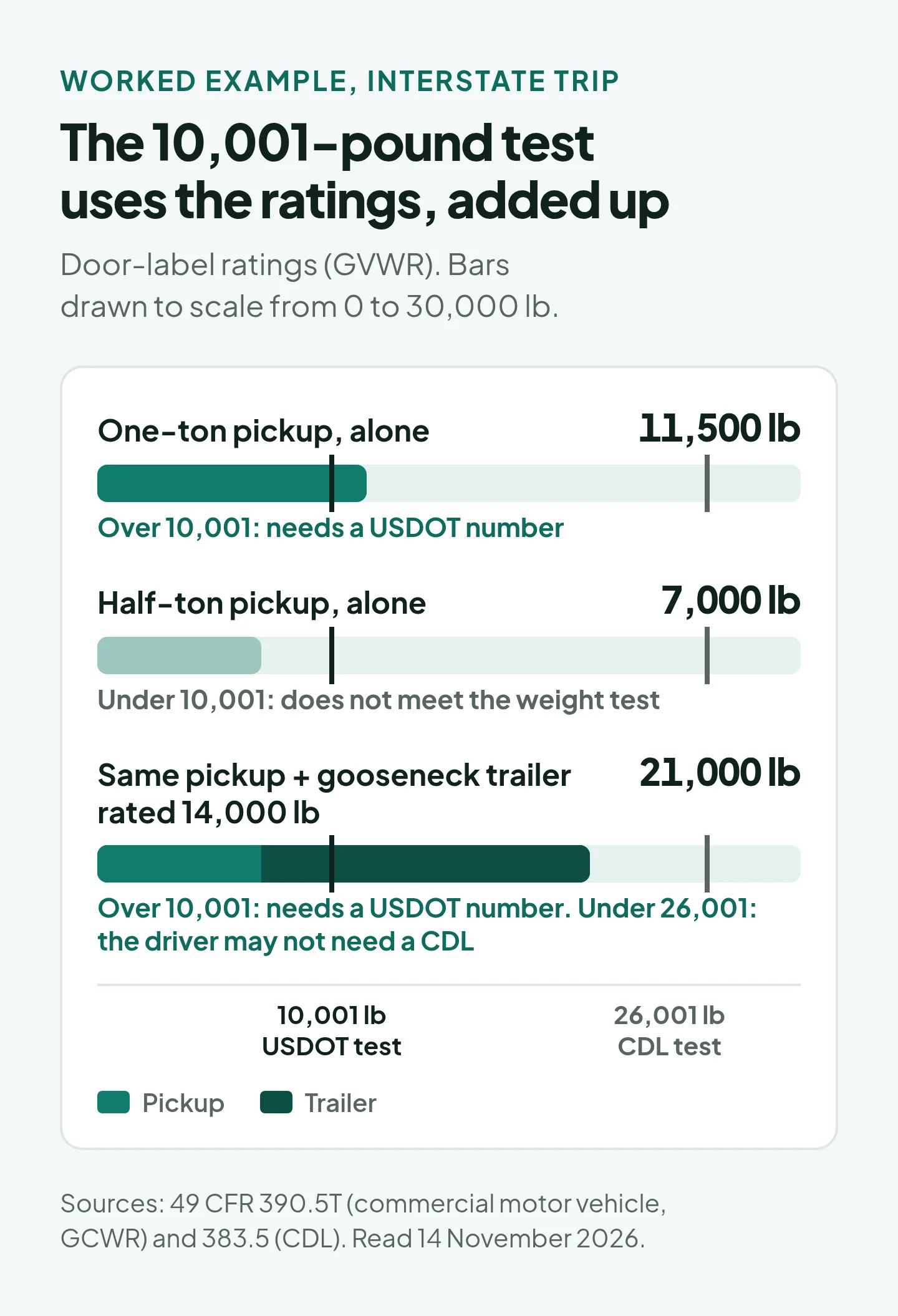
The 10,001-pound test uses the highest of the ratings and the actual weight. A rating is what the manufacturer prints on the certification label, usually on the driver’s door jamb, not what the truck happens to weigh on the scale. For a combination, 390.5T sets the GCWR as the greater of the power unit maker’s GCWR, if one is on the label, or the sum of the GVWRs (or actual weights) of the truck and everything it tows. One exception: a truck that is not towing is not judged by its GCWR.
Worked example. A one-ton pickup has a GVWR of 11,500 pounds on its door label. On its own, on an interstate trip, it already meets the weight test: 11,500 is over 10,001. A half-ton pickup rated 7,000 pounds does not meet it alone. Hitch it to a gooseneck trailer rated 14,000 pounds and the sum of the GVWRs is 21,000 pounds, so on an interstate load the combination is a commercial motor vehicle and the operator needs a USDOT number. That 21,000-pound combination still sits under the 26,001-pound CDL threshold, so the driver may not need a CDL. Many hotshot setups land in this range. The example only shows how the ratings add up: a half-ton pickup is rarely rated to tow a trailer that heavy, so check the truck maker’s towing and GCWR limits before you buy or hitch anything.
When you don’t need one
- Light vehicles with no placarded hazmat, not carrying passengers, and not part of a for-hire, broker or forwarder business. They fall outside the federal definition.
- Purely intrastate work, unless your state requires a USDOT number or you haul hazmat that needs a federal safety permit (below).
- Owner-operators leased on to an authorized carrier, for the loads hauled under that lease. The truck carries the carrier’s name and USDOT number; if your own name is also on it, the carrier’s details must follow the words “operated by” (49 CFR 390.21T(b)(3)). Our owner-operator guide compares leasing on with running under your own number and authority.
A company that already has a USDOT number does not need a new one for each truck, driver or location. The number belongs to the company.
States that require a DOT number for intrastate trucks
Federal rules aside, many states make their own intrastate commercial vehicle registrants get a USDOT number. FMCSA’s page (last updated 3 September 2025) lists these:
Alabama, Alaska, Arizona, California, Colorado, Connecticut, Delaware, Florida, Georgia, Hawaii, Idaho, Indiana, Iowa, Kansas, Kentucky, Maine, Maryland, Massachusetts, Michigan, Minnesota, Missouri, Montana, Nebraska, Nevada, New Jersey, New York, North Carolina, Ohio, Oklahoma, Oregon, Pennsylvania, South Carolina, Texas, Utah, Washington, West Virginia, Wisconsin and Wyoming, plus Puerto Rico.
Treat the list as a starting point. Each state sets its own weight threshold and exceptions, and FMCSA’s FAQ says Motus “will not track or monitor State requirements.” If your state is not on the list, that does not prove it has no rule: ask the state agency that handles motor carrier registration. Intrastate carriers that do need a number apply in Motus like everyone else and get the R suffix.
Intrastate hazmat. A carrier that hauls certain high-risk hazardous materials needs an FMCSA hazardous materials safety permit even inside one state. The list in 49 CFR 385.403 includes highway route-controlled quantities of radioactive material, more than 25 kg of Division 1.1, 1.2 or 1.3 explosives, and certain poison-inhalation hazards and bulk methane shipments. Those carriers file the combined MCS-150B and get a USDOT number with the permit.
How much does a DOT number cost?
Nothing. FMCSA’s fee schedule in 49 CFR 360.3T lists no fee for a USDOT number, and the modernization FAQ says there are “no planned changes to the registration fees” with Motus. Any price you see attached to “getting a DOT number” is a private filing service’s charge. Those services are optional, and under Motus they cannot start your application: you open it and pass identity and business verification yourself, then designate the service, and you review its entries and sign the final oaths.
What does cost money is the registration that usually comes with the number:
| Item | Who pays | Amount |
|---|---|---|
| USDOT number | Everyone who needs one | $0 |
| Operating authority | For-hire carriers, brokers, forwarders | $300 per authority type (360.3T(f)(1)) |
| UCR, 2027 | Interstate carriers with 0 to 2 vehicles, and brokers | $55 (49 CFR 367.50) |
| BOC-3 process agents | Carriers and brokers with authority | No FMCSA fee; agents set prices |
| Liability insurance | For-hire carriers | Premium; $750,000 minimum cover for general freight in 10,001 lb+ trucks (49 CFR 387.9) |
Bigger fleets pay more UCR (the 2027 brackets run up to $54,165 for 1,001 or more vehicles). For a full first-year budget, including the truck, insurance and cash reserve, see what it really costs to start a trucking company.
How to get a DOT number in Motus
The online Unified Registration System (URS) went permanently offline on 14 May 2026, and many guides still send you there. First-time applicants now use Motus. These steps follow FMCSA’s Move into Motus page (updated 18 May 2026) and the 29 April 2026 Federal Register notice on Motus.
- Work out what you need. FMCSA’s USDOT Wizard, linked from the Move into Motus page, asks a short set of questions and tells you whether you need only a USDOT number or a USDOT number plus operating authority. Get this right first: each authority type costs $300 and isn’t refunded once accepted.
- Get the business ready. Form your legal entity and settle the exact legal name. You need a real principal place of business: the FAQ says FMCSA must reject an application if the address “could never satisfy” the regulatory definition, so a mail drop is a risk. Have your vehicle, driver and cargo details to hand, because the application asks about the nature and scope of your operation.
- Create your user profile. Sign in with Login.gov and complete identity verification. If it fails, the FMCSA Contact Center (1-800-832-5660) may refer you to a physical location to finish it.
- Create the company account. Enter the business details and pass business verification. The person who creates the account is its main account holder and can invite other users.
- Apply. Choose a new USDOT number and, if the Wizard said so, the authority types you need. Certify the oaths and pay any fees.
- If you applied for authority, finish the filings. Your insurer or surety files proof of coverage and your process agent files the BOC-3. Authority goes active only after FMCSA publishes the application, a 10-day protest period passes and those filings are on record. The MC number guide linked above explains each filing.
- Mark your trucks and keep the record current. See the next sections.

Paper forms are still accepted until a future rule ends them, but FMCSA’s FAQ says paper requests “are expected to take longer to process” than online ones.
If you are building a whole carrier from scratch, our step-by-step plan for starting a trucking company shows where the USDOT number fits among the entity, insurance, drug testing, UCR, IRP and IFTA steps.
How long it takes
FMCSA has not published a processing time for online applications in Motus. The April 2026 notice gives a floor only for paper forms: “a minimum timeframe of eight business days for the initial review and processing,” plus extra time if an application is flagged for further vetting.
For a private carrier that needs only the number, that review is the main wait. For a for-hire carrier or broker, the number on its own does not let you take paid freight: the authority must be active too, after publication, the protest period and the filings. Plan in weeks, and don’t book loads, sign a lease or start a truck payment on the assumption of a fixed date.
What comes with the number
Marking your trucks
49 CFR 390.21T requires every self-propelled commercial motor vehicle to show, on both sides, your legal name or one trade name (as listed on your MCS-150) and the number preceded by the letters “USDOT.” The letters must contrast sharply with the background and be readable in daylight from 50 feet while the truck is parked. Paint or a removable sign both work if they meet that test. Trailers are not marked under these paragraphs; only intermodal equipment that an equipment provider interchanges has its own marking rule in the same section.
The biennial update
Under 390.19T(b) you update your MCS-150 information every 24 months. The last digit of the USDOT number sets the month (1 is January, 9 is September, 0 is October) and the next-to-last digit sets the year: odd digit, odd years; even digit, even years. A carrier whose number ends in 38 files by 31 August in odd years, so its next update is due by 31 August 2027. Missing it can bring civil penalties and “deactivation of its USDOT Number.”
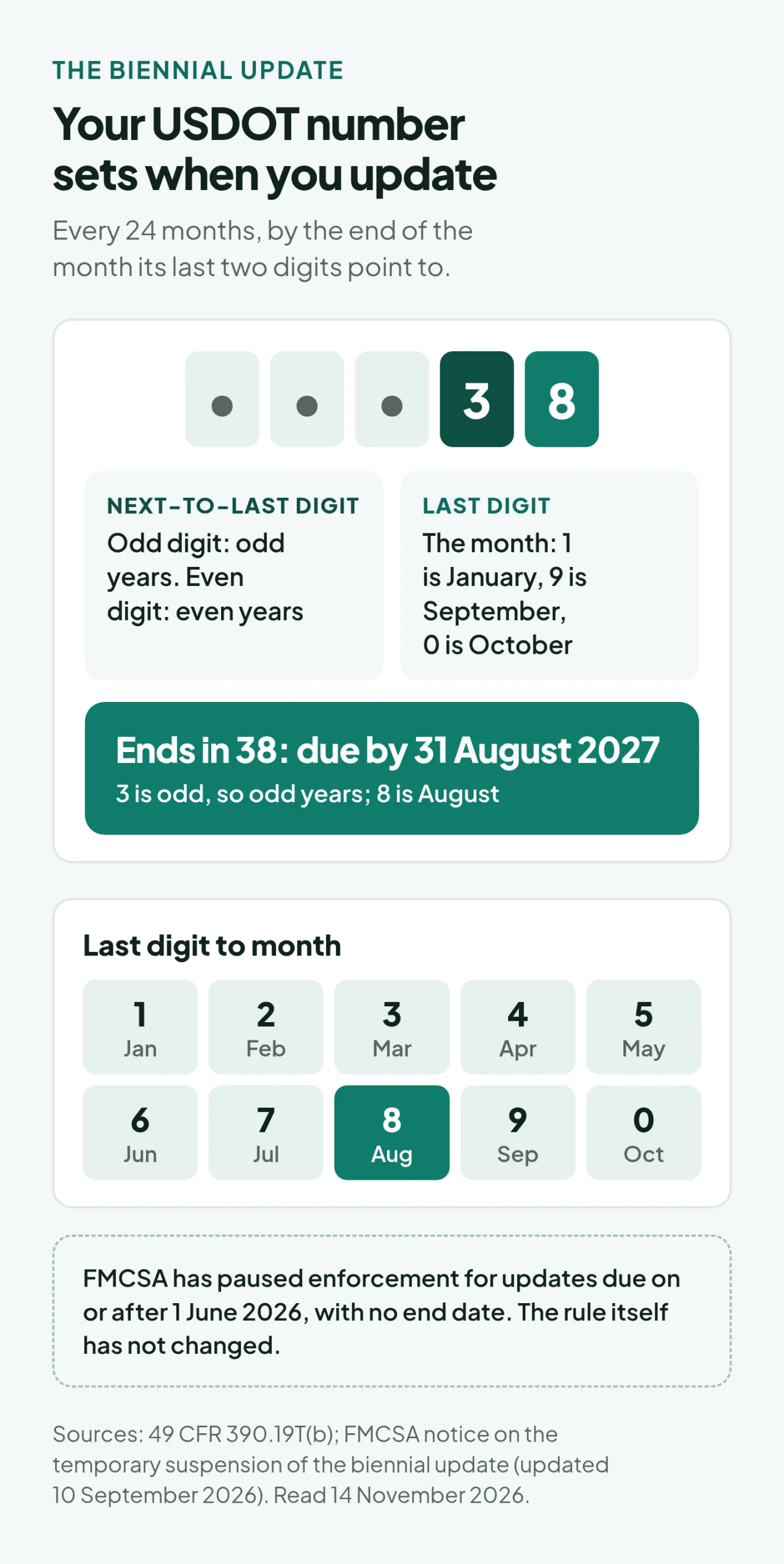
FMCSA has temporarily stopped enforcing updates due on or after 1 June 2026 during the Motus rollout. Its notice, last updated 10 September 2026, gives no end date, and the rule itself has not changed. The simplest course is to file in Motus when your month comes up anyway. Our MCS-150 guide walks through the update.
The new entrant period
A carrier that gets a USDOT number to start interstate operations is a “new entrant.” 49 CFR 385.3 sets an 18-month monitoring period, with a safety audit within 12 months of receiving the number for property carriers (120 days for passenger carriers). Under 385.307, the audit generally comes once you have been operating at least 3 months, so keep driver files, hours-of-service records, maintenance records and drug and alcohol testing records in order from your first load.
Changes, inactivation and reactivation
Name and address changes, extra authority types, voluntary inactivation and reactivation of the number all go through your Motus company account, according to the Move into Motus page. A USDOT number has no expiry date in the rules, but it can be deactivated for a missed update or inactivated when you stop operating, and FMCSA’s FAQ says existing registrants keep their current number in Motus.
Operating without one
49 CFR 392.9b says a commercial motor vehicle in interstate commerce “must not be operated without a safety registration and an active USDOT Number.” Non-recordkeeping violations of Parts 390 to 399 carry civil penalties of up to $19,246 per violation under Appendix B to Part 386, paragraph (a)(3). Hauling for hire without the required authority is a separate violation, with a minimum penalty of $13,676 per violation in paragraph (1) of the same appendix’s registration list.
How to look up a DOT number
FMCSA’s SAFER Company Snapshot searches by USDOT number, MC/MX number or company name and shows the company’s identification, size, cargo, any safety rating, an out-of-service inspection summary and crash information. Motus’s public search, by USDOT number, legal name or DBA, shows the company’s registration record, according to FMCSA’s Motus support notice of 10 September 2026. Our guide to looking up a carrier by MC or DOT number explains both tools field by field.
Checklist before you apply
- Run each vehicle against the 10,001-pound, passenger and placard tests, using the door-label ratings and any trailer you tow.
- Decide whether any trip, or any load’s journey, is interstate.
- Check your state’s intrastate rule if you will run in one state only.
- Decide whether you also need operating authority, and which type.
- Form the business and settle the legal name and principal place of business.
- Have a smartphone or tablet and a government ID ready for identity verification.
- For authority: line up an insurer or surety and a process agent before you submit.
- Order truck lettering with your legal name and “USDOT” plus the number.
- Put your biennial update month in the calendar.
Common questions
Is a DOT number the same as an MC number?
No. The USDOT number identifies the company; an MC number identifies one grant of operating authority. Ending MC numbers is “under consideration” at FMCSA, but no proposed rule has been published, and the FAQ says existing MC numbers “will not be replaced by USDOT Numbers.”
Do I need a DOT number for a pickup truck?
For interstate work, yes if the pickup’s GVWR is 10,001 pounds or more, or if the truck and trailer together reach 10,001 pounds by rating or actual weight. Read both door labels and add the GVWRs. If you haul other people’s regulated freight across state lines for pay, you also need operating authority, whatever the weight.
Do I need a DOT number for a box truck?
If its GVWR is 10,001 pounds or more and it crosses state lines (or carries interstate freight), yes. A single box truck rated under 26,001 pounds, without placarded hazmat, doesn’t need a CDL driver, but the company still needs the USDOT number, the marking and the rest of the safety rules.
Do freight brokers need a DOT number?
Yes. FMCSA’s FAQ says MAP-21 requires every broker to have one, even with no trucks. A broker also needs broker authority and a $75,000 bond or trust fund (49 CFR 387.307).
Does a DOT number expire?
There is no expiry date in the rules, but the number can be deactivated if you miss the biennial update. FMCSA has paused that enforcement for updates due on or after 1 June 2026, with no end date, so keep your information current in Motus anyway.
Should I pay a service to get one?
You don’t have to. The number is free, and in Motus you must complete identity and business verification yourself before a service can help. If you use one, its fee is not an FMCSA fee, and you still review and sign everything it enters.
Facts checked against primary sources on 14 November 2026: the eCFR (Title 49, sections 360.3T, 367.50, 383.5, 385.3, 385.307, 385.403, 387.307, 387.9, 390.5T, 390.19T, 390.21T and 392.9b, and Appendix B to Part 386, current through 12 November 2026), FMCSA’s “Do I Need a USDOT Number?” page (last updated 3 September 2025), registration modernization FAQ, SAFER Company Snapshot page, Move into Motus page (18 May 2026) and biennial-update notice (10 September 2026), and the Federal Register notice of 29 April 2026 (91 FR 23144). Every figure is checked against the linked source. This page is general information, not legal, tax or financial advice.
Sources
- eCFR: 49 CFR 390.5T, definitions (commercial motor vehicle, interstate commerce, GCWR)
- eCFR: 49 CFR 390.19T, motor carrier identification reports and USDOT numbers
- eCFR: 49 CFR 390.21T, marking of self-propelled CMVs
- eCFR: 49 CFR 392.9b, prohibited transportation without an active USDOT number
- eCFR: 49 CFR 360.3T, filing fees
- eCFR: 49 CFR 367.50, UCR fees for 2027
- eCFR: 49 CFR 383.5, CDL definitions
- eCFR: 49 CFR 385.3, new entrant definitions
- eCFR: 49 CFR 385.307, new entrant safety monitoring
- eCFR: 49 CFR 385.403, hazardous materials safety permit
- eCFR: 49 CFR 387.9, minimum levels of financial responsibility
- eCFR: 49 CFR 387.307, broker financial security ($75,000)
- eCFR: Appendix B to Part 386, penalty schedule
- FMCSA: Do I Need a USDOT Number? (last updated 3 September 2025)
- FMCSA: Registration modernization FAQs
- FMCSA: Move into Motus (updated 18 May 2026)
- FMCSA: Temporary suspension of the biennial update requirement (updated 10 September 2026)
- Federal Register: Availability of Motus, FMCSA's New Registration System (29 April 2026, 91 FR 23144)
- FMCSA SAFER Company Snapshot