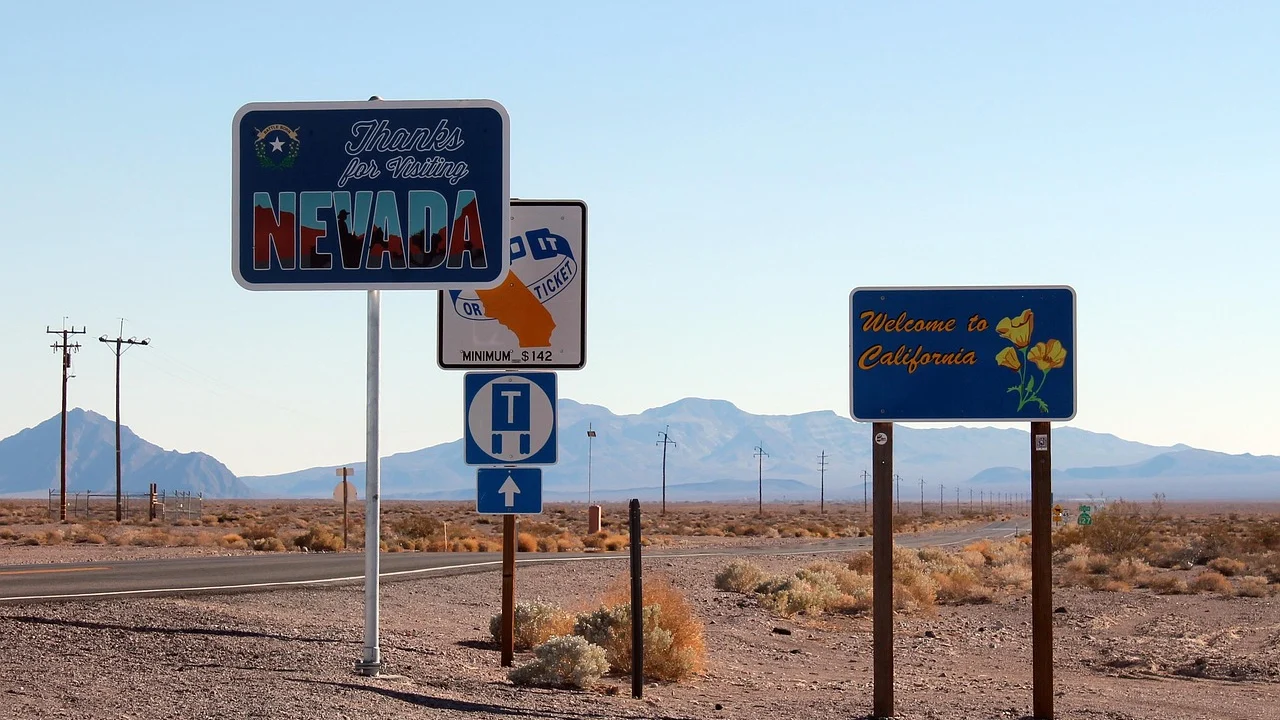
Interstate trucking is any haul that crosses a state line, or that stays inside one state but is one leg of a longer trip that starts or ends outside it. Intrastate trucking is everything else: freight that begins and ends in the same state with no out-of-state journey behind or ahead of it. Whichever way round you put it, intrastate vs interstate comes down to where the freight’s whole trip starts and ends, not just your leg of it. Interstate work puts you under FMCSA’s federal rules (a USDOT number, operating authority for most for-hire work, federal insurance minimums, UCR). Intrastate-only work puts you under your state’s rules, which follow the federal ones closely but may vary on driver age, hours and small trucks. This guide is part of our getting licensed hub.
This is general information, not legal, tax or financial advice. Confirm your own operation with FMCSA and your state’s motor carrier agency before you haul.
Interstate vs intrastate at a glance
The table compares a typical property carrier with trucks of 10,001 lb or more, hauling non-hazardous freight. Each row is explained further down.
| Requirement | Interstate | Intrastate only |
|---|---|---|
| USDOT number | Yes, federal | If your state requires one (FMCSA lists 38 states and Puerto Rico) |
| Operating authority (MC number) | For-hire carriers of regulated freight, and brokers | No federal authority; many states have their own |
| Liability insurance | Federal minimum, $750,000 for for-hire | State minimum (Texas: $500,000 over 26,000 lb) |
| UCR | Yes | No |
| Driver minimum age | 21 | State rule, never under 18 |
| Hours of service | Federal: 11 hours driving, 14-hour window | State rule; may allow 12 and 16 |
| CDL, drug and alcohol testing | Yes, when a CDL is needed | Yes, when a CDL is needed |
| Hazmat rules | Yes | Yes |
| Form 2290 (55,000 lb and up) | Yes | Yes |
| IFTA and IRP | If a qualifying truck runs in two or more jurisdictions | No, while it stays in one state |
The legal definition of interstate commerce
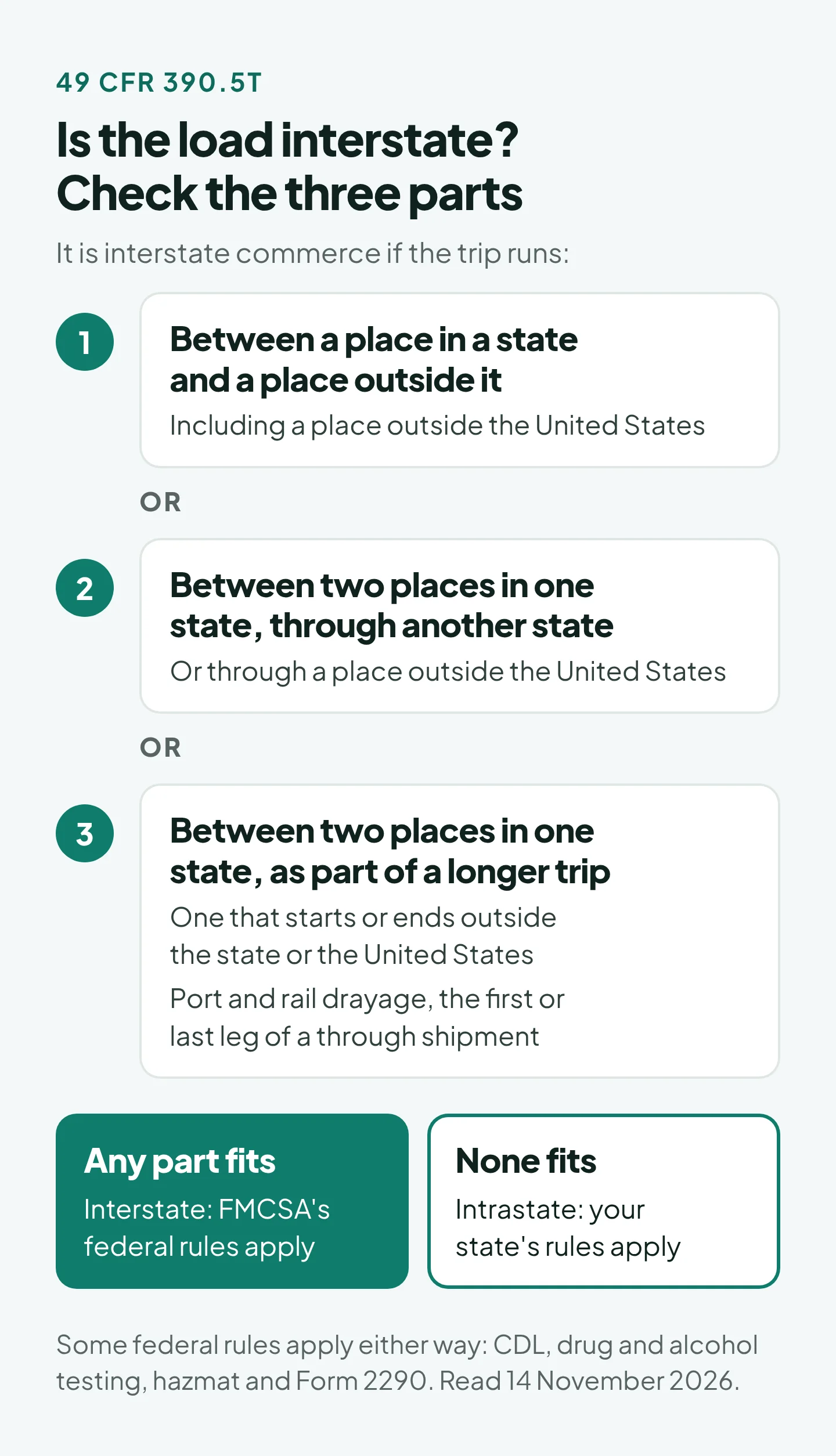
The test isn’t the road you use or how far you drive. It is the definition in 49 CFR 390.5T, which says interstate commerce is trade, traffic or transportation in the United States:
- between a place in a state and a place outside that state, including a place outside the United States;
- between two places in a state, through another state or a place outside the United States; or
- between two places in a state, as part of trade, traffic or transportation that starts or ends outside the state or the United States.
Intrastate commerce, in the same section, is “any trade, traffic, or transportation in any State which is not described in the term ‘interstate commerce.’” So you check whether a load is interstate first. If none of the three parts fits, the load is intrastate.
The first two parts are easy: you cross a state line or a border. The third part is the one that is easy to miss. A truck can spend its whole working life inside Texas and still run in interstate commerce.
When a load that stays in one state is still interstate
FMCSA’s guidance on telling intra- and interstate commerce apart says the answer depends on “the essential character of the movement, manifested by the shipper’s fixed and persistent intent at the time of shipment,” judged from all the facts. When that intent is interstate, the driver and truck are under the federal rules “even when the route is within the boundaries of a single State.”
In practice, ask where the freight came from before it reached your trailer and where it is going after it leaves. Common in-state legs that usually count as interstate:
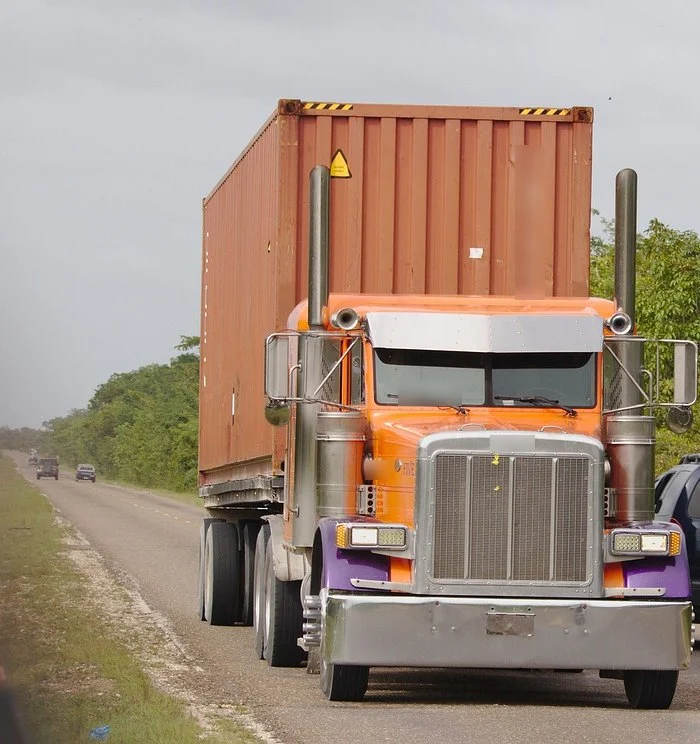
- Port and rail drayage. An import container moved from a port to a warehouse in the same state is finishing a trip that began abroad. Export loads going the other way have the same character.
- The first or last leg of a through shipment. Freight that arrived from another state and is carried on to its planned final customer, or is picked up locally and taken to a terminal for a load leaving the state.
- An empty truck sent across a line to work. FMCSA’s guidance on a carrier that sends an empty truck into a neighboring state to haul between two points there, then return, calls that hauling interstate commerce. The intent was to move the vehicle across state lines to do the work.
Warehouses are the gray zone. If goods come to rest at a distribution center and the owner decides later where they go, the next in-state delivery may be a new, intrastate shipment. If the owner already knew the final customer when the goods were shipped from out of state, the stop at the warehouse doesn’t break the interstate character. Neither the regulation nor FMCSA’s guidance sets a bright-line rule here. Ask the shipper, read the bill of lading and keep what they tell you in writing.
Worked example: one truck, three loads
A new Dallas-based carrier with one tractor (GVWR well over 26,000 lb) is offered three loads in its first week:
| Load | Route | Status | Why |
|---|---|---|---|
| 1. Bagged cement | Texas plant to Texas job site | Intrastate | Starts and ends in Texas, no out-of-state leg |
| 2. Import container | Port of Houston to a Dallas warehouse | Interstate | Part of a trip that began outside the U.S. (third part of 390.5T) |
| 3. Dry van freight | Dallas to Oklahoma City | Interstate | Crosses a state line (first part) |
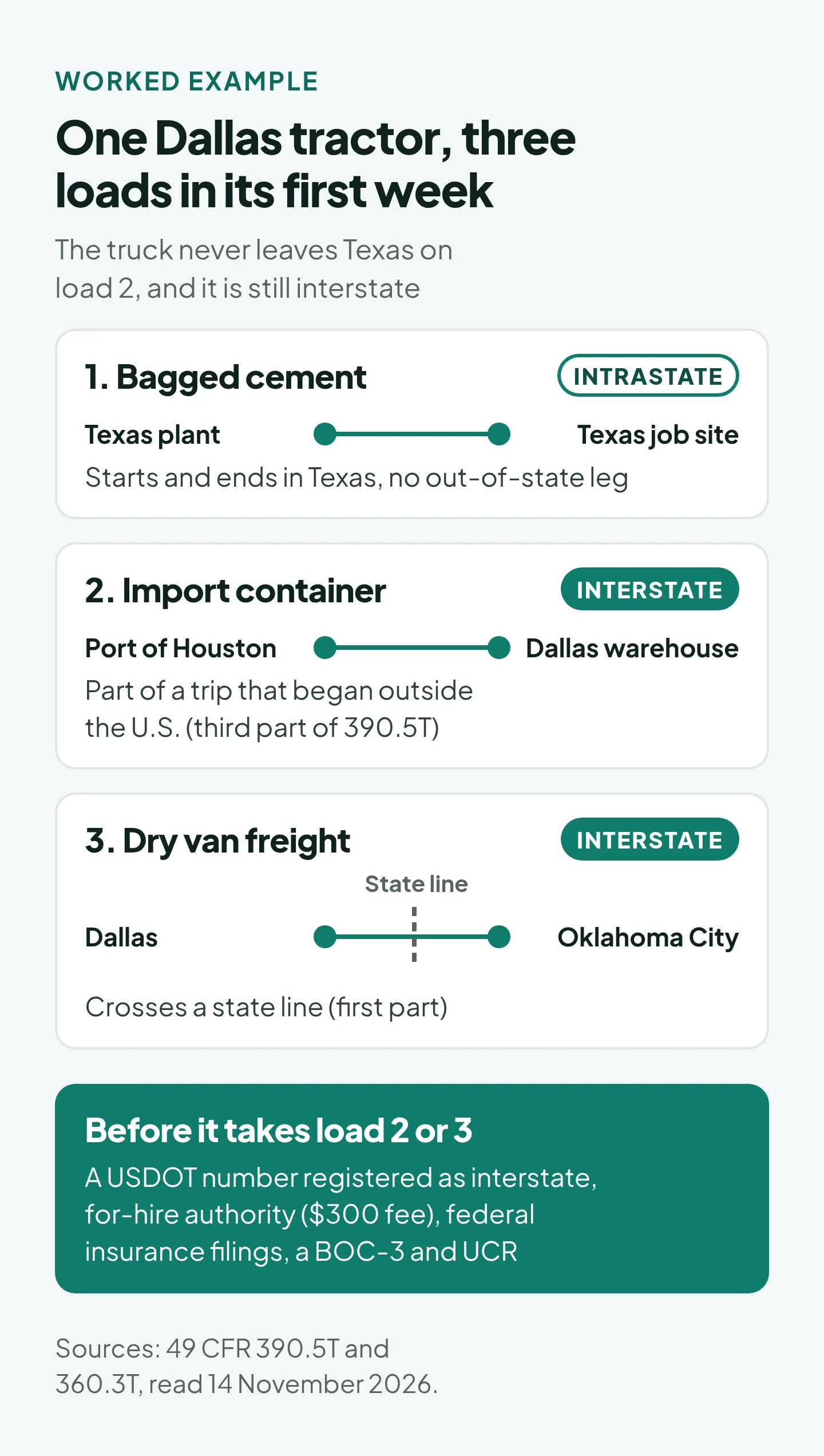
Load 1 alone would put the carrier under Texas’s intrastate program. Loads 2 and 3 change everything: the carrier needs a USDOT number registered as interstate, for-hire carrier authority (the MC number and its $300 fee), federal insurance filings, a BOC-3 and UCR before it can take either one. Load 2 is the easy one to misjudge, because the truck never leaves Texas.
Once it holds federal authority, the carrier can still take load 1. A load’s own character decides which hours, age and other driver rules apply to it, but one interstate trip carries over into the following days, as the section on running both explains.
Rules that apply either way
Staying inside one state doesn’t take you outside federal law entirely. Four sets of rules follow you either way.
- CDL. The CDL rules in Part 383 apply to anyone who drives a commercial motor vehicle “in interstate or intrastate commerce” (49 CFR 390.3T(b)). When you apply, you certify which of four categories you drive in: non-excepted or excepted, interstate or intrastate (49 CFR 383.71(b)(1)).
- Drug and alcohol testing. Part 382 covers drivers who need a CDL and operate “in commerce in any State” (49 CFR 382.103). FMCSA’s guidance on who must be tested names drivers “in intrastate or interstate commerce.” Non-CDL drivers are outside Part 382.
- Hazardous materials. The Hazardous Materials Regulations apply to hazmat transported “in commerce” (49 CFR 171.1). A carrier hauling the materials listed in 49 CFR 385.403 (certain explosives, highway route-controlled radioactive loads, poison-inhalation materials, and compressed or liquefied natural gas in bulk packaging of 3,500 gallons or more) needs a federal safety permit, interstate or intrastate. Those intrastate carriers must also register for a USDOT number and mark their trucks (390.3T(g)). Federal hazmat insurance minimums reach intrastate carriers too, except for most non-bulk loads (49 CFR 387.3).
- Heavy vehicle use tax. Form 2290 is due for any taxable highway vehicle of 55,000 lb or more that is registered, or required to be registered, in your name, under the IRS instructions for Form 2290. Crossing state lines doesn’t come into it.
What interstate trucking adds
Interstate work brings in the full Federal Motor Carrier Safety Regulations: the rules in that subchapter apply to “all employers, employees, and commercial motor vehicles that transport property or passengers in interstate commerce” (390.3T(a)(1)). For a property carrier that means:
- A USDOT number if you run a truck with a GVWR, GCWR or actual weight of 10,001 lb or more, whichever is greater (390.5T). FMCSA charges no fee for it. Our USDOT number guide walks through the Motus application.
- Operating authority if you haul regulated freight owned by others for pay, or arrange it as a broker: $300 per authority type under 49 CFR 360.3T. Private carriers moving their own goods, and carriers of only exempt commodities, need a USDOT number but no authority.
- Federal insurance. For-hire carriers of non-hazardous property need at least $750,000 of liability cover for trucks of 10,001 lb GVWR or more (49 CFR 387.9), or $300,000 for a fleet made up only of lighter vehicles (387.303T). Our guide to trucking liability insurance explains both rules and the filings.
- A BOC-3 naming process agents, and UCR, which interstate carriers, private carriers and brokers pay each year. The UCR Plan says intrastate-only operators don’t register.
- Federal driver rules. Drivers must be at least 21 (49 CFR 391.11(b)(1)), hold a medical certificate unless excepted, and follow federal hours of service: 11 hours driving in a 14-hour window after 10 hours off (49 CFR 395.3).
The full sequence, from forming the company to passing the new entrant audit, is in our step-by-step guide to starting a trucking company.
How state rules for intrastate trucks can differ
States that take federal safety grants (the Motor Carrier Safety Assistance Program) must keep their own truck safety rules compatible with the federal ones. 49 CFR 350.305 lists the differences a state may allow for intrastate commerce without asking FMCSA first:
| Topic | Federal (interstate) | What a state may allow intrastate |
|---|---|---|
| Smaller trucks | Rules start at 10,001 lb | Exempt trucks under 26,001 lb, unless placarded hazmat or 16+ people |
| Driving limit | 11 hours, 14-hour window | 12 hours, no driving after 16 hours on duty |
| Weekly limit | 60 hours in 7 days or 70 in 8 | 70 hours in 7 days or 80 in 8 |
| Driver age | 21 | At least 18 |
| Medical standards | 391.41 standards | Grandfathered drivers and state waiver programs |
These are the limits of what a state may do, not what your state does: it may use some of them, all of them or none. A state can also apply to FMCSA for other intrastate variances, which are granted only if they serve the same safety purpose (350.305(g)). The same section forbids states from exempting intrastate carriers by type of business (for-hire against private) or by distance from base, apart from industry exemptions already in place before April 1988.
Intrastate DOT numbers and intrastate authority
Federal law requires a USDOT number from intrastate carriers only when they haul hazmat that needs a safety permit. Many states require one anyway. FMCSA’s page Do I Need a USDOT Number? (last updated 3 September 2025) lists 38 states and Puerto Rico that require their intrastate commercial vehicle registrants to get one: Alabama, Alaska, Arizona, California, Colorado, Connecticut, Delaware, Florida, Georgia, Hawaii, Idaho, Indiana, Iowa, Kansas, Kentucky, Maine, Maryland, Massachusetts, Michigan, Minnesota, Missouri, Montana, Nebraska, Nevada, New Jersey, New York, North Carolina, Ohio, Oklahoma, Oregon, Pennsylvania, South Carolina, Texas, Utah, Washington, West Virginia, Wisconsin and Wyoming.
That list is FMCSA’s summary, not each state’s law, and FMCSA tells readers to check with the responsible state agency. A state that isn’t on it may still have its own registration or permit. Intrastate USDOT numbers are issued through Motus, the same FMCSA system used for interstate numbers. FMCSA’s registration modernization FAQ says Motus shows an “R” suffix for an intrastate carrier.
“Intrastate authority” is the state version of an MC number, and every state runs it differently. Two examples, read on 14 November 2026:
- Texas. The TxDMV number is required for trucks or combinations over 26,000 lb, placarded hazmat, buses for more than 15 people and household goods movers of any size. You need a USDOT number first, registered as intrastate if you run only in Texas. Private and for-hire carriers over 26,000 lb must file at least $500,000 of liability cover. Fees for a one-year certificate: a $100 application, $10 per vehicle and $100 for the insurance filing (Form E).
- California. The DMV issues the Motor Carrier Permit (MCP). Its MCP FAQ says the CA number “is issued exclusively by the California Highway Patrol (CHP) to identify motor carriers and is used as the MCP number.”
Brokers follow the same split. FMCSA broker authority covers interstate freight. If you only arrange loads inside one state, check that state’s own rules before you start.
IFTA and IRP use a different test
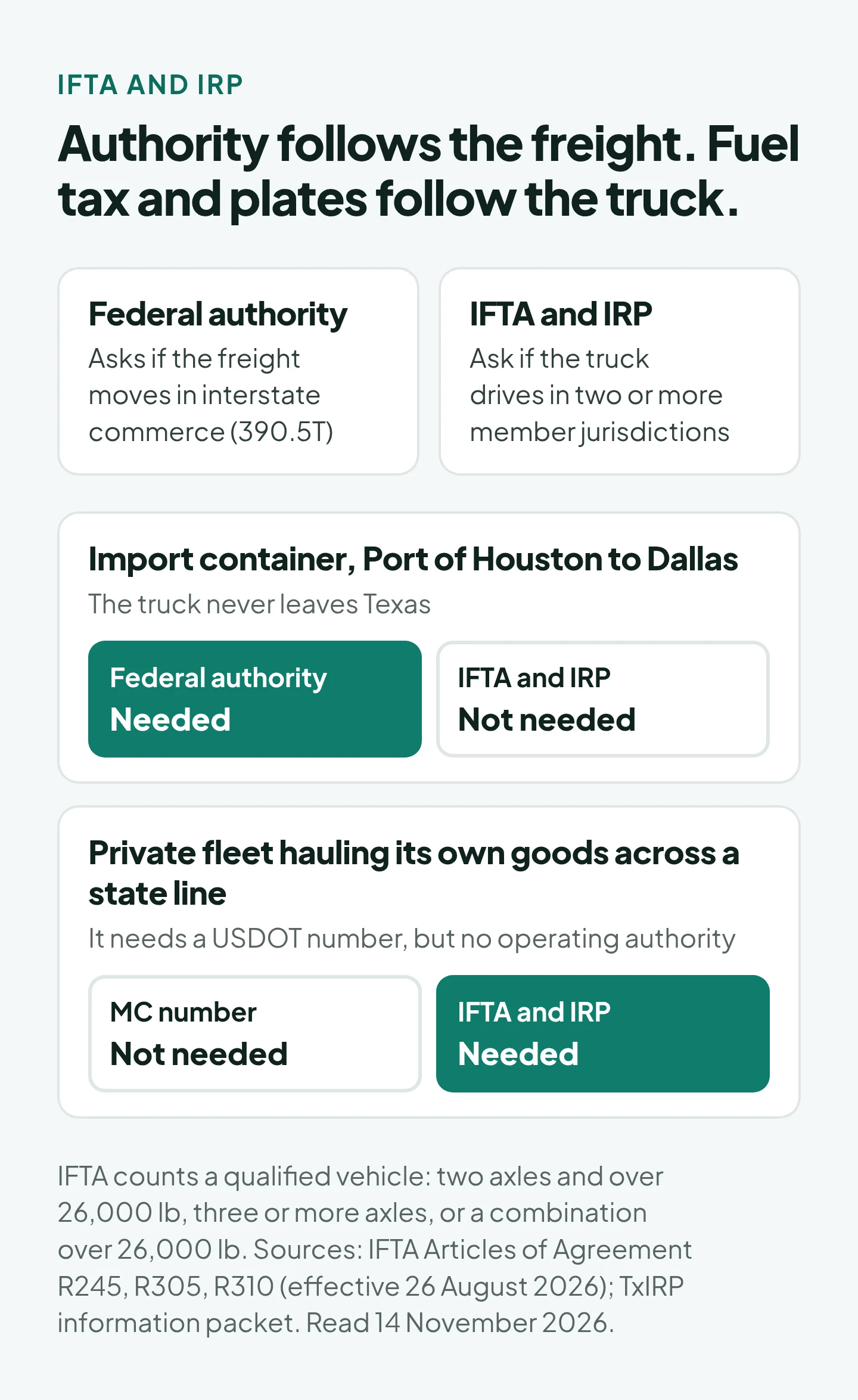
Fuel tax and apportioned plates don’t ask whether the freight is in interstate commerce. They ask where the truck physically drives.
- IFTA: anyone based in a member jurisdiction who runs a qualified motor vehicle “in two or more member jurisdictions” must hold an IFTA license or buy trip permits (IFTA Articles of Agreement R305 and R310, effective 26 August 2026). A qualified vehicle has two axles and over 26,000 lb, three or more axles, or a combination over 26,000 lb (R245).
- IRP: apportioned registration is for vehicles over the same weight and axle tests that are used in two or more member jurisdictions, as the Plan’s definition is printed in Texas DMV’s TxIRP information packet.
So a truck on load 2 above, which never leaves Texas, needs federal authority but not IFTA or IRP. A private fleet that drives its own goods across a state line in qualifying trucks needs IFTA and IRP but no MC number. When you do cross state lines, the IFTA calculator works out what you owe each state per quarter.
Running both, or switching to interstate
One interstate trip doesn’t end when the truck gets home. FMCSA’s policy in its guidance on drivers who only sometimes run interstate (issued 8 February 2000) says a driver who starts an interstate trip must keep to the federal hours of service for the next 7 or 8 consecutive days, depending on the carrier’s 60- or 70-hour schedule, “even if he/she operates exclusively in intrastate commerce” for that period. Before the interstate trip, the driver may follow state hours rules, but must carry records of duty status for the previous 7 days unless the short-haul exception applies.
The same guidance says FMCSA can also cover a driver who hasn’t crossed a state line yet, if the carrier runs interstate and the driver “could reasonably be expected to make one of the carrier’s interstate runs.” A mixed fleet should plan to keep every driver it might send across a line qualified under the federal rules: aged 21 or more, with a medical card and a federal driver file.
To move from intrastate to interstate, a carrier usually needs to:
- Update its USDOT registration in Motus from intrastate to interstate operation.
- Apply for for-hire authority, if it will haul regulated freight for others, and wait out the 10-day protest period.
- Have its insurer file federal proof of insurance (BMC-91 or BMC-91X) and its process agent file the BOC-3.
- Register and pay for UCR for the current year.
- Get IFTA and IRP credentials if the trucks will cross state lines.
- Check every driver against the federal qualification, hours and drug-testing rules.
Should a new carrier start intrastate?
Starting intrastate can mean fewer registrations, lower insurance minimums in some states and more nights at home. It also shrinks your market. Port and rail container moves are usually interstate even when the miles are local, and any broker load that crosses a state line is interstate too. If your customers are local contractors, aggregate or farm work, intrastate can be enough. If you plan to haul general freight from brokers, you’ll need interstate authority sooner or later.
Run the numbers both ways before you decide. Our breakdown of what it costs to start a trucking company lists the federal fees and first-year bills line by line. Owner-operators also have a third option, leasing on to a carrier that already holds interstate authority, which we compare in the owner-operator guide.
Checklist: which rules apply to you
- Will any load cross a state line or the border? You are interstate.
- Will any load come from, or go on to, another state or country (ports, rail ramps, through freight)? Ask the shipper; it is probably interstate.
- Will you ever send a truck across a line, even empty, to work on the other side? Interstate.
- Truck of 10,001 lb or more on interstate work? USDOT number. Hauling others’ regulated freight for pay? Operating authority too.
- Intrastate only? Check whether your state needs a USDOT number, a state carrier number or permit, and what insurance it requires.
- Driver needs a CDL? Drug and alcohol testing applies either way.
- Truck of 55,000 lb or more? Form 2290 either way.
- Placarded hazmat? Federal hazmat rules either way, plus a safety permit and USDOT number for the listed materials.
Common questions
Do I need an MC number for intrastate trucking?
No. Federal operating authority is for interstate for-hire work. Your state may have its own carrier number, permit or certificate, and it may require a USDOT number.
Is a container from a port in my own state interstate?
Usually, yes. Import and export containers are part of a trip that begins or ends outside the United States, which meets the third part of the 390.5T definition. Confirm with the shipper if the goods were stored and resold in between.
Can an 18-year-old drive a truck intrastate?
Only if the state allows it. Federal rules let states set an intrastate minimum as low as 18 (350.305(e)), but interstate drivers must be 21.
Do intrastate carriers pay UCR?
No. UCR is for interstate carriers, private carriers, brokers, freight forwarders and leasing companies. Intrastate-only operators don’t register, according to the UCR Plan.
Does a pickup and trailer under 10,001 lb fall under any of this?
For USDOT purposes, a vehicle or combination under 10,001 lb (by rating or actual weight, whichever is greater) isn’t a commercial motor vehicle unless it carries placarded hazmat or is designed or used to carry more than 8 passengers, counting the driver, for pay (more than 15 otherwise) (390.5T). Hauling others’ regulated freight interstate for pay still needs operating authority, whatever the size of the truck. The MC number guide linked above covers that case.
Facts checked against primary sources on 14 November 2026: the eCFR (Title 49, Parts 171, 350, 360, 382, 383, 385, 387, 390, 391 and 395, current through 12 November 2026), FMCSA registration pages and regulatory guidance, the IRS, the UCR Plan, IFTA, Inc., the Texas Department of Motor Vehicles and the California DMV. This page is general information, not legal, tax or financial advice.
Sources
- eCFR: 49 CFR 390.5T, definitions (interstate and intrastate commerce, commercial motor vehicle)
- eCFR: 49 CFR 390.3T, general applicability
- eCFR: 49 CFR 350.305, allowable variances from the FMCSRs for intrastate commerce
- eCFR: 49 CFR 360.3T, filing fees
- eCFR: 49 CFR 382.103, drug and alcohol testing applicability
- eCFR: 49 CFR 383.71, CDL applicant self-certification
- eCFR: 49 CFR 171.1, applicability of the Hazardous Materials Regulations
- eCFR: 49 CFR 385.403, hazardous materials safety permit
- eCFR: 49 CFR 387.3, financial responsibility applicability
- eCFR: 49 CFR 387.9, minimum levels of financial responsibility
- eCFR: 49 CFR 387.303T, minimum limits for registered carriers
- eCFR: 49 CFR 391.11, general qualifications of drivers
- eCFR: 49 CFR 395.3, maximum driving time for property-carrying vehicles
- FMCSA guidance: How does one distinguish between intra- and interstate commerce? (390.3T Q6)
- FMCSA guidance: empty CMV dispatched into an adjoining state (390.3T Q13)
- FMCSA guidance: drivers who occasionally operate in interstate commerce (390.3T Q24, 8 February 2000 policy)
- FMCSA guidance: which drivers are in a drug and alcohol testing program (382.103 Q7)
- FMCSA: Do I Need a USDOT Number? (last updated 3 September 2025)
- FMCSA: Registration modernization FAQs
- IRS: Instructions for Form 2290 (Rev. July 2026)
- UCR Plan: Do I need to register?
- IFTA, Inc.: Articles of Agreement (effective 26 August 2026)
- Texas DMV: TxIRP information packet
- Texas DMV: TxDMV number (intrastate motor carrier registration)
- California DMV: Motor Carrier Permit FAQs