
Freight broker software is usually a transportation management system (TMS): one database that takes a load from quote to carrier payment. It holds your customers, carriers, rates, rate confirmations, tracking, invoices and payables. No federal rule requires you to buy one, but 49 CFR 371.3 does require a record of every transaction for three years, and a TMS is the usual way to keep it. On 1 November 2026, published prices ran from $69 per user per month to $9,238 a month for a high-volume load tier, and some vendors publish no price at all. This guide, part of our software and paperwork hub, explains what the software does, what your records must show, what it costs, and how to test it before you sign. It ranks nothing and contains no affiliate links.
This is general information, not legal, tax or financial advice. Vendor prices and terms change, so confirm them in writing before you sign anything.
The short version
- Do you need one on day one? Legally, no. Practically, you need one once a second person books loads or a spreadsheet starts missing fields.
- Biggest buying mistake: comparing the monthly headline. Seats, load caps, setup, EDI, tracking and your load board can all sit outside it.
- Biggest risk to test: whether the system proves what you checked on a carrier, and when. That matters more since the Supreme Court’s May 2026 ruling on broker negligent-hiring claims.
- Best test: run one of your own real loads from quote to carrier payment in the demo, then ask for a full export of that load.
- Before you sign: get renewal, cancellation and data-export terms in writing.
What a TMS does
Accounting software knows about money, and a load board knows about available freight and trucks. A TMS connects the work between them, so each load is entered once.
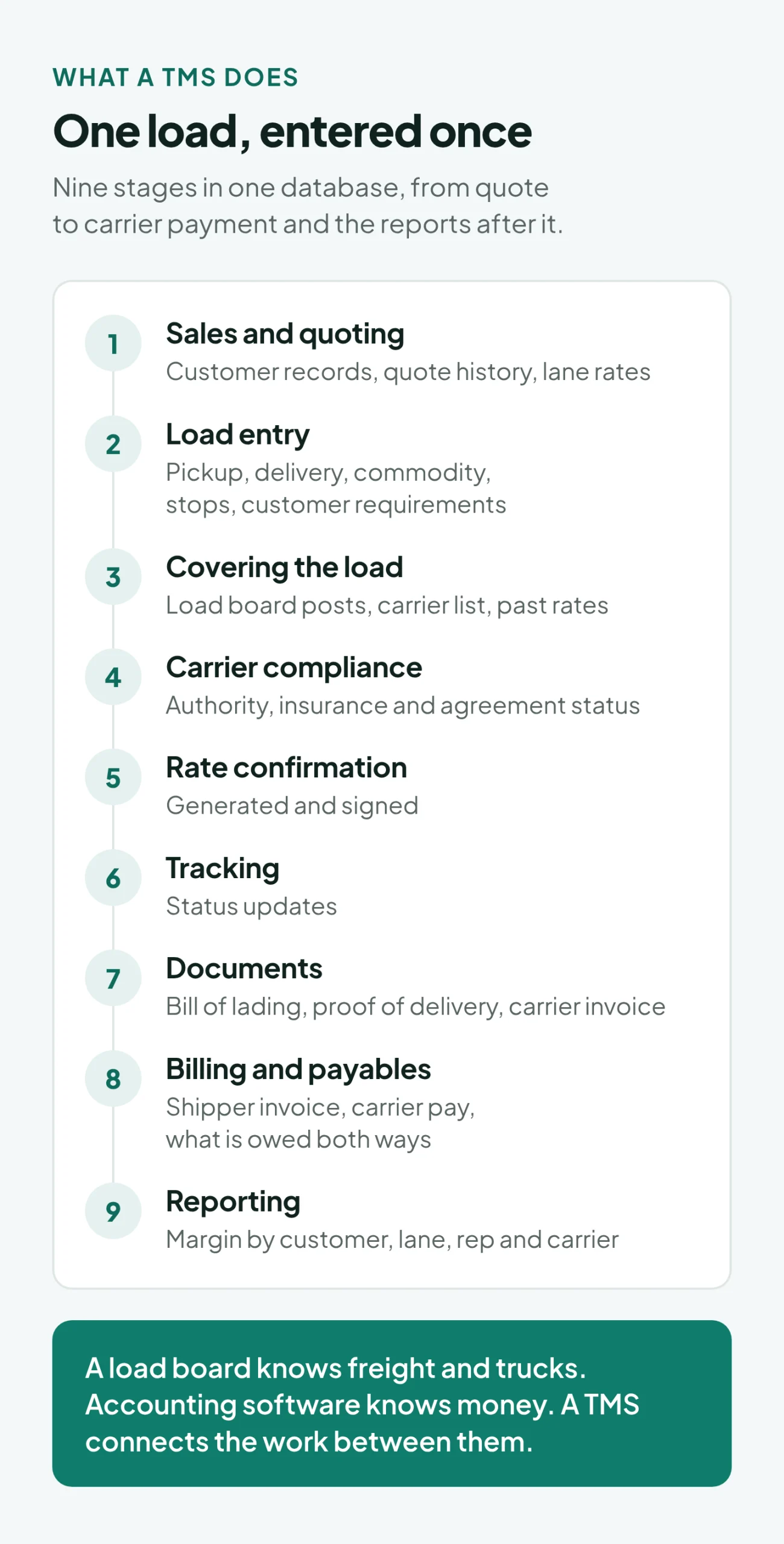
| Stage | What the TMS does | What goes wrong without it |
|---|---|---|
| Sales and quoting | Keeps customer records, quote history and lane rates | You quote the same lane differently twice |
| Load entry | Stores pickup, delivery, commodity, stops and customer requirements | Details get retyped into emails and rate confirmations |
| Covering the load | Posts to load boards, searches your carrier list, shows past rates | You lose track of who was called and what they asked for |
| Carrier compliance | Stores authority, insurance and agreement status, and can block unapproved carriers | An expired or unverified carrier gets booked in a rush |
| Rate confirmation | Generates the confirmation and captures the signature | The agreed rate and accessorials live only in an email thread |
| Tracking | Records status updates, and may connect to location tracking | Staff spend the day on check calls |
| Documents | Attaches the bill of lading, proof of delivery and carrier invoice to the load | Billing stalls while someone hunts for paperwork |
| Billing and payables | Invoices the shipper, queues carrier pay, tracks what is owed in both directions | You pay carriers without seeing which customers are late |
| Reporting | Shows margin by customer, lane, rep and carrier | You know revenue, but not where you make money |
You will meet three more terms in sales calls. EDI is a structured data link with a large shipper. Few new brokerages need it until a customer demands it. A customer portal lets shippers see quotes and tracking themselves. AI agents are the current marketing push, usually for reading emails, documents and check calls. Judge them on your own messy paperwork, not on a demo script.
Do you need one yet?
Not necessarily. The rule requires the record, not any product. A careful one-person broker can run early loads on a spreadsheet, a shared document folder and accounting software, provided every field in the next section is captured. Our guide to getting broker authority covers the steps before this one, and those come first.
Our rule of thumb, which is editorial judgment and not an industry standard: buy before your first load if a low-cost plan fits the budget, because moving data later is a chore. Buy now if any of these is true:
- A second person is booking or billing loads.
- You can’t produce a load’s full record, with paperwork, in a few minutes.
- You are missing invoices, or finding out late which customers haven’t paid.
- You can’t show when you last checked a carrier’s authority and insurance.
- A shipper asks for tracking updates, a portal or EDI.

The math is rarely the obstacle. If your average margin were $200 a load, a hypothetical figure, a $500 monthly plan would need two and a half loads a month to pay for itself. The real cost is setup time and the risk of choosing badly.
What your records must show
Every broker has to keep this record, whatever software it uses. The table maps each 371.3(a) item to what you should see on screen. You may keep master lists for consignors and for carrier addresses and registration numbers rather than repeating them on each load.
| Required by 371.3(a) | What to look for in the system |
|---|---|
| Consignor’s name and address | A customer or shipper record linked to the load. Check it isn’t only the bill-to party |
| Originating carrier’s name, address and registration number | A carrier record with MC or other registration number, frozen to the load as booked |
| Bill of lading or freight bill number | A searchable reference field |
| Your compensation for the brokerage service, and who paid it | A report per load. If you charge a shipper one rate and pay a carrier another, ask how the system shows this |
| Any non-brokerage service, what you were paid and by whom | A separate charge type, not lumped into the line haul |
| Any freight charges you collected, and the date you paid the carrier | Amounts and the actual payment date, not only an approval or due date |
Five more rules should shape your choice:
- Parties can look. Under 371.3(c), each party to a brokered transaction has the right to review the record. Find out how quickly the system can produce one load’s record.
- Electronic records are allowed, with conditions. 49 CFR 379.7 lets you preserve records with any technology that captures everything and can reproduce it accurately later. 49 CFR 390.32 permits electronic records and signatures for FMCSA requirements, but says electronically generated records must include proof of consent where 15 U.S.C. 7001(c) requires it. Ask your attorney how that applies to your e-signature flow.
- Security is a compliance issue. Part 379 applies to brokers, and 49 CFR 379.5 requires you to protect records it covers from destruction, unauthorized access, modification and corruption, and to notify the Secretary if they are substantially destroyed, damaged, or accessed and modified without authorization. So ask about backups, user permissions and audit logs.
- Retention differs by document. The Part 379 schedule lists copies of bills of lading and similar shipping documents at one year, but the 371.3 transaction record runs three years. Set the system never to purge anything under three years, and ask your attorney and insurer whether to keep files longer.
- Mixed businesses must separate their books. If you do anything besides brokering, 49 CFR 371.13 requires segregated brokerage revenue and expenses, with shared costs allocated on a basis you can explain. A broker that also runs trucks should test this in the chart of accounts.
A change is pending. FMCSA’s November 2024 proposal would require electronic records and delivery of the 371.3(a) records within 48 hours of a request. It has not been finalized. The federal list of rules under White House review, checked 1 November 2026, shows a proposed-rule action with the same title and regulation number, received 27 August 2026. Its text isn’t public, so nobody outside government can say what it requires, and today’s 371.3 still applies. Be wary of any page saying a 2026 transparency rule has already taken effect.
Carrier vetting after Montgomery
On 14 May 2026, in Montgomery v. Caribe Transport II, the Supreme Court held unanimously that the Federal Aviation Administration Authorization Act (FAAAA) does not preempt a state-law claim that a broker negligently hired a carrier, because of the law’s exception for state safety authority over motor vehicles. The plaintiff alleged the carrier held a “conditional” federal safety rating, and that the broker knew or should have known from it that crashes were reasonably likely. The Court sent the case back. It didn’t decide that the broker was negligent, or say what a careful broker must check.
Justice Kavanaugh’s concurrence, joined by Justice Alito, said brokers should be able to defend these suits if they acted reasonably and used reputable carriers, while warning that state tort law can be unpredictable and that litigation and insurance costs can be significant even when a broker wins. For software buyers, the lesson is evidence. A claim may arrive years after the load, so you want a record showing what you looked at and when. Our guide to checking a carrier’s MC number covers the lookup itself. In a TMS, test these:
- Snapshot on booking. Does the load keep the carrier’s authority, insurance and safety status as they were that day, or show only today’s values?
- Hard stops. Can an admin block expired, unapproved or flagged carriers, and is every override logged by name?
- Your rules, not the vendor’s. Can you encode your written carrier-selection policy, such as minimum time in business or insurance limits?
- Monitoring. Does it alert you when a carrier’s status changes between loads? Which data source does it use, and how often does that source refresh?
- Identity. What does it do to catch a stolen carrier identity, such as a changed email, phone or payment account?
Software supports your judgment but doesn’t replace it, and a policy your staff routinely override may hurt you. Ask your attorney and your insurer what they expect. If you buy the optional contingent auto and cargo coverage that sits behind a carrier’s policy, your underwriter may have specific requirements too.
What vendors publish
We read each vendor’s own pricing page on 1 November 2026. Prices are US dollars per month, as listed. This is not a ranking or a list of every product, and we have not used these systems. Features differ widely, so a lower price may simply buy less.
| Product | Published price | Basis and limits | Flagged on the vendor’s page |
|---|---|---|---|
| DAT Broker TMS | From $100 | What $100 covers isn’t spelled out | Doesn’t replace a load board subscription. Extra modules are add-ons, with no prices listed |
| AscendTMS | $69, $119 or $149 per user | No load charges, setup fee or contract. 30-day trial | Fuller accounting at Premium. E-sign and outbound EDI at Pro. DAT or Truckstop access needs your own paid subscription |
| Port TMS | $375 (Pro); $750 (Growth) | 5 users; up to 12 users | EDI and API charges may apply. A one-time onboarding fee may apply. AI agents promotional for 3 months only |
| EZ TMS | $500 | 3 seats. No per-load fees | Extra seat price not listed. LTL portal and EDI cost extra |
| Transport Pro | $500 | Up to 5 users, then $100 per added active user. No long-term contract | $2,500 one-time activation. EDI and API access cost extra |
| Descartes Aljex | $699 (Essential); from $999 (Professional); from $2,375 (Enterprise) | 5 users on Essential, 15 on Professional. Unlimited shipments | One-time setup or implementation fee, amount not listed |
| BrokerPro | $950 base | Up to 150 invoiced loads a month. Unlimited users. Its estimator lists tiers up to $9,238 for 3,051 to 3,250 loads | Some partner integrations may have separate fees |
| Tai TMS | $995 (Growth); $2,465; $4,595; $7,925 | Growth: 2 staff logins, 200 shipments, 500 carrier profiles. Limits rise by tier | Overage pricing applies above limits; rate not listed |
| Rose Rocket | From $2,080 | Unlimited users. AI agents included; vendor states a guaranteed 90-day go-live | Enterprise via sales |
| Turvo | From $5,000 | Lists onboarding manager, training and data migration. User and load limits not stated | Second plan priced on request |
McLeod’s PowerBroker page and the CargoWise page for Tailwind TMS show no price, so you would need a quote. Ownership shifts too: Descartes, which sells Aljex, announced on 24 August 2026 that it had acquired Tai. If you are considering either product, ask how long each will be developed and supported, and what happens to your price at renewal.
Some third-party listings still show a free AscendTMS plan. Its pricing page showed three paid plans and a free trial on the day we checked, so don’t budget on free.
What it really costs
Pricing basis changes the answer more than the headline does. Worked example: a brokerage with 3 staff moving 100 loads a month, or 1,200 a year. This uses list prices from the table, for the entry plan that fits on seats and volume. For AscendTMS we used Premium, because fuller accounting starts there. Unpublished setup fees, overages and add-ons are excluded, the plans are not equivalent, and DAT is left out because its page doesn’t say how many users $100 covers. Turvo’s page doesn’t state user limits either, so treat its line as a floor.
| Plan | Year-one list cost | Per load | How it’s calculated |
|---|---|---|---|
| AscendTMS Premium | $4,284 | $3.57 | $119 × 3 users × 12; Basic would be $2,484. E-sign needs Pro, $5,364 |
| Port TMS Pro | $4,500 | $3.75 | $375 × 12; any onboarding fee extra |
| EZ TMS Standard | $6,000 | $5.00 | $500 × 12 |
| Descartes Aljex Essential | $8,388 plus setup | $6.99 plus setup | $699 × 12; setup not published |
| Transport Pro | $8,500 | $7.08 | $500 × 12 + $2,500 |
| BrokerPro base | $11,400 | $9.50 | $950 × 12 |
| Rose Rocket | From $24,960 | From $20.80 | $2,080 × 12 |
| Tai Premium | $29,580 | $24.65 | $2,465 × 12; Growth has only 2 logins |
| Turvo | From $60,000 | From $50.00 | $5,000 × 12 |
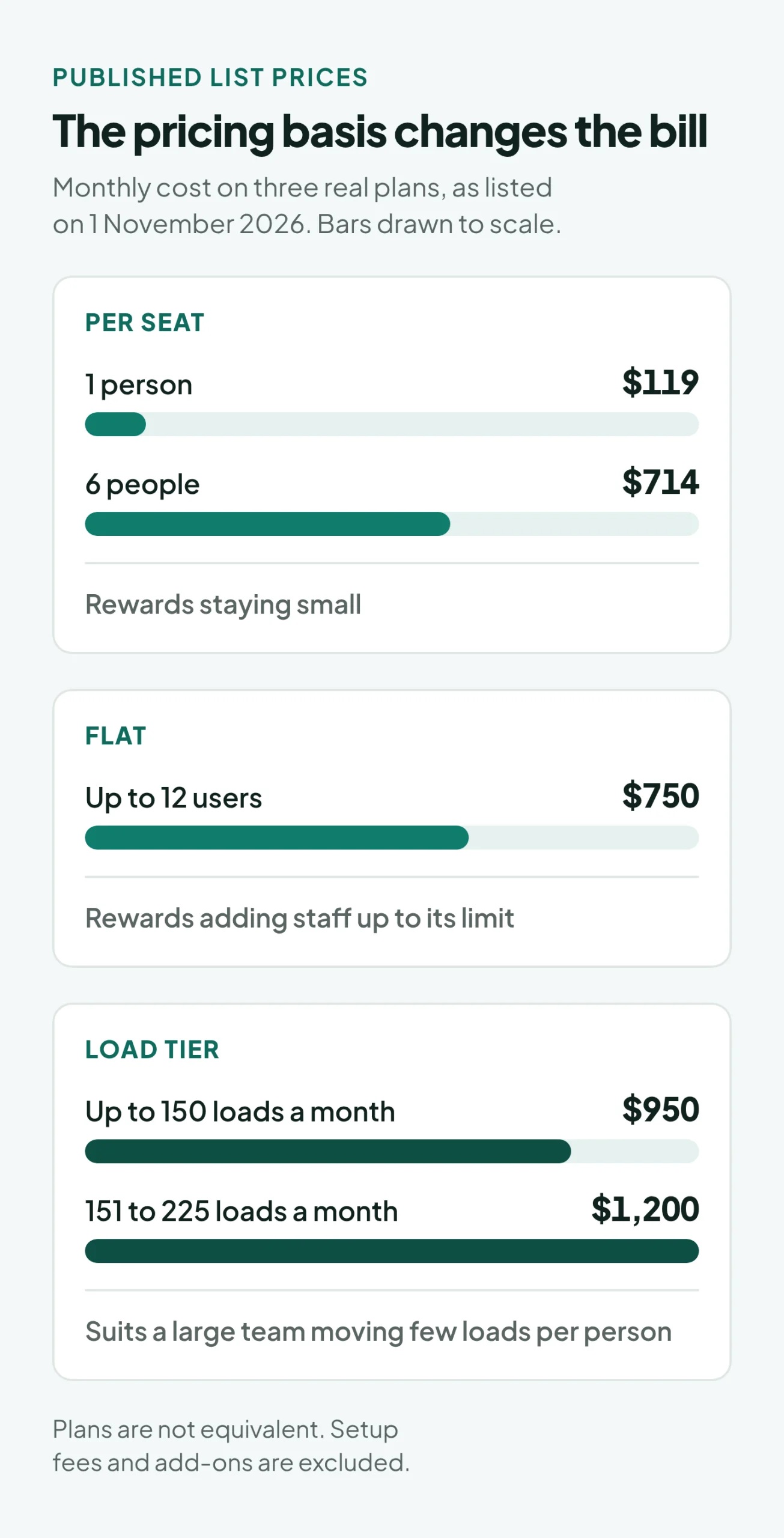
Change the inputs and the order moves. One person on AscendTMS Premium would pay $119 a month, while six people would pay $714, about the same as Port’s $750 Growth plan with room for twelve. BrokerPro moves from $950 to $1,200 a month at 151 loads, then to $1,500 at 226, and keeps climbing by tier. A per-seat plan rewards staying small, a flat plan rewards adding staff up to its limit, and a load-tier plan suits a large team moving few loads per person.
Then add what sits outside the TMS:
- Load board. DAT’s price page lists broker plans at $159, $319 and $449 a month. At $319, that is $3,828 a year. Ask how many seats your plan covers. Truckstop’s load board page lists broker plans at $109, $239 and $369 per user a month, before fees and taxes, with an extra user at no charge on the top plan.
- Accounting. Check whether the TMS replaces your accounting software or syncs with it. A sync can still leave you paying for both.
- Carrier onboarding and monitoring. May be built in, or may be a separate subscription.
- Tracking and market rates. Often priced by a third party, sometimes per load.
- Payment services. If you pay carriers early, or sell your own invoices through invoice factoring, ask how that connects.
- Your own time. Someone must clean data, map workflows and train staff.
How to choose in six steps
- Write down your freight. Truckload or LTL, how many loads, how many staff, any agents, any EDI customers. If you quote LTL, you also need density-based freight class and LTL rating to work properly.
- List your must-haves. Start with the 371.3 fields, carrier vetting records and your accounting route. Keep the list to about ten items.
- Shortlist three. Use public pricing and fit. Skip anything whose minimum plan is built for a far larger operation.
- Run the same demo script on all three. Don’t accept the vendor’s prepared demo. The script is below.
- Request a written quote. Use the same seats and volumes at each vendor, for year one and a realistic year two.
- Speak to customers of your size. Ask the vendor for two references, and search independently for current users as well. Ask about support response times and what surprised them.
The demo script
Bring one real, slightly awkward load, ideally with an extra stop or a detention charge, then ask the vendor to do all of this live.
- Enter the customer and quote the lane. Count the clicks.
- Post the load, then assign a carrier that fails your insurance rule. Does the system stop you?
- Override as an admin, and show where the override is logged.
- Send the rate confirmation and capture the signature on a phone.
- Add a detention charge after pickup, and see how it reaches the invoice and carrier pay.
- Upload a blurry proof of delivery from a phone, and invoice the shipper.
- Pay the carrier, and show where the actual payment date is stored.
- Pull the load’s complete 371.3 record, and export it.
- Show margin by customer, lane and rep, then export it to a spreadsheet.
- Sync to your accounting software, and show what happens when the sync fails.
Contract and exit questions
Few pricing pages cover exit terms, and your data is the hardest part of the business to replace. Get answers in writing, and have your attorney read the agreement.

- Term and renewal. How long is the commitment? Does it renew automatically, and how much notice do you have to give?
- Price changes. What caps renewal increases? Which seat or load increases change your tier, and are they billed retroactively?
- Data ownership. Who owns your customer, carrier and rate data? Does the vendor use it for benchmarks or AI training?
- Exit. Can you export all loads, documents and accounting history in a usable format, at what cost, and for how long after you cancel? Your three-year record duty doesn’t end when the subscription does.
- Service. What are the uptime commitment, support hours and backup schedule? Does the vendor hold an independent security audit such as SOC 2, and will it share the report?
- Third parties. Who pays if a load board, tracking or factoring integration changes or stops working?
If you are switching systems, import master data first, run new loads in the new TMS, and finish in-flight loads in the old one so no load has two sets of books. Start after a month-end close if you can.
Common questions
Is a load board the same as a TMS?
No. A load board is a marketplace for matching freight and trucks. A TMS runs the load after that. They connect, but you usually pay for both. DAT, for example, says its Broker TMS doesn’t replace a load board subscription.
Can I run a brokerage on QuickBooks alone?
You can invoice and pay, but accounting software won’t do carrier vetting, rate confirmations or load tracking on its own. If you skip a TMS, you must keep the 371.3 fields somewhere and connect them to each payment yourself.
Does a freight agent need a TMS?
Usually not their own. Agents typically work in the system of the brokerage whose authority they use. Check this in the agent agreement, along with who keeps your customer and rate history if you leave.
Can I use a carrier TMS for brokering?
Only if it handles brokerage properly. Carrier systems center on drivers, trucks and settlements. A broker needs customer billing and carrier payables on one load, carrier compliance records and margin reporting. Run the demo script above before you decide.
Which is the best freight broker software?
Public data doesn’t support naming one. Many pages on this question are written by TMS vendors. The best choice is the one that passes your demo script at a price you can verify in writing.
Facts checked against primary sources on 1 November 2026: the eCFR (Title 49, current through 29 October 2026), the Federal Register, the Office of Information and Regulatory Affairs list of rules under review, the Supreme Court’s slip opinion, and each vendor’s own page as linked. Every figure is checked against the linked source. This page is general information, not legal, tax or financial advice.
Sources
- eCFR: 49 CFR 371.3, records to be kept by brokers
- eCFR: 49 CFR 371.13, accounting
- eCFR: 49 CFR 379.1, applicability
- eCFR: 49 CFR 379.5, protection and storage of records
- eCFR: 49 CFR 379.7, preservation of records
- eCFR: Appendix A to Part 379, retention schedule
- eCFR: 49 CFR 390.32, electronic documents and signatures
- Federal Register: Transparency in Property Broker Transactions (proposed rule, 20 November 2024)
- OIRA: rules under EO 12866 review (RIN 2126-AC63)
- Supreme Court: Montgomery v. Caribe Transport II, LLC, No. 24-1238 (14 May 2026)
- DAT Broker TMS
- DAT load board pricing
- Truckstop Load Board plans and pricing
- AscendTMS pricing
- Port TMS pricing
- EZ TMS pricing
- Transport Pro pricing
- Descartes Aljex pricing
- BrokerPro pricing
- Tai TMS pricing
- Rose Rocket pricing
- Turvo pricing
- McLeod Software: PowerBroker
- CargoWise: Tailwind TMS
- Descartes press release: Descartes Acquires Tai (24 August 2026)