
A for-hire trucking company hauling ordinary freight across state lines in a truck rated at 10,001 pounds or more must carry at least $750,000 of public liability coverage. That covers bodily injury and property damage it causes to other people. Hazardous materials raise the floor to $1,000,000 or $5,000,000. A fleet made up only of vehicles rated under 10,001 pounds can file $300,000. Those figures come from 49 CFR 387.9 and 49 CFR 387.303T. Your insurer proves the coverage to FMCSA electronically, and your authority stays active only while that filing does. This guide sits in our insurance and finance hub. It covers the minimums, the filings, the MCS-90 endorsement, what a full commercial truck insurance package includes, and what federal law leaves to contracts: cargo, non-trucking liability and broker coverage.
This is general information, not legal, tax, insurance or financial advice. Confirm your own requirements with FMCSA, your state and a licensed insurance agent before you buy or file.
Federal minimums at a glance
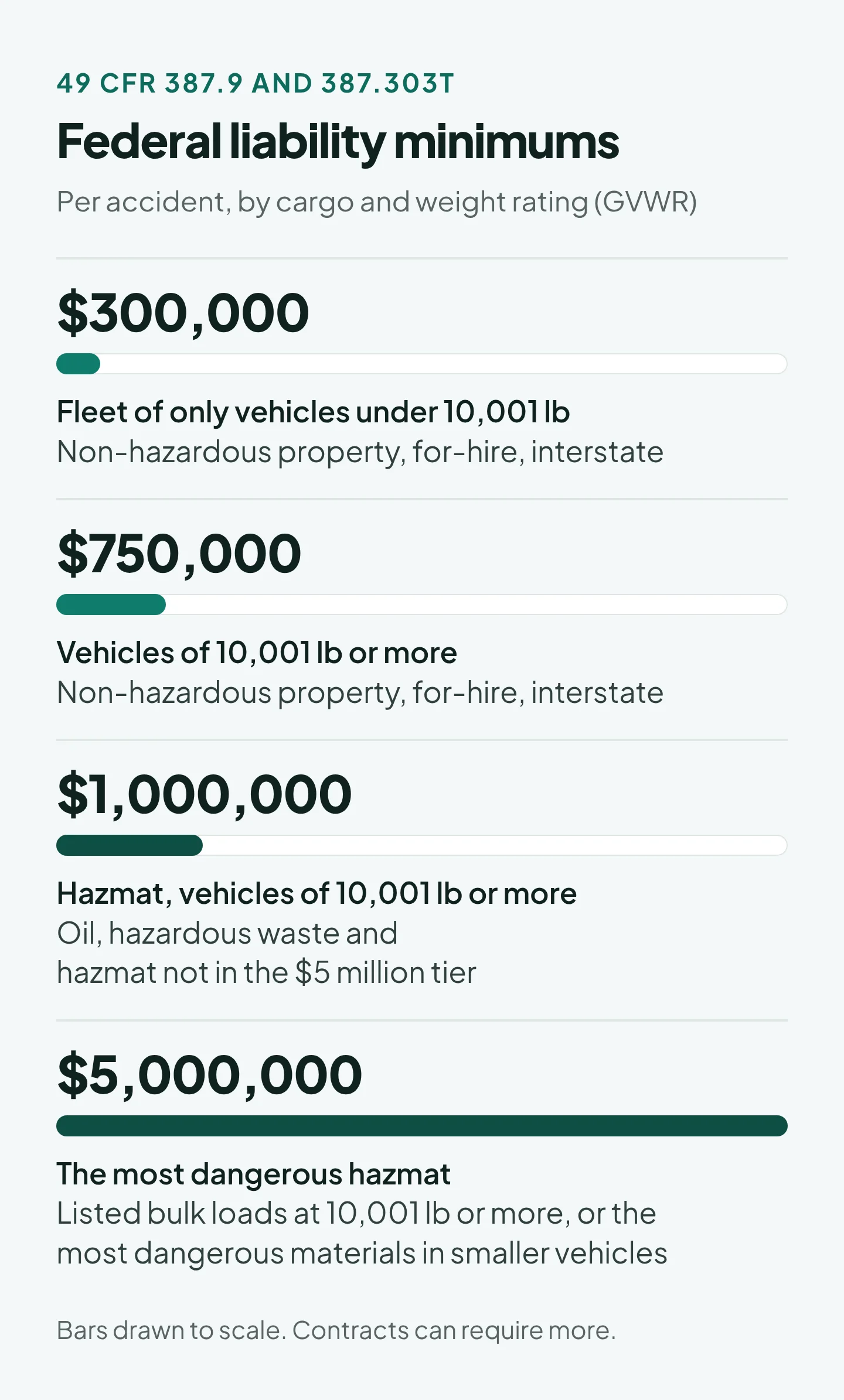
The table below combines the two federal schedules that apply to property carriers. The amounts are per accident and cover “public liability”, which 49 CFR 387.5 defines as bodily injury or property damage, including environmental restoration after a spill.
| Vehicle and operation | What you haul | Federal minimum |
|---|---|---|
| For-hire, interstate, fleet made up only of vehicles under 10,001 lb GVWR | Non-hazardous property | $300,000 |
| For-hire, interstate, 10,001 lb GVWR or more | Non-hazardous property | $750,000 |
| For-hire or private, 10,001 lb GVWR or more (interstate in any quantity; intrastate in bulk only) | Oil, hazardous waste and hazardous materials not in the $5 million tier | $1,000,000 |
| For-hire or private, 10,001 lb GVWR or more, interstate or intrastate | Hazardous substances in bulk tanks or hoppers, bulk Division 1.1–1.3 explosives, bulk Division 2.1 or 2.2 gases, bulk Hazard Zone A poison gas or liquid, highway-route-controlled radioactive material | $5,000,000 |
| For-hire or private, under 10,001 lb GVWR, interstate | The most dangerous materials: Division 1.1–1.3 explosives and Hazard Zone A poisons (in bulk under 387.9; in any quantity under the 387.303T filing rule), highway-route-controlled radioactive material | $5,000,000 |
The 387.9 table still carries the column heading “January 1, 1985”, and the amounts have not moved since. In November 2014 FMCSA published an advance notice asking whether to raise them. It withdrew that notice in June 2017, saying it had “insufficient data or information” to go further.
A minimum is only the legal floor. Shippers, brokers, lenders and lessors can require more, and a serious crash can cost far more than $750,000. How much to buy above the floor is for you and your agent to decide.
What commercial truck insurance includes
“Commercial truck insurance” is not one policy. It is a package of coverages, and federal law requires only one of them for general freight: auto liability at the levels above, carried in one policy or in a primary policy plus excess layers that together reach the minimum (387.303T(a)). The rest come from the contracts you sign, the lender or lessor on your truck, and state law. Here is how the usual pieces line up, checked against the eCFR on 14 November 2026.
| Coverage | What it pays for | Federal requirement | Who usually asks for it |
|---|---|---|---|
| Primary auto liability | Injury and damage you cause to others | Yes: $300,000 to $5 million (387.9, 387.303T) | FMCSA, every customer |
| Motor truck cargo | Loss of or damage to the load | Household goods movers only (387.303T(c)) | Brokers and shippers |
| Physical damage | Your own tractor and trailer | No | Lenders and lessors |
| Non-trucking liability or bobtail | A leased truck driven outside dispatch | No, but the lease must say who provides it (376.12(j)) | The carrier you lease to |
| General liability | Injuries and damage away from driving, such as at a dock | No | Some shipper contracts |
| Trailer interchange | A trailer you pull but don’t own | No | Interchange agreements |
| Workers’ comp or occupational accident | Injury to you or your drivers | No; workers’ comp is set by state law | Your state, carriers you lease to |
| Umbrella or excess | Claims above the primary limit | No, though excess can count toward the minimum (387.303T(a)) | Larger shippers and brokers |
Because only the liability layer is set in federal law, two quotes both labelled “commercial truck insurance” can cover very different things. Ask for each coverage and limit by name. The sections below go deeper on cargo, non-trucking liability, the other coverages and what drives the cost.
Why there are two rules
Part 387 has two layers, and knowing which is which explains the $300,000 figure.
- Subpart A (387.1 to 387.19) is the safety rule. It says no motor carrier may operate a vehicle until the 387.9 coverage is in place, and the proof (the MCS-90 endorsement) must be kept at your principal place of business. Under 387.3 it applies to for-hire interstate property carriers and to hazmat carriers. Vehicles under 10,001 pounds GVWR are excluded, except for the most dangerous hazmat.
- Subpart C (387.301T onward) is the registration rule. A for-hire carrier cannot get or keep operating authority until its insurer has filed proof with FMCSA in the amounts in 387.303T. This is the rule that adds the $300,000 tier for small vehicles and the household-goods cargo requirement.
A note for readers who check the CFR themselves: the sections without a “T” (387.301, 387.303, 387.313, 387.323) are suspended. The “T” versions are the ones in force, a holdover from FMCSA’s 2017 suspension of its Unified Registration System rule. The 387.303T amounts match the older section.
The $300,000 tier and hot shot trucks
The $300,000 figure appears in 387.303T(b)(1) as “Fleet including only vehicles under 10,001 pounds (4,536 kilograms) GVWR”, for non-hazardous property (eCFR text current to 28 October 2026). Three details matter:
- It is a fleet test. Add one vehicle rated at 10,001 pounds or more and the $750,000 tier applies.
- It is keyed to the weight rating, not the weight on the scale. GVWR is the manufacturer’s rating on the door-jamb label. Running light does not lower it.
- Combinations count as one vehicle. Under 387.305, a tractor and its trailer, or a truck and trailer carrying a single load together, are treated as one motor vehicle for Part 387.
That last point is why many hot shot operators, who pull a gooseneck or flatbed behind a heavy-duty pickup, cannot simply assume the $300,000 tier. Part 387 does not spell out how to add up a pickup’s rating and its trailer’s rating. Before you file, get the answer from your agent in writing and keep it with your records. If the combination is rated at 10,001 pounds or more, plan on $750,000.
How proof of insurance is filed
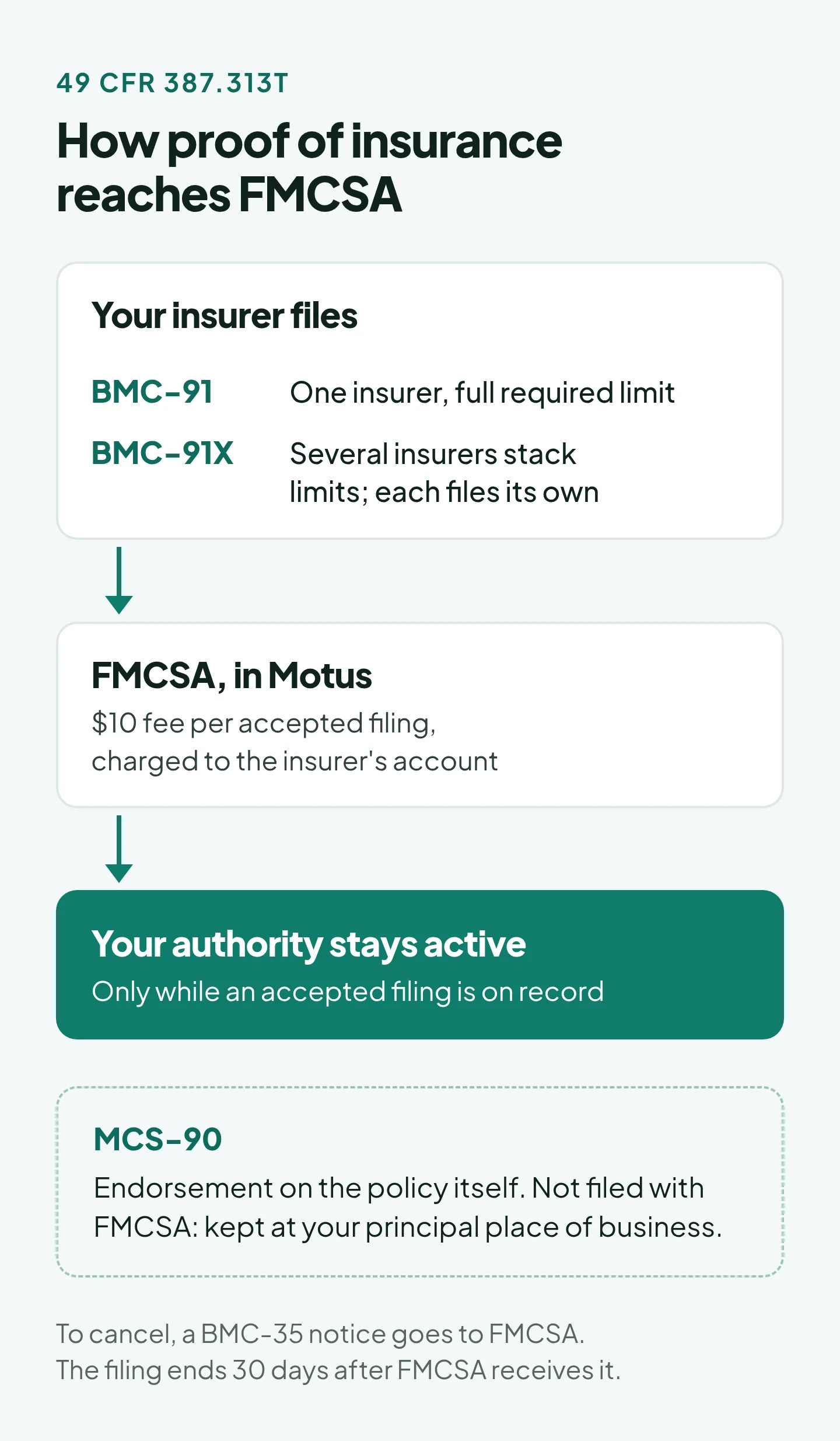
You do not upload a policy to FMCSA. Your insurer does the filing, and FMCSA only grants and keeps your authority while an accepted filing is on record. That is the step that ties insurance to your MC number and operating authority. The forms named in 49 CFR 387.313T:
| Form | What it is | Who files it |
|---|---|---|
| BMC-91 | Certificate of insurance for the full required liability limit from one insurer | Insurer |
| BMC-91X | Certificate for full coverage or for one layer when several insurers stack their limits to reach the minimum. Each insurer files its own. | Each insurer |
| MCS-90 | Endorsement attached to the policy itself. It is not filed with FMCSA but kept at your office as proof (387.7(d)). | Insurer issues it with the policy |
| BMC-82 / MCS-82 | Surety bond used instead of insurance for liability | Surety |
| BMC-34 (with BMC-32 endorsement) | Cargo certificate, required only for household goods carriers | Insurer |
| BMC-35 | Notice cancelling an insurance filing | Insurer or carrier |
| BMC-84 / BMC-85 | Broker’s $75,000 surety bond or trust fund | Surety or financial institution |
Some numbers and deadlines from the regulations that matter for planning:
- $10 per accepted filing. FMCSA charges a $10 service fee for each accepted certificate of insurance or surety bond under 49 CFR 360.3T. It is charged to the insurer’s or surety’s FMCSA service account, not paid by you directly.
- 30 days’ notice to FMCSA. A BMC filing cannot be cancelled until 30 days after FMCSA actually receives the BMC-35 notice (387.313T(d)). Replacing one insurer with another ends the old filing on the effective date of the new one (387.313T(e)).
- 35 days between you and the insurer. Separately, a policy carrying the MCS-90 can be cancelled on 35 days’ written notice from either side (387.7(b)).
- The insurer must be licensed. FMCSA accepts filings only from insurers authorized in each state you operate in, or in your home state with a process agent appointed. Eligible surplus-lines insurers are also accepted (387.315).
- The name must match exactly. Certificates must carry the full, correct legal name of the carrier, and every partner in a partnership (387.313T(c)). Check it against your registration before the insurer files.
Motus has replaced L&I for new filings
FMCSA is moving registration to a new system called Motus. According to its April 2026 Federal Register notice, insurers and sureties could set up Motus accounts from 8 December 2025 (Phase I). Once Phase II opened to all users, they submit and remove filings in Motus, which replaces the URS and the old ICC-era Licensing and Insurance (L&I) system. FMCSA’s FAQ says that as of 14 May 2026, L&I is available only for reviewing historical records and that Motus filings are not reflected in it. A carrier registered recently may therefore show nothing on L&I even with valid insurance on file. Check Motus. For the full sequence of USDOT number, authority, insurance and BOC-3, see our guide to starting a trucking company in 2026.
What the MCS-90 really does
The MCS-90 is an endorsement attached to your auto liability policy, not a separate policy. It protects the public, not you. In its standard wording, as quoted by the Fourth Circuit in Canal Insurance Co. v. Distribution Services (2003), the insurer agrees to pay any final judgment against the insured for public liability “regardless of whether or not each motor vehicle is specifically described in the policy”. No policy condition or exclusion relieves it of that obligation.
The same wording adds the catch: “The insured agrees to reimburse the company” for any payment it would not have owed under the policy itself. The court described the endorsement as a suretyship by the insurer that protects the public when the policy otherwise gives no coverage. In plain terms:
- If you dispatch a truck that isn’t on your policy, or a driver your policy excludes, and that truck injures someone, the insurer may still have to pay the injured person up to the federal minimum.
- The insurer can then come after you to repay every dollar it paid that it would not have owed under the policy.
- It only protects third parties and requires a judgment against the named carrier. FMCSA’s 2005 regulatory guidance says the form does not require the insurer to pay a judgment against “any party other than the carrier named in the endorsement”.
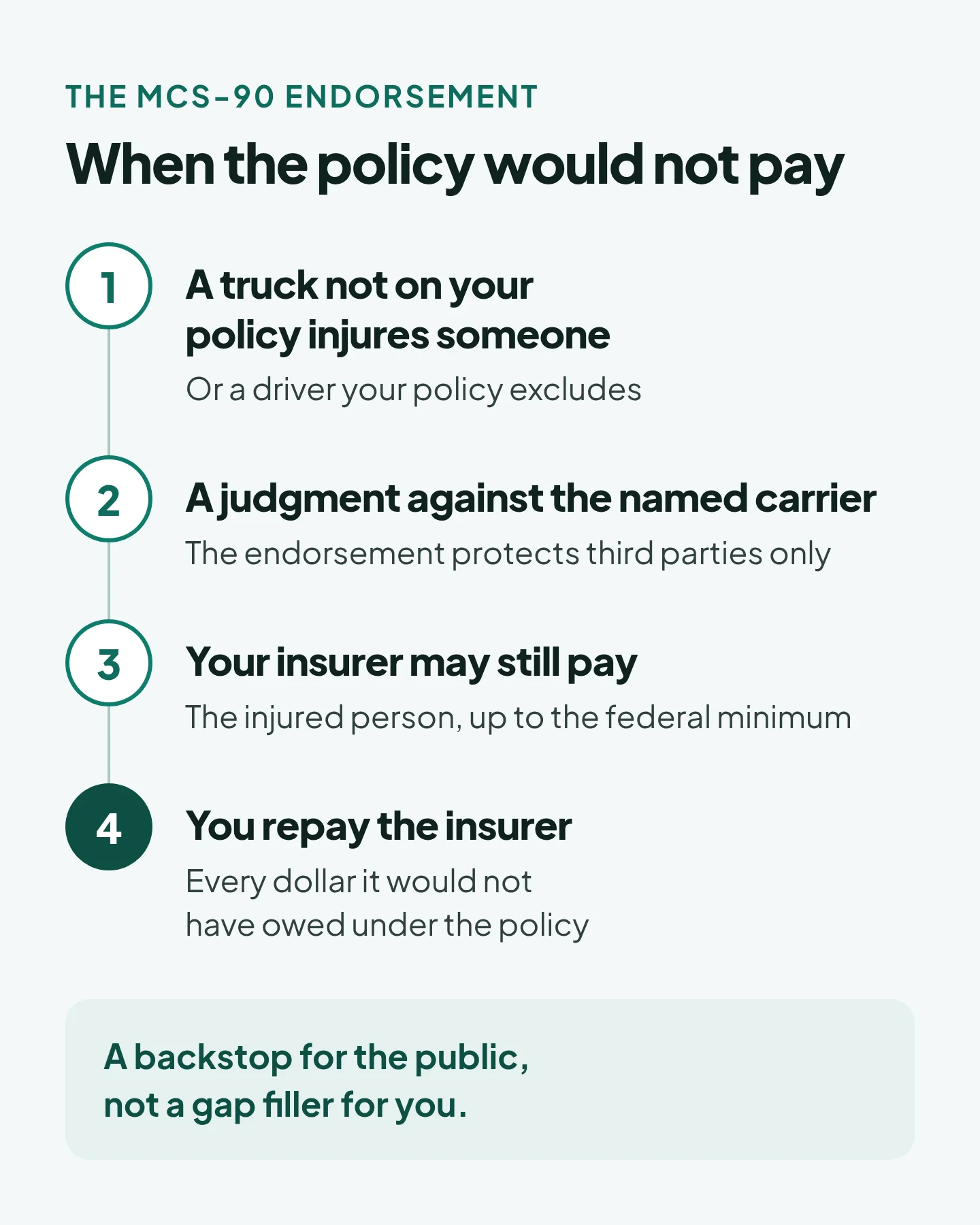
The practical lesson: keep your vehicle and driver schedules current with your agent. The MCS-90 is a backstop for the public, not a gap filler for you.
What happens if coverage lapses
Two things happen. First, FMCSA revokes or suspends operating authority when the required insurance is no longer on file, as FMCSA restates in its Motus notice. Getting it back means a new filing and a reinstatement request, and until then you cannot legally haul under that authority. Second, failing to keep the Part 387 levels can bring a civil penalty of up to $21,114, and each day of a continuing violation counts as a separate offense (49 CFR Part 386, Appendix B, paragraph (d), amount as shown on the eCFR in October 2026; FMCSA adjusts penalties for inflation).
Cargo insurance is set by contract
For motor carriers, federal law sets a cargo insurance minimum for only one group: household goods movers serving individual shippers. Under 387.303T(c) they need $5,000 per vehicle and $10,000 per occurrence, filed on a BMC-34. A general freight carrier has no federal cargo minimum and makes no cargo filing.
In practice you still need cargo coverage, because the people who give you freight demand it. Broker-carrier agreements and shipper contracts name a cargo limit, list exclusions they won’t accept, and often require you to name them as certificate holders. Before you sign, read four things in the cargo policy:
- Per-load limit against what you haul. A $100,000 limit means little on a load of electronics worth far more.
- Commodity exclusions. Policies may exclude or sub-limit particular goods. Check the list against what you plan to haul.
- Reefer breakdown. Temperature loss may be excluded unless you add it.
- Unattended-vehicle and theft conditions. These clauses decide many theft claims.
Cargo liability between carrier and shipper is also shaped by the bill of lading and any agreed value or released rate. If you move LTL freight, class drives the price; our free class calculator estimates it from weight and dimensions.
Non-trucking liability for leased drivers
If you are an owner-operator leased to a motor carrier and running under its authority, the carrier’s filed liability policy covers you while you are working for it. The gap is the time you drive the truck for personal use, outside dispatch. Non-trucking liability (NTL) covers that, and bobtail coverage is a close cousin. The definitions differ between insurers, so read the trigger wording.
No federal rule requires NTL. The federal leasing rule does require the lease to spell it out. Under 49 CFR 376.12(j), the lease must state the carrier’s duty to keep public liability coverage. It must also say who provides “any other insurance coverage for the operation of the leased equipment, such as bobtail insurance”. If the carrier charges the cost back to you, the lease must state the amount. If you buy insurance through the carrier, you are entitled to a copy of the policy on request and a certificate showing the cost and deductible. Read section (j) of any lease before you sign it.
Once you get your own authority, NTL no longer fits. You need your own primary auto liability with an insurer filing on your behalf, as described above.
Freight brokers: bond first, insurance by choice
A freight broker does not file auto liability with FMCSA. The federal requirement is financial security, not an insurance policy: a $75,000 surety bond (BMC-84) or trust fund (BMC-85) that pays shippers or carriers if the broker fails to meet its obligations. Since 16 January 2026, a surety that pays a claim leaving the bond below $75,000, or decides it will have to, must tell FMCSA within 2 business days. FMCSA then notifies the broker, which has 7 business days from that notice to restore the full $75,000 (or show the notice was wrong or the claims were paid another way) before its authority is suspended. Our step-by-step freight broker licensing guide covers the bond in detail.
Brokers often buy two optional coverages that sit behind the carrier’s own policies:
- Contingent auto liability. It responds if a broker is sued over a crash, typically on a negligent-selection theory, and the carrier’s liability policy doesn’t respond or isn’t enough.
- Contingent cargo. It responds when a load is lost or damaged and the carrier’s cargo policy denies the claim, for example over an exclusion.
Both are “contingent” because they are meant to pay only when the primary carrier coverage fails. Neither is a federal requirement. Shippers may require them in contracts, and the policy wording, especially what counts as the carrier’s policy “failing”, varies widely, so read the triggers line by line. Many brokers also carry general liability and errors and omissions coverage, again because contracts ask for it rather than because FMCSA does.
What liability does not cover
Primary auto liability pays others. It does not pay you. A small carrier usually looks at these as well, none of them required by FMCSA for general freight:
- Physical damage (collision and comprehensive) on your own tractor and trailer. If the truck is financed or leased, that contract will usually require it.
- Motor truck cargo, discussed above.
- General liability for non-driving incidents, such as an injury at your yard or at a customer’s dock. Some shipper contracts require it.
- Trailer interchange for damage to a trailer you pull under an interchange agreement but don’t own.
- Workers’ compensation or occupational accident. Workers’ comp is set by state law for employees. Occupational accident is an alternative some carriers buy for independent contractors. Check your state’s rules.
- Umbrella or excess liability above the primary limit.
State rules matter too. Intrastate carriers and some states’ own registration programs set their own insurance levels and filings. Check with your state’s transportation or public utility agency if you will run intrastate.
Trucking insurance cost: what drives premiums
We don’t publish premium ranges for trucking insurance cost. Quotes depend on your record, routes, equipment and insurer, and the price ranges you see online rarely show a source. The best independent cost data comes from the American Transportation Research Institute (ATRI), a non-profit that surveys carriers.
- Liability premiums are rising faster than crashes. ATRI’s May 2026 insurance study found liability premiums rose 18.6% from 2021 to 2024, to 10.2 cents per mile. Heavy-truck crash rates fell 2.6% industry-wide over the same period. Per-mile liability losses among respondents rose 33.1%, and ATRI attributes the rise to crash claims costs and litigation.
- Higher layers rose fastest. In the same study, per-mile premiums for the $5–10 million excess layer rose 34% to 1.58 cents. The $10–15 million layer rose 45% to 1.05 cents.
- Safety and retention can help. ATRI found that fleets keeping more risk in their primary layer had lower combined losses and premiums, regardless of size. Six safety technologies had a statistically significant link to lower per-mile liability losses.
- Insurance is one line in a rising total. ATRI’s 2026 operational costs report put the average cost of running a truck in 2025 at $2.336 per mile, the highest in the report’s history.
To turn the per-mile figure into a yearly one: at ATRI’s 2024 average of 10.2 cents a mile, a truck running 100,000 miles in a year would carry about $10,200 of liability premium (our arithmetic on ATRI’s May 2026 figure, read 14 November 2026). That is an average across ATRI’s respondents, not a quote, and it leaves out cargo, physical damage and the other coverages in the table above.
ATRI’s figures come mostly from established fleets. A new authority has no loss history, so underwriters lean on what they can see. Those usually include the driver’s motor vehicle record and experience, the commodity, radius of operation, garaging location, equipment value and the carrier’s safety data. Expect your first-year price to reflect that, and budget for it before you file for authority.
How to check an insurer and your filing
We don’t rank insurers. These checks use public sources and work for any of them:
- Licensing. Confirm with your state insurance department that the insurer, and the agent, are licensed. FMCSA rejects filings from insurers that don’t meet 387.315.
- Complaint record. The NAIC’s Consumer Insurance Search shows closed, confirmed complaints from state insurance departments by state, company and coverage type for the past three years. Compare several insurers, not one number.
- Financial strength. Rating agencies such as AM Best publish financial strength ratings. Lenders and some shippers set a minimum rating. Our public-data look at the top trucking insurers sets filing counts beside dated ratings.
- Your filing. After binding, ask the agent for the date the BMC-91 or BMC-91X was submitted. Then confirm it appears on your record in Motus. Don’t run until it does.
- Your MCS-90. Keep a copy at your principal place of business, as 387.7(d) requires, and check the legal name matches your registration letter for letter.
Checklist before you get authority
- Decide your tier: under 10,001 lb fleet ($300,000), standard freight ($750,000) or hazmat ($1M or $5M). Get the hot shot combination question answered in writing.
- Get quotes for primary auto liability, cargo and physical damage before you apply. Ask the agent what they need before they can quote and file, and sequence the steps together.
- Read the insurance clauses in the broker-carrier agreements and shipper contracts you expect to sign. That is where cargo limits and higher liability limits come from.
- Have the insurer file the BMC-91 or BMC-91X, and confirm the filing in Motus.
- File your BOC-3 process agent designation.
- Keep the MCS-90 on file and your vehicle and driver schedules current.
- If you are leasing on instead, read lease section (j) and price NTL or bobtail cover.
- If you are a broker, put the $75,000 BMC-84 or BMC-85 in place and decide on contingent coverage.
Facts checked against primary sources on 31 October 2026: the eCFR (Title 49, Parts 360, 376, 386 and 387, current through 28 October 2026), the Federal Register, FMCSA, a federal appeals court opinion and ATRI. The liability minimums, the cargo filing rule, the lease rule, the broker bond rule and the ATRI figures were rechecked on 14 November 2026 (eCFR current through 12 November 2026). Every figure is checked against the linked source. This page is general information, not legal, tax, insurance or financial advice.
Sources
- eCFR: 49 CFR 387.9, minimum levels of financial responsibility
- eCFR: 49 CFR 387.3, applicability of Subpart A
- eCFR: 49 CFR 387.5, definitions
- eCFR: 49 CFR 387.7, financial responsibility required
- eCFR: 49 CFR 387.303T, minimum limits for registered carriers
- eCFR: 49 CFR 387.305, combination vehicles
- eCFR: 49 CFR 387.307, property broker surety bond or trust fund
- eCFR: 49 CFR 387.313T, forms and procedures
- eCFR: 49 CFR 387.315, insurance and surety companies
- eCFR: 49 CFR 360.3T, filing fees
- eCFR: 49 CFR 376.12, lease requirements
- eCFR: 49 CFR Part 386, Appendix B, penalty schedule
- Federal Register: Availability of Motus, FMCSA's New Registration System (29 April 2026)
- Federal Register: Regulatory guidance for Forms MCS-90 and MCS-82 (5 October 2005)
- Federal Register: Withdrawal of financial responsibility ANPRM (5 June 2017)
- FMCSA FAQ: What can I do in Licensing and Insurance (L&I)?
- U.S. Court of Appeals, Fourth Circuit: Canal Insurance Co. v. Distribution Services (2003)
- ATRI: New research analyzes motor carrier responses to rising insurance costs (May 2026)
- ATRI: 2026 Analysis of the Operational Costs of Trucking release (July 2026)
- NAIC Consumer Insurance Search