An MC number is the docket number FMCSA gives a company when it grants interstate operating authority. You need one if you haul other people’s regulated freight across state lines for pay, or if you arrange that freight as a broker. MC numbers still exist in 2026: Motus, FMCSA’s new registration system, opened to everyone on 19 May 2026 and still issues them. The filing fee is $300 for each type of authority under 49 CFR 360.3T. Your authority goes live only once insurance (or a broker’s $75,000 bond) and a process agent filing are on record. This guide is part of our getting licensed hub.
This is general information, not legal, tax or financial advice. Confirm your own situation with FMCSA before you file.
What an MC number is
Operating authority is FMCSA’s registration for for-hire companies. It decides what kind of business you may run and what cargo you may carry. FMCSA identifies each authority by a docket number with a prefix:
- MC for motor carriers and property brokers
- FF for freight forwarders, a separate authority from brokers
- MX for Mexico-domiciled carriers
“MC number” is the everyday name for the whole thing: the authority and the number that tracks it. You will also see it called MC authority, trucking authority, operating authority or just “your authority”. All four mean the same registration: FMCSA’s permission to run as a for-hire carrier, broker or forwarder. Getting your MC number and getting your authority are one application and one $300 fee per authority type. The USDOT number is a separate registration, compared below.
FMCSA’s own registration modernization FAQ says MC numbers “were never a statutory or regulatory requirement.” They are a tracking number for a proceeding. What the law requires is the authority itself, plus a USDOT number. That explains why FMCSA can talk about retiring MC numbers without retiring operating authority.
MC number vs DOT number
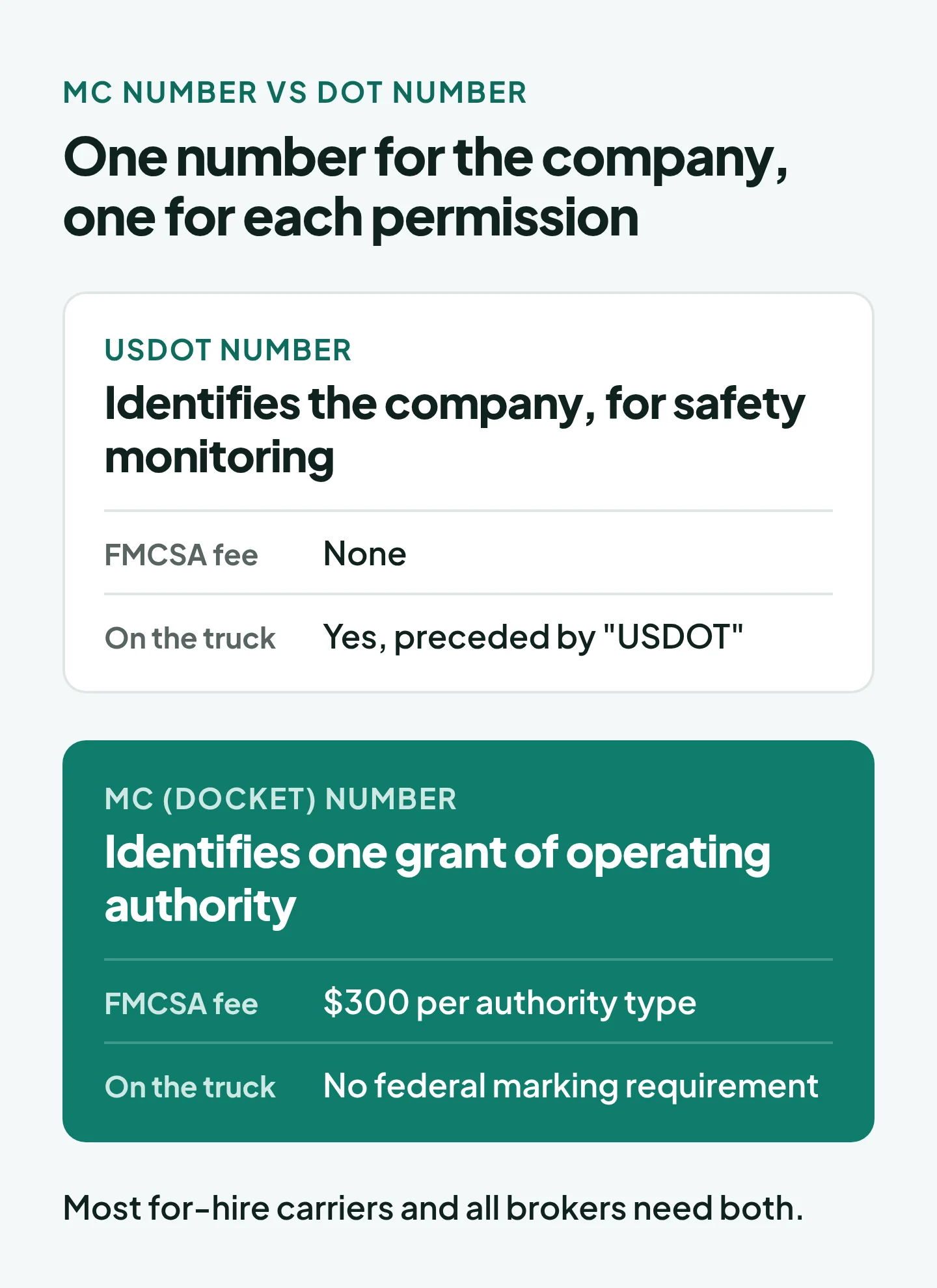
The USDOT number identifies your company. The MC number identifies a permission your company holds. Most for-hire carriers and all brokers need both.
| USDOT number | MC (docket) number | |
|---|---|---|
| What it identifies | The company, for safety monitoring | One grant of operating authority |
| Who needs it | Interstate operators of commercial motor vehicles, plus every broker, freight forwarder and for-hire carrier | For-hire carriers of regulated freight, brokers and freight forwarders |
| FMCSA fee | None | $300 per authority type |
| Goes on the truck | Yes, preceded by “USDOT” (49 CFR 390.21T) | No federal marking requirement |
| Can lapse | Can be inactivated, for example for a missed biennial update | Revoked or suspended if required insurance or a broker’s bond lapses |
For USDOT purposes, a commercial motor vehicle under 49 CFR 390.5 is one that runs in interstate commerce and meets at least one of these tests:
- It weighs or is rated at 10,001 pounds or more.
- It is designed or used to carry more than 8 passengers, including the driver, for pay.
- It is designed or used to carry more than 15 passengers, including the driver, not for pay.
- It carries hazardous materials in a quantity that needs placards.
The FAQ adds that MAP-21 requires every broker, freight forwarder and motor carrier to hold a USDOT number, “whether operating commercial motor vehicles or not.” Our guide to how a USDOT number works and who needs one covers the number itself and how to apply for it.
Who needs an MC number
FMCSA’s operating authority page sets the test. You need authority if you carry passengers interstate for compensation, or if you transport or arrange the transport of federally regulated commodities owned by others, interstate, for compensation.
| Your business | MC number? | USDOT number? |
|---|---|---|
| For-hire carrier hauling customers’ general freight across state lines | Yes | Yes |
| Hotshot or cargo-van carrier under 10,001 lb, for hire, interstate | Yes. Authority depends on for-hire work, not truck size | Yes |
| Freight broker arranging interstate loads | Yes (broker authority) | Yes |
| Freight forwarder | Yes (FF number) | Yes |
| Private carrier moving its own goods | No | Yes, if it runs CMVs interstate |
| For-hire carrier hauling only exempt commodities | No | Yes, if it runs CMVs interstate |
| Carrier running only inside an exempt commercial zone | No | Depends on the operation |
| Intrastate-only carrier | No | Only if your state requires it or you need a hazmat safety permit |
| Owner-operator leased on to an authorized carrier | Not while leased on; you run under the carrier’s authority | The truck carries the carrier’s name and USDOT number, marked “operated by” if your name is also shown |
Three edge cases:
- Exempt commodities. These are listed in 49 U.S.C. 13506. The list is narrow and full of conditions, so check it before you rely on it.
- Leasing on. Under 49 CFR 376.12, the carrier you lease to has “exclusive possession, control, and use” of the equipment for the length of the lease. That is why a leased owner-operator runs under that carrier’s authority.
- Carrier and broker together. If you plan to haul your own loads and also broker the overflow, you need two separate authorities and pay two fees.
Are MC numbers going away?
Not yet. FMCSA has floated the idea, but no proposed rule to end them has been published in the Federal Register.
FMCSA wants to make the USDOT number the only identifier, with a letter suffix for each registration type. A March 2025 FreightWaves report said the agency planned to do this by 1 October 2025, and many pages still repeat that date. It did not happen.
The deciding document is FMCSA’s notice in the Federal Register of 29 April 2026, “Availability of Motus, FMCSA’s New Registration System” (91 FR 23144). A correction on 6 May 2026 only fixed its docket number, to FMCSA-2026-1255 (91 FR 24643). The notice says stakeholders raised concerns about three planned changes:
- introducing “safety registration”
- eliminating MC and FF docket numbers
- changing how Form BOC-3 is filed
FMCSA’s answer:
“In response to stakeholder feedback, the Phase II release of Motus will not include the implementation of safety registration, the elimination of MC/FF numbers, or changes to the Form BOC-3 filing process.”
The same notice said FMCSA expected to propose a rule in “the Spring of 2026.” That rule would require everyone to use Motus and drop the paper forms; the notice’s description of it does not mention ending MC numbers. As of 14 November 2026, the Federal Register’s list of FMCSA documents shows no proposed rule on registration or docket numbers this year. The proposals FMCSA did publish in 2026 covered UCR fees, CDLIS fees, English-language proficiency, emergency exemptions and railroad crossings.
The modernization FAQ adds three points:
- Ending MC numbers is “under consideration” and will be open for comment in a proposed rule first.
- If MC numbers are eventually dropped, “existing MC Numbers will not be replaced by USDOT Numbers.”
- There are “no planned changes to the registration fees” with the first release of Motus.
What did change for new numbers
- USDOT suffixes. Motus shows a letter after the USDOT number for each registration. C is property carrier authority, B is broker, F is freight forwarder, H is household goods and P is passenger. The FAQ’s examples include “USDOT Number 1234567 C” for a carrier and “1234567 B” for a broker. The April notice says suffixes are “only visible in the system for ease of use at this time” and do not appear on formal letters, notices or orders. They are not a vehicle marking.
- One docket number per authority. According to FMCSA’s fact sheet on registration changes in Motus, each newly granted authority gets its own docket number, even when several are requested in one application. New USDOT and docket numbers are also randomized rather than sequential. Existing numbers do not change.
- Identity and business checks. Every new applicant must pass identity verification: a photo of a government ID plus a face scan on a phone or tablet. Business verification then confirms the company’s legal name, address, ownership and officials.
| Date | What happened |
|---|---|
| 12 Dec 2015 | First-time applicants must use the online Unified Registration System (URS) |
| 17 Jan 2017 | FMCSA suspends the URS rollout for existing registrants indefinitely |
| 8 Dec 2025 | Motus Phase I opens, for supporting companies only (BOC-3 filers, insurers, service providers) |
| 29 Apr 2026 | Federal Register notice: Motus replaces URS, and MC and FF numbers stay for now |
| 14 May 2026 | URS and the registration options in the FMCSA Portal shut down at 8:00 p.m. ET |
| 19 May 2026 | Motus opens to all users (DOT announcement) |
| June 2026 | FMCSA stops enforcing biennial updates due on or after 1 June 2026, until further notice |
| 14 Nov 2026 | No proposed rule yet on ending MC numbers |
What an MC number costs
An MC number costs $300 in FMCSA fees for each type of authority you ask for (49 CFR 360.3T(f)(1), read 14 November 2026). The USDOT number that goes with it is free: the same fee schedule lists no charge for one. Motus did not change that: FMCSA’s modernization FAQ says there are “no planned changes to the registration fees” with its first release. The government fees are small. Most of the money goes to insurance or the broker bond, priced by private insurers and sureties.
| Item | Amount | Source |
|---|---|---|
| USDOT number | $0 | No fee in the 360.3T schedule |
| Operating authority application | $300 per authority type, not refundable once accepted | 49 CFR 360.3T(f)(1) |
| Reinstating revoked authority | $80 | 360.3T(f)(52) |
| Name change | $14 | 360.3T(f)(7) |
| Emergency temporary authority | $100 | 360.3T(f)(6) |
| Process agent (BOC-3) filing | No FMCSA fee; blanket agent companies set their own prices | Not in the fee schedule |
| UCR, carriers with 0–2 vehicles and all brokers | $46 for 2026; $55 for 2027 | 91 FR 56063 |
| Broker surety bond or trust fund | $75,000 of coverage; you pay the surety a premium | 49 CFR 387.307 |
| Carrier liability insurance | $750,000 minimum for general freight in trucks of 10,001 lb or more | 49 CFR 387.303T |
The fee rule says “a separate filing fee is required for each type of authority sought,” and once FMCSA accepts the filing, the fee “will not be refunded.” That holds even if the application is later rejected or dismissed. Choosing the wrong authority type is the most expensive easy mistake.
Example 1: a one-truck carrier. A new carrier with one tractor hauling general freight pays $300 for property carrier authority. Its UCR, in the 0–2 vehicle bracket, is $46 for the 2026 registration year and $55 for 2027. Its insurer must file at least $750,000 of liability cover. The premium is the big number, and it depends on the driver, the equipment and the lanes.
Example 2: a carrier that also brokers. The same company also asks for broker authority. The authority fees rise to $600. It now needs the $75,000 BMC-84 bond or BMC-85 trust as well as the truck insurance. In Motus the two authorities get separate docket numbers.
Requirements before your authority goes active
A granted application is not the same as active authority. Under 49 CFR 365.109T, FMCSA reviews the application and publishes a summary in the FMCSA Register. Anyone then has 10 days to protest (49 CFR 365.115). You also need these filings on record:
- Carriers: liability insurance. Your insurer files Form BMC-91 or BMC-91X. The minimums are $750,000 for non-hazardous freight in vehicles of 10,001 pounds or more, and $300,000 for a fleet made up only of vehicles under 10,001 pounds. Hazardous materials need $1,000,000 or $5,000,000 under 49 CFR 387.9. Our guide to trucking liability insurance minimums explains each tier.
- Brokers: $75,000 bond or trust. Form BMC-84 for a surety bond, or BMC-85 for a trust fund. Since 16 January 2026, FMCSA suspends a broker within 7 business days of notice if claims pull the bond below $75,000 and the broker doesn’t restore it (387.307(e)). The freight broker licensing guide covers bond pricing and the rest of the broker setup.
- Everyone: Form BOC-3. This names a process agent for court papers. Carriers need an agent in each state they operate in or pass through. Brokers need one in each state where they have an office or write contracts (49 CFR 366.4T). Many new companies use a “blanket” agent company that covers every state on one filing.
Don’t let these slide. The regulation in force asks for the insurance and BOC-3 filings within 20 days of the FMCSA Register notice. FMCSA’s dismissal FAQ, written before Motus, says an application is dismissed if they are missing about 90 days after filing. After a dismissal you pay $300 again to reapply. Line up your agent and your insurer or surety before you submit.
Interstate carriers and brokers must also register and pay for UCR (Unified Carrier Registration) each year. It runs through the states, separately from your MC application. Carriers pay by fleet size; brokers pay the smallest bracket’s fee.
How to get a DOT and MC number in Motus
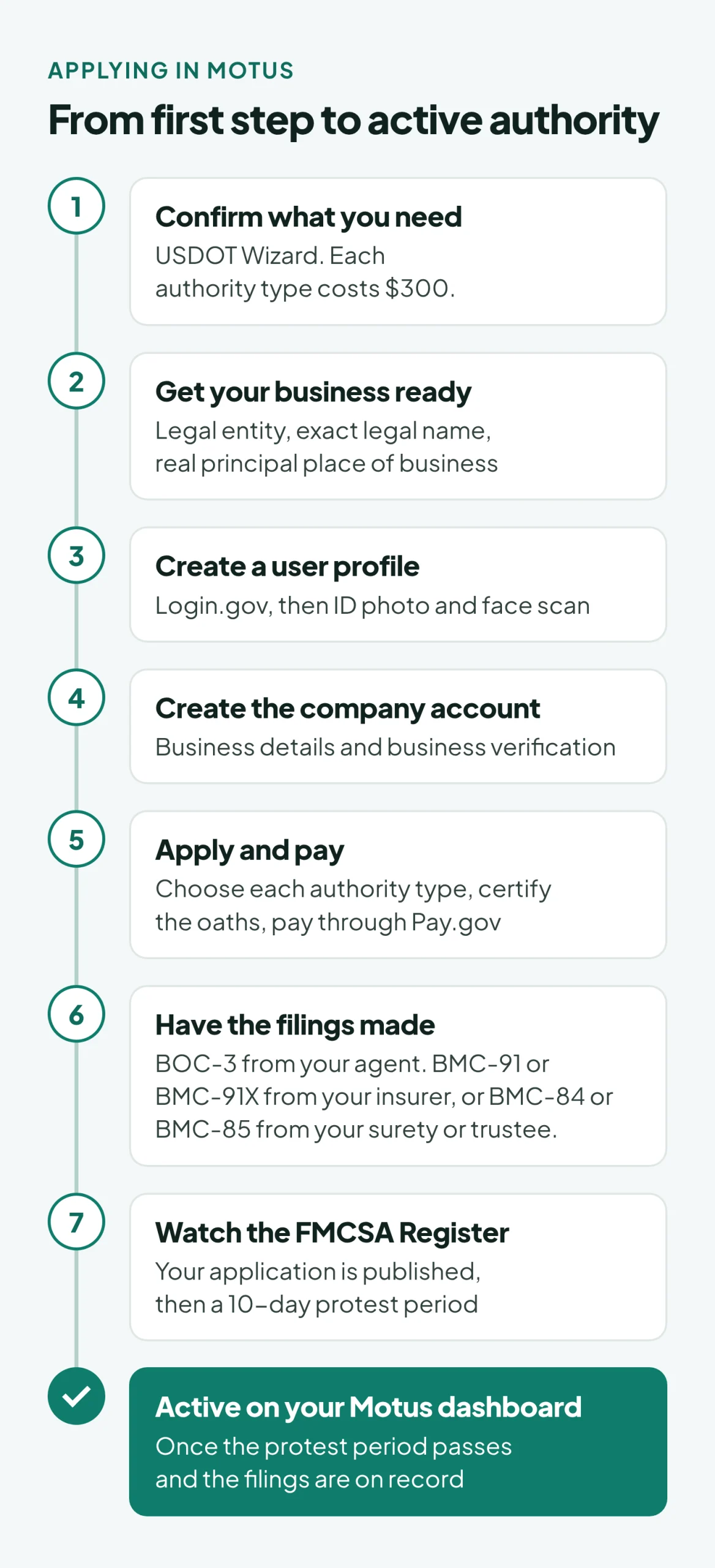
First-time applicants now apply for the USDOT number and operating authority in Motus, at motus.dot.gov. The steps below follow FMCSA’s Move into Motus page and the April notice.
- Confirm what you need. FMCSA’s USDOT Wizard asks a few questions and tells you whether you need only a USDOT number or authority as well. Decide on each authority type now, because each one costs $300.
- Get your business ready. Have your legal entity formed and the exact legal name you will use everywhere. You also need a real principal place of business. The FAQ warns that FMCSA must reject an application if the address “could never satisfy” the regulatory definition, so a mail drop is a risk.
- Create a user profile. Sign in with Login.gov and complete identity verification. You’ll scan a QR code, photograph a government-issued ID and scan your face with a smartphone or tablet. If that fails, call the FMCSA Contact Center at 1-800-832-5660; it may refer you to a physical location to finish the check.
- Create the company account. Enter the business details and pass business verification. Whoever creates the account is its main account holder and can invite other users.
- Apply and pay. Fill in the application, choose each authority type, certify the oaths and pay through Pay.gov.
- Have the filings made. Your blanket agent files the BOC-3. Your insurer files the BMC-91 or BMC-91X, or your surety or trustee files the BMC-84 or BMC-85. They file electronically in Motus under their own accounts.
- Watch the FMCSA Register and your dashboard. After review, your application is published. Once the 10-day protest period passes and the filings are on record, the authority shows as active on your Motus dashboard.
Using a filing service is optional. Under Motus, the FAQ says you must start the application and pass identity and business verification yourself, then designate the service. You must also review its entries and submit the final oaths. A service cannot open the application for you from scratch, and it cannot cut FMCSA’s $300 fee.
How long it takes
FMCSA has not published a processing time for online applications in Motus. The April notice gives a floor only for the paper forms FMCSA still accepts: “a minimum timeframe of eight business days for the initial review and processing,” plus any time needed if the application is flagged for further vetting. The modernization FAQ adds that paper requests take longer than online ones. Either way, the 10-day protest period follows publication.
FMCSA’s operating authority page, last updated in April 2026 before Motus launched, gave 20 to 25 business days for new applications filed online through URS, the system Motus replaced. It added that applications sent for further review “could take an additional 8 weeks or longer.” The rollout has also been rough. Land Line reported in September 2026 that problems with Motus were the reason FMCSA kept its pause on biennial-update enforcement.
Plan for several weeks from application to active authority, not days. Don’t sign leases, buy load-board subscriptions or book freight on the assumption of a fixed date. Our step-by-step plan for starting a trucking company shows how to sequence insurance, equipment and authority so they land together.
After your authority is granted
- Keep the filings continuous. If your insurance or bond lapses, FMCSA revokes or suspends the authority, and reinstatement costs $80. Keep the BOC-3 current too, and tell your agent about any name or address change.
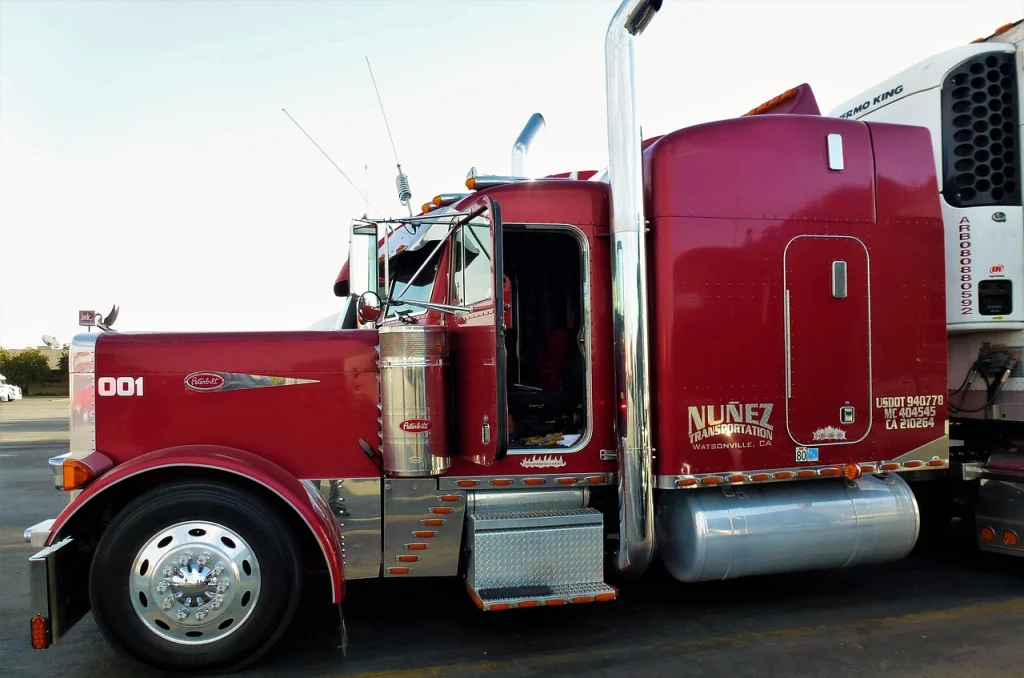
- Mark your trucks. Both sides need your legal or trade name and “USDOT” plus your number, legible from 50 feet (390.21T). The MC number is optional on the truck.
- New entrant period (carriers). For 18 months, FMCSA watches your roadside results closely and runs a safety audit, generally once you have been operating for at least 3 months (49 CFR 385.307). Keep your driver, vehicle and hours-of-service records ready from day one.
- Biennial update. 49 CFR 390.19T requires an MCS-150 update every 24 months. The last digit of your USDOT number sets the month, and the next-to-last digit sets whether you file in odd or even years. FMCSA has temporarily stopped enforcing updates due on or after 1 June 2026. Its notice, last updated 10 September 2026, gives no end date and says only that FMCSA will share more guidance as Motus recovery continues. The simplest course is to file when your month comes up anyway.
- Report changes. Name and address changes go through Motus. A name change costs $14.
- Check your own record. Use Motus’s public registration search and FMCSA’s SAFER Company Snapshot, the same two-step MC number lookup that works on any carrier or broker. FMCSA says historical L&I records stay viewable. Check after every insurance renewal that the new filing shows.
- Brokers quoting LTL. Once you’re active, our LTL freight class tool works out an NMFC density class from a pallet’s size and weight.
If FMCSA later proposes moving to USDOT suffixes, the FAQ says existing MC numbers will not be swapped out, and the proposal must appear in the Federal Register for public comment before anything changes.
Motus and MC number questions
Is Motus a freight company?
No. Motus is FMCSA’s registration system at motus.dot.gov, where companies apply for and manage USDOT numbers and operating authority. It does not haul or broker freight. If you are trying to find the MC number of a trucking or brokerage company, search its name or USDOT number in Motus’s public registration search or FMCSA’s SAFER Company Snapshot. The MC number lookup guide linked above walks through both, and what to check before you book a load.
Does Motus still issue MC numbers?
Yes. A new carrier or broker gets a docket number for each authority FMCSA grants, and Motus also shows a letter suffix after the USDOT number, such as C for a property carrier or B for a broker. The modernization FAQ (read 14 November 2026) says ending MC numbers is “under consideration” and would come through a proposed rule open for comment first.
Do I need a new MC or USDOT number because of Motus?
No. The FAQ says existing registrants keep their current USDOT number, and that if FMCSA stops issuing MC numbers, existing ones “will not be replaced by USDOT Numbers.” What does change: every existing registrant must pass identity and business verification before making any change in Motus, and Login.gov replaces the old USDOT PIN.
Can I still apply in URS or on paper?
Not in URS. FMCSA’s FAQ says the Unified Registration System went permanently offline on 14 May 2026, and the registration options in the FMCSA Portal were switched off at the same time. Paper forms are still accepted until a future rule ends them, but FMCSA says paper requests take longer to process than online ones in Motus.
Who do I call if Motus identity verification fails?
The FMCSA Contact Center, 1-800-832-5660. FMCSA says it may refer you to a physical location to finish the check. A filing service can help only after you have started the application and passed verification yourself.
Facts checked against primary sources on 31 October 2026: the eCFR (Title 49, Parts 360, 365, 366, 367, 376, 385, 387 and 390, current through 29 October 2026), the Federal Register and FMCSA. On 11 November 2026 we read FMCSA’s operating authority page, dismissal FAQ, modernization FAQ, Motus fact sheet and biennial-update notice again on FMCSA’s own site, in place of the archived copies used before, and updated the biennial-update line. On 14 November 2026 we read the modernization FAQ again, checked the Federal Register’s list of FMCSA proposed rules for 2026 (none on registration or docket numbers) and the 49 CFR 360.3T fee schedule (eCFR current through 12 November 2026), and added the Motus questions. Every figure is checked against the linked source. This page is general information, not legal, tax or financial advice.
Sources
- Federal Register: Availability of Motus, FMCSA's New Registration System (29 April 2026, 91 FR 23144)
- Federal Register: Availability of Motus, correction (6 May 2026, 91 FR 24643)
- Federal Register: Fees for the Unified Carrier Registration Plan and Agreement (1 September 2026, 91 FR 56063)
- Federal Register: FMCSA documents
- eCFR: 49 CFR 360.3T, filing fees
- eCFR: 49 CFR 365.109T, FMCSA review of the application
- eCFR: 49 CFR 365.115, after publication in the FMCSA Register
- eCFR: 49 CFR 366.4T, process agents: required states
- eCFR: 49 CFR 376.12, lease requirements
- eCFR: 49 CFR 385.307, new entrant safety monitoring
- eCFR: 49 CFR 387.9, minimum levels of financial responsibility
- eCFR: 49 CFR 387.303T, minimum limits for registered carriers
- eCFR: 49 CFR 387.307, property broker surety bond or trust fund
- eCFR: 49 CFR 390.5, definitions
- eCFR: 49 CFR 390.19T, motor carrier identification reports
- eCFR: 49 CFR 390.21T, marking of CMVs
- 49 U.S.C. 13506, miscellaneous motor carrier transportation exemptions
- FMCSA: Registration modernization FAQs
- FMCSA: Move into Motus
- FMCSA: Changes to FMCSA registrations in Motus
- FMCSA: Get operating authority (docket number)
- FMCSA FAQ: My operating authority application was dismissed
- FMCSA: Temporary suspension of the biennial update requirement
- U.S. DOT/FMCSA news release: Motus launch (19 May 2026)
- Land Line: Motus problems lead to continued pause on biennial update requirement (10 September 2026, context only)
- FreightWaves: What it means for the industry as FMCSA eliminates MC numbers in 2025 (24 March 2025, context only)