Non-trucking liability (NTL) insurance pays for injury or property damage you cause to other people while your leased truck is being used for something other than your motor carrier’s business. It is for owner-operators and small fleets leased to a carrier. No federal rule requires it, but a federal leasing rule makes the lease say who provides it, and carriers often write it in as a condition of the lease. The catch is that “off dispatch” does not mean “covered”. In one federal case a driver told to “take the rest of the night off” was still held to be in the carrier’s business hours later. This guide, part of our insurance and finance hub, explains what NTL pays, who needs it, how it differs from bobtail and unladen coverage, and what the court cases show about where it fails.
This is general information, not legal, tax or financial advice. Policies differ and insurance law is mostly state law, so check your own policy and lease with a licensed agent or a transportation attorney before you rely on them.
The short version
- What it is: liability coverage for a leased truck when it is not being used in the business of the carrier you are leased to. It pays third parties, not you.
- Who needs it: anyone leasing a truck to a motor carrier and running under that carrier’s authority, if the lease requires it or the truck moves for personal reasons.
- Who doesn’t: company drivers in the carrier’s trucks, and carriers with their own authority, who need primary auto liability instead.
- Is it the law? Not under federal rules. The federal leasing rule only requires the lease to say who provides “any other insurance”, naming bobtail insurance as the example, and to state the amount of any charge-back.
- The usual fight: the words “in the business of” the carrier. Courts have applied them to an oil change, repair trips and a drive to a motel. The clearest NTL trips are personal errands and, in the cases, the drive home with no more work pending.
- The name problem: “bobtail” can mean NTL, or a different and broader policy. Ask which one the lease means, in writing.
What NTL covers and what it doesn’t
An NTL policy starts as ordinary auto liability, then an endorsement cuts out the trucking use. The promise in these policies reads much the same from case to case: the insurer pays “all sums an ‘insured’ legally must pay as damages because of ‘bodily injury’ or ‘property damage’” from an accident involving the covered truck. The policy in Argonaut Midwest v. Morales (Illinois, 2014) also promised to defend a suit seeking those damages, but not a suit the insurance does not apply to.
The endorsement then takes most of it back. The wording that shows up across the cases comes in two parts. The insurance does not apply to a covered truck “while used to carry property in any business” or “while used in the business of anyone to whom the ‘auto’ is rented” (quoted in Mahaffey v. General Security, 5th Cir. 2008). This language matches the standard ISO non-trucking endorsement, form CA 23 09. In Lopez v. Western Surplus Lines (D.N.M. 2021) the same idea appeared on a form numbered TE 23 09. Your insurer may use its own wording, so read yours.
| Loss | Does NTL pay? | Where to look instead |
|---|---|---|
| Other people’s injuries or property, on a true personal trip | Generally yes, up to the limit | This is NTL’s job |
| The same loss on a trip that counts as your carrier’s business, loaded or empty | No | The carrier’s liability policy |
| A crash while hauling property for pay, including a side job | No | A policy written for that work, under proper authority |
| Damage to your own truck or trailer | No | Physical damage coverage |
| The freight | No | Cargo coverage |
| Your own injuries | Generally no | Occupational accident or workers’ compensation, depending on your status and state |
Three details vary by policy and are worth checking:
- Attached trailers. Some forms drop coverage when anything is hooked up. The endorsement in Assicurazioni Generali v. Ranger (5th Cir. 1995) excluded any time a trailer or another unit “is attached”. The wording quoted above has no such line.
- Hired drivers. If someone else drives your truck, confirm that they are covered. In Generali the court expressly left open whether “YOU” in the policy included the owner’s driver.
- Uninsured motorist and PIP. The Generali endorsement also limited these, and Mahaffey involved a policy with uninsured-motorist coverage. What applies depends on the policy and the state, so ask.
Who needs NTL
The test is whether the truck is leased to a carrier and whether anyone drives it outside that carrier’s business. The leasing rules are in 49 CFR Part 376, and our guide to how owner-operators work covers the lease-on model. A box truck leased to a carrier raises the same question, and our guide to insuring a box truck sets out the other policies a straight truck needs.
| Your setup | NTL? | Why |
|---|---|---|
| Owner-operator leased to a carrier, under its authority | Usually yes | The carrier must keep public liability coverage, but its policy is built around its own business. The lease often makes you responsible for the rest. |
| Small fleet leasing trucks to a carrier, with hired drivers | Usually yes | Same gap. Several cases below involved a truck owner with an employee driver. |
| Company driver in a carrier-owned truck | No | The truck is the carrier’s, and so is the insurance decision. Personal use is a question for your employer. |
| Carrier with your own authority | No | You need primary liability at the federal minimums, filed with FMCSA. NTL cannot do that job. |
| Hauling for several carriers under separate leases | Ask first | Exclusions refer to “anyone” the truck is rented to, so check how each lease and the policy fit together. |
| Between leases, truck parked | Ask first | The carrier’s coverage for you was tied to the lease. Ask what stays in force before you move the truck. |
Is NTL required? Law vs. lease
Federal law puts the minimum-liability duty on motor carriers. As the Eighth Circuit said in Great West v. National Casualty (2015), federal law requires interstate motor carriers, “but not equipment lessors”, to keep minimum liability insurance. So a bobtail clause in a lease, and the policy behind it, are matters of state contract and insurance law.
Leases fill that space. In Argonaut, Great West, Generali, Mahaffey and three other cases below, the lease or service contract put this coverage on the truck owner. National Continental‘s contract set the figure at $500,000. The federal rule that touches NTL is the leasing regulation, 49 CFR 376.12. It says four things that matter here:
- Who has the truck. The lease must give the carrier “exclusive possession, control, and use of the equipment for the duration of the lease”, and the carrier takes “complete responsibility” for its operation (376.12(c)(1)).
- Who provides what. The lease must state the carrier’s legal duty to keep public liability coverage, and who provides “any other insurance coverage for the operation of the leased equipment, such as bobtail insurance” (376.12(j)(1)).
- What you pay. If the carrier will charge any of that insurance back to you, the lease must state the amount (376.12(j)(1)).
- What you can see. If you buy through the carrier, it must give you a copy of each policy on request and a certificate showing the insurer, policy number, dates, amounts and types of coverage, your cost for each, and your deductible (376.12(j)(2)).
The first point cuts against you more than people expect. In Argonaut, the contract said the owner-operator controlled the truck. The court still applied the non-trucking exclusion, because the contract was subject to federal rules that gave the carrier exclusive possession and control. A contract calling you independent does not keep you out of the exclusion. The decision was 2 to 1, and courts differ here: in Generali the Fifth Circuit said the public-protection purpose of federal leasing rules has no bearing on how two insurers share a loss.
Bobtail insurance vs. non-trucking liability (and unladen)
Bobtail insurance has two meanings. In many leases it is simply another name for NTL: the federal leasing rule names “bobtail insurance” as its example of the insurance a lease must assign (49 CFR 376.12(j)(1), read 14 November 2026). A true bobtail policy is something else: liability cover while the tractor runs with no trailer attached, “whether dispatched or not”. So NTL asks whose business the trip was, and true bobtail asks whether a trailer was hooked up.
People use these words loosely, and so does the law. The regulation says “bobtail insurance”. Courts say a policy that excludes use in a lessee’s business is “commonly known as” bobtail insurance. Yet “bobtail” literally means driving a tractor with no trailer, and Mahaffey points out that a non-trucking endorsement “is not described in terms of bobtailing”. The real difference is the trigger.
| Coverage | Trigger | The question at claim time |
|---|---|---|
| Non-trucking liability (NTL, or non-trucking use) | The truck is not being used in the carrier’s business | Whose business was this trip? |
| True bobtail | No trailer attached, “whether dispatched or not” | Was a trailer attached? |
| Unladen | An attached empty trailer or no trailer, “whether dispatched or not” | Was the truck carrying cargo? |
| Carrier’s primary liability | As the carrier’s policy defines it | Are the truck and driver on the policy? |
The bobtail and unladen wording in the table is from the page for leased owner-operators run by OOIDA, the owner-operators’ association, where its insurance arm describes the policies it sells (read 14 November 2026). Other sellers define them differently, so treat this as one example. Broader triggers remove the argument about purpose. Trade sources say these forms are harder to find and cost more than NTL: see this agency explainer and a 2013 Transport Topics column by an insurance agency CEO and a transportation attorney.
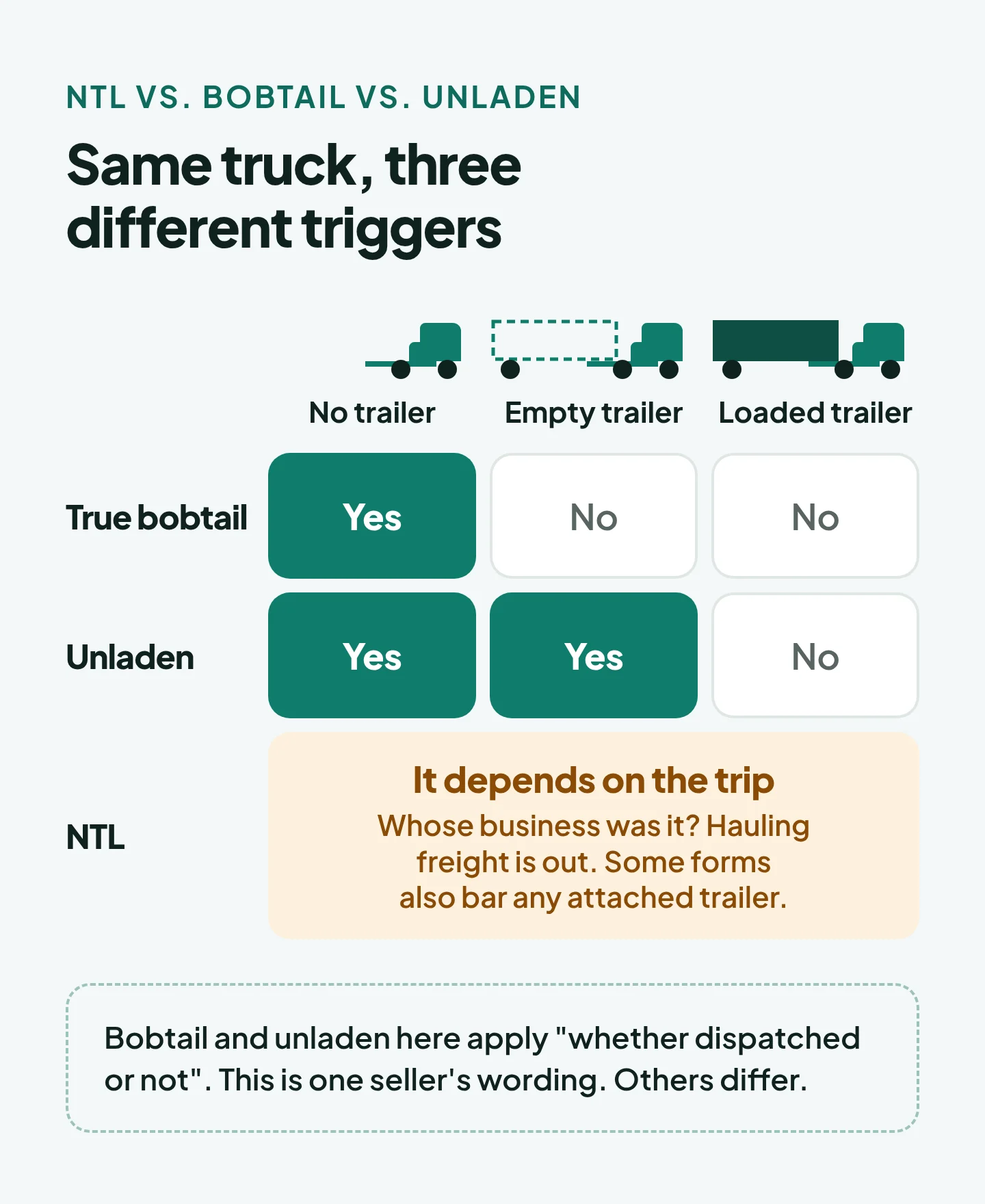
Deadheading, driving with an empty trailer, is where the labels cause most confusion. An empty trailer is not cargo, but a deadhead leg for your carrier is still likely to be in its business. NTL is not “the policy for empty miles”.
Same trip, three policies
The labels matter most on the trips below. The NTL column follows the court cases further down; the bobtail and unladen columns follow the OOIDA wording quoted above. Your own forms decide the real answer.
| The trip | NTL | True bobtail | Unladen |
|---|---|---|---|
| Personal errand, no trailer | Generally yes | Yes | Yes |
| Under dispatch, no trailer, going to hook a load | Likely excluded | Yes, on its trigger | Yes, on its trigger |
| Deadhead for your carrier, empty trailer | Likely excluded | No | Yes, on its trigger |
| Personal trip, trailer attached | Depends on the form | No | Only if empty |
| Hauling a load | No | No | No |
“Yes, on its trigger” means the trip fits the policy’s definition. On a dispatched trip your carrier’s policy may also apply, and how two insurers share a loss turns on both policies’ other-insurance wording and state law, as the cases below show. A loaded haul belongs on the carrier’s policy, or on your own primary policy if you run under your own authority.
So when a lease or a carrier says “bobtail”, ask which one it means. If it means NTL, a non-trucking use policy should satisfy it. If it means a true bobtail or unladen trigger, an NTL policy may leave the gap the carrier wanted closed. Get the answer in writing, because the lease must say who provides this insurance and what any charge-back is (376.12(j)(1)).
Where NTL fails: “in the business of”
Most NTL fights are between two insurers over one phrase. If the truck was in the carrier’s business, the exclusion applies and the NTL insurer walks away. Here is what courts decided on real trips.
| The trip | Case and law applied | NTL result |
|---|---|---|
| Last delivery made, no dispatch pending, bobtailing home unpaid | LeBlanc v. Bailey (La. Ct. App. 1997) | NTL covered, as primary |
| No freight at the terminal, told to call Monday, driving home for the weekend with an empty trailer | Acceptance v. Canter (8th Cir. 1991, Minnesota) | NTL covered, as primary |
| Declined dispatch over bad brakes, bobtailing to the shop | Generali (5th Cir. 1995, Texas) | NTL covered on different policy wording, and so did the carrier’s policy |
| Bobtailing to a shop to fix a heater motor | Zurich-American v. Amerisure (Mich. Ct. App. 1996) | NTL covered, and so did the carrier’s policy |
| Between dispatches, driving from home to a booked front-end alignment | National Continental v. Empire (8th Cir. 1998, Oregon) | Excluded |
| Not under dispatch, trailer leak being repaired at the carrier’s shop when an explosion injured a shop worker, repair was the owner’s cost | Great West (8th Cir. 2015, North and South Dakota) | Excluded |
| Waiting for a load at the terminal, bobtailed out for an oil change and parts | Empire v. Brantley Trucking (5th Cir. 2000, Texas) | Excluded |
| Told to “take the rest of the night off”, six or seven hours at a truck stop, then bobtailing to a motel | Mahaffey (5th Cir. 2008, Louisiana) | Excluded |
| On call, told to bring the tractor to the terminal, bobtailing from home | MGM Transport v. Cain (N.C. Ct. App. 1998) | Excluded |
| Dispatch sheet in hand, on the way to collect an empty container | Argonaut (Ill. App. Ct. 2014) | Excluded |
| Under dispatch to pick up a load of sand, truck empty | Lopez v. Western Surplus Lines (D.N.M. 2021, Texas) | Excluded |
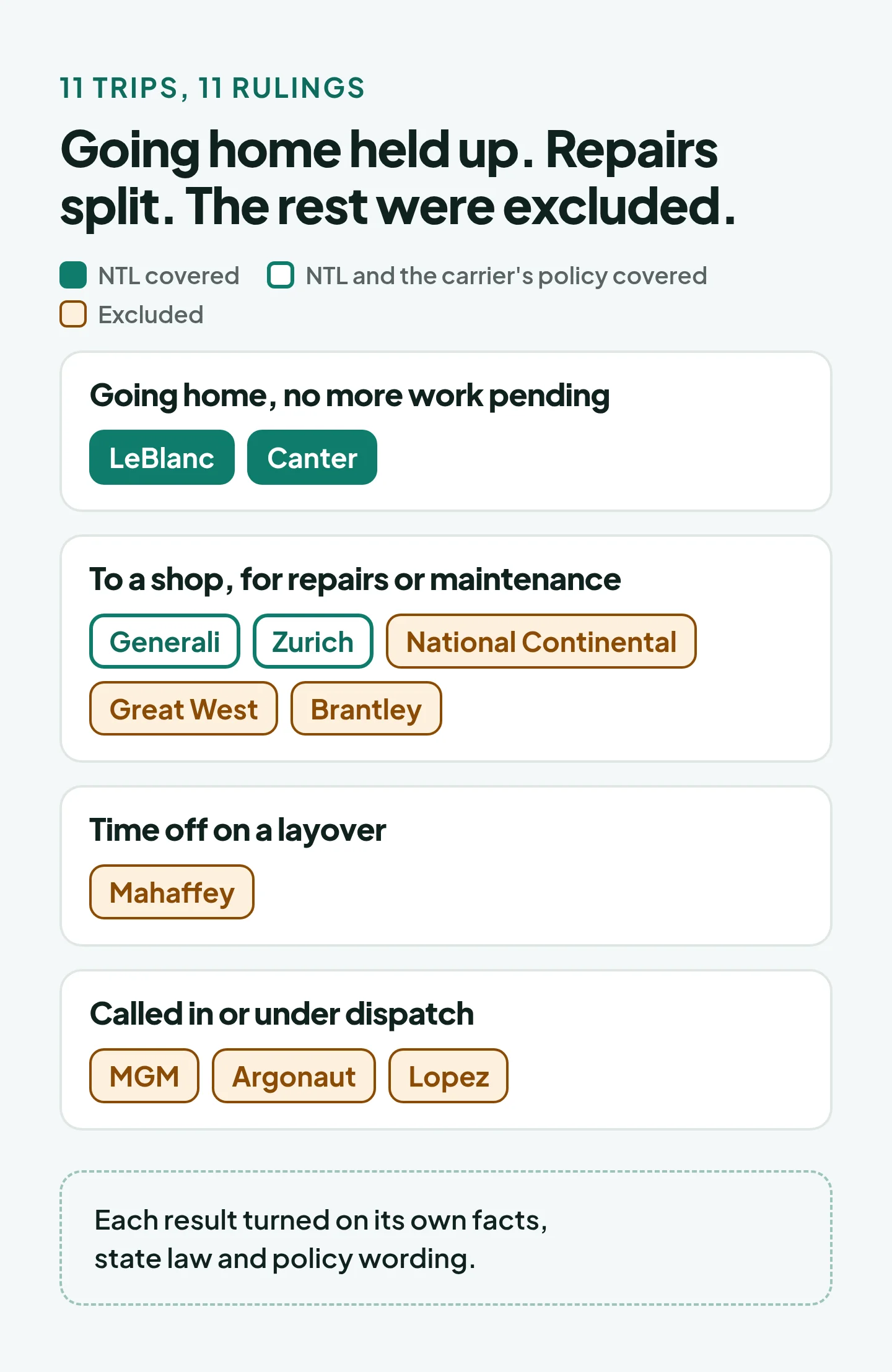
The table points to four things.
“No load” and “no trailer” prove nothing
Most of the excluded trips above were bobtail or empty. The Fifth Circuit in Brantley read the phrase as covering occasions when the truck is used “to further the commercial interests of the lessee”. It rejected the argument that an unloaded truck was outside the carrier’s business. It also drew the other line: “had he been out pursuing leisurely engagement”, the driver would not have been in the carrier’s business. That is what NTL is for.
Repair trips are split, and your lease matters
This is the hardest trip to predict. Michigan’s Court of Appeals in Zurich said the carrier’s business was hauling freight, so a bobtail drive to a repair shop was not in it, even though the lease made the owner keep the truck in repair. The Eighth Circuit went the other way. Its question in National Continental was whether the owner “was fulfilling his bargained-for contractual duties at the time of the accident”. In Great West it looked at the lease, saw that it required the owner to keep the equipment repaired, and held the rig was in the carrier’s business, even though the owner was not under dispatch, was paying for the repair, and did not have to use the carrier’s shop.
The odd result: under that test, the more duties your lease gives you, the less your NTL may cover. The Transport Topics column makes a similar point, that the operating agreement can widen what counts as business use.
Time off is not always off
Mahaffey is the case to know. The driver dropped his load in New Orleans at about 4 p.m. Dispatch told him to take the night off and call in the morning about a load. He ate, showered, played slot machines and was driving to a motel when he crashed. The Fifth Circuit held he was in the lessee’s business as a matter of law. He had not been released to go home, he had to stay near New Orleans to catch a load, and sleeping far from home so he was rested for it was work-related.
The same opinion gives the best guide to the other side. Driving home, it said, “is generally found to be not in the business of a lessee”, and it pointed to LeBlanc, where a driver went home after dropping a load with no further instructions. Canter reached the same result for a driver pulling an empty trailer, so a trailer alone did not decide it. The factors Mahaffey drew from LeBlanc are a useful check on any trip: Were you free to go where you pleased? Were you paid for time or mileage? Were you under dispatch or on standby for more work? Was the activity more personal or work-related? The court said those factors may not be the only ones, and other states ask different questions, as the repair cases show.
Small wording changes change outcomes
Generali and Brantley came from the same court under Texas law, and both were bobtail trips connected to maintenance, though in Generali the driver had declined dispatch and in Brantley he was waiting for a load. The first policy excluded anyone “engaged in the business of transporting property by auto for others”, and the court found that ambiguous on the facts, so the NTL policy covered the crash. The second excluded use “in the business of anyone to whom the ‘auto’ is leased or rented”, and the court called that plain. The court itself pointed to that wording difference. Ask for the actual form, not a summary.
If NTL says no: who pays?
Often the answer is the carrier’s insurer, because the same finding that triggers the exclusion usually places the trip in the carrier’s business. That is how National Continental and Great West ended. The sums can be large. The Brantley suit settled for $625,000, with the NTL insurer paying $300,000 and the carrier’s insurer $325,000. The NTL insurer had already sued to escape coverage, and it won on appeal. In LeBlanc the insurers paid $475,000 (NTL) and $375,000 (carrier) of an $850,000 settlement, then litigated who owed it. National Continental settled for $271,455.94 after both insurers denied responsibility and agreed to split the costs until a court decided.
Two policies can also both apply. In Zurich, each one covered the crash and each called itself primary, so the court sent the case back to split the loss in proportion to the limits. Generali also found both policies primary, and under the parties’ stipulation the carrier’s insurer took two-thirds and the NTL insurer one-third.
The worst case is when neither applies. Don’t count on the MCS-90 to catch it. That endorsement on a carrier’s policy is a federal backstop for the injured public, not a policy for you. In Canal Insurance v. Coleman (5th Cir. 2010), a driver who owned his truck and leased it to his employer hit a car while backing into his own driveway, bobtailing home from work. The carrier’s policy covered only autos it owned, so it did not reach the leased truck, and the court held that the MCS-90 “covers only liability for the transportation of property”. The parties had stipulated that the truck was not engaged in that, and the court stressed it was not holding that a bobtail truck can never be. The driver also had a policy of his own, but it was dropped from the case and the court did not rule on it. The result rested on that stipulation, but it shows the risk: without a policy of your own, a personal trip can leave you personally exposed.
Naming the carrier on your NTL may not protect it either. In Argonaut the lease required bobtail insurance naming the carrier as an “Additional Named Insured”. The endorsement said an insured does not include anyone “engaged in the business of transporting property by ‘auto’ for hire who is liable for your conduct”. The court held the insurer owed the carrier no defense or indemnity.
What NTL costs
There is no reliable public benchmark. We found no government or industry price series for NTL, and no insurer that publishes rates. Treat any range you see online as unconfirmed unless it shows its data.
The one hard figure we found is old. The court record in Mahaffey shows an NTL premium of $360 a year, or $30 a month, deducted from the truck owner’s lease pay under a 1999 lease. It is a single data point from more than 25 years ago, not a guide to today’s price. The record has a useful warning too: that lease let the carrier change the deduction to whatever the insurer set.
Your driving record, garaging location, limit and insurer will all affect a quote. Our guide to comparing trucking insurers with public data shows how to check who you are buying from.
You can get real numbers for your situation in two places:
- Your lease. If the carrier charges NTL back, the amount must be in the lease. Multiply it out: in a made-up example, $15 a week is $780 a year over 52 weeks.
- A competing quote. Ask an agent for the same limit and comparable wording. A cheaper quote means little if the exclusion is broader.
Limits are set by your lease and the policy, not by federal rule. The NTL policies in these cases ranged from $500,000 (National Continental) and $750,000 (MGM) to $1 million (LeBlanc, Argonaut, Lopez). Build the premium into your numbers when you compare a lease offer, along with the other lines in a one-truck startup budget.
What to check before you buy
- Read the lease’s insurance clause. It is the part 376.12(j) requires: who provides what, and what the charge-back is. Note any limit it sets too, since the rule itself sets none. Also read the deductions clause: 376.12(h) requires the lease to list items deducted from your settlement and how each is computed.
- Get the term defined. If the lease says “bobtail”, ask the carrier in writing whether a non-trucking use policy satisfies it.
- Get the form itself. Find the exact exclusion wording before you pay. If you buy through the carrier, ask for the policy and certificate under 376.12(j)(2).
- Give your agent the lease. Ask how the policy would treat these trips: home after the last drop, a repair the lease makes your job, a motel run on a layover, and a personal trip with a trailer attached.
- Check the carrier’s side. Ask how its policy treats your truck and driver while you are not under dispatch. Ask whether the truck is listed and whether you are an insured.
- Consider one insurer. The Transport Topics column suggests placing the carrier’s and the contractor’s policies with the same insurer, which can head off a dispute between two insurers. That may not be possible for you, but ask.
- Look at true bobtail or unladen. If your work is mostly short gaps between loads, ask what the broader trigger costs.
- Keep dispatch records. Coverage turns on what you were doing, who told you to and whether more work was pending, so keep messages that show when you were released.
When NTL stops fitting
NTL only makes sense while someone else’s authority and filing carry the working miles. When a lease ends, ask your agent what changes before you move the truck, and don’t haul anything for pay on an NTL policy, since that is what the “carry property in any business” exclusion removes.
If you plan to get your own authority, you will need a primary policy with a filing before you can run. Our guide to starting a trucking company sets out the order of steps, and our MC number explainer covers the authority itself.
Common questions about bobtail insurance
Is bobtail insurance the same as non-trucking liability?
Sometimes in name, not always in cover. Many leases and courts use “bobtail” for NTL, which turns on whether the trip was in your carrier’s business. A true bobtail policy turns on whether a trailer is attached, dispatched or not. Ask your carrier and agent which one they mean.
Does bobtail insurance cover me under dispatch?
NTL generally does not: in the cases above, every trip made under dispatch or after being called in was excluded. A true bobtail policy with the “whether dispatched or not” wording quoted above is written to respond without a trailer either way. Check how it says it shares a loss with your carrier’s policy.
Who pays for bobtail insurance?
Whoever the lease says. Federal rules make the lease name who provides “any other insurance coverage”, with bobtail as the example, and state any amount the carrier charges back to you (49 CFR 376.12(j)(1), read 14 November 2026). If you buy through the carrier, you can ask for a copy of each policy and a certificate showing your cost (376.12(j)(2)).
Do I need bobtail insurance with my own authority?
Usually not. NTL and bobtail policies are built for trucks leased to another carrier. With your own authority, your own primary auto liability policy is the one that has to cover the truck, as explained above. Ask your agent how it treats trips without a trailer.
Facts checked against primary sources on 1 November 2026: the eCFR (49 CFR Part 376, current through 29 October 2026) and the published court opinions linked above. The Federal Register lists no amendment to Part 376 since 2018. Rechecked on 14 November 2026: 49 CFR 376.12(j) in the eCFR (current through 12 November 2026, unchanged) and OOIDA’s bobtail and unladen wording. We could not open ISO form CA 23 09 itself; its wording here is as quoted in court opinions. We found no current premium data we could confirm. Every figure is checked against the linked source. This page is general information, not legal, tax or financial advice.
Sources
- eCFR: 49 CFR 376.12, lease requirements (read 14 November 2026)
- eCFR: 49 CFR Part 376, lease and interchange of vehicles
- Fifth Circuit: Mahaffey v. General Security Insurance Co. (2008)
- Eighth Circuit: Acceptance Insurance Co. v. Canter (1991)
- Louisiana Court of Appeal: LeBlanc v. Bailey (1997)
- Eighth Circuit: Great West Casualty Co. v. National Casualty Co. (2015)
- Eighth Circuit: National Continental Insurance v. Empire Fire & Marine (1998)
- Fifth Circuit: Empire Fire & Marine v. Brantley Trucking (2000)
- Fifth Circuit: Assicurazioni Generali v. Ranger Insurance (1995)
- Fifth Circuit: Canal Insurance Co. v. Coleman (2010)
- Illinois Appellate Court: Argonaut Midwest Insurance Co. v. Morales (2014)
- Michigan Court of Appeals: Zurich-American v. Amerisure (1996)
- North Carolina Court of Appeals: MGM Transport v. Cain (1998)
- D.N.M.: Lopez v. Western Surplus Lines Agency (2021)
- OOIDA: for leased owner-operators (read 14 November 2026)
- Form listing: CA 23 09, insurance for non-trucking use
- Transport Topics: Liability Coverage: Bobtail Policies (2013, context)
- Cottingham & Butler: Liability coverage for the owner-operator (context)