
Counted by the federal filings that keep trucks legally on the road, the top trucking insurers are Progressive, Old Republic (through Great West Casualty), Berkshire Hathaway (through GEICO Marine) and Travelers (through Northland). Those four families back 52.8% of the 334,938 for-hire property carriers with a current primary liability filing in FMCSA’s last public snapshot, dated 14 May 2026. That is a measure of who is active, not of who is best for you. No public data can tell you which insurer will price your truck lowest or pay your claim fastest. This guide in our insurance and finance hub shows what public data can tell you, and how to use it on your own quotes.
This is general information, not legal, tax, insurance or financial advice. The order of the tables follows the data and is not a recommendation. This page has no affiliate links or quote forms. Confirm any insurer’s current status with your state insurance department and a licensed agent.
Why this list looks different
We read the pages ranking for this search on 1 November 2026. They name different insurers and rarely agree. Some are published by agencies selling those policies, and some carry quote links throughout. Ratings, where they appear, often carry no date. Cost estimates vary widely from page to page and usually give no source.
We used three public records instead, and each answers a different question:
- FMCSA filings: who actually insures motor carriers? Federal data lists the insurer behind each carrier’s liability filing.
- NAIC market share: how big is the insurer in commercial auto? State-filed premium and loss figures for 2025.
- AM Best ratings: how strong is the insurer financially? A dated opinion on its ability to meet policy obligations.
The largest trucking insurers by filings
The first numbers below are our own count from FMCSA’s active and pending insurance dataset, matched to its carrier dataset. Premium figures are from the NAIC’s 2025 Market Share Reports, published in August 2026. The NAIC report covers all commercial auto, not just trucking, and its group index is how we tied each legal company to its parent.
| Insurance family | Carriers with a primary filing | Share of carriers | 2025 commercial auto premium | Share of premium |
|---|---|---|---|---|
| Progressive | 82,550 | 24.6% | $10.18 billion | 13.1% |
| Old Republic | 42,055 | 12.6% | $3.35 billion | 4.3% |
| Berkshire Hathaway | 30,518 | 9.1% | $3.89 billion | 5.0% |
| Travelers | 21,904 | 6.5% | $4.21 billion | 5.4% |
| Canal | 8,057 | 2.4% | $406 million | 0.5% |
| Sentry | 5,647 | 1.7% | $984 million | 1.3% |
| Acuity | 5,584 | 1.7% | $1.05 billion | 1.4% |
Risk retention groups, taken together, would rank fifth: 15,946 carriers (4.8%) across 62 groups we identified by name. They are a separate kind of insurer, covered below. Beyond the top few, the market is wide: filings in the snapshot came from more than 500 insurer families and stand-alone companies.
The name on the filing may not be the name you know
Few buyers would recognize “United Financial Casualty”, yet it holds more filings than any other Progressive company. These are the legal names you may see on a certificate:
- Progressive: United Financial Casualty (24,439 filings), Artisan and Truckers Casualty (11,190), then several Progressive-named companies.
- Old Republic: Great West Casualty (38,137), the largest single filer of all. Old Republic Insurance adds 3,305.
- Berkshire Hathaway: GEICO Marine (18,023), GEICO County Mutual (4,904), GEICO General (3,193).
- Travelers: Northland Insurance (18,503). Other Travelers companies add about 3,400.
Big in commercial auto is not big in trucking
Commercial auto premium covers contractors’ pickups, delivery vans and company cars as well as tractor-trailers. That is why several household names on “best insurer” lists write real commercial auto premium but barely register in FMCSA’s filings. If you run a straight truck rather than a tractor, box truck insurance has its own coverage questions.
| Insurance family | NAIC commercial auto rank, 2025 | Premium | Carriers with a primary filing | Share of carriers |
|---|---|---|---|---|
| Liberty Mutual | 5 | $2.80 billion | 2,280 | 0.7% |
| State Farm | 6 | $2.43 billion | 691 | 0.2% |
| The Hartford | 10 | $1.68 billion | 1,215 | 0.4% |
| Nationwide | 26 | $846 million | 1,200 | 0.4% |
| Allstate | 31 | $562 million | 764 | 0.2% |
This doesn’t mean these companies refuse trucks. Private fleets and intrastate operators don’t appear in this count, and a filing says nothing about one big account. It does mean that a list built on brand recognition may not reflect who writes for-hire authority.
Some newer names work the other way. As their sites read on 1 November 2026, Cover Whale describes “A-rated insurance partners” delivering products on its platform, and Nirvana calls itself an “independent insurance producer“. Neither name appears on a current primary filing in the snapshot, so expect the filing to come from an insurer behind the platform. If you buy through a platform, program or agency, ask which company’s name will be on your BMC-91X, then run your checks on that company.
Who insures new and small carriers
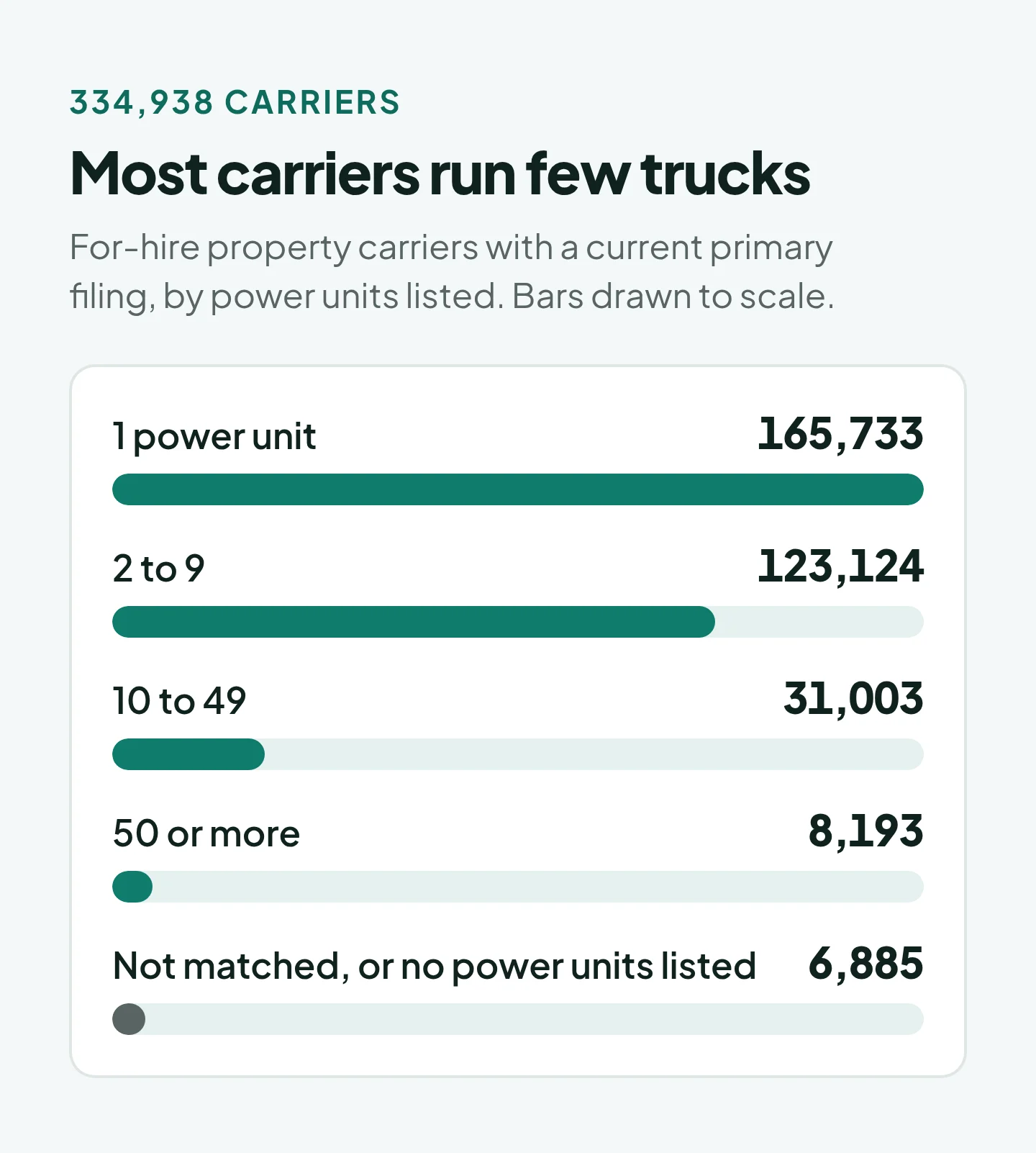
Most of the market is small. We matched carriers to FMCSA’s company census: of the 334,938, 165,733 list one power unit and 123,124 list two to nine, so 86.2% list fewer than 10. Another 31,003 list 10 to 49, and 8,193 list 50 or more. The remaining 6,885 (2.1%) couldn’t be matched or listed no power units. The leaders change sharply as fleets grow.
| Carrier group | Carriers | Largest families by share of that group |
|---|---|---|
| Authority granted since 1 January 2025 | 54,915 | Progressive 42.0%, Berkshire Hathaway 20.0%, risk retention groups 7.8%, Old Republic 4.1% |
| 1 power unit | 165,733 | Progressive 32.1%, Old Republic 12.8%, Berkshire Hathaway 11.1%, Travelers 7.9% |
| 2 to 9 | 123,124 | Progressive 20.8%, Old Republic 12.4%, Berkshire Hathaway 8.1%, Travelers 5.4% |
| 10 to 49 | 31,003 | Old Republic 11.5%, Travelers 5.2%, Progressive 4.7%, Sentry 4.0% |
| 50 or more | 8,193 | Old Republic 11.3%, Zurich 7.4%, American Financial 6.0%, Travelers 5.8% |
Three things stand out for anyone setting up a new motor carrier:
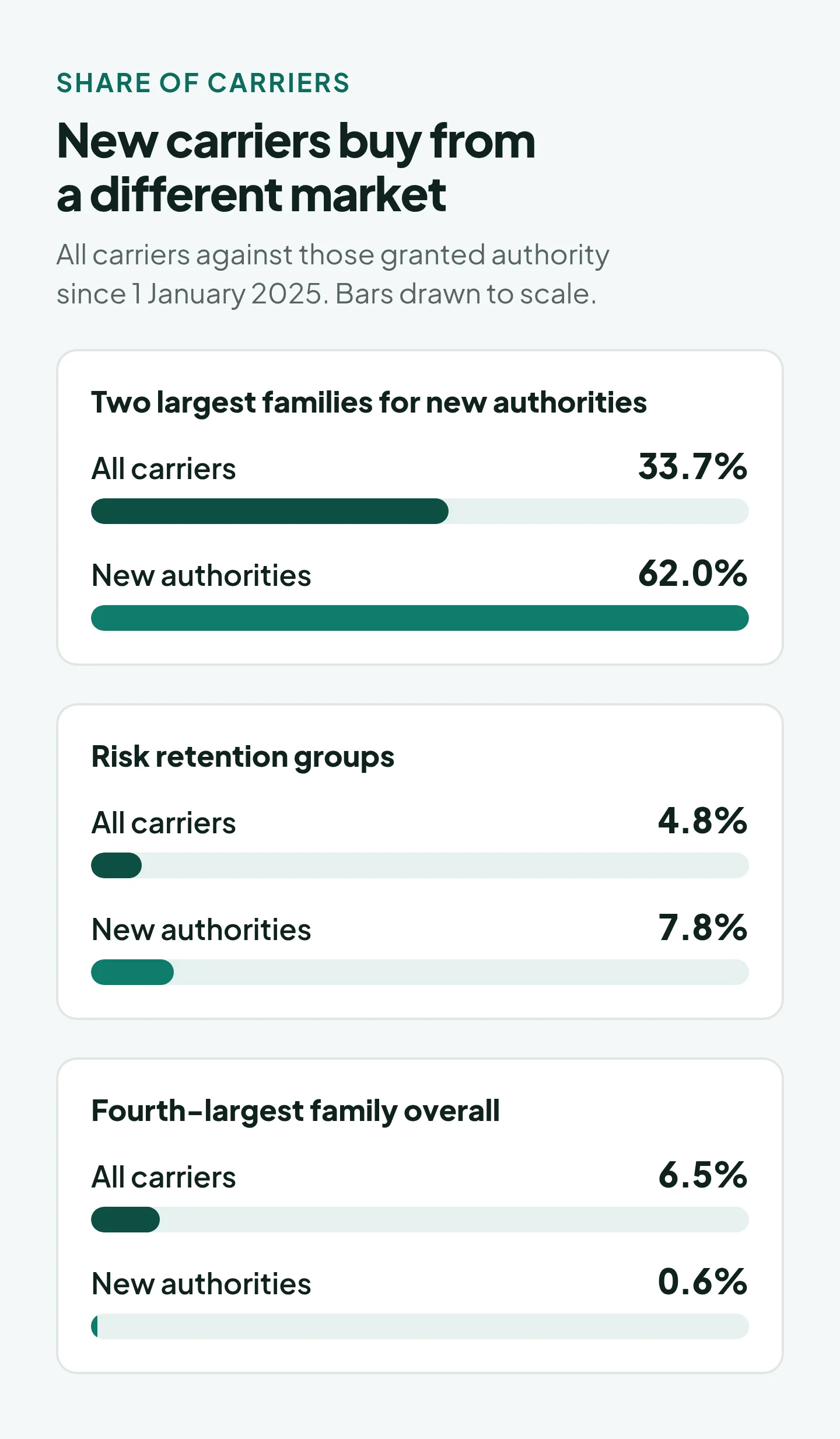
- New authorities are concentrated. Progressive and Berkshire Hathaway together hold 62.0% of the new-authority group, nearly double their combined 33.7% of all carriers. Risk retention groups aside, no other insurance family reaches 5% of that group, so don’t be surprised if your quotes come from a short list.
- Travelers drops away. It backs 6.5% of all carriers but only 0.6% of those granted authority since January 2025. The data can’t say why, but a company’s share of established carriers tells you little about whether it would quote a new one.
- Risk retention groups matter more here. Their share of new authorities (7.8%) is well above their share overall (4.8%), which makes the next section relevant to new entrants.
Limits vary too. 61.9% of carriers show a highest primary filing of $750,000, the federal floor for ordinary freight in trucks rated 10,001 pounds or more, and 34.6% show $1 million. At Old Republic, 95.1% show $1 million. See our guide to federal liability minimums and filings for what each tier means. A filing also shows only what reaches FMCSA, not your cargo or physical damage cover.
Financial strength: what AM Best says
An AM Best Financial Strength Rating is, in the firm’s own guide to its ratings, “an independent opinion of an insurer’s financial strength and ability to meet its ongoing insurance policy and contract obligations”. The seven categories run from Superior (A+, A++) and Excellent (A, A-) down to Poor (D). It is not assigned to specific policies, and it is an opinion as of a date, not a guarantee. Size is shown separately, in a Financial Size Category from I (under $1 million of capital and surplus) to XV ($2 billion or more). Some lenders and contracts set a minimum rating, so check before you bind.
| Main filing company | AM Best rating | Latest date we could confirm | Family’s commercial auto direct loss ratio, 2025 |
|---|---|---|---|
| United Financial Casualty (Progressive) | A+ (Superior) | 1 May 2026 | 55.8% |
| Great West Casualty (Old Republic) | A+ (Superior) | 29 April 2026 | 73.5% |
| GEICO Marine (Berkshire Hathaway) | A++ (Superior) | 16 April 2026 | 60.0% |
| Northland (Travelers) | A++ (Superior) | 8 August 2025 by name; main Travelers companies affirmed 21 August 2026 | 62.3% |
| Canal Insurance | A- (Excellent), outlook stable | 7 October 2026, affirmed, AM Best rating disclosure | 84.4% |
| Sentry Select (Sentry) | A+ (Superior), for Sentry as a group | 5 August 2026, company statement that doesn’t name Sentry Select | 82.9% |
| Acuity | A+ (Superior) | March 2026, company statement | 55.0% |
The loss ratio column shows direct losses as a share of earned premium, from the same NAIC report, for the whole family’s commercial auto book. The industry figure was 66.8%. Don’t over-read it. The NAIC warns that these are calendar-year results that “should not be considered as measures of overall profitability”, and a trucking-heavy book will differ from one full of contractors’ vans. A high ratio doesn’t mean an insurer is weak, and a low one doesn’t mean it pays claims generously.
Risk retention groups
A risk retention group (RRG) is an insurer owned by its members and chartered in one state under the federal Liability Risk Retention Act. FMCSA’s records show RRG filings alongside those of ordinary insurers. The difference is what happens if it fails. Federal law lets any state require RRGs to print this notice in their policies: “State insurance insolvency guaranty funds are not available for your risk retention group.“
That risk is real. A Vermont court placed Global Hawk Insurance Company RRG into liquidation on 8 June 2020. It was authorized to write auto liability for motor trucking carriers, and the proposed order called it “so deeply insolvent that the vehicles are effectively uninsured“. An RRG isn’t automatically a bad choice, but look at it differently: ask for its AM Best rating if it has one, its latest financial statement, its chartering state, and how a member would be affected by a loss assessment. An unrated RRG should prompt harder questions, not a quick signature to save on premium.
Federal rules also accept surplus lines insurers, which are licensed in one state and eligible to write elsewhere. Whether a guaranty fund would respond to your policy depends on the insurer and your state, so ask your state insurance department.
How to compare your own quotes
Say you have authority coming and two quotes: one from an agency and one through an online platform. Work through these checks for each, using the company on the quote or binder rather than the brand in the ad.
- Get the legal name and NAIC company code. Ask your agent. Every check below depends on it.
- Confirm the license. Check with your state insurance department that the insurer and the agent can do business in your state. FMCSA accepts filings only from insurers meeting 49 CFR 387.315.
- Look up the rating for that exact company, with its date and outlook, on AM Best’s site. A family’s rating may not cover every member; in AM Best’s May 2026 release, Progressive’s Protective group carries A rather than A+.
- Check complaints. The NAIC’s Consumer Insurance Search shows closed, confirmed complaints by state, company and insurance type for the past three years. The NAIC’s own advice is to compare complaints, financials and premium across several companies. Small trucking books can produce few complaints, so treat a clean record with caution.
- Ask if it is an RRG or surplus lines, and read the notice on the policy.
- Ask who handles claims and filings. Find out whether the insurer or a third party adjusts claims, and how fast certificates and BMC-91X filings go out. Public data doesn’t show this, so ask for it in writing and ask other carriers.
- Compare the coverage, not just the price. Line up limits, deductibles, cargo exclusions, reefer breakdown, and cancellation terms. A cheaper policy with a commodity exclusion that hits your freight costs more when a load is lost.
Then confirm your filing shows up once bound. Our MC number lookup guide covers where to find a carrier’s public record. Budget for the premium before you file: itemized trucking startup budgets set it beside your other startup costs. If you are leased on rather than running your own authority, you are buying different cover, so start with our guide to non-trucking liability instead.
What this data can’t tell you
- The snapshot is frozen. FMCSA’s files say they were “last refreshed on 05/14/2026 and will no longer be updated”, and new filings now go through its Motus system. Our count is a picture of that date. The insurers’ positions may have moved since, and the fleet sizes come from a census file we pulled on 1 November 2026. That later file marks 35,961 of the 334,938 carriers (10.7%) as inactive; we kept them and used the power units they list, because they held a filing on the snapshot date.
- A filing is a count, not a size. A one-truck carrier and a 500-truck fleet each count once. Self-insured fleets aren’t credited to any insurer and excess layers aren’t counted, which understates insurers serving large fleets. That’s why the premium column belongs beside it.
- Who is counted. We counted active for-hire property authorities with a BMC-91 or 91X primary filing and no cancellation date. Of 370,752 active authorities, 35,814 didn’t meet that test: 16,983 had only a filing with a cancellation date, and most of the rest were Mexico-based MX dockets with no such filing. A carrier with two insurers counts for both. The new-authority row uses FMCSA’s authority history file and covers any common or contract property authority granted since 1 January 2025 and still active in the snapshot. About 5% sit on older docket numbers, so not all are first-time carriers, but removing them moves the top shares by 0.1 point at most.
- Names are matched imperfectly. We matched filing names to the NAIC report’s group index by script, fixed the largest misses by hand, and identified RRGs by name, so small errors are possible.
- No price data. We don’t publish premium ranges or say which insurer is cheapest, because no public record shows it.
- No complaint scores. We didn’t pull complaint data for this page. Run it yourself for the exact company you are considering, in your state.
Facts checked against primary sources on 1 November 2026: FMCSA open data on data.transportation.gov (insurance, carrier and authority files last refreshed 14 May 2026; company census retrieved 1 November 2026), the NAIC 2025 Market Share Reports, AM Best’s guides, rating releases and, for Canal, its rating disclosure read on 11 November 2026, 15 U.S.C. 3902, 49 CFR 387.9 and 387.315, the Federal Register and the Vermont Department of Financial Regulation. Filing counts are FreightFledge calculations from those files. Ratings can change at any time. Every figure is checked against the linked source. This page is general information, not legal, tax, insurance or financial advice.
Sources
- FMCSA: ActPendInsur, All With History (data.transportation.gov)
- FMCSA: Carrier, All With History (data.transportation.gov)
- FMCSA: AuthHist, All With History (data.transportation.gov)
- FMCSA: Company Census File (data.transportation.gov)
- NAIC: 2025 Market Share Reports for Property/Casualty Groups and Companies (August 2026)
- NAIC: How to file a complaint and research complaints against insurance carriers
- NAIC: Consumer Insurance Search
- AM Best: Guide to Best's Credit Ratings (October 2023)
- AM Best: Guide to Best's Financial Size Category
- AM Best release: Progressive and subsidiaries, 1 May 2026 (republished)
- AM Best release: Old Republic subsidiaries, 29 April 2026
- AM Best release: members of GEICO, 16 April 2026 (republished)
- AM Best release: Travelers subsidiaries including Northland, 8 August 2025
- AM Best release: Travelers, 21 August 2026 (republished)
- Sentry: AM Best A+ announcement, 5 August 2026
- Acuity: 24th consecutive A+ rating, March 2026
- 15 U.S.C. 3902: Risk retention groups
- 49 CFR 387.9: Schedule of limits, public liability
- 49 CFR 387.315: Insurance and surety companies
- Vermont DFR: Notice of Liquidation, Global Hawk Insurance Company RRG
- Federal Register: Availability of Motus, FMCSA's new registration system (April 2026)
- Cover Whale: company site
- Nirvana: company site
- AM Best rating disclosure: Canal Insurance Company (AMB #000234), FSR A- affirmed 7 October 2026
- Insurance Journal: Vermont-domiciled Global Hawk placed into liquidation, July 2020