Starting a one-truck trucking company in 2026 takes about $64,000 in cash if you finance a used tractor and run under your own authority, by our worked budget below. Leasing onto a carrier first brings that down to about $30,000. Buying an older truck outright, or financing a new one, takes it to $94,000 to $100,000. The FMCSA fee is only $300, and all the registration and compliance paperwork comes to about $4,100. The real money goes on the truck, the insurance down payment and, above all, the cash to run for two months before the first invoices pay. This page in our starting a trucking company hub itemizes each line, says where every figure comes from and marks which ones are our assumptions, so you can swap in your own quotes.
This is general information, not legal, tax or financial advice. Prices change and vary by state, truck and driving record, so get written quotes before you commit money.
The four budgets at a glance
| Route | Cash to start | Monthly cost, before you pay yourself |
|---|---|---|
| Lease onto a carrier, financed used tractor | About $30,000 | About $9,900 |
| Own authority, financed used tractor | About $64,000 | About $10,900 |
| Own authority, older tractor bought outright | About $94,000 | About $9,800 |
| Own authority, financed new tractor | About $100,000 | About $13,500 |
Cost pages online give very different totals, often with no source. The gap comes from what they include: some leave out the truck, and some count only a down payment. The full line-by-line version is in the worked budgets further down.
All four budgets assume one tractor at 80,000 lb, dry van general freight with no hazmat, a start in January 2027, and an owner who already holds a Class A CDL. Our step-by-step guide to starting a trucking company explains what each filing does. This page only prices them.
Registration and compliance
This is the part of the bill that can be pinned down best, and one of the smallest. The first table holds the government charges, the second the services you buy from private companies.
| Government item | Budget | Basis |
|---|---|---|
| USDOT number | $0 | No fee in the FMCSA fee schedule, 49 CFR 360.3T |
| Motor carrier operating authority | $300 | 360.3T, per authority type. Our MC number guide covers what you receive for it |
| UCR for 2027, 0 to 2 vehicles | $55 | UCR Plan fee brackets ($46 for 2026) |
| Form 2290, first used January 2027 | $275 | Prorated from the $550 full-year tax in the IRS Form 2290 instructions. Due 1 March 2027 |
| EIN | $0 | IRS |
| LLC formation | $300 | Texas Form 205 as an example. Your state’s fee will differ |
| IRP apportioned plates | $2,000 | Our assumption. No national figure exists; see below |
| IFTA license and decals | $10 | Allowance. Georgia charges $3 a set |
| Subtotal | $2,940 |
IRP is the one government line with no simple answer. Each state sets its own full-year fee, and each gets a share based on miles. A new fleet has no actual miles, so your first year is figured from your base state’s average per-vehicle distance chart for all IRP jurisdictions, as Oklahoma’s IRP Q&A explains. We could not confirm a current state fee table for an 80,000 lb truck from a state source, so the $2,000 is a placeholder. Ask your base state’s IRP office for a written estimate, which replaces the biggest guess in this table.
| Private service | Budget | Basis |
|---|---|---|
| BOC-3 process agent, first year | $168 | InCorp’s published price, $129 a year plus $39 enrollment. FMCSA sets no price |
| Consortium and pre-employment drug test | $350 | OOIDA’s fee sheet (posted September 2025): $45 dues, $50 enrollment, $170 program, $85 test |
| Clearinghouse queries | $3 | $1.25 each. Two queries, the pre-employment one and the first annual one, cost $2.50, rounded up here |
| ELD, first year | $228 | HOS247’s published price (September 2025), $19 a month on an annual plan. Check any device against FMCSA’s registered list |
| Annual inspection, driver file, motor vehicle record | $300 | Our assumption. Shop rates vary |
| Load board, first month | $149 | DAT’s Enhanced plan as listed on 1 November 2026 |
| Subtotal | $1,198 |
Together that is $4,138. The named companies are examples of published prices, not recommendations. Your insurer also pays FMCSA $10 for each accepted filing under 360.3T, and may pass that on. If you start before January, you owe more on some lines: an 80,000 lb truck first used in November 2026 owes $366.67 on Form 2290, and it needs both the 2026 and 2027 UCR.
How much does a semi truck cost?
A new Class 8 semi truck, the tractor alone, cost an average of $170,000 in 2023, the latest public average we found, and likely more now, before the 12% federal excise tax. A used sleeper tractor sold at retail for roughly $60,000 to a little over $100,000 in September 2026, depending on whether it was five or three years old, according to J.D. Power. The trailer is extra. The table pulls the semi truck prices on this page together, and the sections below explain each one.
| Semi truck | Price | Source |
|---|---|---|
| New Class 8 tractor | About $170,000 average (2023), likely higher now | ATA, May 2025, citing ATRI; read 11 November 2026 |
| Excise tax on a new tractor | 12% of the sales price at the first retail sale: $20,400 on $170,000 | IRS Form 720 instructions; read 14 November 2026 |
| 3-year-old used sleeper, retail | A little over $100,000 | J.D. Power, October 2026 update, September sales; read 14 November 2026 |
| 4-year-old used sleeper, retail | About $80,000 | J.D. Power, October 2026 update, September sales; read 14 November 2026 |
| 5-year-old used sleeper, retail | Close to $60,000 | J.D. Power, October 2026 update, September sales; read 14 November 2026 |
| 6-year-old sleeper at auction | A little under $40,000 | J.D. Power, October 2026 update, average auction hammer price, September; read 14 November 2026 |
| All used Class 8 sleepers | Near $60,000 average (May 2026) | ACT Research, charted in ATRI’s 2026 report |
| Used dry van trailer | $12,000 in our budgets | Our assumption. No public benchmark confirmed |
These used prices are for sleeper tractors, the trucks these reports track. We found no comparable public average for day cabs. The J.D. Power figures are averages read from its charts, so a particular truck’s price depends on its mileage, engine, condition and specs. Buying the truck is also only the start: on our financed used budget, running it costs about $10,900 a month before you pay yourself.
Used tractors
The best public benchmark we found is J.D. Power’s monthly Commercial Truck Guidelines. Its October 2026 update gives prices as a chart, not a table. Reading from that chart, the average retail price in September was close to $60,000 for a five-year-old sleeper tractor, about $80,000 for a four-year-old and a little over $100,000 for a three-year-old. Retail prices were up 9.9% on a year earlier, and J.D. Power says inventory of clean used trucks was tight.
ACT Research’s average for all used Class 8 sleepers, charted in ATRI’s 2026 operational costs report, stood near $60,000 in May 2026. We use $60,000 for the financed used budget, with 20% down. Lenders set their own down payment and rate, and a brand-new authority with no history should expect tougher terms than an established carrier. The 12% rate over 60 months in our budgets is an assumption, not a quote. The prime rate was 7.00% at the end of October, per the Federal Reserve.
Older trucks cost less to buy and more to keep running. J.D. Power’s chart puts the auction hammer price of a six-year-old sleeper a little under $40,000, so our outright-purchase budget uses $40,000 plus $5,000 for first repairs. That is an auction figure. J.D. Power’s charts show auction prices below retail for the younger trucks, so expect a dealer to ask more. ATRI found that truckload fleets with fewer than 5 trucks had the highest repair costs in the sector, and links that to spending less on equipment.
New tractors and the 12% excise tax
The American Trucking Associations told the Commerce Department in its May 2025 comment that a new Class 8 truck cost “an average of $170,000 (likely higher in 2025)”. The same filing traces that figure to ATRI: an average purchase price of $170,000 in 2023, up from under $130,000 in 2014. We found no current public average, so treat $170,000 as a floor. ATRI says Section 232 tariffs remain in effect on heavy trucks and that fleets have been ordering ahead of 2027 NOx rules.
New heavy equipment also carries a federal excise tax. IRS Form 720 instructions put it at 12% of the sales price on the first retail sale of a heavy tractor, and also of a trailer rated over 26,000 lb. On $170,000 that is $20,400. Because it falls on the first retail sale, it is a new-equipment cost. Ask whether any quote includes it. Our new-truck budget assumes it does not, giving $190,400 before state taxes.
The trailer
We found no public price benchmark for used dry vans that we could confirm, so the $12,000 we budget, in cash, is our assumption. Replace it with a dealer quote. Power-only freight or a carrier-supplied trailer removes this line. Refrigerated and flatbed work changes it, and the insurance too.
Add tax, title and dealer fees. State sales tax rules on trucks differ, and some states exempt interstate equipment, so we allow a flat 3% of the tractor price, before any excise tax. Replace it with your state’s actual charge.
Insurance: get real quotes
There is no public price list for trucking insurance, and any single number online is an estimate. ATRI’s 2026 report puts liability and cargo premiums for truckload fleets with fewer than 5 trucks at 10.6 cents a mile in 2025, and for specialized fleets of that size at 18.1 cents. At ATRI’s average of 85,991 miles a year, that is about $9,100 and $15,600. Across the industry, premiums per mile rose another 6.4% in the first quarter of 2026.
Those are survey results from carriers already in business, and they leave out physical damage cover on your truck. A new authority has no loss history, so those averages may understate your quote.
We budget $18,000 a year with 25% down, or $22,000 on a new truck because physical damage cover follows the truck’s value. Both are assumptions, and yours could easily differ by thousands. Get three quotes before you buy the truck. Your age, your CDL history, your lanes and your base state all move the price. Our trucking liability insurance explainer covers what the federal $750,000 minimum requires and what cargo and physical damage add.
The cash reserve
You pay for fuel at the pump, and a broker may pay you 30 days after delivery. So the largest line in two of our four budgets is not equipment. It is the money that keeps the truck moving until invoices start to pay.
Diesel makes this worse right now. EIA’s weekly on-highway average was $6.352 a gallon on 26 October 2026, against an average of $3.66 for 2025. ATRI’s fuel benchmark of 48.2 cents a mile describes 2025. At ATRI’s 7.43 miles per gallon, today’s price is about 85.5 cents a mile, which adds about $2,670 a month to a truck running ATRI’s average miles. Any budget built on 2025 fuel costs is short by that amount. Part of it may come back through fuel surcharges or higher spot rates, but you pay the pump first.
Diesel has eased a little since. EIA’s weekly series showed $6.127 a gallon on 9 November 2026 (read 14 November). At that price the two-month reserve in the financed used budget would be about $430 lower. The budgets below keep the 26 October price, and the table under “What moves the total most” shows how to adjust for any other price.
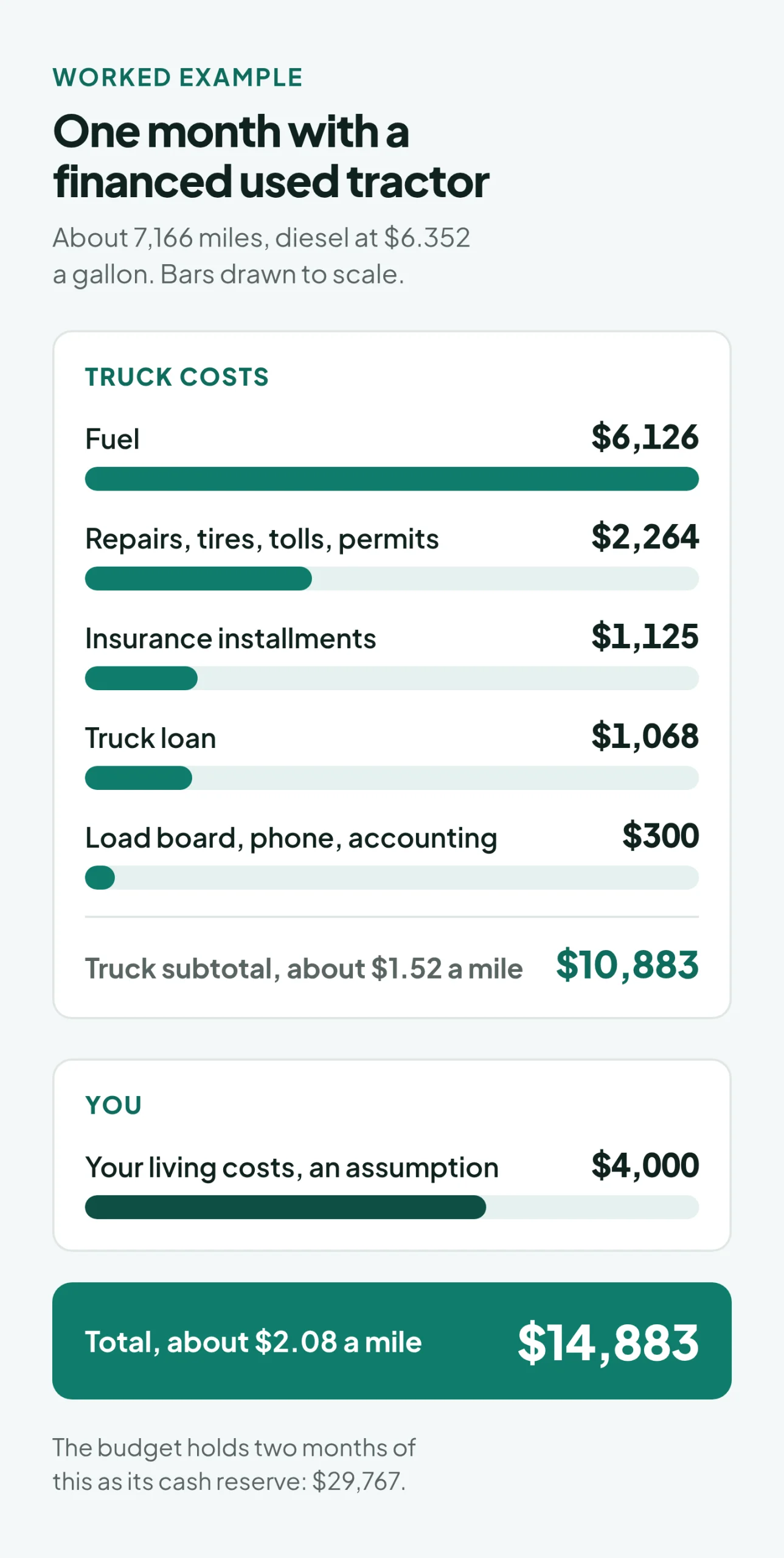
Here is one month for the financed used budget, at ATRI’s average of about 7,166 miles a month:
| Monthly cost | Amount | Basis |
|---|---|---|
| Fuel | $6,126 | $6.352 a gallon at 7.43 mpg |
| Repairs, tires, tolls, permits | $2,264 | ATRI 2025: 31.6 cents a mile combined |
| Truck loan | $1,068 | $48,000 at an assumed 12% over 60 months |
| Insurance installments | $1,125 | Remaining $13,500 of the assumed premium, over 12 months |
| Load board, phone, accounting | $300 | Our allowance |
| Truck subtotal | $10,883 | About $1.52 a mile |
| Your living costs | $4,000 | Assumption. Use your real household number |
| Total | $14,883 | About $2.08 a mile |
We hold two months of that, $29,767 (worked out before each line is rounded), matching the advice in our startup guide. That $2.08 is per mile driven, loaded or empty. ATRI found that non-tank fleets ran 16.5% of their miles empty, and at that rate you need about $2.49 for every loaded mile just to cover this table. For comparison, ATRI reports that carriers paid contracted owner-operators an average of $2.08 a mile in 2025, a year when diesel was far cheaper.
Worked budgets, line by line
| Cash needed on day one | Lease on, used truck | Own authority, used, financed | Own authority, older, outright | Own authority, new, financed |
|---|---|---|---|---|
| Registration and compliance | $875 | $4,138 | $4,138 | $4,138 |
| Insurance down payment | $1,250 | $4,500 | $4,500 | $5,500 |
| Tractor down payment or price | $12,000 | $12,000 | $40,000 | $38,080 |
| First repairs | $0 | $0 | $5,000 | $0 |
| Tax, title, fees (3% allowance) | $1,800 | $1,800 | $1,200 | $5,100 |
| Used trailer | $0 | $12,000 | $12,000 | $12,000 |
| Cash reserve | $13,921 | $29,767 | $27,632 | $34,908 |
| Total | $29,846 | $64,205 | $94,470 | $99,726 |
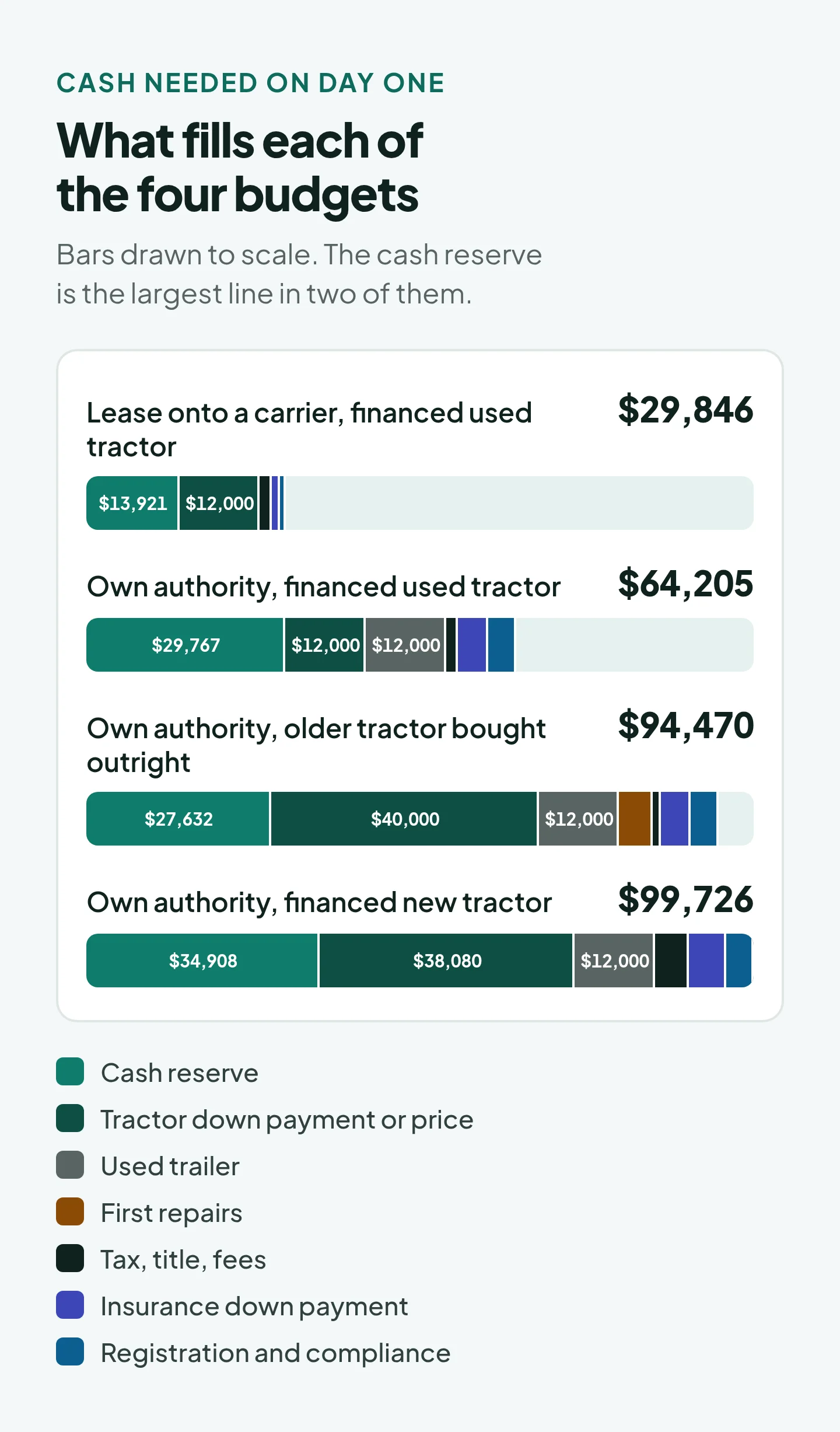
Each reserve includes $4,000 a month of living costs. If you have other household income, take out $8,000 from the three own-authority budgets and $4,000 from the lease-on budget. The new-truck loan is $152,320 (the $190,400 price less 20% down), which at the same assumed 12% costs $3,388 a month.
Why lease-on is so much cheaper. You skip the authority, most of the compliance stack and usually the trailer. The carrier must keep the required public liability cover, and 49 CFR 376.12 requires the lease to say who pays for any other insurance, such as bobtail, and any amount charged back. The same rule requires payment within 15 days of submitting your delivery paperwork, so we hold one month’s reserve instead of two. The $875 covers the LLC, Form 2290 and the inspection allowance, and we assume a $5,000 insurance bill for cover such as non-trucking liability, with 25% down. The reserve also uses $150 a month for phone and accounting, not $300. The savings are real, but the lease can add charges of its own, including escrow funds and chargebacks. Read those clauses, and read our guide to how owner-operators work before you sign.
Why the outright purchase costs more on day one and less after. You spend $30,000 more at the start, and it pays you back with no loan payment. It also leaves you with no cash if the engine fails in month three, so don’t spend the reserve on a nicer truck.
What moves the total most
| Change to the financed used budget | Effect on cash to start |
|---|---|
| Diesel at $4.49, EIA’s forecast average for 2027 | $3,592 less |
| Each $1 change in the price of diesel | About $1,929, up or down |
| Each $1,000 change in monthly living costs | $2,000, up or down |
| Each $5,000 change in annual insurance premium | About $1,875, up or down |
| Power-only, no trailer | $12,000 less |
| 10% down on the tractor, not 20% | About $5,700 less, but $133 more a month for 60 months |
The diesel forecast comes from EIA’s October 2026 Short-Term Energy Outlook, which expects $5.19 for all of 2026 and $4.49 for 2027, with $4.92 in the first quarter of 2027, when these budgets start. It is only a forecast. The June outlook quoted by ATRI expected $4.87 for 2026, so the estimate has already moved up by 32 cents. Don’t plan on it.
Factoring can shrink the reserve, because invoices pay in days. It costs a percentage of every load and the contract terms vary, so compare that cost with holding the cash. Our guide to freight factoring rates and contract traps shows what to check.
No CDL yet? Add training, which is required by the entry-level driver training rule for first-time Class A applicants. Prices vary widely. Wallace Community College Selma in Alabama lists $3,000 tuition, plus $100 to $175 for the DOT physical and $75 to $100 for a drug screen. SUNY Jefferson in New York lists $9,495 before license fees. Expect insurers to ask about driving experience too, so a new CDL may raise your premium or limit who will quote. Port work can add one more card: a TWIC for unescorted access to secure areas of port facilities; see what a TWIC card costs and how to apply.
Hotshot or box truck? These budgets don’t transfer. A lighter truck can fall below the 55,000 lb Form 2290 threshold, and some of the IRP and IFTA weight tests may not apply, but the insurance, equipment and load market all differ. Build that budget from your own quotes. For the box truck route, our guide to how to start a box truck business covers authority, contracts and costs.
What comes due in your first year
Several of the startup charges come back. Put these on a calendar on the day you start.
| Item | When | Amount |
|---|---|---|
| Form 2290 for the new tax year | By 31 August 2027 | $550 at the current rate |
| IFTA return | Each quarter | Fuel tax owed by state; a late return can cost $50 or 10% of the late tax, whichever is greater |
| Estimated income and self-employment tax | Quarterly | 15.3% self-employment tax on net earnings, plus income tax |
| Insurance renewal | 12 months | A new premium, based on your first year’s record |
| IRP renewal | Annually | Based on actual miles in the July-to-June reporting period, or the chart again if you ran none |
| UCR for 2028 | Before 1 January 2028 | Check the UCR Plan; the 2027 fee was $55 |
| Consortium renewal and random tests | Annually | $215 on the OOIDA schedule, plus any test fees |
| Annual vehicle inspections | Every 12 months | Shop rate, truck and trailer |
Let any filing lapse and the cost grows fast. FMCSA’s fee to petition for reinstatement of revoked authority is only $80 under 360.3T, but the lost loads while you wait are the real price.
Paying for it
Most new carriers fund this with savings plus equipment finance. SBA microloans go up to $50,000, but the SBA says the average is about $13,000, with rates generally between 8% and 13% and a seven-year maximum term. So a microloan can help with the reserve or a down payment, but will rarely cover the financed used budget alone. The funding section of our startup guide covers 7(a) loans and why “free trucking grants” don’t exist for new carriers.
If the $64,000 is out of reach, the next step is the lease-on route, or a company driving job while you save. Either costs less than running out of cash in month three with a truck loan in your name.
Facts checked against primary sources on 1 November 2026: the eCFR (49 CFR 360.3T, 376.12 and 380.603), the IRS Form 2290 and Form 720 instructions, the UCR Plan, the IFTA Articles of Agreement, EIA weekly diesel prices and the October 2026 Short-Term Energy Outlook, the Federal Reserve H.15 release, the SBA, ATRI’s 2026 operational costs report and J.D. Power’s October 2026 Commercial Truck Guidelines. Items marked as assumptions are ours, for planning only, and are not quotes. Used truck prices are read from J.D. Power’s and ACT’s published charts, so they are approximate. The $170,000 new-truck figure is ATA’s, read on 11 November 2026 in its May 2025 comment on regulations.gov (docket BIS-2025-0024). Sourced figures are checked against the linked source. ATRI’s report is a free download behind a request form on the linked page. Rechecked on 14 November 2026: J.D. Power’s October 2026 update was still its latest, the Form 720 excise tax was still 12%, and EIA’s weekly diesel price for 9 November was $6.127. This page is general information, not legal, tax or financial advice.
Sources
- FMCSA Clearinghouse: query plans
- HOS247: Elog prices (published price, September 2025)
- InCorp: BOC-3 filing service (published price)
- UCR Plan: fee brackets
- ATRI: Analysis of the Operational Costs of Trucking, 2026 Update
- DAT: load board pricing
- eCFR: 49 CFR 360.3T, filing fees
- eCFR: 49 CFR 376.12, lease requirements
- eCFR: 49 CFR 380.603, entry-level driver training applicability
- EIA: annual US diesel retail prices
- EIA: Short-Term Energy Outlook, October 2026
- EIA: Gasoline and Diesel Fuel Update
- Federal Reserve: H.15 selected interest rates
- IRS: Self-employment tax
- IRS: Employer Identification Number
- IRS: Instructions for Form 2290 (July 2026)
- IRS: Instructions for Form 720 (June 2026)
- J.D. Power: Commercial Truck Guidelines, October 2026
- Georgia Rule 560-9-2-.02, IFTA licensing requirements
- OOIDA: fee sheet for new clients, posted September 2025
- SBA: Microloans
- Texas Secretary of State: Form 205, certificate of formation, LLC
- SUNY Jefferson: CDL Class A
- American Trucking Associations: comment on the Section 232 investigation of truck imports (16 May 2025, docket BIS-2025-0024)
- Wallace Community College Selma: commercial truck driver program
- Oklahoma: IRP Full Reciprocity Plan Q&A
- IFTA Articles of Agreement (R1220 penalties)
- EIA: weekly US on-highway diesel retail prices